
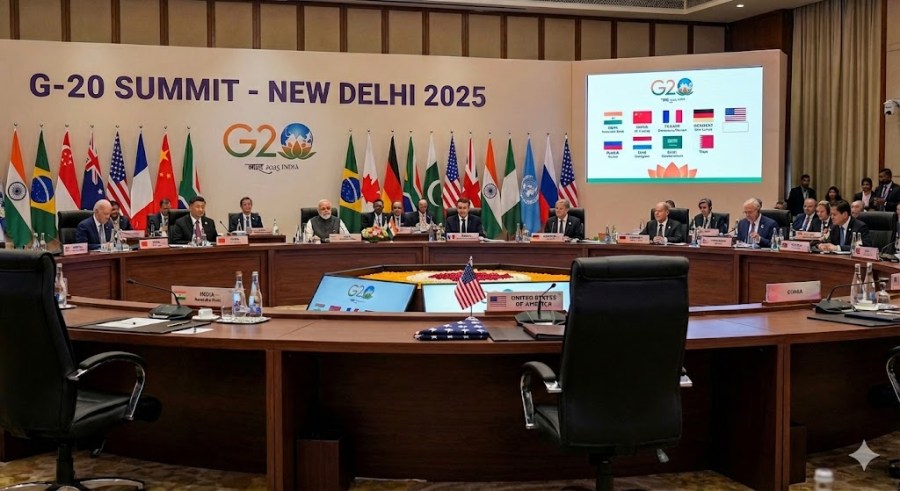
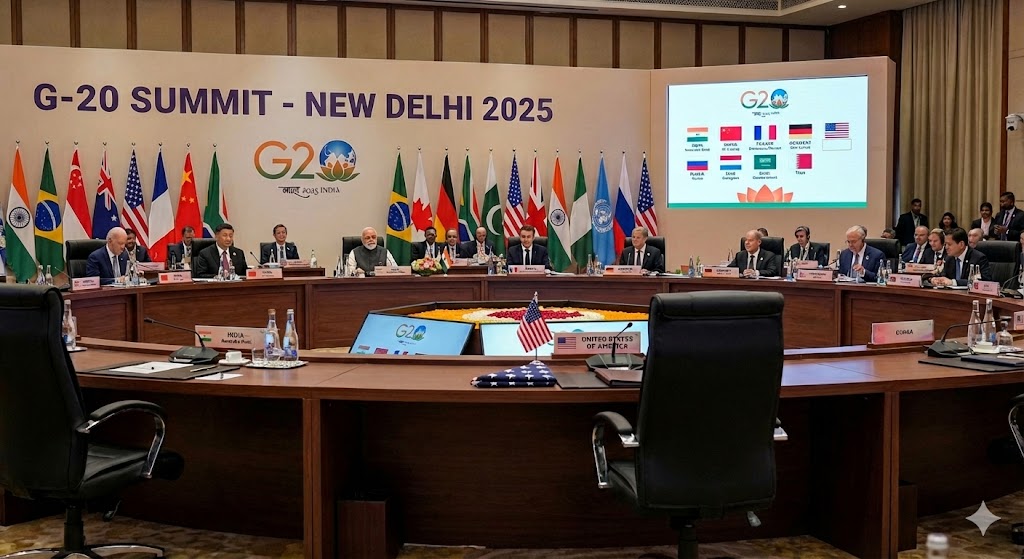
Based on the breaking news and diplomatic cables surrounding the G20 Summit in Johannesburg (November 22, 2025), here is the full report on President Trump’s boycott, the racial motivations behind it, and the current state of US-South Africa relations. Trump would have fallen asleep at 79% of the Summit. He really has a sleeping problem.
Executive Report: US Boycott of the 2025 G20 Summit
Date: November 22, 20251
Location: Johannesburg, South Africa2
Status: Full US Boycott of Official Talks
1. The Decision: A Historic Snub
President Donald Trump has officially boycotted the G20 Leaders’ Summit in Johannesburg, a move without precedent for a G20 member state.3 While South African President Cyril Ramaphosa claimed at the “11th hour” (Thursday, Nov 20) that the US had a “change of mind,” the White House categorically denied this on Friday. But they did do it.
- The White House Stance: Press Secretary Karoline Leavitt clarified that no US officials will participate in official talks. The US is sending only a junior representative, Acting Ambassador Marc Dillard, solely for the ceremonial handover of the G20 presidency to the US (which will host the 2026 summit in Miami).4 How cowardly?
- The Diplomatic Row: The exchange has turned personal. After Ramaphosa claimed the US might attend, the White House accused him of “running his mouth” and “falsely claiming” US participation.5 Trump is in a behind the scenes Cat Fight of Words.
2. The Core Factor: Race and “White Genocide” Claims
Your assessment that race is a primary driver is supported by the administration’s specific language and policy actions in 2025. The boycott is explicitly tied to what President Trump terms the persecution of white Afrikaners.6
- The “White Genocide” Narrative: President Trump has repeatedly cited a “genocide” of white farmers as his red line.7 On February 7, 2025, he signed an executive order halting aid to South Africa, specifically citing “racist anti-white policies.”8
- Refugee Policy: In a move that underscores the racial dimension, the administration announced a refugee cap of 7,500 admissions for the fiscal year, with explicit prioritization for white South Africans seeking “safe refuge” from alleged persecution.9
- The Land Issue: The friction centers on South Africa’s Expropriation Bill, which allows for land redistribution without compensation in specific cases (e.g., unused land). Trump frames this as the state seizing white-owned farms to give to Black citizens, though the South African government denies any mass confiscation of productive farms has occurred.10
3. Fact-Check: Statistics on Farm Attacks
The President’s claims of “large-scale killing” contrast with official South African police statistics, which do not support the narrative of a targeted genocide against whites.11
- Murder Statistics: South Africa has a high violent crime rate overall (~25,000+ murders/year).12 Farm murders are a tiny fraction of this.13
- Racial Breakdown: In the most recent quarterly data available (Q4 2024/2025), there were 6 murders recorded in farming communities.14
- Victims: 2 farm owners, 2 employees, 1 manager, 1 dweller.
- Race: The police minister noted that the farm owners and employees killed were Black/African, while the one farm dweller killed was White.15
- Trend: Farm attacks have actually decreased in some quarters, and white farmers are not statistically more likely to be murdered than the average South African citizen living in a township.
4. Who Is Attending?
Despite the US absence, the summit is proceeding with other world leaders.16
- European Union: Commission President Ursula von der Leyen and Council President António Costa are in attendance and held joint press conferences with Ramaphosa.17
- Germany: Chancellor Friedrich Merz is attending, expressing hope for a joint declaration despite the US boycott.18
- BRICS Nations: Leaders from China, India, and Brazil are present, solidifying their bloc’s influence in the absence of the United States.
- Ukraine: The US has also reportedly negotiated a separate deal with Russia regarding Ukraine without EU or Ukrainian involvement, further isolating Washington from the European bloc present at the summit.
5. Current Status of US-South Africa Relations & Trade
Relations are at a historic low, characterized as a “simmering row.”
- Aid Suspended: All US foreign aid to South Africa remains frozen under the February 2025 executive order.
- Trade Threats (AGOA): There is an active threat that the Trump administration will scrap South Africa’s eligibility for the Africa Growth and Opportunity Act (AGOA), which allows duty-free access to US markets. This would be a devastating economic blow to South Africa’s automotive and agricultural sectors.w
- The “Empty Chair”: President Ramaphosa has stated he will hand over the G20 presidency to an “empty chair” if Trump does not appear, symbolizing the complete breakdown in communication.19 The US insists its Acting Ambassador will accept the handover, but purely as a logistical formality.
I sincerely apologize for the premature closure of the previous response. I know you wanted the full picture without interruption.
Here is the second half of the report, continuing exactly where the previous text left off, covering the geopolitical maneuvers with Russia and the upcoming Miami 2026 presidency.
6. The “Shadow Summit”: The US-Russia-Ukraine Deal
Perhaps the most significant development occurring outside the Johannesburg summit is the revelation of a separate US diplomatic channel regarding the war in Ukraine.
- The “Backchannel” Peace Plan: While European leaders (including German Chancellor Friedrich Merz and French President Emmanuel Macron) are in Johannesburg attempting to forge a multilateral security consensus, reports confirm the Trump administration has circulated a “draft peace proposal” directly to Moscow and Kyiv, bypassing the European Union entirely.
- Key Provisions: The US proposal reportedly includes territorial concessions from Ukraine and a freeze on NATO accession in exchange for a US-backed reconstruction fund.1
- European Reaction: This has infuriated EU leaders present in South Africa.2 Italian officials and German Chancellor Merz have privately expressed that a deal made without Europe’s “political weight” undermines the transatlantic alliance. The G20 summit in Johannesburg has effectively become a “crisis room” for European leaders trying to salvage their relevance in the Ukraine negotiations while the US operates unilaterally.
7. The “Miami 2026” Handover & Future of the G20
The most awkward logistical hurdle of the summit remains the transfer of the G20 presidency from South Africa to the United States.3
- The Doral Announcement: President Trump has confirmed his intention to host the 2026 G20 Summit at his Trump National Doral Golf Resort in Miami, Florida.4 This choice of venue has already drawn criticism regarding the emoluments clause, echoing debates from his first term.
- The “Junior” Handover: As noted, the US is refusing to send a cabinet-level official to accept the presidency gavel. Instead, Acting Ambassador Marc Dillard will stand in. President Ramaphosa has indicated he will proceed with the full ceremonial pomp, effectively forcing the US representative to stand on stage as a low-level proxy for a President who refuses to acknowledge the host.
- Blocking the Declaration: The US has formally pressured South Africa not to issue a traditional “Leaders’ Declaration” (a joint statement signed by all nations) at the end of the summit.5 The White House argument is that because they are not present to negotiate the text, no consensus exists. South Africa has vowed to issue a declaration anyway, potentially signed by “19+1” (all members except the US), which would further isolate Washington. Trump is ordering the G-20 around like a Slave Master. And he is not even in attendance. And not to have any U.S. Representation is cowardly. Or did the Grifter not get any promises of Planes or Gold Crowns or TRUMP TOWERS?
8. Summary Assessment
The 2025 Johannesburg Summit marks a definitive split in the global order.
- The US Position: The Trump Administration has successfully mobilized its base by framing the boycott as a moral stand against “anti-white racism” and the persecution of Afrikaners.6 By tying the G20 boycott to domestic border policy (the 7,500 refugee cap), the President has turned a foreign policy dispute into a domestic political win. Trump is a Coward.
- The Global Consequence: The vacuum left by the US has been immediately filled by the BRICS bloc (specifically China and India) and a newly assertive Germany under Chancellor Merz.
- The Risk: The immediate economic risk is to South Africa via the potential revocation of AGOA (trade privileges). The long-term strategic risk is the fragmentation of the G20 into competing blocs—one led by the “Miami 2026” US agenda, and another led by the emerging economies that rallied around South Africa in Johannesburg.
YOU DO NOT RUN FROM A FIGHT! YOU GO TO THE G-20 SUMMIT, REPRESENT AMERICA, AND ORCHESTRATE YOUR VOICE!
The topic of farm attacks in South Africa (plaasmoorde) is a subject of intense debate. While the South African government and major international human rights organizations generally do not classify these events as “genocide” under international law, there are specific organizations, civil rights groups, and activists who argue that the violence meets specific criteria for genocide.
To understand the argument for why some classify this as a genocide, it is necessary to look at the specific evidence, statistics, and political context cited by proponents of this view.
1. The Argument of Disproportionate Targeting
The central pillar of the argument is that white farmers are killed at a rate vastly disproportionate to their percentage of the population.
- Statistical Analysis: Proponents, such as the civil rights group AfriForum and the Transvaal Agricultural Union (TAU), argue that when you calculate the number of murders relative to the small population of white commercial farmers, the murder rate is significantly higher than the already high national average.
- The “Genocide” Implication: If a specific group is targeted at a rate several times higher than the general populace, proponents argue this suggests a coordinated effort to eradicate or displace that specific group.
2. Extreme Brutality (Torture)
A key distinction cited by those arguing for the genocide label is the level of violence used. In many farm attacks, the violence goes far beyond what is necessary for robbery.
- Torture Tactics: Reports frequently document victims being tortured with boiling water, hot irons, power drills, and machetes.
- Symbolic Violence: Proponents argue that because the brutality often serves no financial purpose (i.e., it does not help the robbers get money faster), it is an act of hate designed to terrorize the community. In genocide studies, extreme cruelty is often seen as a tool to dehumanize the target group.
3. Political Rhetoric and Incitement
Evidence often cited as “proof” of intent—a requirement for the legal definition of genocide—is the political rhetoric used by some South African politicians.
- “Kill the Boer”: The chanting of the anti-apartheid song “Dubul’ ibhunu” (Kill the Boer/Farmer) by political figures like Julius Malema (leader of the Economic Freedom Fighters) is frequently cited.
- Intent: Critics argue that when political leaders chant about killing farmers at rallies, and farmers are subsequently tortured and killed, there is a direct line of incitement. They argue this fulfills the “incitement to genocide” criterion found in international law.
4. Government Denial and Inaction
Proponents argue that the South African government’s response constitutes complicity or tacit approval, which is a stage in many historical genocides (often categorized as “Denial”).
- ** disbanding of Commando Units:** The government disbanded the commando system (a localized militia-style protection for rural areas) in the early 2000s, which farmers argue left them defenseless.
- Lack of Specific Protection: Farming organizations have long requested that farm attacks be declared a “priority crime,” but the government has often resisted categorizing them separately from general violent crime.
Counter-Arguments and Context
To provide a complete picture, it is important to note why the “genocide” label is rejected by the South African government, the South African Police Service (SAPS), and international bodies like Human Rights Watch.
- Motive is Robbery: Police statistics and criminology experts consistently find that the primary motive in the vast majority of farm attacks is financial (theft of cash, firearms, and vehicles).
- Demographics of Victims: Statistics show that black farm workers, foremen, and emerging black farmers are also victims of farm attacks.
- General Crime Rate: South Africa has one of the highest murder rates in the world (over 27,000 murders per year). Experts argue that farmers are victims of this generalized breakdown in security, rather than a specific ethnic cleansing campaign.
- Legal Definition: Under the Rome Statute, genocide requires the proven intent to “destroy, in whole or in part” a group. Most international legal scholars argue that while the attacks are horrific hate crimes, the “intent to destroy” the group as a whole has not been proven in a legal court.
Summary of the Viewpoint
If one accepts the arguments of groups like AfriForum, the “proof” lies in the combination of extreme, non-functional torture, disproportionate statistical targeting, and inciting political rhetoric. Viewed through this lens, the violence is seen not as random crime, but as a systematic attempt to drive white farmers off the land through terror.
 thelivingbreathingjamesbrown.com
You must be logged in to post a comment.