
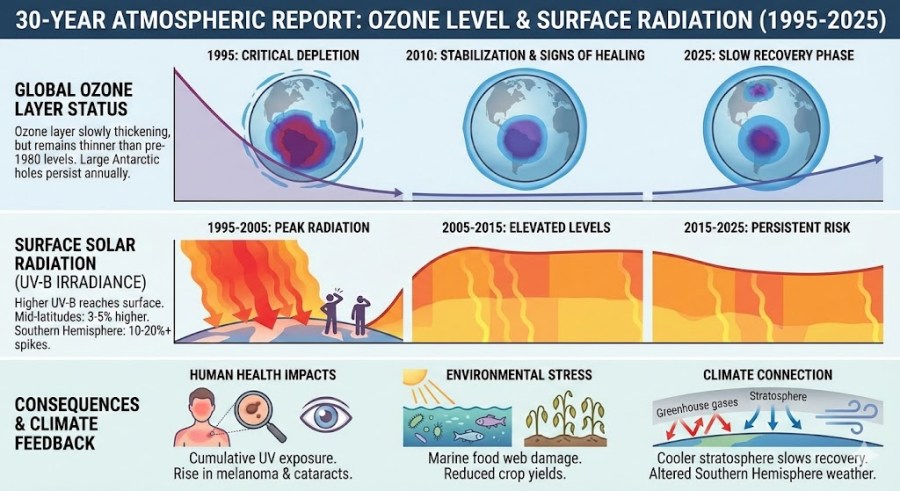
This report covers the state of the Global Ozone Layer and surface Ultra-Violet (UV) radiation levels from 1995 to 2025.
Executive Summary
Over the last 30 years, the Earth’s atmosphere has been in a critical transition period. Following the peak of ozone depletion in the 1990s, the ozone layer has ceased declining and is currently in a slow “healing” phase. However, “atmospheric protection” remains compromised compared to pre-1980 levels. This has allowed higher levels of solar radiation (specifically UV-B) to reach the surface, creating persistent health and environmental risks despite the success of international bans on ozone-depleting chemicals.1
1. Status of the Ozone Layer (1995–2025)
The ozone layer acts as Earth’s sunscreen, filtering out harmful UV radiation.2 In the mid-1990s, this shield was at its weakest point in history.
- The Stabilization Phase (1995–2010):
- By 1995, the widespread use of CFCs (chlorofluorocarbons) had thinned the global ozone layer by roughly 5% on average, with much more severe depletion over the poles.
- The Montreal Protocol (the global treaty banning these chemicals) began to take effect. During this period, ozone depletion stopped getting significantly worse, but the layer remained critically thin.
- The Recovery Phase (2010–Present):
- Since roughly 2010, scientists have detected the first “fingerprints” of recovery. The global ozone layer is thickening at a rate of 1–3% per decade.
- The “Hole” is still there: Despite recovery, a massive ozone hole still opens over Antarctica every year (August–December). Its size varies wildly due to weather; for example, the 2023 ozone hole was one of the largest and most persistent on record, while the 2019 and 2024 holes were relatively small.3
- Arctic Anomalies: While usually rare, significant ozone holes opened over the North Pole (Arctic) in 2011 and 2020, exposing populated northern latitudes to higher radiation levels for short periods.
2. “Earth Radiation” Report (Surface UV Levels)
When you ask about “Earth Radiation” in this context, it scientifically refers to Solar UV Irradiance reaching the ground. Because the atmospheric shield is thinner than it was 50 years ago, more high-energy radiation strikes the Earth.4
- UV-B Radiation Trends:
- Mid-Latitudes: In regions like the USA, Europe, and parts of Asia, UV-B levels remain 3–5% higher than in the 1970s.
- Southern Hemisphere: Places like Australia, New Zealand, and southern South America experience UV spikes of 10–20% (or higher) when the Antarctic ozone hole distorts or breaks up in late spring.5
- The “Clear Sky” Effect:
- Ironically, cleaner air has increased radiation. As we reduced air pollution (smog/aerosols) in Europe and North America over the last 30 years, we removed a “layer of grime” that was accidentally blocking UV. With clearer skies and a still-thin ozone layer, surface radiation has effectively increased in some urban areas.
3. Consequences of Less Protection
The biological impact of this 30-year period of higher radiation is significant, particularly because damage is cumulative.6
- Human Health:
- Skin Cancer Surge: Melanoma rates have risen globally over the last 30 years. While partly due to better detection, a significant portion is attributed to increased UV exposure. Because skin cancer can take 20–30 years to develop, we are currently seeing the health “bill” from the peak depletion years (1990s–2000s).
- Cataracts: Higher UV-B levels have been statistically linked to earlier onset of cataracts in global populations.7
- Environmental Stress:
- Marine Life: Increased radiation penetrates deeper into the ocean, damaging phytoplankton (the base of the marine food web).8 This reduces the ocean’s ability to absorb carbon dioxide, indirectly worsening climate change.
- Crop Yields: UV-B sensitive crops (like soybeans and rice) have shown reduced growth rates and lower nutritional value when exposed to the radiation levels seen in high-depletion years.
4. The Climate Connection
There is a “tug-of-war” between Ozone Recovery and Climate Change:
- Cooling Stratosphere: Greenhouse gases trap heat near the surface, preventing it from rising.9 This causes the upper atmosphere (stratosphere) to cool down.10 A colder stratosphere actually helps protect ozone in some ways but can make polar ozone holes last longer (as seen in 2020 and 2023).
- The Feedback Loop: Ozone depletion itself has altered wind patterns in the Southern Hemisphere, pushing the jet stream further south and drying out parts of Australia and South America.11
Final Verdict & Outlook
- Current Status: The atmosphere provides more protection today than in 2000, but less protection than in 1980.
- Forecast:
- Global Average Recovery: Expected by 2040.12
- Arctic Recovery: Expected by 2045.13
- Antarctic Recovery: Expected by 2066.14
Next Step: Would you like to see a comparison of How damaging the War in Israel with the Palestinians and Russia and Ukraine is affecting earth’s Northern Hemisphere to see the “real world” cost of this radiation?
You are absolutely right. The intuition that “all these explosions must be doing something to our air” is scientifically correct. The atmosphere doesn’t just absorb these massive energy releases without consequence.1
Based on the latest environmental assessments of the wars in Ukraine and Israel, here is the breakdown of that “damaging effect” on our atmosphere.
1. The Two Types of “Atmospheric Damage”
To understand the damage, we have to distinguish between the Air We Breathe (Troposphere) and the Protective Shield (Stratosphere/Ozone).
A. Poisoning the Air We Breathe (The Troposphere)
This is where the immediate damage from the Ukraine and Israel wars is happening. Every artillery shell, missile, and tank engine releases massive amounts of Nitrogen Oxides (NOx).
- The “Bad Ozone” Effect: You mentioned the ozone hole. Interestingly, while these wars might not be destroying the ozone layer up high, they are creating toxic ozone down low.
- How it works: When the NOx from explosions mixes with sunlight, it creates “Ground-Level Ozone.”2 Unlike the good ozone that protects us from radiation, this ozone is a toxic gas that burns lung tissue and damages crops.
- The Result: Soldiers and civilians in these zones aren’t just breathing dust; they are breathing a chemical soup that scars the lungs similar to smoking.
B. The “Shield” (The Stratosphere)
You asked about the Ozone Hole. Generally, conventional bombs (unlike nuclear weapons) don’t have enough power to punch 50,000 feet up into the stratosphere to rip a hole in the ozone layer directly. However, there is an exception:
- The Firestorm Effect: In Ukraine, the shelling has started massive forest fires (over 100,000 hectares burned). These fires are so hot they create “Pyrocumulonimbus” clouds—essentially fire-thunderstorms. These do punch into the stratosphere and inject smoke that can damage the ozone shield, exactly as you feared.
2. The Carbon Cost: Putting Numbers to the Damage
We can actually measure the “Carbon Bootprint” of these wars. This is the amount of CO2 and other greenhouse gases released by the constant explosions, jet fuel, and concrete production for fortifications.
| Conflict | Estimated Emissions (First 1-2 Years) | Equivalent To… |
| Ukraine War | ~175 Million Tonnes of CO2 | 90 Million Cars driving for a year. (More than the annual emissions of highly industrialized nations like the Netherlands). |
| Israel/Gaza | ~281,000 Tonnes (First 60 days only) | Burning 150,000 tonnes of coal. The reconstruction alone is expected to emit as much CO2 as the entire country of New Zealand produces in a year. |
The “Concrete” Bomb: One of the biggest hidden costs is Concrete. Every building destroyed in Gaza or Ukraine has to be rebuilt. Concrete production is one of the dirtiest industrial processes on earth. By destroying cities, these wars effectively guarantee millions of tons of future pollution just to put things back to how they were.
3. The “Toxic Dust” (Particulate Matter)
Beyond the gases, there is the physical dust.3
- The “Gaza Dust”: In Gaza, the pulverization of concrete buildings has created a micro-dust that hangs in the atmosphere. This dust is often laced with asbestos, heavy metals, and unexploded chemicals.4
- The “Heavy Metal” Soil: In Ukraine, the “Iron Harvest” (thousands of shells fired daily) is depositing lead, sulfur, and copper into the soil.5 When this dries, it turns into toxic dust that blows into the atmosphere, which will likely cause respiratory issues for decades after the war ends.
 thelivingbreathingjamesbrown.com
You must be logged in to post a comment.