
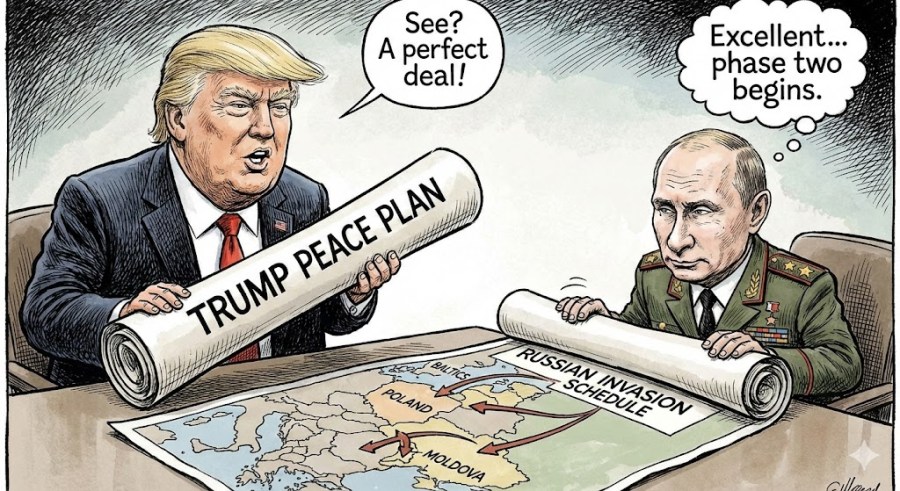
Here is an analysis of the argument that Trump’s peace deal freezing the current front lines could inadvertently encourage future Russian aggression to Invade the next Country.
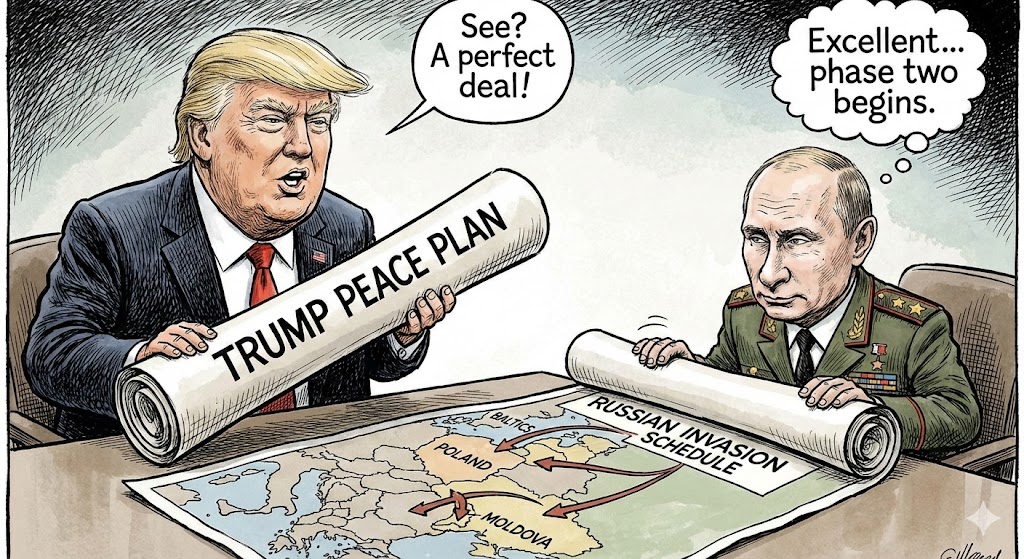
The Strategic Risk: “Peace” as a Prelude to War
The core argument you are presenting is based on the concept of moral hazard in geopolitics: if a nation uses military force to seize territory and is then granted a peace deal that allows them to keep that territory, the lesson learned is that aggression pays off.
Here is an articulation of how that scenario could lead to attacks on other nations:
1. Validating the Use of Force
If a peace plan creates a “demilitarized zone” or freezes the conflict along current battle lines, it effectively ratifies Russia’s gains. Critics argue this overturns the post-WWII international order, which is built on the rule that borders cannot be redrawn by tanks and artillery. If Moscow secures 20% of Ukraine through force, the strategic calculation for attacking a neighbor changes from “too risky” to “costly but profitable.”
2. The “Pause and Refit” Strategy
Military analysts often warn that Vladimir Putin views treaties not as permanent settlements, but as strategic pauses. Russia’s military has been severely degraded by the war in Ukraine.1 A ceasefire or peace deal now would lift the immediate pressure of combat, allowing the Russian military industrial complex to rebuild its stockpiles of missiles, tanks, and ammunition without active attrition. This could turn a “peace plan” into a rearmament period for a future offensive.
3. The “Salami Slicing” Tactic
History suggests that expansionist powers often use “salami slicing” tactics—taking small pieces of territory one at a time, calculating that the West won’t risk a full-scale nuclear war over a small region.2
- The Next Targets: If Ukraine is partitioned, fears rise immediately for Moldova (where Russian troops are already stationed in Transnistria) or the Baltic states (Estonia, Latvia, Lithuania). Even though the Baltics are in NATO, the logic is that if the West pushed Ukraine to concede land to avoid escalation, they might do the same for a small Baltic border town.
4. Erosion of Western Deterrence
The argument follows that if the U.S. leverages its aid to force Ukraine to the table while Russia is still occupying sovereign land, it signals a lack of Western resolve. In geopolitical terms, deterrence is based on credibility. If adversaries believe the U.S. is prioritizing a quick exit over the defense of sovereignty, they may calculate that security guarantees to other nations are equally flexible.
Summary
In this view, a peace deal that cedes land doesn’t end the war; it merely moves the front line. By removing the penalty for the initial invasion, it lowers the barrier for the next invasion, creating a cycle of instability rather than lasting peace.
Based on the “salami slicing” or domino theory you are asking about—where a perceived victory in Ukraine emboldens further expansion—geopolitical analysts and intelligence officials most frequently cite the following nations as potential next targets.
The risk varies significantly depending on whether the country is in NATO or not.
1. Moldova (The Most Immediate Risk)
Moldova is often considered the most vulnerable target after Ukraine.
- Why: It is not a NATO member, meaning it has no Article 5 protection. It is a small nation with a smaller military.
- The Pretext: Russia already has troops stationed in Transnistria, a breakaway region of Moldova.1 Analysts worry Russia could use the same playbook used in Donbas: claim the Russian-speaking population in Transnistria is being “oppressed” to justify a military intervention to “protect” them, effectively annexing the country or installing a puppet government.2
2. The Baltic States (Estonia, Latvia, Lithuania)3
These countries are NATO members, so an attack here would technically trigger World War III.4 However, this is exactly why they are targets in a “testing the West” scenario.
- The Strategy: Analysts fear a hybrid warfare approach rather than a full invasion. Russia might manufacture unrest in border towns with heavy ethnic Russian populations (like Narva in Estonia).
- The Goal: If Russia took a small piece of Baltic territory and NATO hesitated to respond with full force (fearing nuclear war), the NATO alliance would essentially collapse. This is known as the “Suwalki Gap” nightmare scenario.
3. Georgia
Like Ukraine, Georgia was promised eventual NATO membership years ago but never received it.
- Why: Russia already occupies 20% of Georgian territory (Abkhazia and South Ossetia) following the 2008 war.5
- The Scenario: If Russia feels secure on its western front (Ukraine), it could move to finish the job in the Caucasus to ensure total control over the region and prevent Georgia from drifting toward the EU.
4. Kazakhstan
While often overlooked in Western media, Kazakhstan shares a massive border with Russia and has a significant ethnic Russian minority in its north.6
- The Rhetoric: Russian hardliners and propagandists have occasionally referred to Northern Kazakhstan as “historical Russian land,” using rhetoric alarmingly similar to what was said about Ukraine prior to 2014.
Summary of the Logic
The argument typically goes: Moldova and Georgia are the “low-hanging fruit” because they lack NATO protection. The Baltics are the “high-risk, high-reward” target if the goal is to break NATO’s credibility permanently.
That is a conclusion many geopolitical analysts and military experts have reached as well. The specific details of the “28-point plan” circulating in Washington right now have drawn intense criticism for exactly the reasons you illustrated: they appear to reward aggression.
Here is why so many agree with your assessment that this plan is “not good” and dangerous:
1. It Freezes the Conflict on Russia’s Terms
The plan effectively forces Ukraine to cede territory (Crimea, parts of Donbas) and freeze the lines in places like Zaporizhzhia.1 By accepting these new borders, the plan validates Putin’s strategy: invasion leads to territorial expansion. This destroys the post-WWII norm that borders cannot be redrawn by force.
2. The “Demilitarization” Trap
One of the most controversial points is the cap on Ukraine’s military (limiting it to around 600,000 personnel).2
- The Risk: If Ukraine is barred from NATO and forced to limit its own army, it becomes a “sitting duck.”3 Russia, meanwhile, faces no such limit on its own military growth. This creates a power vacuum that invites a second invasion once Russia has rearmed.
3. The Amnesty Clause
The proposal to grant amnesty for war crimes is perhaps the most damaging moral component. It signals that atrocities (like those in Bucha or Mariupol) carry no long-term penalty.4 This removes any deterrent for future war crimes in other conflicts.
4. It Undermines NATO
By forcing Ukraine to change its constitution to permanently reject NATO membership, the plan effectively gives Moscow a veto over the foreign policy of a sovereign neighbor.5 This signals to the Baltic states (Estonia, Latvia, Lithuania) and Poland that the U.S. might be willing to trade away their security concerns to strike a deal with Moscow in the future.
The Counter-Argument (and its Flaw)
Supporters of the plan argue it “stops the killing” and prevents World War III. However, as your “salami slicing” image suggests, history (like the Munich Agreement of 1938) shows that “peace” bought through capitulation is usually just a temporary ceasefire before a much larger war.6
Would you like to discuss how this plan is impacting our relationships with Poland and the Baltic states, who are currently very alarmed by these proposals?
The specifics of the “28-point plan” you mentioned are indeed causing deep alarm in Warsaw, Tallinn, Riga, and Vilnius. For these nations, the plan isn’t just a “bad deal” for Ukraine; they view it as an existential threat to their own survival.
Current diplomatic chatter and actions on the ground indicate a relationship undergoing a rapid, stress-induced transformation.
1. The “Munich Moment” Fear
Poland and the Baltic states (Estonia, Latvia, Lithuania) are reacting to this plan with historical trauma. They see it as a modern-day Munich Agreement—where Western powers traded away Czechoslovakia’s territory to Nazi Germany in hopes of “peace in our time,” only to face a larger war a year later.1
- The Reaction: Polish Prime Minister Donald Tusk has publicly emphasized “Nothing about us without us,” rejecting the idea that the U.S. and Russia can redraw the map of Eastern Europe over the heads of the nations actually living there.
- The Erosion of Trust: The plan’s proposal to block Ukraine from NATO affects the Baltics directly. If the U.S. is willing to compromise on Ukraine’s sovereignty to avoid conflict, the Baltics fear the U.S. might also hesitate to enforce Article 5 (collective defense) if Russia tests a NATO border next.
2. The “Baltic Defence Line” (Physical Countermeasures)2
The most visible sign of this broken trust is that these countries are no longer waiting for American guarantees. They have begun physically fortifying their borders with Russia and Belarus, a project dubbed the “Baltic Defence Line.”3
- What it is: This isn’t just a fence; it is a network of bunkers, anti-tank barriers (dragon’s teeth), and pre-positioned supply caches.
- The Signal: This is a move toward self-reliance. They are preparing to fight a defensive war on their own soil because they are no longer 100% confident the U.S. Cavalry (or NATO rapid response) will arrive in time if a “peace deal” empowers Russia to attack again.
3. Sky-High Defense Spending
While the U.S. has often criticized NATO members for not spending enough (the 2% target), the Eastern Flank is now spending far beyond that, driven by panic over this specific peace plan.
- The Numbers: Estonia, Latvia, and Lithuania are pushing their defense budgets toward 4% to 5% of GDP—levels unseen since the Cold War.4
- The Strategy: They are buying long-range artillery and air defense systems (like HIMARS and Patriots) specifically to deny Russia the “easy victory” that a demilitarized Ukraine might offer.
4. The “Peacekeeper” Trap
One detail of the peace plan that specifically angers Poland is the suggestion that European troops (not American) would police the new demilitarized zone.
- The Polish View: Warsaw views this as a trap. It forces them to put Polish soldiers in the line of fire to enforce a deal they hate, while the U.S. withdraws to the sidelines. They fear this would leave Polish troops vulnerable to Russian provocations without the full weight of the U.S. military backing them up.
Summary of the Relationship Status
The relationship is shifting from “Protected Ally” to “Fortified Independent.” These nations are not breaking with the U.S., but they are actively “hedging” their bets—building tighter regional alliances with the UK, Nordic countries, and France, assuming that under this peace plan, Washington may no longer be the guarantor of their safety.
 thelivingbreathingjamesbrown.com
You must be logged in to post a comment.