
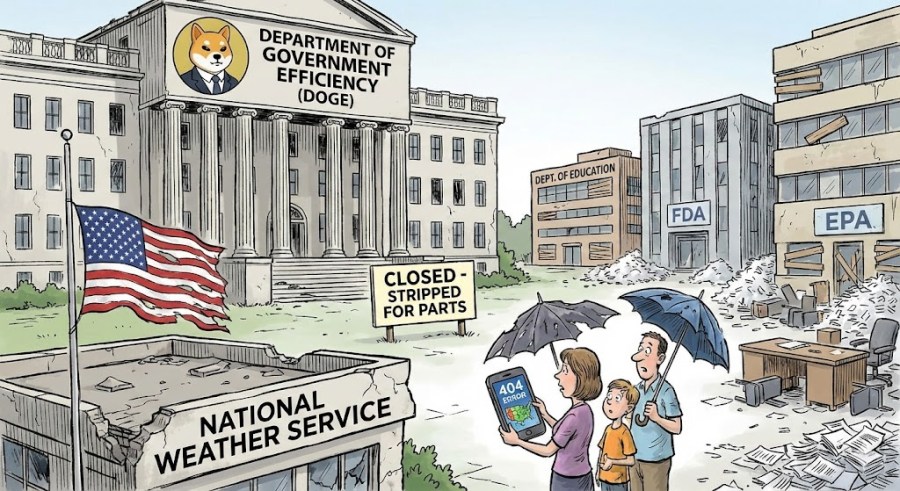
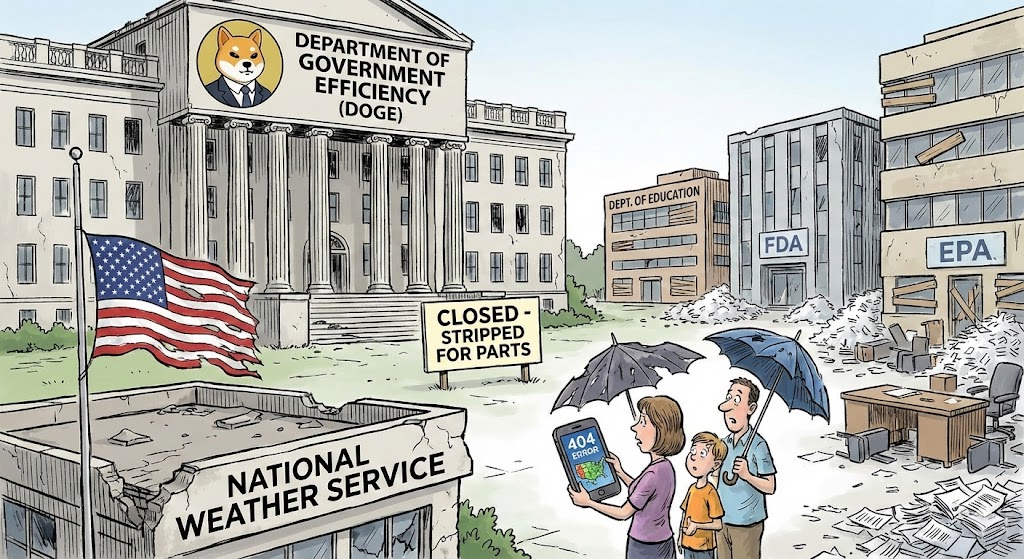
Criticism of the Department of Government Efficiency (DOGE)—led by Elon Musk and Vivek Ramaswamy—often centers on the argument that its approach was less about “trimming fat” and more about “severing nerves.” By treating the federal government like a distressed tech startup rather than a public service provider, critics argue that DOGE fundamentally broke the social contract between the government and its citizens.

Here is a breakdown of how these actions are viewed as having “done badly” to America, specifically regarding the National Weather Service (NWS) and other stripped departments.
1. The Dismantling of the National Weather Service (NWS)
The attack on the NWS is frequently cited as the most dangerous example of DOGE’s “efficiency” over efficacy. The NWS does not just predict sunny days; it provides the foundational data for every airline, shipping company, military operation, and farmer in the country.
- The “Privatization” of Public Safety: The core criticism is that DOGE pushed to commercialize data that taxpayers had already paid for. By slashing the NWS budget and reducing staff, the administration effectively forced Americans to rely on private companies (like AccuWeather) for life-saving alerts.1 This created a “tiered” safety system where wealthy citizens could pay for premium, hyper-local warnings, while lower-income communities were left with degraded, less accurate public forecasts.
- Brain Drain: You cannot simply fire a meteorologist with 30 years of experience in local micro-climates and replace them with an algorithm. Reports indicate that when DOGE instituted mass layoffs and forced resignations, the NWS lost institutional knowledge that will take decades to rebuild.
- Disaster Response: Critics point to delayed warnings during severe weather events (hurricanes, tornadoes) as a direct result of understaffing. When a radar technician is fired to save $80,000, and a radar goes down during a supercell storm, the cost in human life and property damage far exceeds the salary saved.
2. The Department of Education: Chaos by Design
The Department of Education was a primary ideological target, but the practical fallout went beyond politics into administrative chaos.2
- Student Loan Paralysis: By slashing the workforce responsible for processing income-driven repayment plans and consolidations, DOGE effectively froze the financial lives of millions of borrowers.3 “Efficiency” in this case looked like non-functioning websites, unanswered phones, and interest capitalizing on loans because there was no one left to process the paperwork.
- Research Blackout: The termination of contracts for the Institute of Education Sciences (IES) halted critical research into what actually works in classrooms.4 This wasn’t cutting waste; it was blinding the country to educational data.
3. Public Health and Safety (FDA, CDC, USDA)
The “stripped” nature of regulatory agencies arguably made the American food and drug supply less safe.
- Food Safety: Cuts to the FDA and USDA inspection services meant fewer boots on the ground in processing plants. Critics argue this increased the risk of foodborne illness outbreaks (E. coli, Salmonella) because “self-regulation” by corporations rarely matches the rigor of federal oversight.5
- Disease Tracking: The CDC’s ability to monitor emerging pathogens was compromised. By cutting “administrative bloat,” DOGE reportedly severed the lines of communication between state health departments and the federal government, leaving the country vulnerable to the next pandemic or biological threat.
4. The “Hidden” Economic Damage
While DOGE touted billions in saved tax dollars, economists argue the downstream costs were much higher:6
- The IRS: Slashing the IRS budget under the guise of efficiency actually increased the deficit. Every dollar spent on IRS enforcement typically yields multiple dollars in revenue. By gutting the agency, the government arguably emboldened tax cheats and delayed refunds for honest taxpayers who rely on that money.
- The “Hacker” Mentality: Reports that DOGE appointees (often without security clearances or relevant experience) were given access to sensitive federal databases—including Social Security and NOAA systems—raised massive privacy and national security concerns.7 The approach was described by some insiders as akin to “hackers” tearing through a mainframe without understanding the code.
Summary
The prevailing criticism is that DOGE confused business efficiency (profit maximization) with government efficiency (service delivery). A business can stop serving unprofitable customers; a government cannot. By stripping departments like the NWS, DOGE didn’t just cut costs; it transferred those costs to the American people in the form of higher insurance premiums, lost services, increased risk, and the need to pay private companies for what used to be a public right.
 thelivingbreathingjamesbrown.com
You must be logged in to post a comment.