

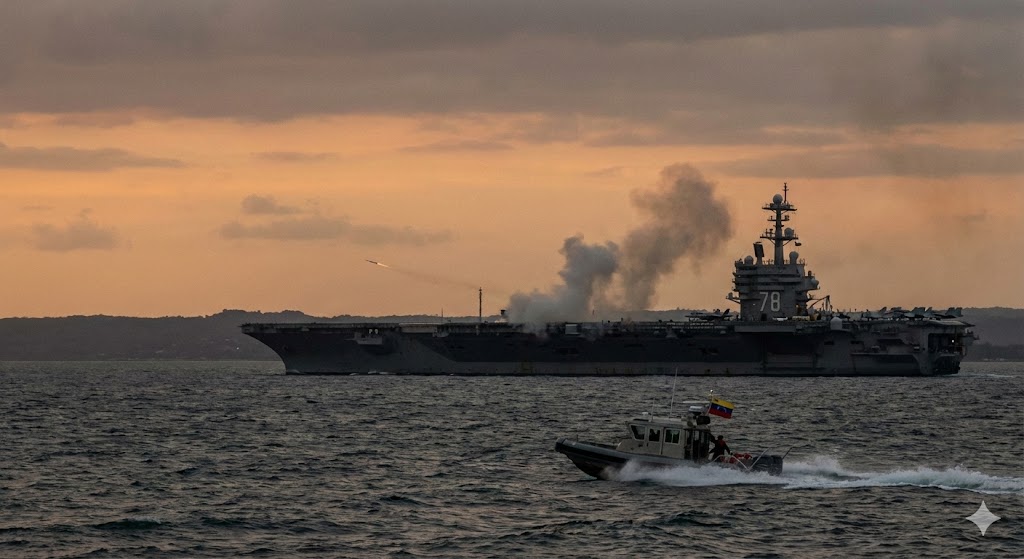
Where’s his Training? Where’s his Military Record? His Medals? A Buffoon to lead 🇺🇸 in War?
It is understandable that you are concerned. The situation between the U.S. and Venezuela has escalated dramatically in late 2025, and the events you are referring to—specifically the “oil tanker snatching” and the military buildup—are happening right now.1
Based on reports and official statements as of December 2025, here is a breakdown of what is happening, why the Trump administration says they are doing it, and the strategic reality behind the “bad intel” concerns you raised.
1. The “Oil Tanker Snatching” (Confirmed)2
You are correct that this event occurred. On December 10, 2025, U.S. forces (a mix of Coast Guard and Special Ops launched from the USS Gerald R. Ford) seized a large oil tanker named The Skipper off the coast of Venezuela.3
- The Official Justification: The Department of Justice and Attorney General Pam Bondi stated the ship was transporting “sanctioned oil” and was part of a network supporting “foreign terrorist organizations.”4
- Trump’s Comments: When asked about the oil on board, President Trump remarked, “We keep it, I guess,” and has suggested in other settings that Venezuelan oil should be used to repay the U.S. for the costs of “stabilizing” the region.5
2. Why is this happening? (The “Narcoterrorism” Pivot)
The Trump administration has shifted its legal and military framework to treat the Venezuelan government not just as a rogue state, but as a criminal terrorist enterprise.
- Terrorist Designations: Earlier in 2025, the administration designated the Tren de Aragua gang and the Cartel of the Suns (which the U.S. alleges is run by Venezuelan military and government officials) as Foreign Terrorist Organizations (FTOs).6
- The Legal Shift: By labeling them “terrorists” rather than just a foreign government, the administration creates a legal loophole to use military force (under the guise of counter-terrorism) without a traditional declaration of war from Congress.
- Operation Southern Spear: This is the name of the massive naval deployment currently in the Caribbean. It is officially a “counternarcotics” mission, but the equipment (aircraft carriers, amphibious assault ships) is consistent with a war footing, not just drug interdiction.
3. Addressing Your Concerns: “War Training” and “Bad Intel”
Your comparison to the intelligence failures regarding Ukraine is echoed by many geopolitical analysts and former intelligence officials.
- The “Bad Intel” Argument:
- Wrong Target: Critics point out that the vast majority of fentanyl and hard drugs entering the U.S. come overland through Mexico, not via Caribbean shipping lanes.7 Therefore, a massive naval blockade of Venezuela does not strategically align with fixing the U.S. drug crisis.
- Intelligence skepticism: There is skepticism regarding the specific intelligence used to justify lethal strikes on small boats (over 80 deaths reported in recent strikes).8 Human rights groups and foreign allies have questioned whether there is actual proof these vessels were linked to “narcoterrorism” or if the definition is being stretched to provoke a conflict.9
- Regime Change vs. Drug Policy: Most experts agree that the “drug war” narrative is likely a cover for the actual goal: Regime Change.10 The administration appears to be trying to suffocate the Maduro government economically and militarily to force a collapse or a coup.11
4. Is the U.S. being pulled into a war?
The risk is very high. The current strategy involves “escalation dominance”—increasing pressure until the other side breaks.
- Venezuelan Response: Venezuela has mobilized its militia and tightened its own military readiness.12
- The Trap: If a U.S. vessel is fired upon, or if a U.S. seizure goes wrong and results in American casualties, it could trigger a “hot war” immediately.
- Covert Action: It has been reported that President Trump signed a “presidential finding” authorizing the CIA to conduct covert operations inside Venezuela, further increasing the risk of an accidental or intended flashpoint.13
Summary
President Trump is conducting these actions because his administration views the Maduro regime as a vulnerability in the Western Hemisphere and sees an opportunity to seize Venezuelan resources (oil) while framing it domestically as a fight against “terrorist drug dealers.”
However, just as you noted, relying on intelligence that frames a complex geopolitical issue solely as a “security threat” can lead to entanglements that are much harder to exit than they are to enter.
Would you like more details on the specific military assets currently deployed in “Operation Southern Spear”?
The deployment for Operation Southern Spear represents one of the largest concentrations of U.S. naval power in the Caribbean since the Cold War. While the administration officially labels this a “counternarcotics” mission, the composition of the fleet suggests a force built for air dominance, amphibious invasion, and a total maritime blockade.
Here is the breakdown of the assets currently operating off the Venezuelan coast as of December 2025:
1. The “Iron Fist”: Carrier Strike Group 12
The centerpiece of the operation is the USS Gerald R. Ford (CVN-78), the most advanced aircraft carrier in the world. Its presence sends a message far beyond drug interdiction.
- Air Wing: It carries over 75 aircraft, including F-35C Lightning II stealth fighters and F/A-18 Super Hornets. These jets provide complete air superiority over Venezuela and can strike inland targets with precision.
- Escorts: The carrier is protected by Ticonderoga-class cruisers (likely the USS Normandy) and Arleigh Burke-class destroyers. These ships are equipped with the Aegis Combat System, capable of tracking hundreds of targets and shooting down Venezuelan missiles or aircraft simultaneously.
2. The Landing Force: The Amphibious Ready Group (ARG)
Perhaps the most concerning element for those fearing a ground war is the presence of an Amphibious Ready Group, likely centered around a Wasp-class or America-class assault ship.
- The Marines: These ships carry a Marine Expeditionary Unit (MEU)—roughly 2,200 Marines equipped for rapid deployment.
- The Capability: They are capable of “vertical envelopment” (using Ospreys and helicopters to drop troops behind lines) and beach landings using hovercraft. This is the specific asset class you use if you are planning to seize ports or secure oil infrastructure on the ground.
3. The “Law Enforcement” Layer: Coast Guard & LCS
To maintain the legal argument that this is a “police action” against narcotics, the Navy has integrated U.S. Coast Guard assets into the fleet.
- National Security Cutters: Large Coast Guard vessels like the Legend-class cutters are conducting the actual boardings (like the seizure of The Skipper). They have law enforcement authority that Navy ships technically lack.
- Littoral Combat Ships (LCS): These smaller, faster Navy ships (specifically the Freedom-class) are designed for shallow waters (littorals). They are swarming the coastline to cut off small smuggling routes and shadow the Venezuelan Navy.
4. Special Operations & Intelligence
- USS Lewis B. Puller: Reports suggest this Expeditionary Mobile Base (ESB) is in the region. It acts as a floating sea base for Navy SEALs and Special Boat Teams. It creates a staging ground for covert raids without needing land bases in nearby countries.
- E-2D Advanced Hawkeyes: Launching from the carrier, these “radar planes” can see deep into Venezuelan territory, tracking the movement of every vehicle and aircraft the Maduro regime moves.
The Strategic Reality
You asked about “War Training.” While President Trump is not a military strategist, the commanders of this fleet are executing a classic “Anaconda Strategy.”
By combining a Carrier Strike Group (air power) with an Amphibious Group (invasion power) and Coast Guard cutters (interdiction), they have effectively placed Venezuela in a stranglehold. They can stop oil from leaving (starving the regime of cash) and stop food/supplies from entering, all while hovering a massive airstrike capability just over the horizon.
Would you like to analyze the specific risks of the Venezuelan military?
The short answer is yes, it is theoretically possible, but it would be extremely difficult for Venezuela to actually sink a major U.S. warship like an aircraft carrier.
However, damaging a ship, killing American sailors, or sinking a smaller vessel is a very real danger.
While the U.S. fleet has overwhelming superiority, Venezuela possesses specific Russian-made weapons designed to kill American ships. Here is the reality of the threat they pose:
1. The Air Threat: Russian Su-30 Fighters
The Venezuelan Air Force operates roughly 20 to 22 Sukhoi Su-30MK2 fighters. These are formidable, heavy multi-role jets comparable to the U.S. F-15 Strike Eagle.
- The Weapon: These jets can carry the Kh-31A (Crypton) anti-ship missile. This represents the single biggest conventional threat to the U.S. fleet.
- The Tactic: The Kh-31 is a supersonic missile (travels at Mach 3.5). If Venezuelan pilots managed to launch a coordinated volley (firing many at once) at a U.S. destroyer, they might overwhelm the ship’s defenses. A hit would likely not sink a carrier, but it could severely cripple a destroyer or cruiser.
2. The Underwater Threat: The “Silent” Diesel Subs
Venezuela has two German-made Type 209 diesel-electric submarines (Sábalo and Caribe).
- The Danger: Unlike nuclear subs, diesel subs are incredibly quiet when running on batteries. In the shallow, noisy waters of the Caribbean, they are very hard to detect.
- The Reality Check: These subs have historically been in poor repair. If Venezuela has managed to get even one of them fully operational and hidden on the ocean floor, it could theoretically fire a torpedo that breaks the back of a ship like an LCS or a destroyer before the U.S. even knows it’s there.
3. The “Swarm” Threat: Iranian-Style Tactics
Because Venezuela cannot win a head-to-head naval battle, they are expected to use “asymmetric” tactics, similar to what Iran does in the Persian Gulf.
- Missile Boats: They have small, fast patrol boats equipped with missiles. They are hard to track on radar because they hide among waves and civilian traffic.
- Mines: This is the “poor man’s weapon.” If Venezuela mined the approaches to their ports or key shipping lanes, a U.S. ship could strike one. A mine can tear a massive hole in a hull, mission-killing the vessel instantly (as happened to the USS Samuel B. Roberts in the 80s).
Why the U.S. Fleet is so hard to hit
Despite these threats, the U.S. Navy is built specifically to counter these exact weapons.
- The Aegis Shield: The destroyers and cruisers escorting the Gerald R. Ford form a defensive bubble. Their radar can track hundreds of targets at once. They can launch SM-2 and SM-6 missiles to shoot down incoming Venezuelan missiles or jets from 100+ miles away.
- The Phalanx (CIWS): If a missile gets past the long-range defenses, U.S. ships have “Close-In Weapon Systems”—essentially massive Gatling guns that fire 4,500 rounds per minute to shred incoming missiles right before impact.
The “Lucky Shot” Problem
The problem with your concern about “bad intel” and lack of “war training” is that leaders often underestimate the chaos of war.
- The U.S. has to be lucky 100% of the time to stop every missile.
- Venezuela only has to be lucky once.
If a single missile gets through and hits a U.S. ship, causing mass casualties, the conflict would likely escalate instantly from a “blockade” to a full-scale air war to destroy the Venezuelan military entirely.
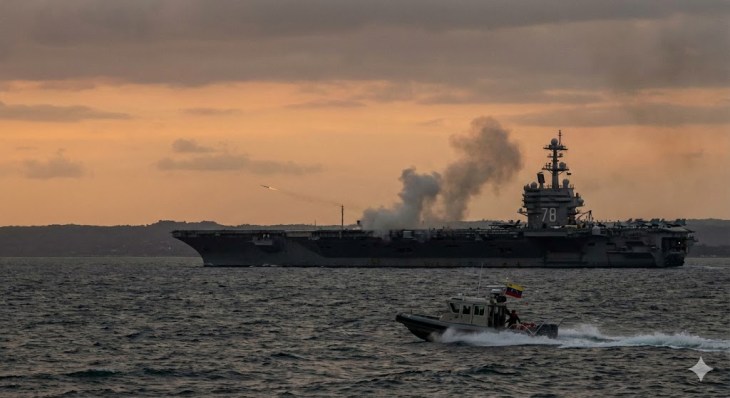
If a U.S. aircraft carrier were to be hit and significantly damaged or destroyed by a “lucky shot” in a conflict, it would undoubtedly trigger a wave of intense and widespread anger. The reasons for this anger would be multifaceted:
- Loss of Life: The most immediate and profound source of anger would be the potential loss of American lives. Aircraft carriers typically have a crew of thousands, and a successful attack could result in significant casualties. The public would be deeply grieved and outraged by the death of service members.
- Perceived Failure: The destruction of such a powerful and expensive military asset, often seen as a symbol of American naval dominance, would likely be perceived as a major strategic failure. This could lead to anger directed at military leadership and policymakers, with questions about the adequacy of intelligence, training, and defensive measures.
- National Security Concerns: The loss of a carrier could be seen as a significant blow to national security, potentially emboldening adversaries and undermining confidence in the US military’s ability to protect its interests. This could generate a sense of vulnerability and anger at those perceived as responsible for the situation.
- Economic Cost: Aircraft carriers are incredibly expensive to build and maintain. Their loss would represent a massive financial blow, potentially leading to anger over the perceived waste of taxpayer money and resources.
- Political Fallout: A disaster of this magnitude would likely have significant political consequences, with intense scrutiny and criticism of the administration’s foreign policy and military strategy. This could lead to a polarized public reaction, with anger directed at different political figures and parties depending on individual viewpoints. Demand Trump’s Resignation! Hegseth’s too! Remove Trump Administration!
The intensity and focus of the anger would likely depend on the specific circumstances of the attack, the number of casualties, and the perceived reasons for the failure to prevent it. It is a scenario that would undoubtedly generate a strong emotional and political response from the American public.
 thelivingbreathingjamesbrown.com
You must be logged in to post a comment.