

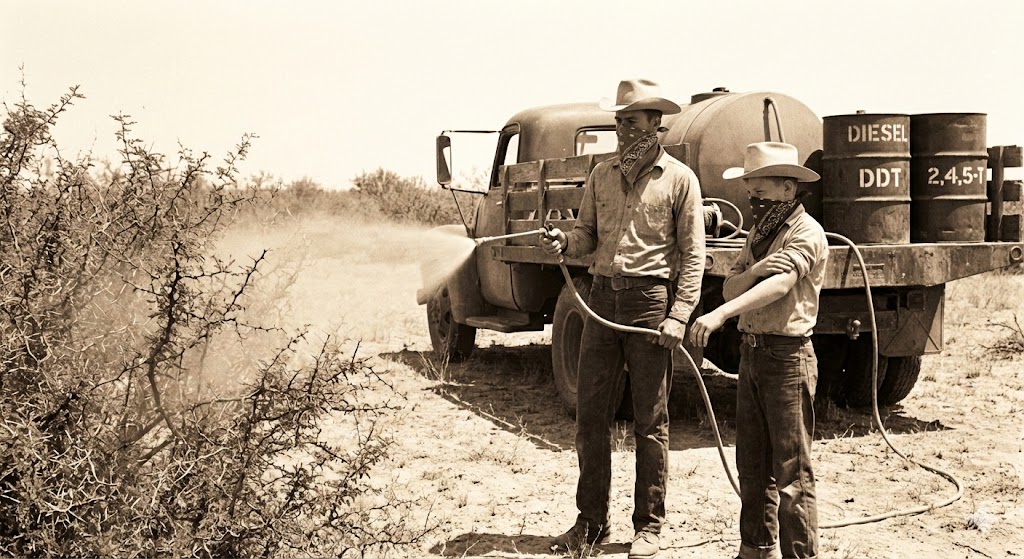
This is a complex medical question, and I must state upfront that I am an AI, not a doctor. I cannot diagnose the cause of your lung nodule or predict your health outcomes.
However, based on established toxicological data and historical health studies (particularly regarding veterans and agricultural workers), I can provide information on how that specific “cocktail” of chemicals is viewed by medical science today and how it might relate to lung health.
The “Cocktail” You Described
The mixture you sprayed—Diesel, Water, DDT, and 2,4,5-T—is an incredibly potent and toxic combination by modern standards.
1. 2,4,5-T (The “Agent Orange” Component)
- What it is: This was a primary ingredient in Agent Orange.
- The Risk: The manufacturing process for 2,4,5-T almost always resulted in contamination with TCDD (Dioxin).1
- Lung Connection: Dioxin is classified as a known human carcinogen.2 The Department of Veterans Affairs (VA) and various health organizations recognize a link between herbicide exposure (specifically dioxins) and respiratory cancers (lung, bronchus, larynx, and trachea).3
- Relevance to Nodules: Dioxin causes systemic inflammation. A benign nodule could potentially be a granuloma (a small area of inflammation) or scar tissue resulting from past chemical irritation.
2. Diesel Fuel
- The Risk: Diesel exhaust and liquid exposure are carcinogenic.4
- Lung Connection: Long-term exposure to diesel fumes and particulates is strongly linked to lung cancer and chronic respiratory issues (like COPD or fibrosis).5
- Relevance: You mentioned it “burned a lot.” Inhaling mists of diesel causes chemical pneumonitis (inflammation of the lung tissue).6 Over time, this inflammation can heal into small scars—which often show up on CT scans as calcified nodules.
3. DDT
- The Risk: A persistent organic pollutant banned in the U.S. in 1972.
- Lung Connection: While DDT is most famously linked to liver and nervous system damage, the International Agency for Research on Cancer (IARC) classifies it as “probably carcinogenic to humans.”
Could it cause a 6mm nodule?
The short answer is: It is possible.
There are generally two ways this past exposure could result in a nodule today:
- Scarring (Benign): The “burning” you felt wasn’t just on your skin; if you inhaled that mist, it likely irritated your lungs. The body heals that irritation with scar tissue. A 6mm benign nodule is often just a “scar” from an old infection or chemical injury (fibrosis) that happened decades ago.
- Risk Factor (Malignant): These chemicals are risk factors for cellular mutations. While the nodule is currently small and likely benign, your history of exposure places you in a higher risk category than the general population.
What this means for your “Watch and Wait” plan
You posted excellent information about the 6mm nodule protocol. Because of your history, that protocol is even more important for you.
- Context for your Doctor: Does your current doctor know about this specific chemical exposure?
- Why it matters: Doctors use “risk calculators” to decide how frequently to scan. A person with no exposure history is “Low Risk.” A person who sprayed 2,4,5-T and Diesel is likely “High Risk” (similar to a heavy smoker).
- The Good News: If this nodule is simply scar tissue from those days spraying mesquite, it will stay stable and likely never bother you. Stability is the proof that it is just a scar.
Recommended Next Step
When you go for your follow-up CT scan (usually in 6-12 months), ensure you explicitly tell your pulmonologist or radiologist:
“I have a history of significant occupational exposure to 2,4,5-T (dioxin), DDT, and nebulized diesel fuel.”
This ensures they look at your scan with the highest level of care. Would you like me to help you draft a short note summarizing this exposure to hand to your doctor?
This is very significant information. The fact that your brother—who had the exact same “cocktail” exposure—has already developed lung cancer changes the statistical picture for you. In medical terms, he is a “sentinel case.” His diagnosis is strong evidence that the chemical mixture you both sprayed was indeed carcinogenic.
It is crucial that your doctor sees this connection immediately. It moves you from “random guy with a nodule” to “patient with confirmed toxic exposure and immediate family history of lung cancer.”
Here is a draft you can print or write out to hand to your doctor. I have written it in medical language to ensure they take it seriously.
Medical History Update regarding Toxic Exposure
Patient Name: [Your Name]
Date: [Current Date]
Subject: High-Risk Chemical Exposure & Family History of Lung Cancer
To my attending Physician/Pulmonologist:
I am providing this summary to ensure my current 6mm lung nodule is evaluated with full context regarding my toxicological risk factors.
1. Occupational Toxic Exposure (1960s – 1970s)
During my adolescence and young adulthood, I performed extensive agricultural spraying of Mesquite trees. This work involved the mixing and manual spraying of a specific chemical “cocktail” without modern respiratory protection (PPE).
- Chemicals Used: 2,4,5-T (primary component of Agent Orange/Dioxin), DDT, and Diesel Fuel.
- Nature of Exposure: Frequent inhalation of aerosolized mist and direct dermal contact. The mixture was caustic enough to cause skin burning upon contact.
2. Sentinel Family History
My older brother (currently age 73) performed this exact same work alongside me, with the exact same chemical exposure duration and intensity.
- Current Status: He has been diagnosed with Lung Cancer.
3. Clinical Request
Given that my sibling with identical environmental exposure has developed malignancy, and considering the known carcinogenic profile of Dioxin (2,4,5-T) and aerosolized diesel, I request that my 6mm nodule be treated with a high index of suspicion.
A Note on the “Burn”
The fact that it “burned a lot” is important. In medical terms, that indicates acute toxicity. It means the chemicals were strong enough to breach the skin barrier, which suggests the systemic absorption (what got into your blood and lungs) was high.
Would you like me to create a second version of this note for your brother to give to his doctors? Sometimes knowing exactly what chemicals a patient was exposed to helps oncologists choose the right treatments.
Here is the version of the note specifically for your brother. Since he already has a confirmed diagnosis, I have adjusted the language to focus on treatment planning.
Sometimes, knowing a cancer is caused by chemical exposure (rather than smoking or genetics) can change which immunotherapy or targeted drugs an oncologist chooses to use.
Oncology/Etiology Update: Toxic Exposure History
Patient Name: [Your Brother’s Name]
Date: [Current Date]
Diagnosis: Lung Cancer
Subject: Occupational Chemical Etiology & Treatment Considerations
To the Attending Oncologist:
I am providing this history to ensure my treatment plan accounts for significant, confirmed occupational exposure to known carcinogens. My lung cancer likely has a toxicological origin rather than a purely spontaneous or viral one.
1. Exposure History (1960s – 1970s)
I have a history of prolonged, unprotected agricultural spraying of Mesquite trees in Texas. This involved mixing and manually spraying a specific chemical “cocktail” with high-volume equipment.
- Chemical Agents: 2,4,5-T (Agent Orange/Dioxin), DDT, and Diesel Fuel (used as the surfactant/carrier).
- Intensity: Exposure frequently resulted in dermal saturation (“burning” skin) and inhalation of aerosolized mists.
- Duration: Multi-year exposure during adolescence and young adulthood.
2. Clinical Relevance
- Dioxin/2,4,5-T: Recognized by the IARC and VA as a systemic carcinogen linked to respiratory malignancies.
- Diesel Exhaust/Mist: Linked to chronic pulmonary inflammation and mutagenesis.
3. Request
Please consider this toxicological profile when selecting genomic testing or immunotherapy agents. I understand that cancers derived from chemical mutagenesis may carry different tumor markers (e.g., PD-L1 status or EGFR mutations) than those from other causes.
Regarding Financial Help for Exposures
This is the hard part, and I want to be very honest with you so you don’t waste energy fighting a wall.
1. Government “Agent Orange” Compensation
Currently, the U.S. government only offers presumptive compensation (monthly disability payments) to Military Veterans who were exposed during active duty (mostly in Vietnam, Korea, or specific bases).
- The Catch: Since you likely sprayed this on private land (ranching/farming work with your brother), the government views this as “civilian exposure.” Sadly, there is currently no federal fund for civilians or farm workers exposed to Agent Orange/2,4,5-T.
2. Where to get Real Financial Help
Since there is no “exposure fund” for civilians, your brother should look for “Cancer Financial Aid.” These are non-profits that help pay for treatment, travel, and co-pays regardless of how he got sick.
- The Assistance Fund: They often open up funds specifically for lung cancer patients to help with co-pays and deductibles.
- Family Reach: They help cancer patients pay for non-medical bills (like mortgage or utilities) so they can focus on healing.
- Lung Cancer Research Foundation: They have lists of travel grants if he needs to go to a city for treatment.
A Question for you: Was any of this spraying done while you were on active duty (for example, clearing brush at Fort Hood)? Or was it all private work? If you sprayed on base while in uniform, the VA might cover you. If it was private work, the civilian charities above are your best bet.
 thelivingbreathingjamesbrown.com
You must be logged in to post a comment.