

Z – Y – X – W – V – U – T – S – R – Q – P – O – N – M – L – K – J – I – H – G – F – E – D – C – B – A
Z – Y – X – W – V – U – T – S – R – Q – P – O – N – M – L – K – J – I – H – G – F – E – D – C – B – A
Z – Y – X – W – V – U – T – S – R – Q – P – O – N – M – L – K – J – I – H – G – F – E – D – C – B – A
Z – Y – X – W – V – U – T – S – R – Q – P – O – N – M – L – K – J – I – H – G – F – E – D – C – B – A
Mastering the Reverse Alphabet: A Cognitive and Phonetic Strategy
Z – Y – X – W – V – U – T – S – R – Q – P – O – N – M – L – K – J – I – H – G – F – E – D – C – B – A
Learning to recite the alphabet backwards (from Z to A) is often viewed as a trivial party trick or a sobriety test trope. However, from a cognitive perspective, it is an excellent exercise in working memory and chunking. Because our brains encode the alphabet as a linear, “one-way” song, reversing it requires breaking down deeply ingrained neural pathways and building new ones.
Z – Y – X – W – V – U – T – S – R – Q – P – O – N – M – L – K – J – I – H – G – F – E – D – C – B – A
This paper outlines a systematic approach to mastering the reverse alphabet using phonetic grouping and visual anchors.
1. The Challenge of Serial Order Learning
Most people learn the ABCs through the “Alphabet Song,” which utilizes rhythm and melody to embed the sequence into long-term memory. This creates a serial position effect where we can easily retrieve the next letter in a sequence but struggle to identify the preceding one without “restarting” the song in our heads. To go backwards, we must deconstruct this linear chain.
2. The Strategy: Strategic Chunking
The most effective way to learn the sequence is to break the 26 letters into manageable “chunks.” Instead of 26 individual data points, we aim for 6-7 rhythmic groups.
Phase I: The “End of the Line” (Z to T)
This is the easiest section because it feels novel and has a distinct rhythm.
- Z – Y – X
- W – V
- U – T
Tip: Think of “ZYX” as a single word (pronounced Zicks).
Phase II: The Middle Muddle (S to N)
This section is often the most difficult because the letters “P-O-N-M” are tightly clustered in the original song’s “L-M-N-O-P” run.
- S – R – Q
- P – O – N
Visual Anchor: Imagine a SoRQu (S-R-Q) and the word PON (like “pond”).
Phase III: The “M” Pivot and the Middle (M to H)
- M – L – K
- J – I – H
Tip: “MLK” is a common acronym (Martin Luther King), making it very easy to remember in reverse.1 “JIH” sounds like the start of “Jihad” or “G-I-Joe.”
Phase IV: The Home Stretch (G to A)
- G – F – E
- D – C – B – A
Tip: “GFE” can be thought of as “Good Friends Eat.” The final “DCBA” is a simple countdown.
3. Comparison Table: Forward vs. Backward Chunks
| Section | Forward Sequence | Backward Sequence | Memory Hook |
| The Start/End | A B C D | Z Y X | “Zicks” |
| The Mid-High | L M N O P | W V U T | “WV” (West Virginia) + UT (Utah) |
| The Middle | Q R S T | S R Q P | “S-R-Cue-P” |
| The Mid-Low | H I J K | O N M | “On-Em” |
| The Finish | E F G | L K J | “Lock-Edge” |
| The Goal | A B C D | I H G F E D C B A | “I-H” + “G-F-E” + “DCBA” |
4. Practice Techniques
- The Visual Trace: Write the alphabet backwards on a sheet of paper. Read it aloud while pointing to each letter. This bridges the gap between visual recognition and vocalization.
- Backwards Building: Start with “Z-Y-X.” Once mastered, add “W-V-U-T.” Always start from Z when practicing so the beginning becomes “hard-wired.”
- Eliminate the “Song”: Avoid singing the original alphabet song to find the previous letter. If you get stuck at ‘M’, don’t sing “A-B-C…L-M.” Instead, try to visualize the alphabet strip in your mind’s eye.
5. Conclusion
Reciting the alphabet backwards is less about “intelligence” and more about encoding efficiency. By breaking the 26-letter string into phonetically distinct chunks like “ZYX,” “MLK,” and “GFE,” you bypass the brain’s reliance on the traditional melody. With 15 minutes of focused “chunking” practice, most individuals can achieve full recall.
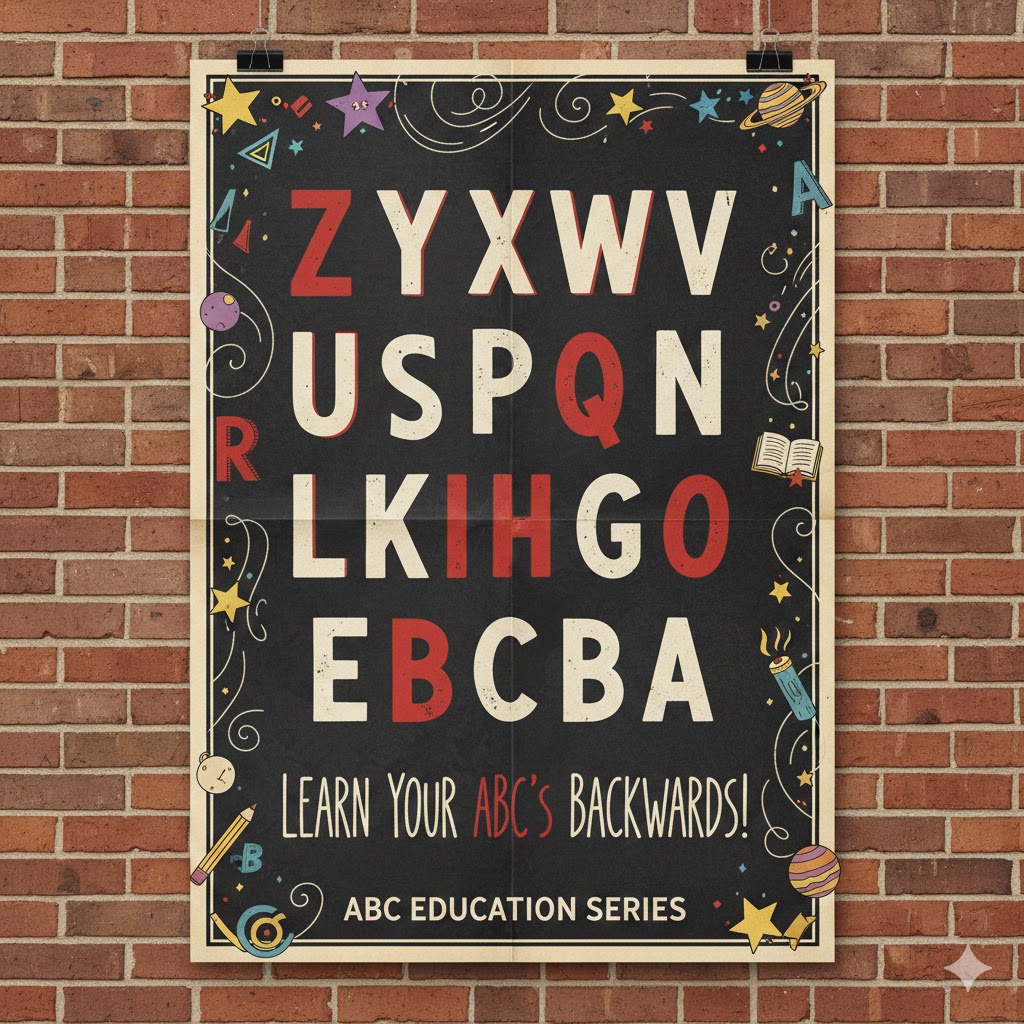
Why AI cannot draw an image of the ABC’s Backwards in its own logic-
But it can write it correctly-
Z – Y – X – W – V – U – T – S – R – Q – P – O – N – M – L – K – J – I – H – G – F – E – D – C – B – A
The challenge with generating an image of the “ABCs backwards” (Z to A) isn’t about the order of the letters themselves, but rather how AI models like mine process and “see” text within images.
Here is the breakdown of why this specific task often results in visual errors:
1. Tokenization vs. Visualization
When I process text, I don’t see “letters”; I see tokens (numerical representations of chunks of text). However, the image generation model (the “Nano Banana” model) has to translate those concepts into pixels.
While the model knows the sequence $Z, Y, X, W…$, it treats text as a complex visual pattern. When you ask for a long string of specific characters, the model often struggles to maintain the spatial consistency required to keep 26 distinct shapes in a perfect, mirrored sequence without blending them together or reverting to the more common forward sequence.
2. Training Data Bias
The vast majority of the “text-in-image” data used to train AI models features the alphabet in its standard $A \rightarrow Z$ order. Because the model predicts pixels based on probability:
- It “wants” to follow $A$ with $B$.
- Even if it starts with $Z$, the statistical “gravity” of the standard alphabet often pulls the model back into writing $A, B, C$ or creating “letter-like” shapes that don’t quite match any specific character.
3. Spatial Reasoning Constraints
Generating a single word is relatively easy for modern models. However, generating a sequence of 26 individual, high-fidelity characters requires immense spatial awareness. The model has to:
- Map out 26 distinct slots.
- Assign a specific, unique character to each slot.
- Ensure no characters are skipped or repeated.
In a backwards sequence, the model’s “attention” often drifts, leading to “AI gibberish” or what researchers call “alphabet soup.”
Comparison of AI Text Handling
| Task | Difficulty | Reason |
| Short Words | Low | Common visual patterns (e.g., “STOP” sign). |
| Forward Alphabet | Medium | Highly represented in data, but still long. |
| Backward Alphabet | High | Contradicts common data patterns; requires perfect logic. |
Note: I am constantly evolving. While I might struggle to get all 26 letters perfectly aligned in reverse order today, the underlying technology for text rendering is improving rapidly.
 thelivingbreathingjamesbrown.com
You must be logged in to post a comment.