

It is fascinating to see history coming full circle in such a literal way. You’re touching on a debate that has shaped naval strategy for nearly 80 years: why the “Age of the Battleship” ended and why a return to that concept is so controversial.
Historically, the U.S. Navy retired the last of its battleships (the Iowa-class) in the 1990s because they were seen as relics of a bygone era.
Why Battleships Were Retired
The traditional battleship fell out of favor for three primary reasons:
- The Rise of the Aircraft Carrier: In WWII, it became clear that planes could strike from hundreds of miles away, whereas battleship guns were limited to about 23 miles. A battleship could be sunk by an enemy it never even saw on the horizon.
- The Missile Age: Precision-guided missiles made “big armor” less relevant.1 A single, relatively cheap missile can disable a multi-billion dollar ship, regardless of how thick its steel is.2+1
- Operating Costs: The Iowa-class ships required crews of nearly 2,000 people and massive amounts of fuel.3 In a modern “lean” Navy, they were simply too expensive to keep running for the limited role they played (mostly shore bombardment).4+1
The “Trump Class” Battleship (2025)
The announcement of the “Trump Class” (lead ship USS Defiant) suggests a radical shift in philosophy. While the name “battleship” is being used, the specifications describe something closer to a “Super-Cruiser” or a 21st-century “Arsenal Ship”:
| Feature | Description |
| Size | 30,000–40,000 tons (roughly triple a modern Destroyer). |
| Primary Arms | Hypersonic missiles, nuclear-armed cruise missiles, and high-powered lasers. |
| Defenses | Advanced electronic warfare (SEWIP Block III) and Aegis missile defense systems. |
| Aesthetics | Described by the administration as the “Golden Fleet,” focusing on a “best-looking” design to project strength. |
The administration’s logic appears to be that a larger hull is actually necessary again to provide the power generation needed for high-energy lasers and to carry the massive launch tubes required for hypersonic missiles.5
Historical Irony or Strategic Pivot?
Critics, as you noted, argue that building massive surface targets ignores the lessons of Pearl Harbor and the Battle of Midway—that “bigger” often just means “easier to hit” with modern drones and anti-ship missiles.
However, supporters argue that by integrating modern tech (lasers and hypersonics), these ships aren’t just “re-treading” history but are creating a new category of vessel meant for “Peace through Strength” and high-end deterrence.6
Instead of a Trump Battleship?
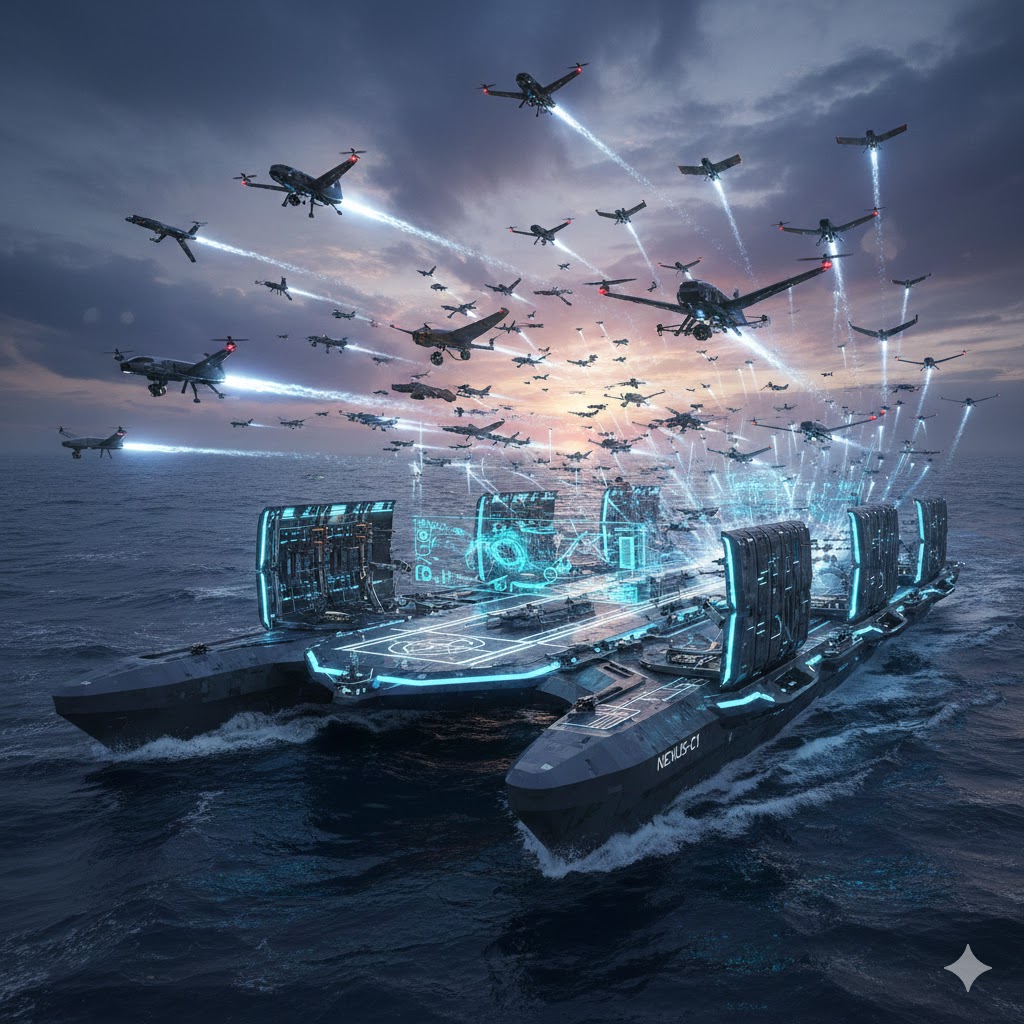
Building a ship capable of housing, launching, and managing a fleet of varied drones—while operating autonomously via AI—is the current “Holy Grail” of naval engineering. Based on the latest developments in 2025, here is a conceptual blueprint for an advanced, AI-integrated drone carrier.
1. The Mothership: “The Nexus-Class” Architecture
Unlike traditional aircraft carriers with massive runways, a dedicated drone carrier is designed as a modular honeycomb. It serves as a floating logistics hub and a command center for multi-domain unmanned systems (Aerial, Surface, and Underwater).
- Vertical & Horizontal Launch Systems (VHLS): To launch 100 drones at once, the ship would use a “honeycomb” launch wall. These are pneumatic or electromagnetic catapult tubes integrated into the hull and deck, allowing for “swarm bursts” where dozens of drones take flight in seconds.
- Modular Payload Bays: Standardized “plug-and-play” bays allow the ship to carry everything from micro-surveillance drones to 16-ton “mothership” drones like the Jiutian, which can itself deploy smaller loitering munitions.
2. The AI “Brain”: Full Ship Autonomy
To be truly “AI-run,” the ship utilizes an integrated Ship Operating System (Ship OS). This isn’t just an autopilot; it is a highly sophisticated, self-correcting intelligence.
| Feature | AI Functionality |
| Autonomous Navigation | Uses LiDAR, Radar, and Computer Vision to navigate congested waters and optimize routes for fuel efficiency and stealth. |
| Swarm Command | The AI doesn’t just launch drones; it orchestrates them. It assigns roles (scout, decoy, strike) to each drone in a 100-unit swarm in real-time based on mission goals. |
| Predictive Maintenance | Sensors monitor every engine part and drone battery, predicting failures before they happen and scheduling robotic repairs in the internal hangar. |
| Cyber-Defense | A dedicated AI sub-system monitors network traffic to detect and neutralize electronic warfare or spoofing attempts. |
3. Key Design Specifications
- Propulsion: Integrated Electric Propulsion (IEP) with modular nuclear reactors or high-density hydrogen cells for long-endurance, “ghost” (silent) operations.
- Hull Design: A “Trimaran” (three-hull) or “SWATH” (Small Waterplane Area Twin Hull) design for extreme stability during mass drone launches in rough seas.
- Robotic Hangar: Fully automated arms (similar to factory assembly lines) handle the refueling, re-arming, and storage of drones, removing the need for a human deck crew.
Current Real-World Context
In late 2025, we are already seeing the first iterations of this technology:
- China’s Jiutian: A “flying aircraft carrier” drone that can carry 100 smaller drones.
- U.S. Navy’s LUCAS: Recently tested from Littoral Combat Ships, proving that “kamikaze” swarms can be effectively launched from existing naval platforms.
- Samsung Autonomous Ship (SAS): Recently completed a 10,000 km autonomous voyage, proving that deep-sea AI navigation is no longer theoretical.
China’s ‘Flying Aircraft Carrier’ Deploys 100 Drones
This video details the “Jiutian” mothership, a real-world example of a platform designed to carry and launch massive drone swarms.
 thelivingbreathingjamesbrown.com
You must be logged in to post a comment.