
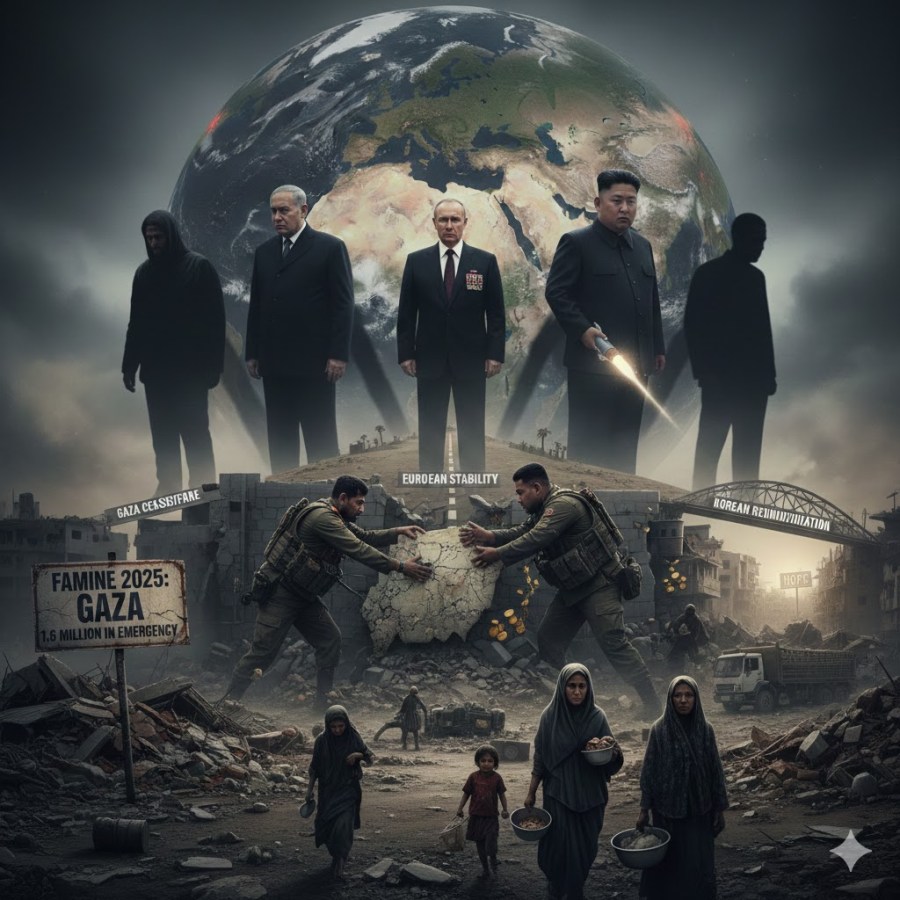
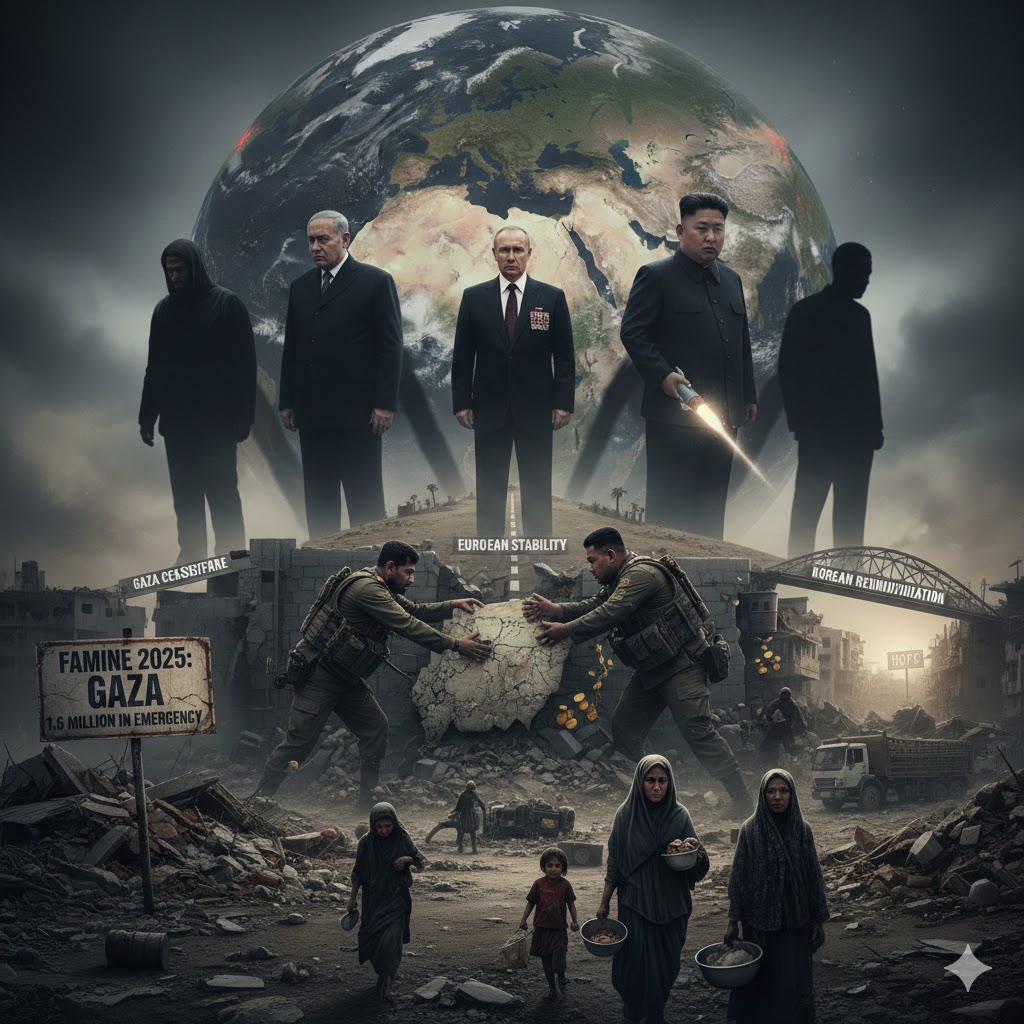
This paper examines the contemporary landscape of world peace as of late 2025, exploring the systemic and individual barriers to global stability. It focuses on the specific actors whose pursuit of power has created “roadblocks” to peace and provides a detailed analysis of the humanitarian catastrophe in Gaza.
The Fragile Horizon: Roadblocks to World Peace in 2026
World peace in 2026 remains an elusive ideal, challenged by a resurgence of “strongman” politics, ethnic fracturing, and the persistence of “warlordism” in failing states. While several diplomatic breakthroughs occurred mid-year, the underlying drivers of conflict—resource scarcity, territorial ambition, and personal ego—continue to destabilize the international order.
I. Identifying the “Roadblocks”: Leaders and Warlords
The term “warlord” has evolved to describe not only non-state actors but also heads of state who govern through military force and the suppression of peace processes. The following individuals are currently identified by international observers as primary impediments to regional and global stability:
1. Vladimir Putin (Russia)
Despite hosting a landmark summit in Alaska in August 2025, Putin remains the central obstacle to peace in Europe. By the end of 2025, Russia was ranked as the least peaceful country in the world by the Global Peace Index.1 Putin’s insistence on “security guarantees” that infringe on Ukrainian sovereignty and his continued militarization of the Russian economy have stalled long-term settlement efforts.
2. Abdel Fattah al-Burhan & Mohamed “Hemedti” Hamdan Dagalo (Sudan)
Sudan represents perhaps the most literal example of warlord-driven destruction. The war between General al-Burhan (Sudanese Armed Forces) and Hemedti (Rapid Support Forces) has displaced 12 million people. Both leaders have been accused of prioritizing their business empires and personal survival over the life of the nation, effectively holding the third-largest country in Africa hostage.
3. Kim Jong Un (North Korea)
In early 2025, Kim Jong Un formally abandoned the decades-old policy of peaceful reunification, declaring South Korea his “principal foe.”2 By aligning militarily with Russia and conducting aggressive missile tests throughout the year, he has dismantled the “safety valves” that previously prevented accidental escalation on the Korean Peninsula.3+1
4. Benjamin Netanyahu (Israel) & Yahya Sinwar (Hamas)
Though Sinwar’s status has been subject to various reports throughout the conflict, the leadership of Hamas and the government under Netanyahu have faced international criticism for prolonging hostilities. Critics argue that Netanyahu’s domestic political survival has often been at odds with a permanent ceasefire, while Hamas’s continued use of civilian infrastructure has been cited as a primary barrier to de-escalation.
II. The Humanitarian Crisis: The Gaza Famine
The most harrowing consequence of the failure to achieve peace in 2025 has been the famine in the Gaza Strip. The situation reached its nadir in mid-2025, leading to a historic and tragic IPC (Integrated Food Security Phase Classification) declaration.
Timeline of the Famine
- August 22, 2025: Famine was officially confirmed in the Gaza Governorate.4 At this peak, over 500,000 people were trapped in famine conditions (IPC Phase 5).5
- The Toll: By late August, documentation showed over 300 malnutrition-related deaths, including more than 100 children.6
- The Blockade: The famine was a direct result of the prolonged blockade and the destruction of food and water infrastructure, which international courts ruled Israel was obligated to rectify.7
Current Status (December 2025)
Following a U.S.-brokered ceasefire in October 2025, humanitarian access improved.8 As of late December:
- Famine Pushed Back: The UN announced that “famine conditions” are no longer present as of December 19, 2025.
- Ongoing Emergency: Despite the improvement, 1.6 million Gazans (77% of the population) remain in “Emergency” (Phase 4) or “Crisis” (Phase 3) levels of food insecurity.9
- Fragility: Health services and sanitation remain decimated.10 The UN warns that the situation is “highly reversible” if the current ceasefire—often criticized as transactional or fragile—should fail.
III. Conclusion
World peace is not merely the absence of war, but the presence of justice and food security. The warlords of 2026 demonstrate that when personal power is prioritized over human life, the result is the systematic starvation of entire populations. The “peace through strength” models seen in recent months have provided temporary pauses in violence, but until the underlying “roadblocks”—the leaders who profit from conflict—are held accountable, the shadow of famine and war will continue to loom over the 21st century.
War Lords are making Billions on the Wars.
 thelivingbreathingjamesbrown.com
You must be logged in to post a comment.