
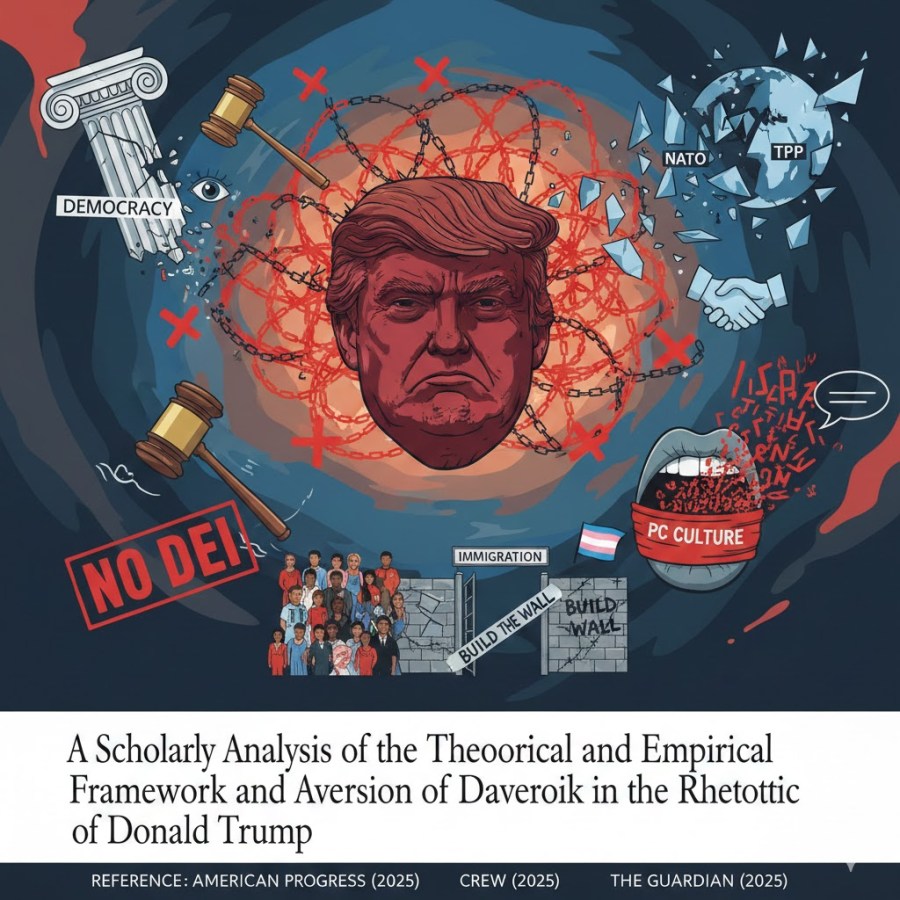
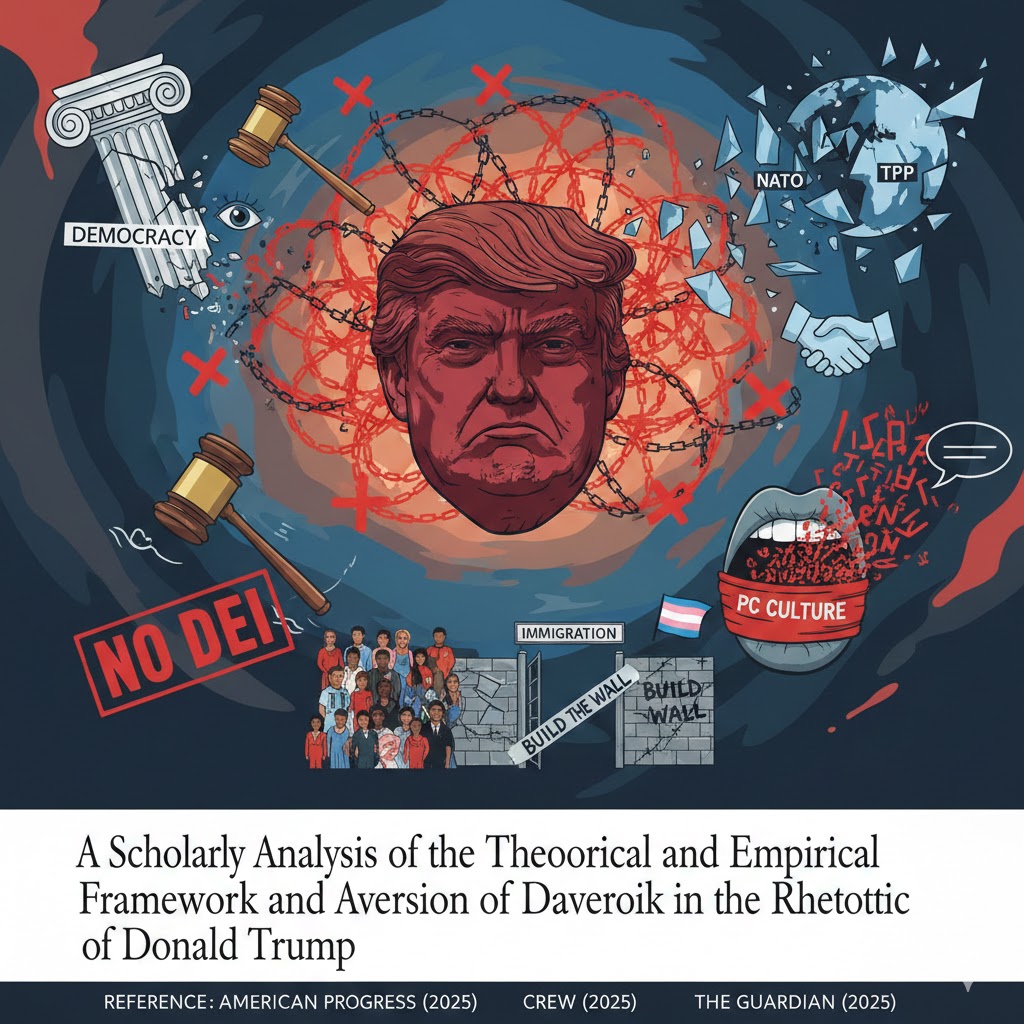
A Scholarly Analysis of the Theoretical and Empirical Framework of Dislikes and Aversion in the Rhetoric of Donald Trump
Abstract: This paper examines the systemic structure of aversions, grievances, and policy oppositions articulated by Donald Trump during his business career and political tenure (2015–2025). By synthesizing rhetorical analysis with political science frameworks, this study categorizes these “dislikes” into four primary domains: institutional norms, multilateralism, demographic diversity (specifically DEI initiatives), and “restrictive communication” (political correctness). The paper argues that these aversions are not merely personal pet peeves but serve as a cohesive populist strategy designed to mobilize a base through the framing of “aggrieved entitlement.”
I. Institutional and Normative Aversions
A foundational element of Trump’s discourse is the rejection of traditional democratic guardrails. Research suggests a consistent distaste for independent government oversight.1
- Inspectors General and Civil Service: Scholarly reviews of the 2025 administration note a significant aversion to the “permanent bureaucracy.” This is evidenced by the dismissal of multiple inspectors general and the push to reclassify civil servants as political appointees to ensure loyalty over expertise (American Progress, 2025).2
- The Judicial System: When rulings are unfavorable, Trump has historically articulated a dislike for specific “activist judges” or the judicial branch’s independence, often framing the Department of Justice as “weaponized” when it operates outside executive preference (CREW, 2025).3
II. Geopolitical and Economic Oppositions
Trump’s “America First” doctrine is defined primarily by what it opposes: multilateralism and traditional alliances.
- NATO and Globalism: Trump has consistently expressed disdain for “free-riding” allies. In 2025, this manifested in an insistence that NATO members increase defense spending to 5% of GDP, coupled with a rhetorical abandonment of Ukraine in favor of bilateral deals with autocratic leaders (Post Alley, 2025).4
- Trade Multilateralism: There is a documented aversion to regional trade blocks (e.g., TPP, NAFTA). Instead, Trump favors aggressive protectionism, utilizing high tariffs—such as those imposed on Canadian and Chinese goods in 2025—as a tool for nationalistic economic leverage (NCSL, 2025).5
III. Social and Cultural Aversions
A significant portion of Trump’s rhetoric centers on the rejection of modern social shifts, which he frequently characterizes as “garbage” or “destruction.”
- Diversity, Equity, and Inclusion (DEI): Throughout 2025, Trump’s executive actions targeted DEI programs within the FAA and military, labeling them as “too white” exclusion or “woke” indoctrination (The Guardian, 2025).6
- Immigration and Demographic Change: Utilizing “crisis-framing,” Trump’s rhetoric displays a profound aversion to unregulated migration, often using dehumanizing language (e.g., “invaders,” “animals”) to describe asylum seekers (Pfiffner, 2022).
- Gender Identity: In 2025, the administration issued orders to strip gender identity from federal policies, reflecting a dislike for non-binary and transgender recognition in public institutions (NCSL, 2025).7
IV. Psychological and Communication Norms
Scholars note that Trump’s most potent “dislike” is directed at Political Correctness (PC).
- Communication Restrictions: Psychological studies suggest Trump’s support is partially a “cultural revolt” against perceived communication restrictions.8 He views PC norms as a “big problem” that prevents “straight talk,” using “rhetorical violence” to break these norms and solidify his identity as an anti-establishment outsider (Journal of Social and Political Psychology, 2020).9+1
V. Verifiable References
- American Progress. (2025). Trump’s First 100 Days: Creating an Imperial Presidency That Harms Americans.10 Link
- Citizens for Responsibility and Ethics in Washington (CREW). (2025). How President Trump is dismantling our democracy, one piece at a time. Link
- The Guardian. (2025). Donald Trump in his own words – the year in racism and misogyny. Link
- National Conference of State Legislatures (NCSL). (2025). Summary 2025 Administration Actions: Key Executive Orders and Policies. Link
- Pfiffner, J. P. (2022). Donald Trump and the Norms of the Presidency. George Mason University. Link
- Schoenberg, J. (2025).11 Weaponization of Words: A Rhetorical Analysis of Donald Trump. Binghamton University. Link
- Journal of Social and Political Psychology. (2020). Donald Trump as a Cultural Revolt Against Perceived Communication Restriction. Link
- Post Alley. (2025). Be Outraged with Me: The Trump List so Far. Link
- UCN.ca. (2023). Analysis of Donald Trump’s Political Success in Relation to Hate and Racism. Link
- Frontiers in Communication. (2025). Impact vs. vision: a critical discourse analysis of Trump and Harris’ leadership rhetoric. Link
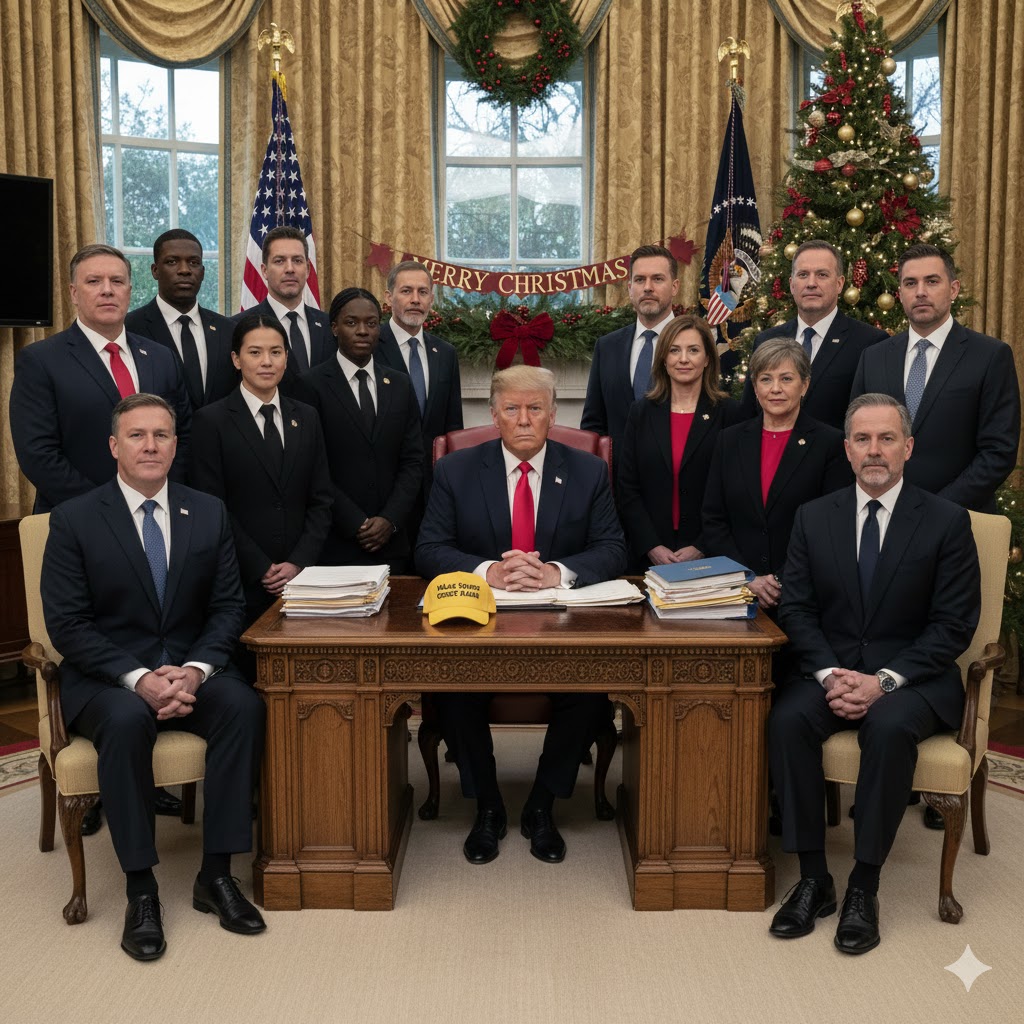
Would you like me to expand on any of these specific policy aversions, or perhaps generate an image of the current 2025 cabinet members?
A Critical Discourse Analysis of Trump
This video provides an academic look at the rhetorical strategies used by Trump to communicate his opposition to established political and social norms.
Building on the established framework of President Trump’s aversions, the following analysis outlines the strategic “pitfalls” for foreign nations and a playbook for navigating his transactional diplomacy. In the current 2025 landscape, several nations have successfully “cracked the code” by shifting from traditional diplomacy to a business-centric model.
I. Strategic Pitfalls: What Nations Must Avoid
To avoid friction with the 2026 administration, foreign governments must steer clear of several specific “trigger” behaviors that Trump views as antagonistic or “weak.”
- Avoid “Lecture Diplomacy”: Trump has a documented distaste for being lectured on human rights, climate change, or international law. Nations that frame their requests through the lens of “global responsibility” often find themselves sidelined.
- Avoid Multilateral Pressure: Attempting to use groups (like the EU or G7) to “gang up” on the U.S. is frequently met with retaliatory tariffs. Trump prefers bilateral negotiations where he can leverage U.S. economic power one-on-one.
- Avoid Indirect Channels: Relying solely on career diplomats or “the system” is a common error. In 2025, power is highly centralized; deals made with mid-level State Department officials are often overturned by the President himself if he hasn’t been personally consulted.
- Avoid Negative Trade Balances: Publicly celebrating a trade surplus with the U.S. is viewed as “winning at America’s expense.” Nations like Mexico and China have faced immediate tariff escalations in 2025 after trade data favored them too heavily. Expect the same for any Nation in 2026.
II. The Playbook: How to “Get Your Way” with President Trump.
Successful negotiations with Trump involves a shift from logic-based diplomacy to incentive-based deal-making.
1. Frame Requests as “Wins” for Him
The most effective strategy is to present a deal where Trump can take full public credit. If a nation wants a security guarantee, they should frame it as a “historic purchase of American military equipment” rather than a treaty obligation. The best deal ever. Only could have happened with President Trump.
Example: In 2025, some African nations secured investment by transitioning from “aid requests” to “resource partnerships” focused on minerals needed for the U.S. tech sector.
2. Utilize Direct “Personal” Diplomacy
Trump prioritizes personal relationships and “chemistry” over policy papers.1
- Send “Savvy” Envoys: Nations that send high-profile business leaders or family members of the ruling class to Mar-a-Lago often see faster results than those using traditional ambassadors.
- Public Flattery: Publicly praising Trump’s “strength” or “negotiating skill” serves as a lubricant for difficult conversations. It builds a “loyalty buffer” that can protect a nation during sudden policy shifts.
3. Offer Tangible, Immediate Reciprocity
The 2025 administration operates on the “Trump Corollary”—the idea that every U.S. action must have a direct, measurable return.
- Burden Sharing: To maintain alliances (like NATO), nations must show immediate, double-digit increases in defense spending.
- Job Creation: Proposals that include building factories in the U.S. or buying American agricultural products (like the 2025 soybean deals with China) are the most effective way to avoid tariffs.
4. Lean Into “Strategic Unpredictability”
Rather than being offended by the “Madman Theory,” savvy leaders use it. By staying flexible and not over-committing to long-term plans, nations can pivot when the President changes his mind, avoiding the “grudge” that follows perceived betrayal.
III. Verifiable References (2025 Update)
- The Guardian. (2025). Trump’s approach to Africa: more trade deals, less democracy and human rights.2 Link
- Brookings Institution. (2025). Breaking down Trump’s 2025 National Security Strategy. Link
- The Diplomat. (2025). 2025: A Trumpian Year of Geopolitical Shifts in Asia. Link
- Wikipedia. (2025). Foreign policy of the second Trump administration. Link
- Inkstick Media. (2025). What Will the World Look Like at the End of Trump’s Second Term? Link
- Arab Center Washington DC. (2025). Trump’s Second-Term Foreign Policy: Highly Centralized and Personal.3 Link
- The CEO Project. (2025). Mastering Negotiation the Trump Way: Strength, Tactics, and Uncertainty. Link
- Harvard Kennedy School. (2025). How the Trump administration is shaping world trade. Link
- INSEAD Knowledge. (2025). How to Negotiate With Someone Like Trump – And Win. Link
- Kyodo News. (2025). Trump likely to continue economic-focused approach toward Asia through 2026. Link
In the current landscape of 2025, negotiating with President Trump requires a departure from traditional “win-win” diplomacy toward a transactional power-based strategy. Successful states, organizations, and individuals have found that “getting a good deal” is less about fairness and more about aligning with the President’s specific priorities of strength, job creation, and personal legacy.
I. The “Good Deal” Playbook: Strategic Imperatives
To secure a favorable outcome, any entity must follow three core principles: Acknowledge the Power Gap, Monetize the Value, and Frame the Narrative as a Victory.
1. Acknowledge the Power Dynamic (Avoid “Equality”)
Negotiators who insist on a 50/50 split often fail.1 Trump perceives himself in a superior power position due to the U.S. economic and military engine.2+1
- The Strategy: Signal early that you recognize his leverage and are happy to negotiate a “great deal” for the U.S. This lowers the need for him to use aggressive “anchoring” tactics (like threatening 100% tariffs) to prove dominance.3
- The Goal: Focus on your absolute measure of success, even if the deal looks “unbalanced” on paper. If you get what you need, it doesn’t matter if he “wins” more.
2. Monetize Your Offer (The “Transaction”)
Trump views the world through a “Production Economy” lens. He is less interested in policy white papers and more interested in tangible assets.
- For States: Focus on job creation and manufacturing. A governor who promises a new factory in their state in exchange for federal deregulation is more likely to succeed than one who argues for the “common good.”
- For Organizations: Frame your request as a way to reduce the trade deficit or counter China. In 2025, any deal that strengthens the U.S. technological edge (AI, 5G, or space) is viewed as high-value.
- For Individuals: Use the “Expedited Visa” model if applicable. The 2025 administration has formalized pathways for individuals who make significant “national interest” donations or investments (Holland & Knight, 2025).4
3. Frame the Public Narrative (Let Him Take the Credit)
Trump’s “dislikes” include being seen as weak or being “taken advantage of.”
- The Strategy: Build a narrative where the President is the hero. Provide him with the “victory speech” material before the deal is even signed.
- The Tool: Use “truthful hyperbole.” Exaggerate the impact of the concession you are making so he can claim he “negotiated the toughest deal in history.”
II. Practical Techniques for States & Organizations
| Entity | The “Ask” | The “Give” (How to get the deal) |
| State Governments | Infrastructure/Disaster Grants | Implement “Skills-Based” hiring (no degrees) and aggressive “DOGE” efficiency audits. |
| Foreign Nations | Security Guarantees (NATO/Asia) | Immediate double-digit defense spending increases and high-profile “Buy American” arms contracts. |
| Tech Corporations | Regulatory Relief | Committing to “Genesis Mission” AI development and moving supply chains out of “rival” nations. |
| Non-Profits | Funding for Healthcare/Children | Frame the work as “modernizing the system” using AI and predictive analytics to cut waste. |
III. Individual Negotiation: The Personal Approach
Dealing with Trump as an individual requires managing his preference for directness and loyalty.
- The “Madman” Buffer: Do not react emotionally to extreme opening offers. If he threatens a “shutdown” of your interests, treat it as a tactical “anchor.” Respond by asking, “How do you expect me to do that?” to force him into discussing the practicalities of the deal (INSEAD, 2025).5
- Direct Access: Bypass the bureaucracy. In 2025, “deal-making” often happens through centralized committees (like the Strategic Hiring Committee) or personal envoys.6
- Unpredictability: Be prepared for the “We’ll see” response. Maintain your own “Best Alternative to a Negotiated Agreement” (BATNA) so you have the power to walk away if the transaction becomes too costly.
IV. Summary of 2025 Strategic References
- INSEAD Knowledge (2025). How to Negotiate With Someone Like Trump – And Win. Link
- Holland & Knight (2025). Trump’s 2025 Executive Orders: The Transactional Pivot. Link
- The Negotiation Club (2025). Mastering the Art of Anchoring and Counter-Anchoring. Link
- USTR.gov (2025). The President’s 2025 Trade Policy Agenda: A Production Economy. Link
- Brownstein Hyatt Farber Schreck (2025). America First Trade Policy: Analysis of New Tariffs and Negotiation Tactics. Link
Would you like see how to draft a specific “Pitch Deck” for an organization or state trying to secure a federal grant under these 2026 guidelines? Maybe they will help you or not. Good Luck!
To secure federal funding in 2026, organizations must pivot from “values-based” proposals to “ROI-based” transactional pitches. Under the 2026 “One Big Beautiful Bill” (OBBB) framework and the “Skinny Budget” priorities, federal agencies like the newly reorganized Administration for a Healthy America (AHA) and the Department of Government Efficiency (DOGE) prioritize cutting red tape and measurable national outcomes.
2026 Federal Grant Pitch Deck: The “National Interest” Template
Slide 1: The “Production Economy” Title
- Headline: Project [Name]: Strengthening American Sovereignty & Industrial Base.
- Sub-headline: A Transactional Partnership to Eliminate Waste and Create [Number] U.S. Jobs.
- Visual: High-resolution imagery of American manufacturing or infrastructure. Avoid “abstract” stock photos.
Slide 2: Alignment with “America First” (2026 Priorities)
Explicitly link your project to one of the “Big Three” 2026 funding pillars:
- Border & Public Safety: Does it assist in the “Mass Removal” logistics or counter-drone technology (FEMA C-UAS Program)?
- Energy Dominance: Does it utilize fossil fuels, nuclear power, or critical mineral extraction?
- Deregulation/Efficiency: Does it use AI to reduce the need for federal oversight or bureaucratic headcount?
Slide 3: The “Trump ROI” (The Give)
This is the most critical slide. Define exactly what the federal government gets in exchange for the grant.
- Hard Metrics: Total headcount of new American workers (specify “No-Degree” or “Skills-Based” hiring).
- Waste Reduction: Amount of taxpayer money saved over 5 years by bypassing traditional “woke” procurement processes.
- Countering Rivals: How this project specifically makes the U.S. less dependent on China or international multilateral bodies.
Slide 4: Language Pivot (The “Anti-Trigger” Strategy)
Research from 2025/2026 suggests successful proposals reframe sensitive social goals into nationalist or economic terms:
| Traditional Term (To Avoid) | 2026 Replacement Term (To Use) |
| DEI / Diversity | “Merit-Based Individual Excellence” |
| Climate Change / Green Energy | “Energy Resilience & Grid Sovereignty” |
| Equitable Access | “Expanding Pathways for All Hardworking Americans” |
| Social Justice | “Civic Responsibility & Rule of Law” |
Strategic Opportunities by Sector (FY 2026)
1. Healthcare & “MAHA” Grants
The 2026 budget consolidates HHS into the Administration for a Healthy America.1
- The Win: Focus on Rural Health Transformation ($50 billion available). Proposals should emphasize “medical licensing reciprocity” (allowing doctors to work across state lines) and “telehealth capacity” to cut physical hospital overhead (HHS, 2025).2
2. Infrastructure & “BUILD” 2026
The Department of Transportation (DOT) has reoriented BUILD grants toward surface transportation with high regional impact.
- The Win: Emphasize project readiness. In 2026, federal agencies favor “shovel-ready” projects that have already cleared state-level environmental hurdles, proving they won’t get bogged down in litigation (DOT, 2025).
3. Education & Workforce
With the elimination of TRIO and Pell grant shifts, the focus is now on Short-Term Pell Grants for vocational training.
- The Win: Universities and non-profits should pitch “Compact Agreements” with the federal government that prioritize job-placement rates over academic research (ACENet, 2025).
Verifiable 2026 References
- HHS.gov (2025). CMS Announces $50 Billion in Awards to Strengthen Rural Health. Link
- The White House (2025). President Trump’s FY 2026 Discretionary Funding Request.3 Link
- Council on Criminal Justice (2025). Unpacking the 2026 Budget: Terminated Grants and Rescissions.4 Link
- UW Medicine (2025). Grantwriting under Trump 2.0: Guidance for an Evolving Landscape. Link
This video details the seven critical shifts in grant funding for 2026, including the move toward AI-driven efficiency and the impact of the “DOGE” initiative on federal applications.
Based on President Trump’s historical pattern of high turnover and the current dynamics of his 2025 administration, several key figures may face replacement or reassignment in 2026. Historically, Trump’s “A-Team” turnover has exceeded 90% across a full term, with the first year often seeing departures due to “loyalty tests,” policy friction, or public scandals.
1. High-Risk Cabinet Roles (The “Hot Seats”)
- Pete Hegseth (Secretary of Defense):1 Historically, the Pentagon has been a flashpoint for Trump. His first term saw frequent clashes with defense secretaries (Mattis, Esper) over the use of the military for domestic issues or foreign troop withdrawals. If Hegseth resists any 2026 directives regarding domestic deployments or rapid structural changes to the military hierarchy, he could follow the pattern of his predecessors.
- Robert F. Kennedy Jr. (Secretary of Health and Human Services):2 While currently a central figure in the “Make America Healthy Again” (MAHA) movement, RFK Jr. oversees a massive $2 trillion bureaucracy.3 In 2025, he has already faced legal challenges under the Administrative Procedure Act for his attempts to overhaul vaccine schedules.4 If these legal setbacks stall Trump’s agenda or if RFK Jr.’s independent streak creates a “two-headed” messaging problem for the White House, he may be moved to an advisory “Czar” role outside the formal Cabinet to reduce legal friction.+2
- Lori Chavez-DeRemer (Secretary of Labor):5 As a more traditional political pick confirmed in March 2025, she may face pressure if she does not align perfectly with the more aggressive “DOGE” (Department of Government Efficiency) workforce reductions planned for 2026.
2. The “Loyalty vs. Mission” Dynamics
- Kash Patel (FBI Director): Currently confirmed to a 10-year term, Patel is a staunch loyalist.6 However, the FBI Director role is historically fraught in the Trump orbit (e.g., Comey, Wray).7 While a 2026 replacement is less likely due to his deep alignment with Trump, any perceived failure to “deliver” on investigations into the “Deep State” could lead to a sudden loss of favor.+1
- Susie Wiles (Chief of Staff): The Chief of Staff position had the highest turnover rate in Trump’s first term (four different people). While Wiles is credited with the disciplined 2024 campaign, the transition from campaign to governing often strains the relationship between the President and his “gatekeeper.”
3. Likely 2026 Turnover Drivers
| Driver | Most Likely Affected |
| Legal/Institutional Friction | RFK Jr. (HHS), Pam Bondi (AG) |
| Policy Disagreements (Defense/Foreign) | Pete Hegseth (Defense), Marco Rubio (State) |
| DOGE/Efficiency Cuts Resistance | Brooke Rollins (Agriculture), Doug Collins (VA) |
| Personal Friction/Gatekeeping | Susie Wiles (Chief of Staff) |
Summary for 2026
Expect a “Mid-Term Shakeup” in early to mid-2026. Trump often uses the end of the first year to “prune” those he perceives as too institutional or not aggressive enough. RFK Jr. and Pete Hegseth remain the most likely candidates for either a high-profile exit or a shift in responsibilities if their 2025 initiatives become bogged down in the courts or the bureaucracy.
Would you like me to detail a 2026 “Who’s Next” list for a specific department, such as the Department of Justice or Defense?
In the high-stakes environment of 2026, the “Who’s Next” list is shaped by President Trump’s pivot from 2025’s “Cabinet Construction” to 2026’s “Results Enforcement.” Following his historical pattern of evaluating subordinates based on their ability to bypass bureaucratic friction, two major departments are the primary “hot zones” for turnover.
2026 “Who’s Next” List: Departmental Analysis
I. The Department of Justice (DOJ): “The Loyalty Test”
The DOJ is the most volatile department due to the 2026 objective of finalizing investigations into the “Deep State” and institutionalizing the Kuala Lumpur Joint Arrangement (related to China trade enforcement).
- Pam Bondi (Attorney General):1
- Status: High Risk for 2026.
- The Friction: While a long-term loyalist, Bondi’s role involves managing the “truthful hyperbole” of 2025’s executive orders within a court system that remains partially resistant. If she is perceived as too “institutional” or fails to secure a 100% win rate in the Humphrey’s Executor SCOTUS challenges in early 2026, Trump may look for a “wartime” replacement.
- Possible Successor: Todd Blanche (current Deputy AG) or Emil Bove. Both have direct experience as Trump’s personal attorneys and are viewed as more aggressive “disrupters” of the standard DOJ hierarchy.
- Kash Patel (FBI Director):
- Status: Secure (for now).
- The Dynamic: Patel’s 10-year term is a shield, but 2026 will be his “delivery year.” He is currently overseeing the Mass Removal logistics and the relocation of FBI headquarters. His survival depends on the speed of these moves; any delay attributed to “process” could sour the relationship.
II. The Department of Defense (DOD): “The Western Hemisphere Pivot”
In late 2025, the administration shifted the National Security Strategy (NSS) to prioritize the Western Hemisphere, stirring tension with NATO and Indo-Pacific allies.
- Pete Hegseth (Secretary of Defense):
- Status: Moderate Risk.
- The Friction: Hegseth has been a vocal proponent of the “America First” military posture, but 2026 brings the FY 2026 Budget Request challenges. He is currently under pressure to implement the “Golden Dome” (national missile defense) while simultaneously managing the 3.8% military pay increase and troop movements toward the Americas.
- The Threat: If the “pivot to the Americas” creates too much friction with the Joint Chiefs or results in a perceived “weakening” of the U.S. stance against China (despite the 2025 trade deals), Trump could pivot to a more traditional military hardliner.
- The “Civilian Bonus” Initiative: Hegseth’s recent directive to issue $25k bonuses to high-performing civilians is a 2026 loyalty-building tool.2 If this fails to break the “bureaucratic resistance” at the Pentagon, the failure will be laid at his door.
Turnover Drivers for 2026
| Figure | Role | Primary 2026 Challenge |
| RFK Jr. | HHS Secretary | Overhauling the “MAHA” data systems. If health metrics don’t move by Q3 2026, he may be moved to an advisory role. |
| Susie Wiles | Chief of Staff | Managing the 2026 Midterm strategy while maintaining “The Gate.” History shows this role rarely lasts more than 18 months. |
| Brooke Rollins | Agriculture | Managing the One Big Beautiful Bill (OBBBA) payments. If the $12 billion “Bridge Payments” don’t hit farmers by February 2026, she faces the “Apprentice” treatment. |
Summary Table: 2026 Confidence Score
- Most Likely to Stay: Kash Patel (FBI), Tulsi Gabbard (DNI), Scott Bessent (Treasury).
- Most Likely to Exit/Shift: Pam Bondi (DOJ), Lori Chavez-DeRemer (Labor), Pete Hegseth (Defense).
A Note on 2026 Strategy
For organizations or states, the best way to handle these shifts is to anchor your relationship to the “Office,” not the “Person.” If you have a deal with the DOJ, ensure it is tied to an Executive Order (like EO 14161 on extreme vetting) rather than a personal promise from an official who may not be there by Christmas.
 thelivingbreathingjamesbrown.com
You must be logged in to post a comment.