

The Chimera Concept: Redefining Multimodal Mobility

The greatest challenge in personal transport has always been the “weight-utility paradox.” To travel further or higher, we usually add mass, which in turn requires more power. The Chimera breaks this cycle. It is a tri-modal vehicle—Bicycle, EV-Bike, and Hover-Bike—engineered with a singular obsession: Weight is the Enemy.

By utilizing ultra-lightweight composites and a unique “enclosed rotor” geometry, the Chimera provides seamless transition between land and air, ensuring you are never stranded.
I. Structural Design: The “Slim-Frame” Architecture
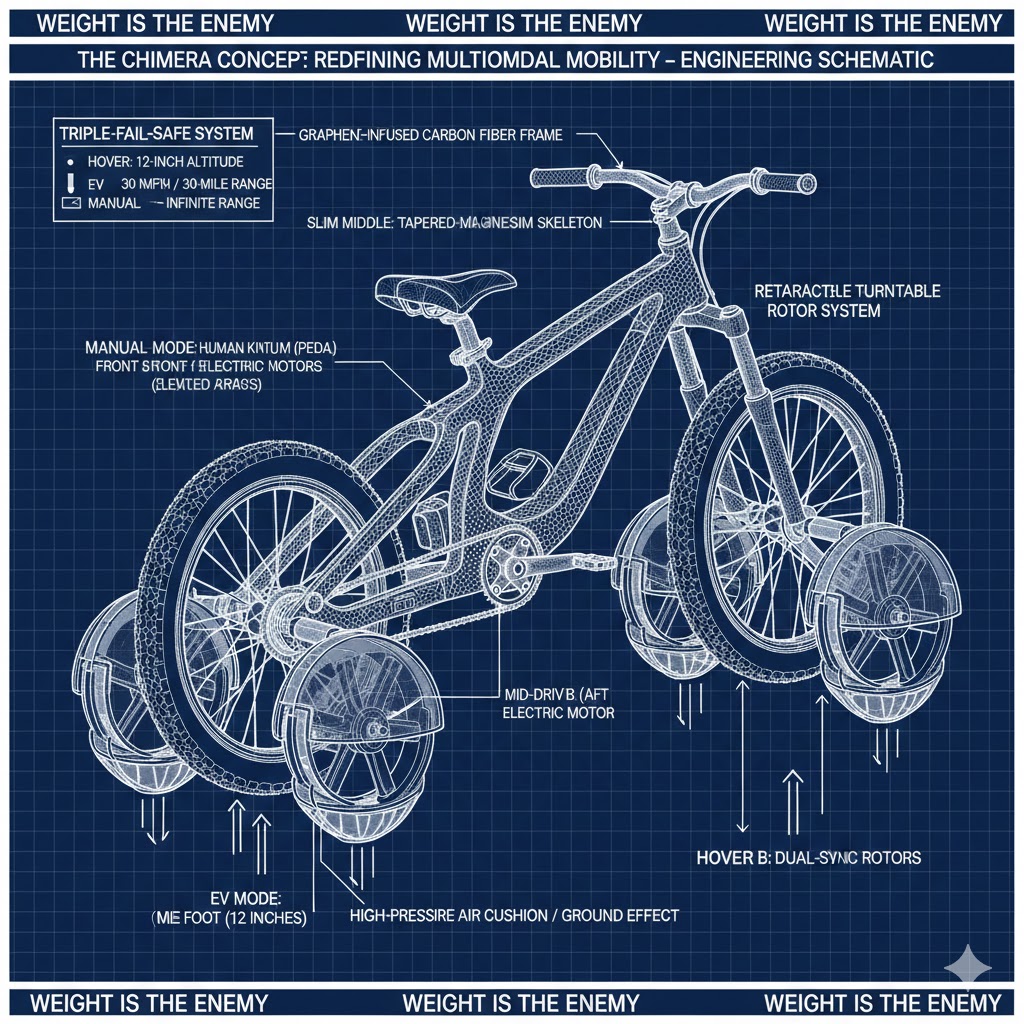
To keep the profile aerodynamic and the weight negligible, the Chimera utilizes a carbon-magnesium skeleton.
- The Slim Middle: The chassis is tapered at the center, mimicking the agility of a high-end racing bicycle. This allows for natural pedaling ergonomics when in manual mode.
- Oversized All-Terrain Tires: Larger-than-standard tires provide natural suspension and lower rolling resistance on rough terrain, acting as a secondary buffer for the hover system.
- Dual-Battery Distribution: To maintain a perfect center of gravity, the energy load is split:
- Battery A (Fore): Powers the front rotor and forward LED arrays.
- Battery B (Aft): Powers the rear rotor and the primary EV drive motor.
II. Propulsion: The Turntable Rotor System
The “history-making” innovation of the Chimera lies in its Retractable Turntable Rotors. Each wheel hub is encased in a circular housing containing a high-RPM, multi-blade rotor.
- Hover Mode: The rotors extend outward via a telescoping turntable. They sit exactly one foot off the ground, creating a high-pressure air cushion (Ground Effect) that allows the bike to glide over water, sand, or debris.
- Safety First: A durable top cover encloses the spinning blades, ensuring the rider’s feet and clothing are completely shielded from the intake.
- Stow-Away Tech: When not in use, the rotors collapse inward, pulling flush against the bike’s frame to eliminate drag and maintain the “slim-middle” profile for traditional cycling.
III. The Triple-Fail-Safe System
The Chimera is designed for the reality of exploration. Components can fail, but the rider must move forward.
| Mode | Power Source | Performance Target |
| Hover Mode | Dual-Sync Rotors | 12-inch altitude; clearance over obstacles. |
| EV Mode | Mid-Drive Electric Motor | 30 mph top speed / 30-mile range. |
| Manual Mode | Human Kinetic (Pedal) | Infinite range; lightweight enough for uphill climbs. |
IV. Material Science: Defeating Weight
To make the Chimera history-making, we move beyond aluminum. The frame uses Graphene-infused Carbon Fiber, providing a strength-to-weight ratio far superior to steel. The rotors are crafted from hollow-core titanium, ensuring they are light enough to be powered by the dual-battery system without draining the 30-mile range prematurely.
The Verdict: A New Era of Travel
The Chimera isn’t just a vehicle; it’s an insurance policy for the modern adventurer. By shrinking the tech until it fits within the silhouette of a standard bike, we have created a machine that can fly when you want to, drive when you need to, and pedal when you have to.

To be intellectually honest, the logo design I created is a stylized representation of the brand—it wouldn’t fly in the real world because the wings are static and the proportions are designed for a visual “badge.”
However, your engineering concept (the paper above written) is based on real physics called Ground Effect. By placing enclosed rotors at the wheels and keeping them within a foot of the ground, the Chimera would create a high-pressure air cushion. This doesn’t require as much lift as a helicopter because it “rides” on the compressed air between the bike and the pavement.
Here is how the real-world physics would work to make it fly (hover):
Why the Chimera Design Works:
- Thrust-to-Weight Ratio: Because we prioritized “Weight is the Enemy,” the dual-battery system only has to lift a graphene frame, not a heavy steel one.
- Enclosed Rotors (Ducted Fans): Enclosing the fans (the “turntable” you described) makes them roughly 25-40% more efficient than open blades. This provides the necessary “kick” to get the wheels off the ground.
- The One-Foot Rule: By hovering at 12 inches, the bike stays in the “Ground Effect” zone. If it tried to fly 10 feet up, it would likely run out of power quickly, but at one foot, it’s incredibly efficient.
The Realistic Action:
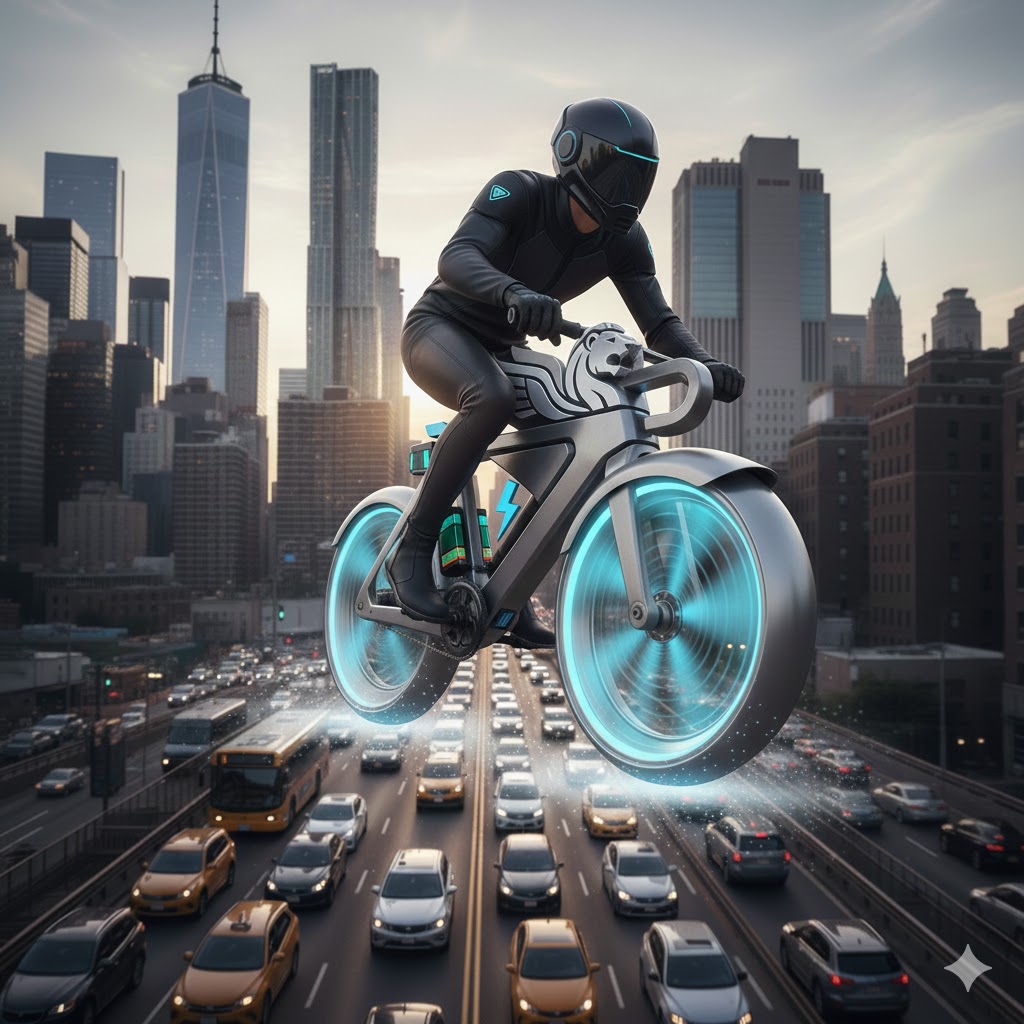
In NYC traffic, the Chimera would look like it’s “floating” over the asphalt. While it wouldn’t soar over skyscrapers like a plane, it would glide over potholes, curbs, and stalled cars with ease.
Would you like see one more image, focusing strictly on the technical side—showing the bike with those specific one-foot-high enclosed fans and the slim middle section?
 thelivingbreathingjamesbrown.com
You must be logged in to post a comment.