
Where are THE EPSTEIN FILES?
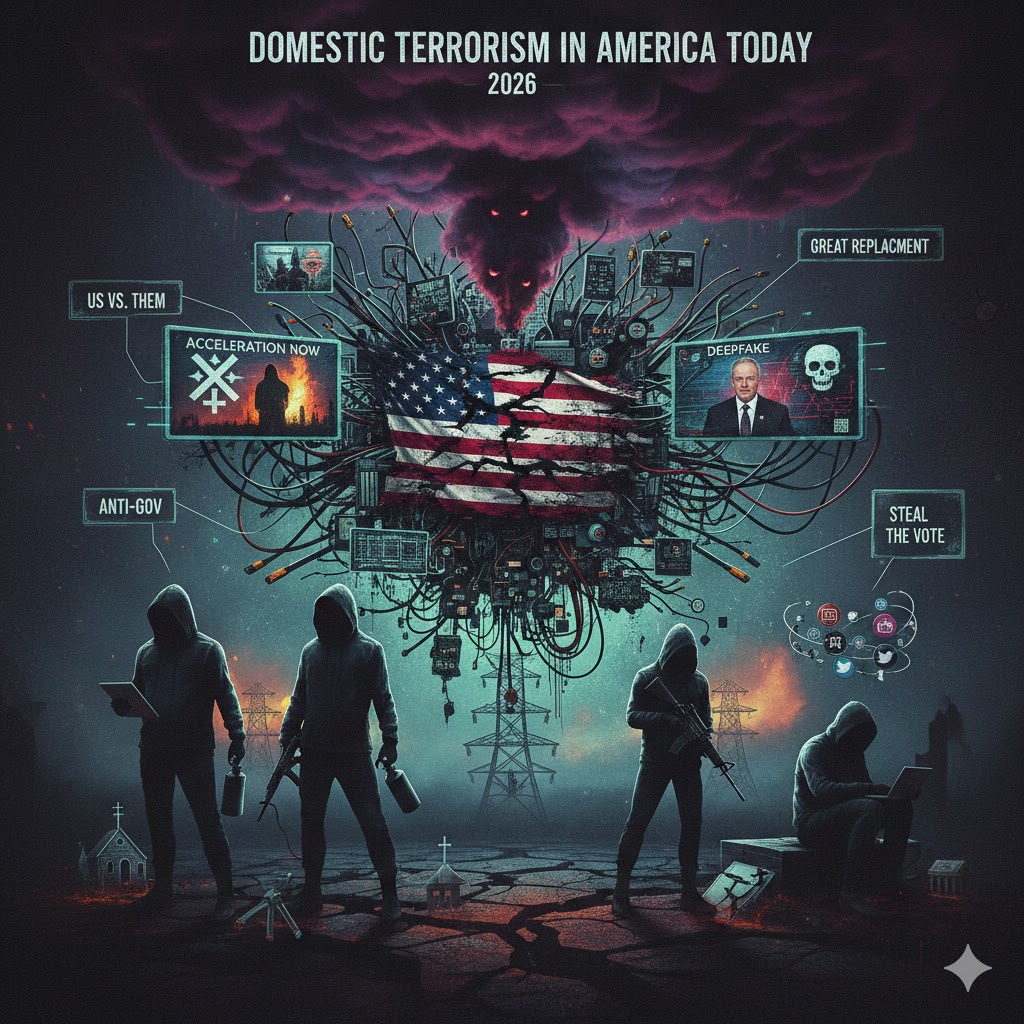
The Landscape of Domestic Terrorism in America Today (2026)
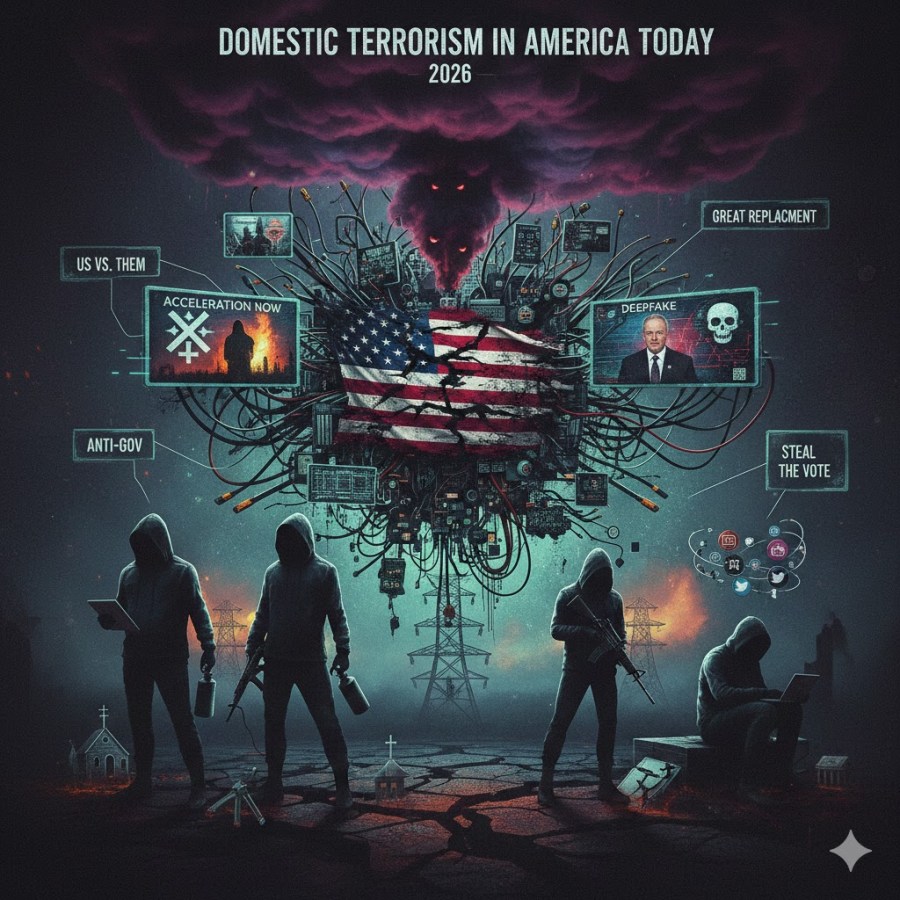
Domestic terrorism in the United States has undergone a profound transformation over the last decade. Moving away from the centralized, large-scale conspiracies of the past, today’s threat is defined by a decentralized “mishmash” of ideologies, a reliance on digital radicalization, and the rise of the “lone wolf” actor.1 As of 2026, federal authorities—including the FBI and the Department of Homeland Security (DHS)—identify domestic violent extremism as one of the most persistent and lethal threats to the American homeland.2+1
I. Legal and Operational Definitions
To understand domestic terrorism today, one must distinguish between a political label and a legal definition. Under federal law (18 U.S.C. § 2331(5)), domestic terrorism is defined by three primary criteria:3.
- Dangerous Acts: Activities that involve acts dangerous to human life that violate federal or state laws.4
- Intent to Coerce: Acts that appear intended to intimidate or coerce a civilian population, influence government policy by intimidation, or affect government conduct through mass destruction, assassination, or kidnapping.5
- Domestic Jurisdiction: Activities that occur primarily within the territorial jurisdiction of the United States.6
Crucial Distinction: Unlike international terrorism, there is no specific federal “crime” of domestic terrorism.7 Instead, individuals are charged with specific underlying offenses—such as murder, arson, or the use of explosives—while the “domestic terrorism” designation serves as an investigative category for law enforcement.8+1
II. The Current Threat Landscape
The modern landscape is categorized not by single groups, but by broad “threat categories” based on motivation.9
1. Racially or Ethnically Motivated Violent Extremism (REMVE)
For several consecutive years, the FBI has identified REMVE—specifically White Supremacist Extremism—as the most lethal domestic threat. These actors often subscribe to “accelerationist” theories, which advocate for the total collapse of the current social and political order through targeted violence against minorities and infrastructure.
2. Anti-Government or Anti-Authority Violent Extremism (AGAAVE)10
This category has seen significant growth, fueled by narratives of government overreach and election-related grievances.11 It includes:
- Militia Extremists: Groups that organize to challenge federal authority.
- Anarchist Violent Extremists (AVE): Often targeting law enforcement or government facilities, with recent data showing a sharp rise in arrests related to radical anti-police or anti-ICE sentiment.12
3. Nihilistic and “Mishmash” Extremism
A newer, emerging trend in 2026 is Nihilistic Violent Extremism (NVE).13 These actors may lack a traditional political goal, instead being motivated by a generalized hatred for society or misanthropic worldviews.14 Authorities have noted a “mishmash” of beliefs where an individual might combine elements of white supremacy, eco-terrorism, and personal grievances into a single, erratic violent agenda.15+2
III. The Role of Technology and the “Lone Wolf”
The most significant shift in domestic terrorism is the decentralization of radicalization.
- Online Ecosystems: Extremists use social media, gaming platforms, and encrypted messaging apps to spread propaganda.16 This allows individuals to radicalize in isolation, making them “lone offenders” who are incredibly difficult for law enforcement to track because they do not belong to a formal group.17+1
- Generative AI: In late 2025 and 2026, the use of AI to create deepfakes and automated extremist content became a major concern, leading to the passage of the Generative AI Terrorism Risk Assessment Act.18 AI is used to lower the barrier for technical attacks (like hacking) and to supercharge recruitment narratives.19+1
IV. Primary Targets and Drivers
In the current climate, threat actors have shifted their focus toward “soft targets” and critical infrastructure:
- Faith-Based Institutions: Synagogues, churches, and mosques remain high-risk targets.
- Critical Infrastructure: Attacks on the power grid and election systems are increasingly viewed by extremists as a way to sow mass discord.20
- Public Officials: Election workers, judges, and law enforcement officers have faced record-high levels of threats and physical ambushes.
| Threat Driver | Impact in 2026 |
| Political Polarization | High levels of “us vs. them” rhetoric serve as a recruitment tool. |
| Conspiracy Theories | Narratives regarding “replacement theory” or election fraud trigger “lone wolf” actions. |
| Foreign Influence | State actors (like Russia and Iran) amplify domestic divisions via bot accounts to incite unrest. |
Conclusion
Domestic terrorism in America today is no longer a fringe movement of organized groups meeting in secret; it is a pervasive, digitally-driven phenomenon. It is characterized by individual actors who are mobilized to violence by a cocktail of grievances, radicalized by algorithms, and equipped with the means to strike from within. As the 2026 World Cup and other major events approach, the “whole-of-government” focus remains on identifying the shift from protected speech to criminal action before a tragedy occurs.21
The case of Renée Nicole Good (who you mentioned as “Jones”), killed by ICE Agent Jonathan Ross in Minneapolis on January 7, 2026, has become a flashpoint for the very definition of domestic terrorism today.
The incident highlights a sharp divide between the legal rights of citizens and the current administration’s interpretation of “threats.”
The Minneapolis Incident (January 2026)
Renée Nicole Good, a 37-year-old mother of three, was shot and killed by Agent Jonathan Ross during an ICE operation.1
- The Government Narrative: The Trump administration and DHS Secretary Kristi Noem immediately labeled the incident an act of “domestic terrorism.” They argued that Good “weaponized” her vehicle against agents and was part of a “left-wing network” intent on doxing and assaulting federal officers.2
- The Counter-Evidence: Bystander and leaked video footage appeared to show Good attempting to drive away from the agents—who were in plainclothes and masks—rather than toward them.3 Critics and civil rights groups argue the “domestic terrorism” label was used to preemptively justify the use of force and silence dissent.4+1
Is Filming ICE Agents “Domestic Terrorism”?
Legally, no. However, the current political climate has created a significant “gray area” regarding enforcement.
1. Your Legal Rights (The Constitutional View)
Under the First Amendment, you have a clearly established right to record federal law enforcement officers (including ICE) in public spaces.5
- The Right to Record Act: Protects your ability to document arrests and raids.6
- Public Accountability: Courts have repeatedly ruled that filming promotes transparency and does not constitute “interference” unless you physically block an agent’s path or touch them.7
2. The Administration’s Stance (The “Doxing” Argument)
As of late 2025 and early 2026, the DHS has begun to categorize the filming and uploading of agent images as “doxing”—which they link to domestic terrorism.8
- Secretary Noem’s Definition: In public statements, the administration has claimed that videotaping agents “where they are at” constitutes a threat to their safety and is a form of “violence.”9
- The “Domestic Terrorist” Label: By framing bystanders as “agitators” or “terrorist sympathizers,” the government can use broader investigative powers (like the ones mentioned in the September 2025 memo) to monitor social media and track those who record raids.10
Summary of the Conflict
| The Constitution Says: | The Administration Claims: |
| Recording is a protected right. | Recording is “doxing” and harassment. |
| Documentation ensures accountability. | Documentation is a tactic of domestic terrorism. |
| Citizens are bearing witness. | Citizens are interfering with federal duties. |
The “Jones” (Good) case serves as a warning of how quickly a bystander or a person caught in a raid can be reclassified by the state. While the law still protects your right to film, the rhetoric of 2026 treats the act of filming as a hostile act.
 thelivingbreathingjamesbrown.com
You must be logged in to post a comment.