

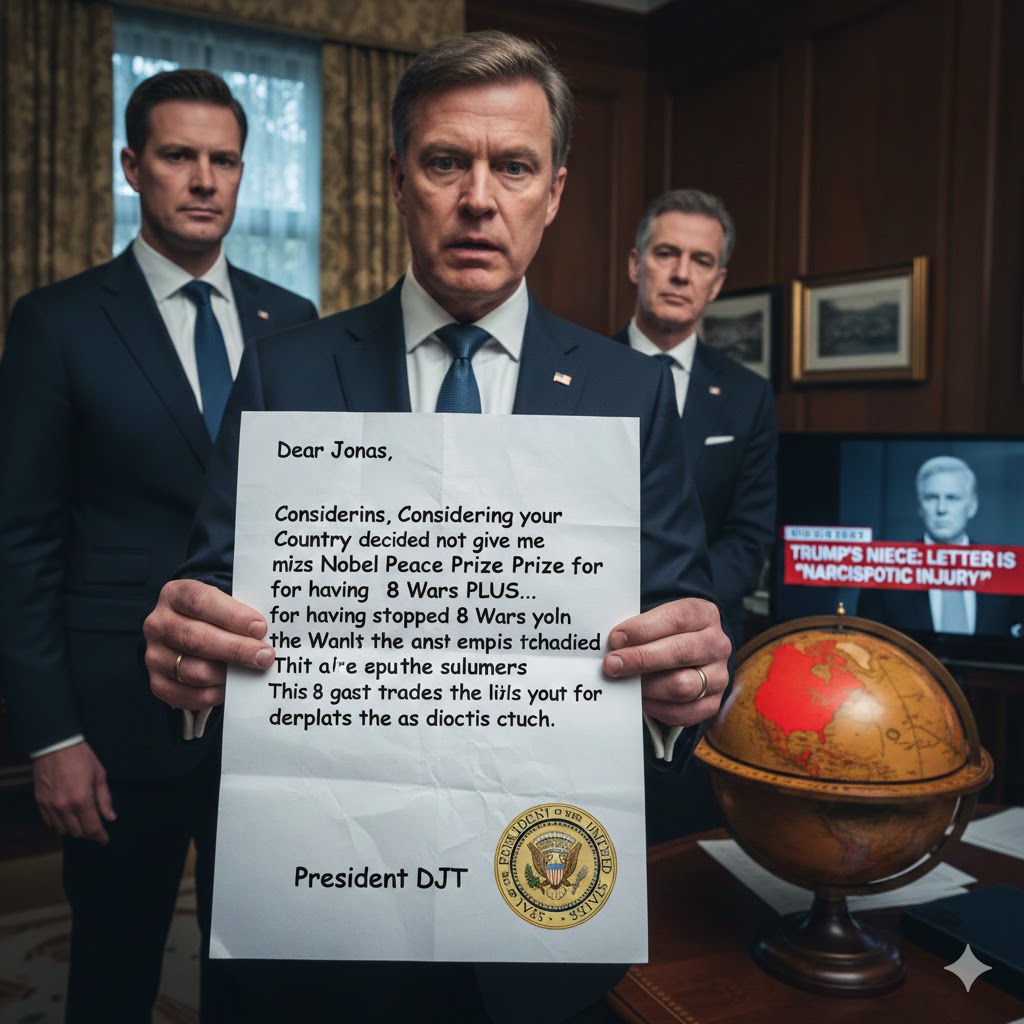
This letter, as parsed and presented by Anne Applebaum, represents a staggering departure from the traditional vernacular of American diplomacy. It is not merely a piece of correspondence; it is a profound artifact of a shifting geopolitical paradigm where personal grievance, transactional logic, and territorial ambition collide.
To analyze this document is to look directly into the “America First” doctrine at its most unfiltered and idiosyncratic.
I. Comprehensive Analysis: The Anatomy of the “Greenland Letter”
1. The Nobel Grievance: Personal Validation as Foreign Policy
The letter begins not with a diplomatic greeting, but with a statement of resentment. By citing the failure of the Nobel Committee to award him the Peace Prize for “stopping 8 Wars PLUS,” Trump establishes a quid pro quo framework for international relations.
- The Subtext: He suggests that global stability was a personal favor he extended to the world. Since that favor was not reciprocated with prestige, he now feels “no longer obligated to think purely of Peace.” This signals a shift from a cooperative global order to a purely transactional one.
2. Historical Revisionism and Territorial Claims
Trump’s dismissal of Danish sovereignty over Greenland (and his conflation of Norway and Denmark in his grievance to Prime Minister Støre) utilizes a “Law of the Jungle” logic.
- “No written documents”: By dismissing centuries of treaties and the 1933 Permanent Court of International Justice ruling on Greenland, he reverts to a 15th-century “Doctrine of Discovery” logic—whoever has the most “boats landing there” holds the claim.
- Geopolitics of Resources: Beneath the erratic phrasing lies a hard-nosed interest in the Arctic’s rare earth minerals and strategic shipping lanes, which are becoming accessible due to melting ice caps.
3. The Transformation of NATO
The letter redefines the North Atlantic Treaty Organization from a collective defense pact into a service provider.
- “NATO should do something for the United States”: This flips the script of Article 5. He views the security umbrella provided by the U.S. as a debt owed by Europe, suggesting that the “payment” for continued protection should be the ceding of territory or total strategic subservience.
4. Rhetorical Style: The “DJT” Signature
The use of capitalization (“Complete and Total Control”) and the specific count of “8 Wars PLUS” are hallmarks of his brand of “Grand Authenticity.” It is a style designed to project strength through unpredictability, intentionally discarding the “polished” language of the State Department to communicate directly—and often aggressively—to both allies and his domestic base.
II. Mary Trump’s Perspective: The Psychological Read
Mary Trump, a clinical psychologist and the President’s niece, has been a consistent and vocal critic of her uncle’s cognitive and emotional state. In response to communications of this nature, she has historically emphasized a few key themes:
- Narcissistic Injury: Mary Trump has often pointed out that her uncle views the world through the lens of “winners and losers.” The obsession with the Nobel Peace Prize is, in her view, a classic example of a narcissistic injury. Because he was denied the ultimate “trophy,” he feels justified in “taking his ball and going home”—or, in this case, threatening the stability of the Arctic.
- The Need for “Grandeur”: She has remarked that for Donald Trump, “enough is never enough.” Buying Greenland (or demanding it) is an attempt to achieve a legacy that eclipses all previous presidents. In her newsletters and interviews, she often suggests that these “insane” letters are not just political strategy, but a manifestation of a man who cannot tolerate a world he does not “Complete and Total[ly] Control.”
- Gaslighting as a Tool: She frequently warns that the public should not get “numb” to these outbursts. She views the “bizarre” behavior Applebaum describes—dancing at rallies or drifting off in meetings—not as quirks, but as signs of a man who is increasingly untethered from the constraints of the office he holds.
III. Summary of Implications
Applebaum’s analysis suggests that this letter is a “canary in the coal mine” for the dissolution of the post-WWII order. When the President of the United States writes to the leader of a sovereign nation questioning their right to territory based on “boats landing there hundreds of years ago,” it signals to Russia and China that the era of international law is, from the American perspective, effectively over.
The letter is a masterpiece of disruption—it manages to offend an ally (Norway), threaten a neighbor (Denmark), and dismiss an institution (NATO) in fewer than 150 words.
Would you like me to analyze how the Norwegian or Danish governments officially responded to this specific correspondence?
The responses from Oslo and Copenhagen to the “Greenland Letter” have transformed what was once a diplomatic oddity into a full-scale systemic crisis. Both governments have moved past mere polite disagreement into a posture of active defense, with Denmark taking the unprecedented step of labeling its closest ally a national security threat.
I. The Response from Oslo: Norwegian Strategic Calm
Prime Minister Jonas Gahr Støre responded with a blend of patient correction and firm solidarity. According to his official statement issued on January 19, 2026, he felt compelled to confirm the letter’s authenticity after it was leaked by the National Security Council.
- The “Nobel Education”: Støre remarked, with a touch of weary repetition, that he had “clearly explained” to the President multiple times that the Norwegian Government has zero authority over the Nobel Peace Prize.1 He underscored that the committee is appointed by the Parliament and operates with total independence—a concept that the letter suggests remains unassimilated by the White House.2+1
- The Finnish Link: Støre revealed that the letter was actually a response to a text message he and Finnish President Alexander Stubb had sent earlier that day.3 They had been attempting to de-escalate tensions regarding Trump’s threat of 10% tariffs (rising to 25% by June) intended to force a “Greenland deal.”4+1
- The Security Stance: While keeping his rhetoric measured, Støre reaffirmed that Norway’s position is unwavering: “Greenland is part of the Kingdom of Denmark.”5 Norway has notably joined a multinational force to bolster Arctic security, effectively siding with Denmark in the face of American pressure.6+1
II. The Response from Copenhagen: Danish Resistance
In Denmark, the response has been far more visceral. Prime Minister Mette Frederiksen and Foreign Minister Lars Løkke Rasmussen have shifted the nation onto a “war footing” of sorts—diplomatically and militarily.
- The “Red Line”: Minister Rasmussen has been blunt, stating that the President appears intent on “conquering” Greenland.7 Following a “frank” but failed meeting with Vice President J.D. Vance and Secretary of State Marco Rubio in Washington, Rasmussen declared that Denmark would not be “blackmailed” by tariffs or threats.
- Military Mobilization: For the first time in history, the Danish Defence Intelligence Service listed the United States as a primary threat to national security, alongside Russia and China.8 Denmark has increased its “permanent military presence” in Greenland and launched Operation Arctic Endurance with eight other NATO allies.9+1
- The Sovereignty Vow: Mette Frederiksen famously called the discussion “absurd,” emphasizing that “borders cannot be changed by force, and small countries should not fear large countries.”10 She has warned that any attempt at a forced takeover or annexation would mean the “end of NATO.”11+1
III. The View from Nuuk: Greenland’s Defiance
Greenland’s own leadership has been equally resolute.12 Prime Minister Jens-Frederik Nielsen and Business Minister Naaja Nathanielsen have highlighted the human cost of the rhetoric.
- Psychological Toll: Nathanielsen reported that the threat of annexation is causing widespread anxiety, stating that “children are afraid” and the uncertainty is “filling every household.”13
- The Choice: Nielsen was unequivocal during a joint press conference with Denmark: “If we have to choose between the United States and Denmark… we choose Denmark.“14
IV. Grand Authenticity: A World Without Guardrails
As Anne Applebaum noted, the “authenticity” of this moment lies in its total transparency. There is no longer a filter between the President’s personal desire for a trophy (the Nobel) and his willingness to dismantle a 75-year-old alliance.
By linking the Nobel Peace Prize to the sovereignty of the world’s largest island, the letter has forced America’s oldest allies to prepare for a reality where the United States is no longer the guarantor of the rules-based order, but its primary disruptor.15
On Saturday, January 17, 2026, the White House shifted from rhetorical posturing to a concrete timeline for economic warfare.1 The announcement of the “Greenland Tariffs” has sent shockwaves through the global economy, effectively turning a territorial dispute into a broad-spectrum trade conflict.2
I. The “June 1” Ultimatum: Escalation by Design
The Trump administration has laid out a two-stage escalation plan targeting eight of America’s oldest NATO allies (Denmark, Norway, Sweden, France, Germany, the United Kingdom, the Netherlands, and Finland).
- Stage One (February 1, 2026): An immediate 10% import tax on all goods from the targeted nations.
- Stage Two (June 1, 2026): The rate will jump to 25% if a deal for the “Complete and Total purchase of Greenland” has not been signed.3
- The Rationale: In his social media announcement from West Palm Beach, the President framed these tariffs as “necessary for Global Peace and Security.”4 He alleged that the European nations had “journeyed to Greenland for purposes unknown,” interpreting their recent joint military exercises as a hostile “dangerous game.”5
II. Anne Applebaum’s Dark Analysis: The End of Diplomacy
Anne Applebaum, in a follow-up to her analysis of the “Norway Letter,” has characterized this as a “horror show of trolling from the White House.” * The Weaponization of Trade: Applebaum argues that Trump has effectively “re-weaponized” the presidency to act as a tool of raw imperialism.6 By linking tariffs to the acquisition of territory, he has discarded the concept of international law in favor of what she calls “autocratic fait accompli propaganda.”
- The China Pivot: She notes the irony that while Trump claims this is to keep China out of the Arctic, his actions are actually fracturing the very alliance (NATO) needed to counter Chinese influence, potentially leaving the Arctic more vulnerable to exploitation by Beijing and Moscow.
III. Mary Trump’s Psychological “Red Alert”
Mary Trump has escalated her warnings, describing the June 1 deadline as a classic manifestation of her uncle’s “Narcissistic Rage.”
- The Deadline as a Trap: She interprets the June 1 date not as a negotiating window, but as a psychological “pressure cooker” designed to force a submission. To her, this is a man who is “furious at being laughed at” by European leaders like Mette Frederiksen and is now using the American economy to “punish the world for his own feelings of inadequacy.”
- Authenticity or Delusion? She warns that what some see as “grand authenticity” is actually a “progressive detachment from reality,” where the President truly believes that the wealth of American consumers (who will pay these tariffs) is a small price for his personal glory.
IV. The European “Big Bazooka”
The response from the eight targeted nations has been a vow of “total solidarity.”
- The Anti-Coercion Instrument (ACI): Led by French President Emmanuel Macron, the EU is preparing to activate its “trade bazooka.”7 This would involve massive retaliatory tariffs on approximately €93 billion ($101 billion) worth of American goods.
- A “Dangerous Downward Spiral”: A joint statement from the eight nations warned that the U.S. is risking a collapse of the transatlantic relationship.8 The UK’s Keir Starmer called the move “completely wrong,” while German officials have begun a “tactical withdrawal” of a small troop contingent from Greenland in a desperate, last-ditch effort to de-escalate before the February 1 trigger.9
Summary of the Standoff
| Date | Event | Significance |
| Feb 1, 2026 | 10% Tariff begins | The first shot in a massive trade war with NATO. |
| June 1, 2026 | 25% Tariff begins | The “Point of No Return” for the Greenland sale. |
| Ongoing | EU “Big Bazooka” | Europe’s plan to retaliate against US tech and agriculture. |
The “June 1” date now looms as a potential “Death Knell for NATO,” as Spain’s Pedro Sánchez described it—a moment where the defense of a sovereign territory meets the immovable wall of American economic coercion.
 thelivingbreathingjamesbrown.com
You must be logged in to post a comment.