
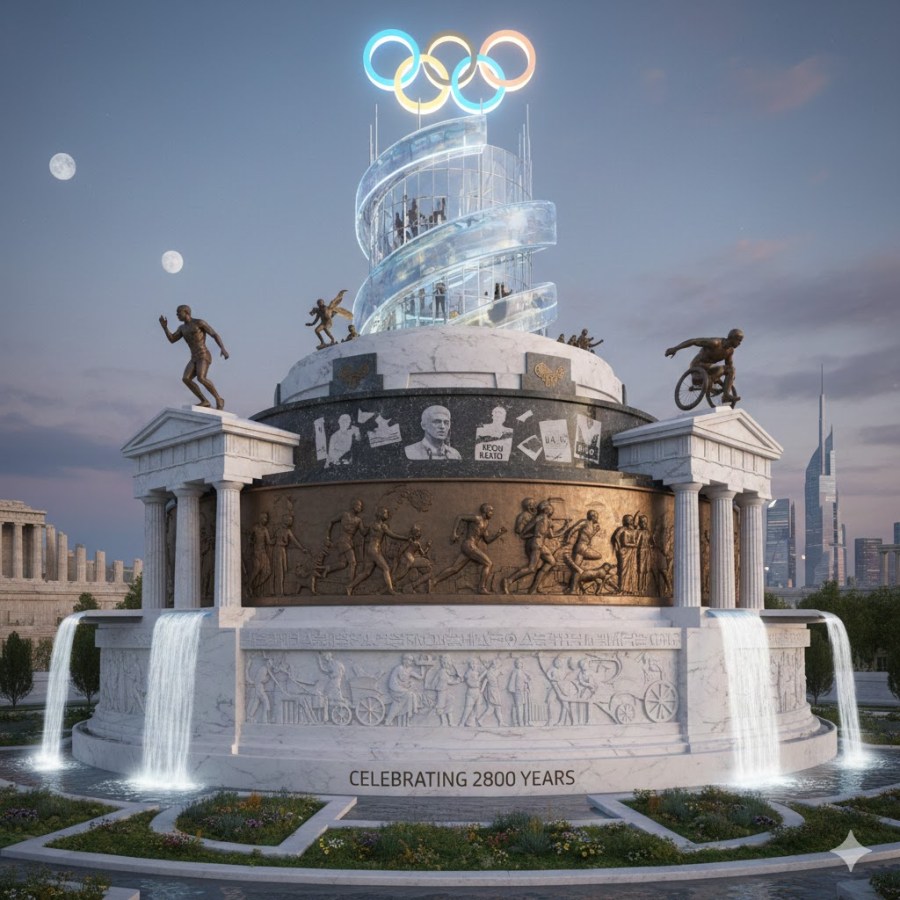
The Eternal Flame: A 2,800-Year Odyssey of the Olympic Games (Expanded Edition)
From the sun-drenched dust of the Peloponnese to the neon-lit, high-tech spectacles of the 21st century, the Olympic Games have served as the ultimate mirror to human civilization. More than a mere track meet, the Olympics are a recurring testament to our obsession with greatness, our capacity for corrosive political drama, and our enduring, collective love for the underdog. To understand the Games is to understand the heartbeat of humanity across three millennia.
I. The Ancient Foundations (776 BCE – 393 CE)
The Games began not as a secular pursuit of records, but as a burning religious devotion to Zeus. Legend credits Heracles (Hercules) with the founding, claiming he matched his stride against his brothers. However, the first historical victor was Coroebus, a humble baker from Elis. He won the stade, a sprint of roughly 192 meters, proving that Olympic glory has always been a platform for the common man to achieve immortality.
- The Sacred Truce (Ekecheiria): This was history’s first grand diplomatic experiment. As the Games approached, messengers traveled across Greece to announce a month-long ceasefire. It wasn’t just about sports; it was a realization that culture and competition could—and should—supersede the carnage of war.
- The Tale of Milo of Croton: Milo was the ancient world’s first “super-athlete.” Beyond his six wrestling titles, he was a master of psychological warfare. He once walked into the stadium carrying a full-grown bull on his shoulders, slaughtered it, and purportedly ate the entire animal in a single day. Yet, he was also a student of Pythagoras, proving the ancient ideal of the “scholar-athlete.”
- Kyniska of Sparta: While women were generally barred from competing or even spectating, the Spartan princess Kyniska exploited a loophole. As the owner of a chariot team, she became the first female Olympic victor in 396 BCE. She famously stated that her victory was a win for her gender over the “unmanly” men of Greece.
- The Fall: As the Roman Empire embraced Christianity, the Games were viewed with increasing suspicion. In 393 CE, Emperor Theodosius I officially suppressed the festival, viewing the celebration of physical prowess and polytheistic ritual as a “pagan cult.” The flame was extinguished, and the site at Olympia was eventually reclaimed by silt and time.
II. The Rebirth and the Victorian “Chaos” (1896 – 1924)
The 1,500-year silence ended because of Baron Pierre de Coubertin, a French educator who believed that “the important thing in life is not the triumph, but the struggle.”
- Athens 1896: The revival was a shoestring affair held in the reconstructed Panathenaic Stadium. It featured 14 nations, exclusively male competitors, and a distinct lack of uniform standards. The winners received silver medals and olive branches, as gold was considered too “commercial.”
- The 1904 St. Louis “Circus”: This marathon remains the pinnacle of Olympic absurdity. The race was run in 32°C (90°F) heat on dusty roads. The “winner,” Thomas Hicks, was kept moving by his trainers injecting him with strychnine (rat poison) and washing it down with brandy—perhaps the first documented “doping” incident, though it was then considered cutting-edge medicine. Meanwhile, a Cuban postman named Andarín Carvajal finished fourth despite stopping mid-race to eat some rotten apples and take a nap.
- 1912: The Rise of Jim Thorpe: At the Stockholm Games, Thorpe (a Native American) won both the pentathlon and decathlon. King Gustav V told him, “Sir, you are the greatest athlete in the world.” Thorpe’s medals were later stripped due to a minor violation of “amateurism” rules—a decision that took 70 years to overturn.
III. The Age of Ideology and Tension (1936 – 1988)
As the 20th century progressed, the Games were no longer just a hobby for aristocrats; they became a proxy for the Cold War and the battle for cultural supremacy.
- Berlin 1936: Often called “Hitler’s Games,” the Nazis spent millions to showcase their regime. They introduced the Olympic Torch Relay as a propaganda tool to link the Third Reich to Ancient Greece. However, Jesse Owens dismantled the narrative of “Aryan superiority” by winning four gold medals in front of the Führer, a silent but deafening blow to the Nazi ideology.
- The 1968 Black Power Salute: In Mexico City, Tommie Smith and John Carlos raised black-gloved fists during the national anthem to protest racial injustice in the U.S. They were expelled from the Games, but their image remains one of the most powerful political statements in sports history.
- The Cold War Boycotts: The 1980 Moscow Games were boycotted by the U.S. and 65 other nations to protest the Soviet invasion of Afghanistan. The Soviets retaliated by boycotting the 1984 Los Angeles Games. These “tit-for-tat” politics nearly broke the Olympic movement, proving that sport is never truly separate from the state.
IV. The Modern Spectacle and Global Shift (1992 – 2026)
The transition to the “Open Era” allowed professional athletes to compete, turning the Olympics into a multibillion-dollar media juggernaut.
- The 1992 Dream Team: The inclusion of NBA stars like Jordan, Johnson, and Bird didn’t just win gold for the U.S.; it globalized basketball overnight. It marked the moment the Olympics became a showcase for the absolute best, not just the best “amateurs.”
- Human Limits (Phelps and Bolt): In the 2000s, we witnessed the ceiling of human capability. Michael Phelps became the most decorated Olympian of all time (28 medals) through a combination of freakish wingspan and relentless drive. Simultaneously, Usain Bolt turned the 100-meter dash into a 9-second carnival, proving that peak performance could coexist with pure charisma.
- The Digital and Social Shift: The 21st century brought a focus on mental health and diversity. Athletes like Simone Biles sparked a global conversation about the “twisties” and the psychological weight of greatness. Meanwhile, the inclusion of “lifestyle” sports like surfing, sport climbing, and breakdancing indicates an Olympic movement trying to stay relevant to a generation that values expression as much as raw strength.
Summary of Olympic Evolution
| Era | Primary Focus | Key Cultural Vibe |
| Ancient (776 BCE – 393 CE) | Divine Worship | Naked wrestling, sacred fires, and bull sacrifices. |
| Early Modern (1896 – 1932) | Amateur “Gentleman” Ideal | Mustaches, brandy-fueled marathons, and chaotic organization. |
| Mid-Century (1936 – 1988) | Political Proxy War | Nationalistic fervor, boycotts, and civil rights protests. |
| Global Era (1992 – Present) | Hyper-Professionalism | High-tech fabrics, social media, and focus on mental health. |
The Olympics endure because they provide a rare, quantifiable answer to the eternal question: How much further can we go? Whether it was Coroebus sprinting for a crown of wild olive or a modern athlete flying through the air in a carbon-fiber suit, the spirit remains the same—a pursuit of the Citius, Altius, Fortius – Communiter (Faster, Higher, Stronger – Together) ideal.
 thelivingbreathingjamesbrown.com
You must be logged in to post a comment.