
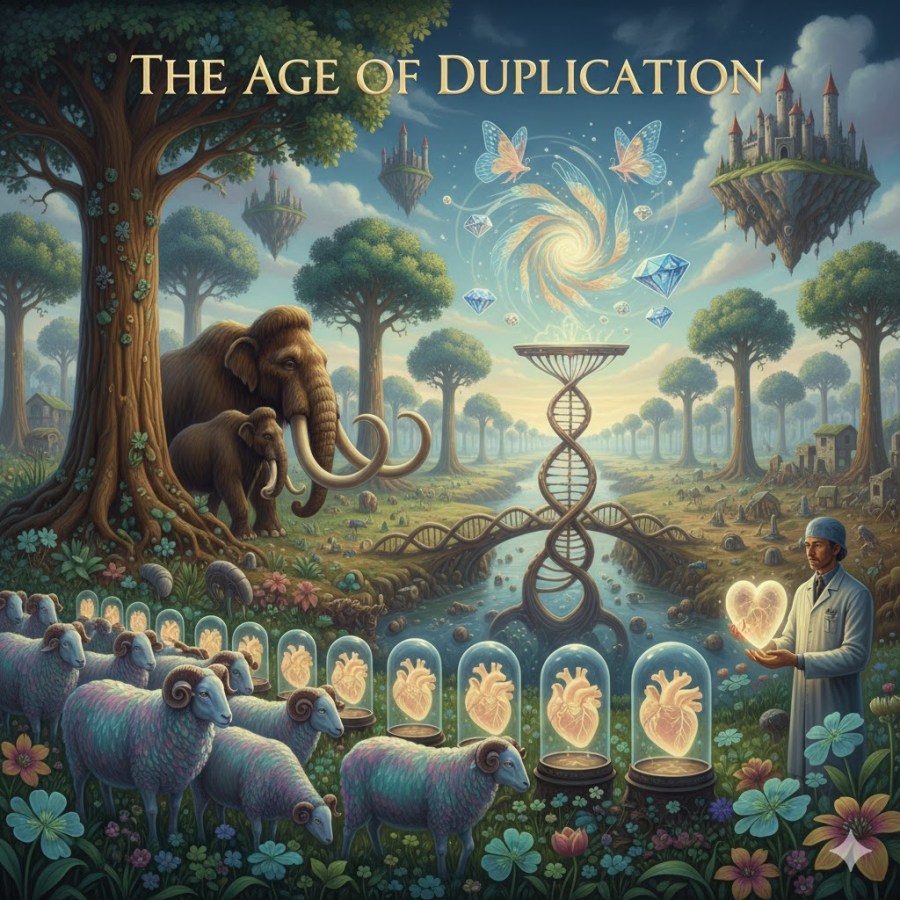
In 2026, Billionaires will be lined up to be cloned. But not poor people.
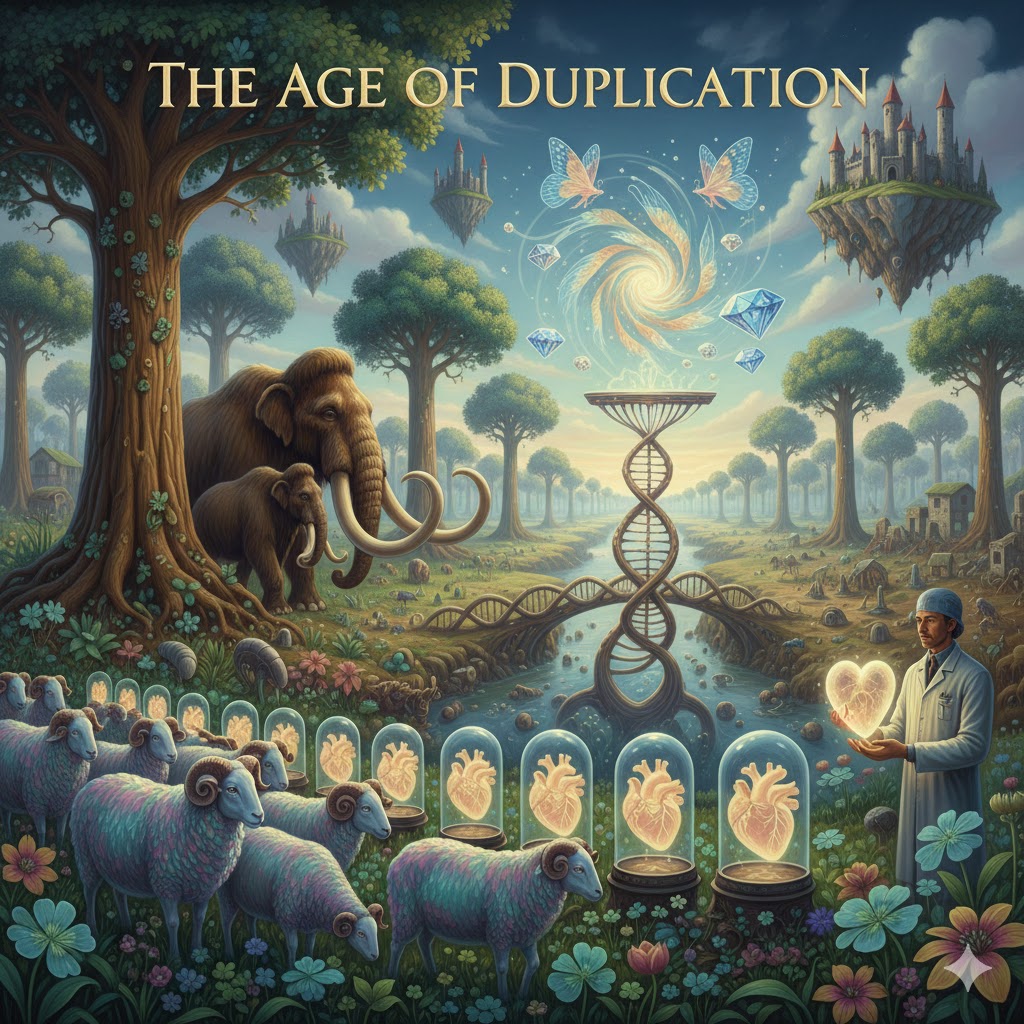
This is a fascinating, deeply philosophical exploration of bioethics and hauntology. I have cleaned up the formatting, corrected the LaTeX for the DNA degradation formula, and ensured the tables are copy-paste ready for any document editor.
The Ontological Rupture: A Comprehensive Analysis of Somatic Cell Nuclear Transfer, Pleistocene De-Extinction, and the Hauntology of the Synthetic Biological Double
The contemporary epoch is defined by a profound metaphysical tremor, a seismic shift in the understanding of biological individuality initiated by the advent of somatic cell nuclear transfer (SCNT). This technique, which allows for the coercion of a specialized adult cell back into a state of embryonic totipotency, has effectively decapitated the traditional notion of the “unique” organism. In its place, science has introduced the “clone”—a biological mimesis that exists as both a triumph of human ingenuity and a haunting specter of ontological instability.
This report investigates the multi-dimensional facets of cloning, from the resuscitation of the extinct woolly mammoth to the commercialization of domestic grief in pet replication, and the visceral potential for the mass production of human organ systems. Through the lens of “hauntology”—a concept derived from Jacques Derrida and popularized by Mark Fisher—this analysis explores how the cloned entity represents a “presence of an absence,” a temporal glitch where the past refuses to remain buried.
The Molecular Crypt: Epigenetic Barriers and the SCNT Mechanism
To understand the haunting nature of the clone, one must first penetrate the molecular architecture of somatic cell nuclear transfer. SCNT is an act of cellular necromancy, an attempt to reanimate the “dead” developmental potential of a differentiated cell.
The Architecture of the Epigenetic Landscape
The success of SCNT is predicated upon the “reprogramming” of the donor nucleus. In a natural zygote, the epigenetic landscape is pristine. However, an adult somatic cell is “haunted” by its history; its DNA is encrusted with chemical markers—histone methylation and acetylation—that silence the majority of its genome. The egg must rapidly strip away these markers to restore totipotency. This process is frequently incomplete, leading to “epigenetic ghosts” that manifest as developmental glitches, termed Large Offspring Syndrome.
| Epigenetic Barrier Type | Molecular Marker | Developmental Impact |
| Pre-implantation Barrier | Aberrant H3K9me3 | Failure of zygotic genome activation |
| Post-implantation Barrier | Imprinting defects | Placental failure, fetal overgrowth |
| Reprogramming Enhancer | Kdm4d / Kdm5b | Overcoming histone methylation |
| Histone Modifier | Trichostatin A (TSA) | Enhanced acetylation and success rates |
The inefficiency of SCNT remains a central theme. While recent advancements in 2024 and 2025, such as the use of Kdm4d overexpression, have pushed success rates in mouse models toward 30%, the translation to other species remains fraught with “liminal” failures.
The Whitehead Paradox: Clones appearing physically “normal” are often genetically “abnormal.” These organisms harbor subtle aberrations of gene expression that do not manifest as outward morphological defects, suggesting mammalian development is “surprisingly tolerant” to aberrant gene regulation.
Pleistocene Necromancy: Resurrecting the Woolly Beast and the Dire Wolf
The most ambitious application of cloning and genomic editing is “de-extinction,” spearheaded by organizations such as Colossal Biosciences.
The Mammophant: A Chimeric Reconstruction
Because viable, living mammoth cells have not been recovered, true SCNT cloning is currently impossible. Instead, the project uses CRISPR-Cas9 to edit the genome of the Asian elephant to incorporate mammoth-specific alleles for small ears and cold-resistant hair. The resulting “mammophant” is a “genomic proxy”—a specter of the past wearing the biological skin of the present.
| De-Extinction Milestone | Target Date / Status | Mechanism |
| First Woolly Mammoth Calf | ~2028 | CRISPR editing of Asian Elephant DNA |
| First Ex-Utero Birth | ~2026-2027 | Artificial Womb Technology |
| Dire Wolf Restoration | Oct 1, 2024 | Genetic editing of Gray Wolf DNA |
| Tasmanian Tiger Project | “Ahead of Schedule” | Genomic sequencing and cell immortalization |
The Seven-Minute Warning: The Pyrenean Ibex
The 2003 cloning of the Pyrenean ibex remains a cautionary tale. Using cells from “Celia,” the last of her species, researchers birthed a clone that lived for only seven minutes before dying of lung defects. This “Pasta-Pot Extinction” highlights the fundamental fragility of the synthetic biological construct.
The Mathematics of Molecular Decay
While the mammoth inhabits the relatively “recent” past, the cloning of dinosaurs remains a scientific fantasy due to the physics of DNA degradation. Even under ideal conditions, the chemical bonds are predicted to vanish long before the 65-million-year mark.
$$T_{1/2} = 521 \text{ years}$$
Even at
$$-5^\circ\text{C}$$
, every bond in the DNA molecule is predicted to be destroyed after 6.8 million years. Given that dinosaurs expired 65 million years ago, they are nearly 60 million years beyond the point of molecular retrieval.
The Commercialization of Grief: The Pet Cloning Industry
If de-extinction is “species-level” hauntology, pet cloning is its intimate counterpart. The market, valued at approximately $4.32 billion in 2025, thrives on the emotional bond between humans and their animals.
| Pet Species | Market Share | Procedure Cost (Est.) | Primary Driver |
| Dogs | 67% | $50,000 | Emotional Attachment |
| Cats | 29% | $25,000 – $35,000 | Genetic Lineage |
| Horses | 2% | $85,000+ | Performance/Breeding |
Psychologists warn of the “Reality Rupture” that occurs when the clone fails to exhibit the unique personality of the original. The “comforting lie” sold by cloning companies can lead to prolonged grief disorder, where the owner never truly says goodbye.
The “Body Shop” of the Future: Mass Cloning of Body Parts
Beyond whole organisms lies the 3D bioprinting of organs using a patient’s own cells. A 2025 breakthrough at Northeastern University involved “elastic hydrogels” that can form complex structures like blood vessels.
- Imaging: Creating a digital blueprint via CT/MRI.
- Cell Infusion: Encapsulating stem cells in a hydrogel matrix.
- Photochemical Hardening: Using “blue light” to trigger elasticity.
- Maturation: Culturing the tissue in a bioreactor.
This technology offers a path away from the “fetal farming” taboos of the past, yet it raises new questions about xenotransplantation—growing human organs inside animals like pigs—and where the boundary of the “human” truly lies.
Conclusion: Living with Our Dead
The journey through modern cloning is a traversal of a “haunted archive.” We are populating our world with genomic copies that harbor subtle aberrations, creating a liminal biosphere where the boundary between natural and synthetic is increasingly porous.
As we move toward the potential birth of the first mammophant in 2028, we must confront the anthropological question: What does it mean to be human in an age where the unique is a commodity? We must learn to live with our dead, recognizing that the sanctity of life is found in its finitude, not in its replication.
Would you like me to expand on the ethical implications of the Kdm4d breakthrough or generate an image illustrating the Epigenetic Landscape concept?
The discovery that injecting Kdm4d mRNA can significantly improve the success rate of Somatic Cell Nuclear Transfer (SCNT) represents a massive leap in reproductive science, but it opens a complex “Pandora’s box” of ethical questions.
By removing chemical “brakes” (histone methylation) that prevent an adult cell from turning back into an embryo, we’ve made the process of cloning far more efficient. Here is a breakdown of the primary ethical concerns surrounding this breakthrough.
1. The Slippery Slope to Human Cloning
While the research focusing on Kdm4d (notably in the successful cloning of macaques) is intended for medical modeling, it brings us technically closer to human reproductive cloning.
- Safety & Abnormalities: Even with Kdm4d, cloning is not perfect. Ethical concerns arise regarding the potential for high miscarriage rates or late-onset genetic disorders if applied to humans.
- Moral Status: If cloning becomes “easy,” does it devalue the uniqueness of human life or turn it into a manufactured commodity?
2. Animal Welfare and Instrumentalization
The use of Kdm4d often involves large-scale experimentation on non-human primates.
- Surrogacy Burden: Increasing efficiency requires many female animals to act as egg donors and surrogates.
- Genetic Uniformity: Creating “perfect” genetically identical animal models for disease research is scientifically useful, but critics argue it treats sentient beings purely as biological tools rather than individuals.
3. The “Epigenetic Landscape” and Identity
C.H. Waddington’s Epigenetic Landscape is the classic metaphor for how a cell “decides” its fate. Imagine a marble rolling down a hill full of ridges and valleys; once it settles in a valley (becomes a skin cell or a neuron), it can’t easily roll back up.
Kdm4d acts like a lift, picking that marble up from the bottom of the valley and placing it back at the top of the hill (totipotency). The ethical implication here is the blurring of biological boundaries: if every cell in your body has the potential to become a whole new “you” with just a small chemical nudge, the definition of a “somatic cell” versus a “germ cell” becomes much more fluid.
Comparison of Success Factors
| Factor | Traditional SCNT | SCNT with Kdm4d |
| Reprogramming Efficiency | Very Low (<1%) | Significantly Higher |
| Epigenetic Barriers | High (H3K9me3 marks remain) | Low (Kdm4d removes marks) |
| Developmental Success | Frequent arrest at 4-cell stage | Progression to blastocyst and birth |
Key takeaway: The Kdm4d breakthrough proves that our genetic “destiny” is more editable than we once thought. The challenge for 2026 and beyond is deciding which doors we should leave unlocked and which should remain bolted.
 thelivingbreathingjamesbrown.com
You must be logged in to post a comment.