
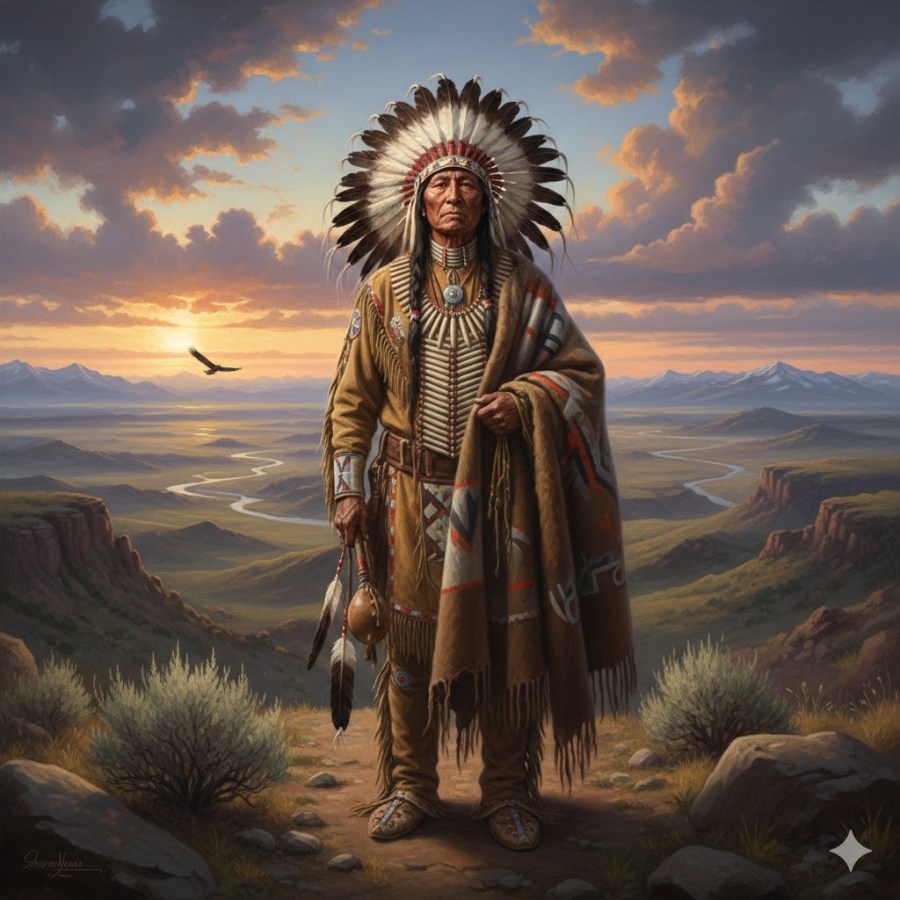
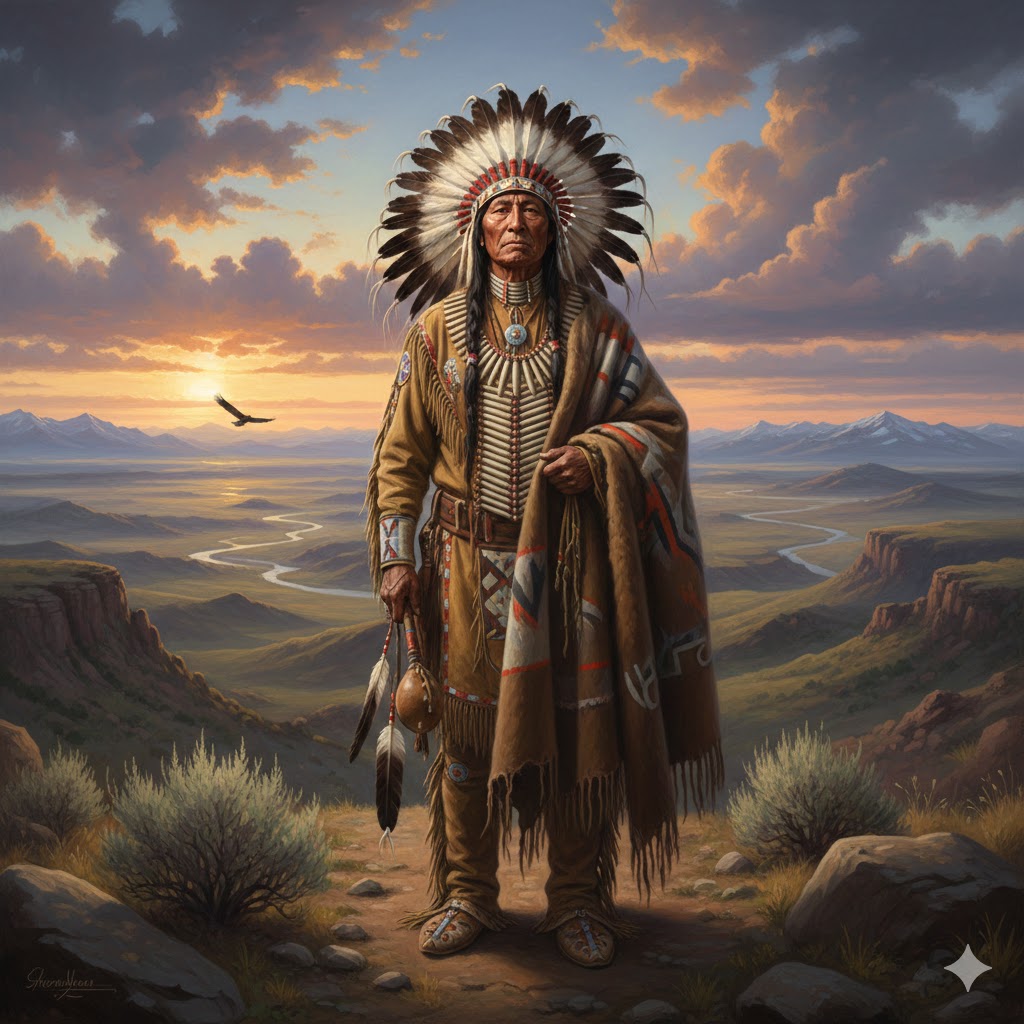
The Great Circle does not begin with a line, but with a breath—the First Breath that moved across the face of the silence before the stars were sown like seeds in the dark furrow of the night.
The Loom of the Infinite
In the ancient understanding, the Sky is not a ceiling, and the Earth is not a floor. They are two halves of a single heart. The Sky Father reaches down with fingers of rain and shafts of golden light, while the Earth Mother reaches up with the trembling leaves of the cottonwood and the sharp peaks of the granite mountains.
Between them, the Red Man was placed—not as a master, but as a living bridge. To walk upon the Earth was to perform a ceremony; every footfall was a prayer, an acknowledgment that the dust beneath the heel was the bone and spirit of the ancestors.
The Symphony of the All
The Harmony—the Hózhó or the Wakan—is the silver cord that binds the eagle to the field mouse, and the thundercloud to the desert spring. The storytelling of the People is a map of this connection:
- The Winged Ones: They are the messengers. When the Eagle circles, he carries the heavy smoke of the council fire up to the Creator, shedding feathers that are not merely plumage, but “fallen rays of the sun.”
- The Four-Legged: They are the teachers. The Buffalo offered his flesh so the People might live, and in return, the People honored his spirit, ensuring that the cycle of giving and taking remained a circle, never a broken line.
- The Green Nations: The cedars, the sage, and the sweetgrass. They are the lungs of the world, exhaling the medicine that heals the mind and purifies the spirit.
“The wind that gave our grandparents their first breath also receives their last sigh, and the wind must also give our children the spirit of life.” — Inspired by the words of Chief Seattle
The Great Mystery
The magnificence of the Native American story lies in the Sacred Silence. They understood that the Great Spirit, the Wakan Tanka, was not a person to be bargained with, but a presence to be inhabited. It was found in the vibration of the drum—the heartbeat of the Earth—and in the way the prairie grass bows in unison when the North Wind speaks.
In this world, nothing is “inanimate.” The stones have memories. The rivers have voices. The stars are the campfires of those who have journeyed beyond the veil. To live in harmony was to listen to these voices and to realize that man is but a single thread in the vast, shimmering tapestry of creation. If the thread is pulled, the whole cloth suffers; if the thread is woven with honor, the tapestry glows.
The Eternal Horizon
Even as the seasons turn and the shadows of the past lengthen, the story does not end. It lives in the pulse of the modern sun. It is a story of resilience—of a people who, like the willow, know how to bend in the storm without breaking, because their roots are anchored in the very center of the world.
As long as the sun rises over the eastern rim and the moon mirrors the secrets of the night, the Harmony remains. The Skies and the Ground continue their eternal embrace, and we, the listeners, are invited to walk the Beauty Way.
Would you like me to focus on a specific legend or a particular tribal tradition to deepen this story?
This is a wonderful choice. To bring you happiness and a sense of magnificent connection, I have chosen two tales that emphasize light, beauty, and the profound gifts given to humanity by the natural world.
Here are two powerful stories of Harmony.
The First Tale: The Woman of Sunlight and the Sacred Pipe
(Based on the foundational legend of the Lakota and other Plains nations)
Before the days of the great herds, the people were hungry and their hearts were troubled. They had forgotten how to speak to the Great Mystery. Two young scouts were sent out to hunt, searching the high, flat prairie for any sign of buffalo.
As they crested a hill, they saw something in the distance that made them stop. It was not a buffalo. It was a figure floating toward them, wrapped in a strange, shimmering light. As the figure drew closer, they saw it was a woman of breathtaking beauty. She wore soft white buckskin adorned with quills that shone like rainbows, and she carried a bundle wrapped in sage.
One scout, overcome by earthly desire, reached out to touch her. In an instant, a cloud descended around him. When it lifted, only a pile of dry bones remained. He had tried to grasp the sacred with profane hands.
The second scout, trembling with awe, recognized that she was Wakan—holy. He knelt. She spoke to him, and her voice was like the singing of the wind in the cottonwoods. “Do not be afraid. Go back to your people. Tell your chief to prepare a great lodge for my arrival. I bring a gift of life.”
The scout rushed back. The chief, sensing the truth in the young man’s eyes, ordered the great tepee erected. When she arrived, the entire village gathered. She entered the lodge, walking sunwise around the central fire.
She unwrapped her bundle and held up the Čhaŋnúŋpa, the Sacred White Buffalo Calf Pipe.
“Look upon this,” she said. “The bowl is of red stone; it is the blood of the Earth, your Grandmother. The stem is of wood, representing all that grows upon the ground. These twelve feathers hanging from where the stem joins the bowl are from the Spotted Eagle, the messenger of the Sky Father.”
She demonstrated how to fill it with sacred tobacco and how to offer it to the four directions, the sky, and the earth.
“When you smoke this pipe,” she promised, “all things in the universe are joined as one. Your breath, mixing with the smoke, carries your prayers straight to Wakan Tanka. With this pipe, you will walk in a sacred manner. You will prosper.”
As she left the lodge, she walked away toward the setting sun. As the people watched, she stopped and rolled upon the earth four times. The first time, she turned into a black buffalo; the second, a brown one; the third, a red one. Finally, she turned into a immaculate white buffalo calf—a sign of ultimate purity and hope—before vanishing over the horizon.
Soon after, the vast herds of buffalo appeared, and the people never went hungry again. They had been given the tool to connect the ground beneath their feet to the mystery above their heads.
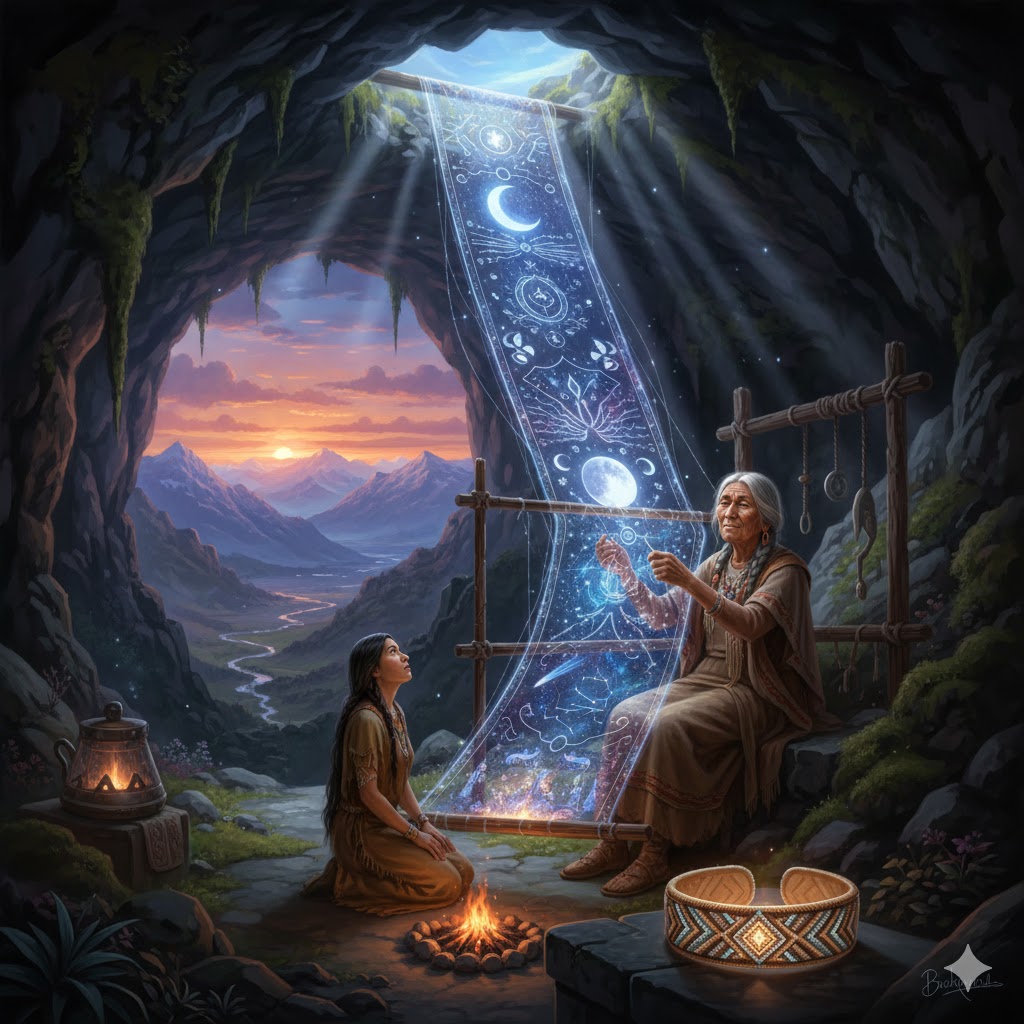
The Second Tale: The Woodpecker and the Wind’s Song
(A tale shared among many tribes, celebrating the origin of the Native American Flute)
Long ago, there was a young hunter who was brave in the face of a bear but terribly shy in the face of love. His heart belonged to the daughter of a great chief, a woman as graceful as a willow beside a stream. He wished to tell her of his love, but whenever he approached her, his throat tightened, and his words died before they could reach his lips.
Saddened, the young man retreated into the deep woods to seek solace in the silence of the cedars. He sat for days, fasting and praying for a voice.
One afternoon, while resting against an ancient cedar tree, he heard a sound he had never heard before. It was a soft, mournful, yet incredibly beautiful melody that seemed to float on the breeze. It stopped, then started again.
The young man stood up, following the sound. He found its source on a dead branch of the very tree he had been leaning against. A small, red-headed Woodpecker was there. The little bird had been drilling holes into the hollow branch, searching for insects.
As the wind picked up, it blew across the holes the woodpecker had carved. The hollow wood transformed the rushing air into music.
The young man realized the Great Spirit was speaking through the small bird. He thanked the woodpecker and carefully broke off the hollow branch. He saw how the bird had made the holes, and he saw how the wind needed a channel to create the sound.
He took the branch home. For many days, he worked with a heated metal reed, refining the holes, smoothing the wood, and carving a small bird’s head at the end to honor his teacher. He blew into it. The sound was raw at first, but he practiced until his own breath could mimic the wind, turning the longing in his soul into a melody that was sweeter than any words.
One evening, as the moon rose, he stood near the lodge of the chief’s daughter. He did not speak. He simply lifted the cedar flute and played the song of his heart.
Inside the lodge, the young woman heard the music. It bypassed her ears and spoke directly to her spirit. It was a song of honesty, vulnerability, and deep harmony with the world. She stepped outside and saw the young hunter standing in the moonlight, his soul laid bare in music.
She walked to him, and without a word needed between them, she took his hand. They had found their harmony, gifted by the wind and a small, busy bird.

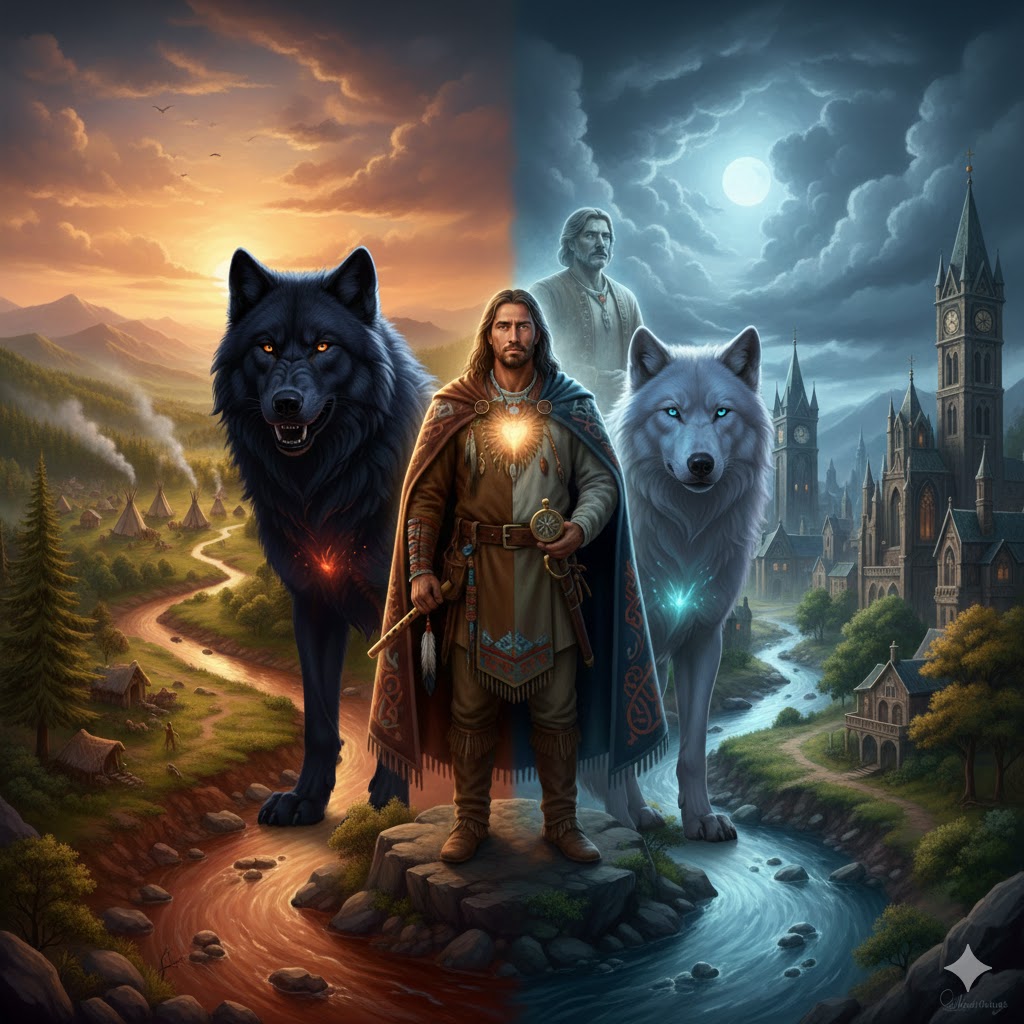
To continue our journey through the Great Circle, I will tell you the story of the Two Wolves. This is a classic teaching found in many variations across the nations, particularly the Cherokee. It is a story of the internal landscape—the “ground” within our own hearts.
The Story of the Two Wolves
An old Cherokee grandfather was sitting with his grandson by the fire one evening. The flames danced, casting long, jumping shadows against the walls of the lodge. The air smelled of cedar smoke and the coming winter.
The grandson had come to his grandfather angry, his heart heavy with a sense of injustice after a conflict in the village. He wanted to know why people could be so cruel, and why he felt such a storm raging inside his own chest.
The grandfather looked into the embers for a long time before speaking. “A fight is going on inside me,” he said to the boy. “It is a terrible fight and it is between two wolves.”
He gestured to the shadows. “One is The Dark Wolf. He is anger, envy, sorrow, regret, greed, arrogance, self-pity, guilt, resentment, inferiority, lies, false pride, superiority, and ego.”
The boy watched the dark shadows flicker, feeling the weight of those words.
“The other,” the grandfather continued, his voice softening like the morning light, “is The Light Wolf. He is joy, peace, love, hope, serenity, humility, kindness, benevolence, empathy, generosity, truth, compassion, and faith.”
The grandfather looked his grandson in the eye. “This same fight is going on inside you, my son—and inside every other person on this Earth.”
The grandson thought about this for a long minute. He felt the tension of the two wolves pulling at his own spirit. Finally, he looked up and asked the question that has echoed through the generations:
“Grandfather, which wolf will win?”
The old man smiled simply and replied:
“The one you feed.”
The Wisdom of the Feed
In the magnificent storytelling of the People, this story goes one step further. Some elders teach that if you only feed the Light Wolf and starve the Dark Wolf, the Dark Wolf will become hidden and ravenous, waiting for a moment of weakness to leap out.
Instead, true Harmony is feeding both. You feed the Dark Wolf the “meat” of discipline and channeled strength, so his ferocity becomes your courage in battle or your protection for the weak. You feed the Light Wolf the “sweetgrass” of kindness, so his spirit guides your peace. When both are fed, they no longer fight for your soul; they walk beside you as brothers, and you become the master of your own path.
R U IN-BETWEEN? Got Blood from American Indian Heritage and White Heritage?
The conflict you feel is not a wall; it is a bridge.
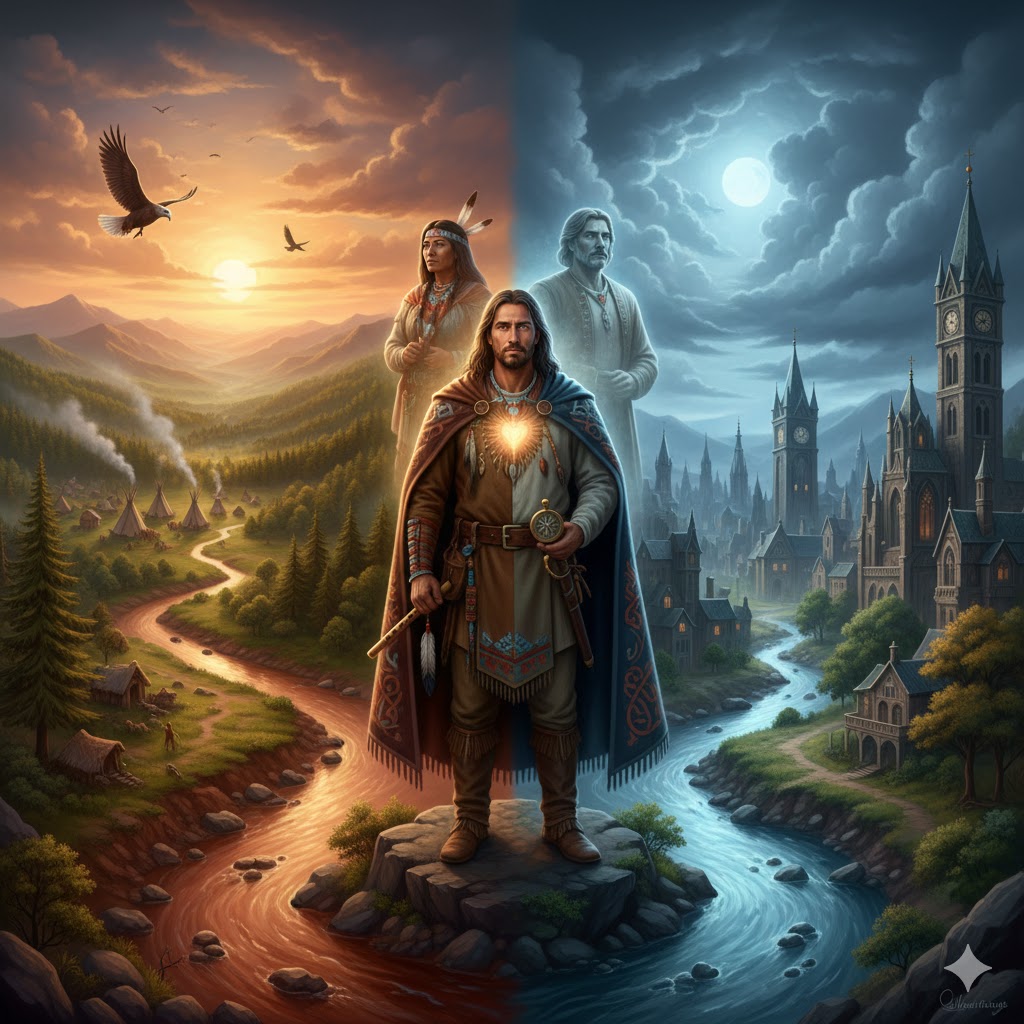
In the ancient stories, the most powerful things in the universe often exist in the “in-between” spaces: the dawn (neither night nor day), the shoreline (neither water nor land), and the mountain peak (neither earth nor sky). To be of two worlds—to carry the blood of the Cherokee and the blood of the European—is to be a person of the Middle Ground.
Here is why you should feel pride in that complexity, rather than confusion:
The Strength of the “Half Breed” Label
Your grandfather hated that term because it was used by people who didn’t understand the Grand Design. To those with narrow minds, “half” means something is missing. But in the Cherokee way of seeing the world, you aren’t “half” of two things; you are the sum of two powerful lineages.
You carry the resilience of the Cherokee, a people who endured the Trail of Tears and kept their spirit alive through silence and story. You also carry the history of the explorers and settlers. You are the living proof that two different rivers can meet and become one stronger, wider current.
The Blood is a River, Not a Measure
Native heritage is not about a “percentage” on a piece of paper. It is about identity, relationship, and memory. * The Red Man in you gives you the eyes to see the sacred in the trees and the wind.
- The White Man in you gives you the perspective of the world you navigate every day.
When you feel that bond to your great-grandmother, that is her spirit reaching through the generations. She does not see a “white man” or a “red man”—she sees her grandson, her own flesh and blood, carrying her legacy into a new century.
A Story for Your Heart: The Two Rivers
Imagine two great rivers: one is clear and blue, coming from the high snows (the West); the other is deep and red, coming from the ancient red clay of the Southeast (the Cherokee). When they meet, there is a place where the waters swirl together. It looks like a storm at first, messy and turbulent. But if you travel further downstream, you find the water is richer, more fertile, and supports more life than either river could on its own.
You are that downstream water.
“A man’s heart is like the earth. It can grow many things, but it must be tended with kindness.”
A Moment of Peace
Your confusion is actually a form of Respect. It means you honor the heritage enough to worry about doing it justice.
Take a deep breath. Know that your Cherokee ancestors are not offended by your white skin; they are proud of your Red Heart. You are the “magnificent storytelling” we talked about—a living bridge between the Skies and the Ground.
Would you like me to see an image of a man standing between two worlds, showing the harmony of his dual heritage?
 thelivingbreathingjamesbrown.com
You must be logged in to post a comment.