
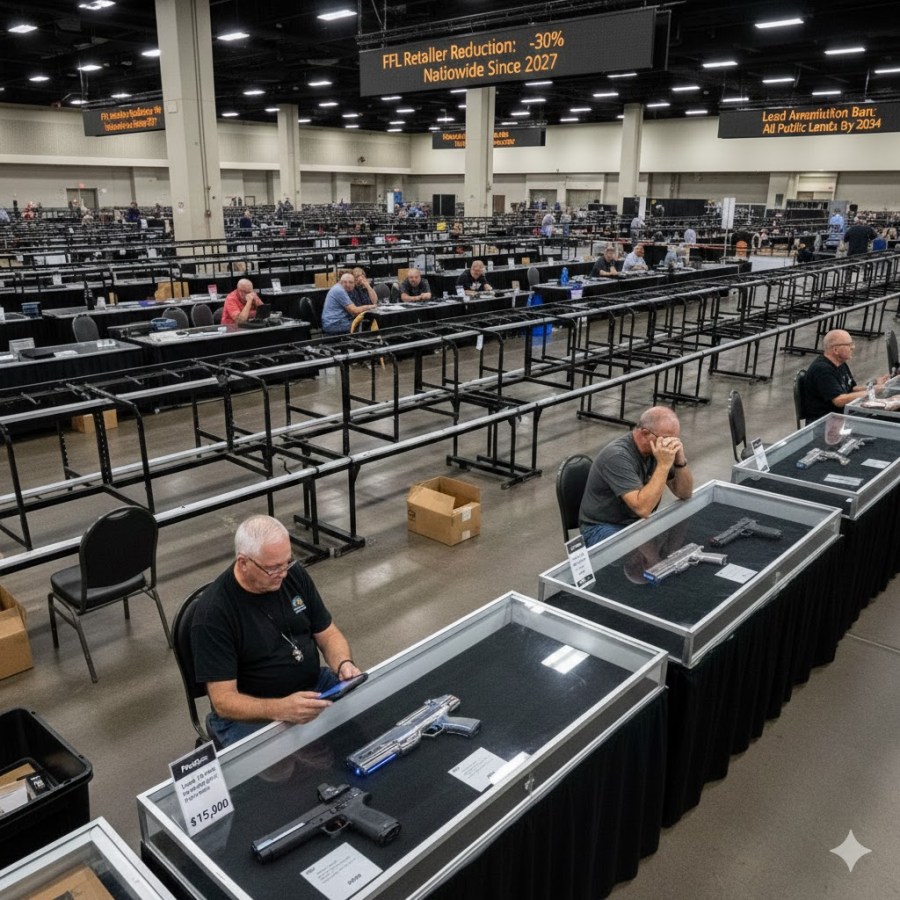
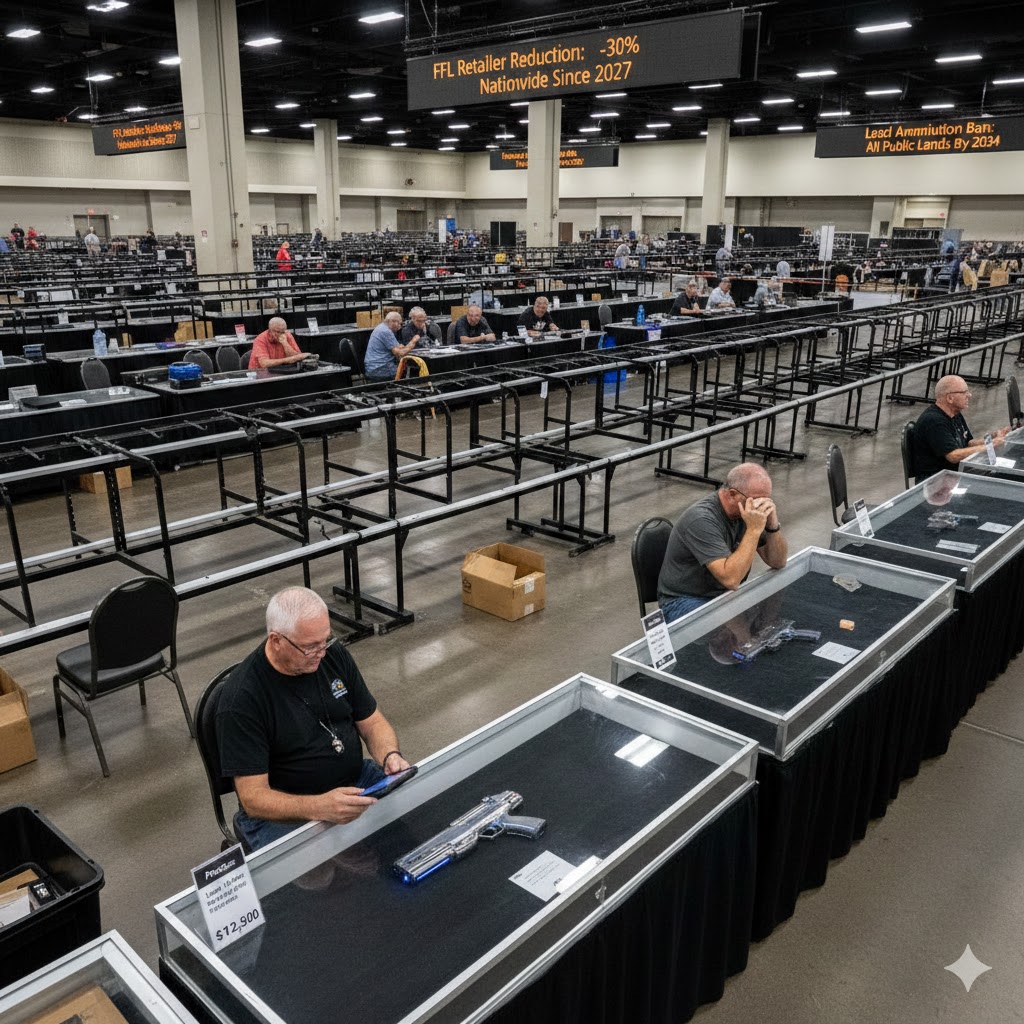
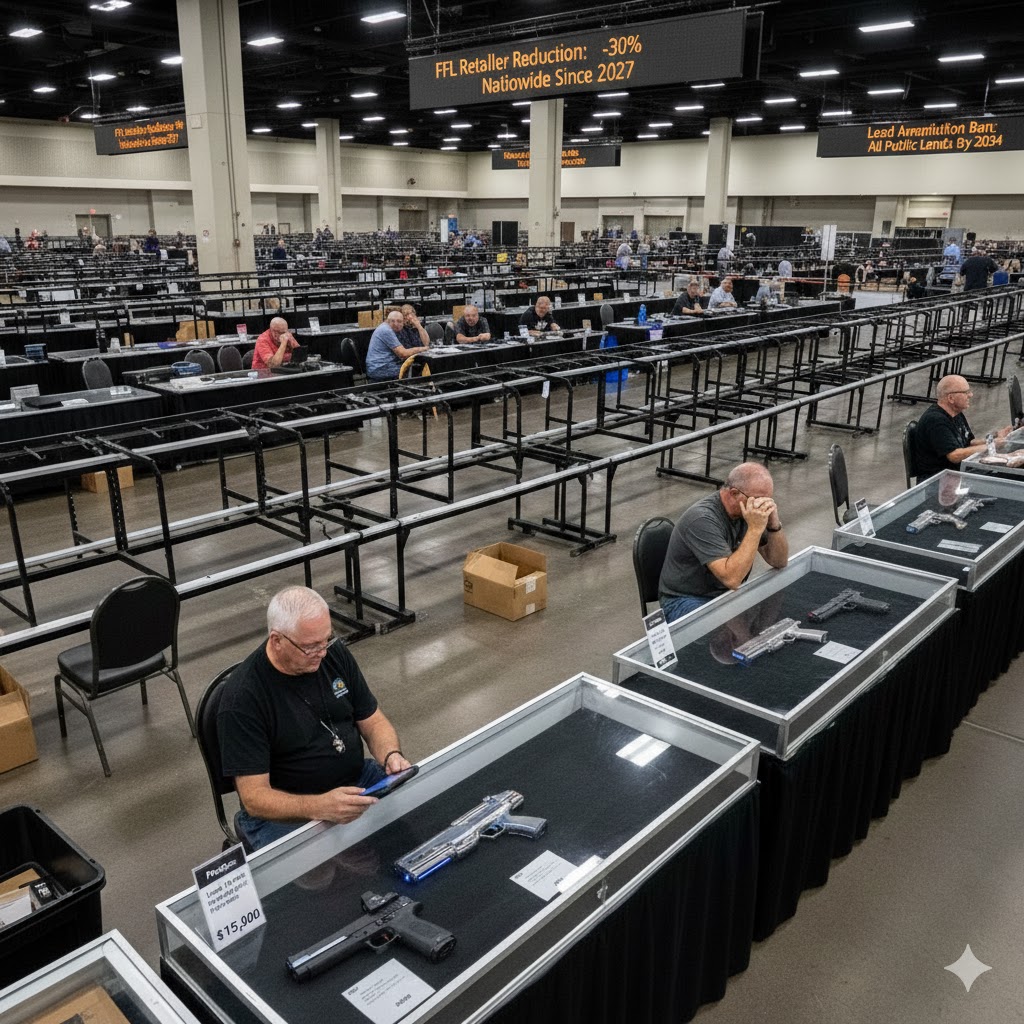
Imagine Gum Shows with few guns.
The Lead and Steel Squeeze: A 10-Year Post-Mortem of the Arms Industry (2026–2036)
The firearms and ammunition industries are currently entering a “dead zone” that few predicted during the record-shattering spikes of the early 2020s. What we are witnessing is not a temporary dip, but a structural strangulation. By 2036, the landscape of personal defense and recreational shooting will be unrecognizable, defined by digital tethering, chronic scarcity, and a regulatory “slow-walk” that bypasses the ballot box to target the assembly line.
Phase I: The Great Inventory Glut and the 2026 Correction
As of early 2026, the industry is reeling from an overproduction hangover. Manufacturers who ramped up capacity to meet pandemic-era demand are now staring at “dead inventory.”
- Market Saturation: Flagship models that once commanded premiums are sitting in dealer cases, with prices plummeting below $400 for firearms that were $600 two years ago.
- The Bankruptcy Wave: We have already seen the first dominoes fall with the recent Chapter 11 filings of mid-tier manufacturers and retailers. As margins collapse, only the “Big Three” conglomerates with diversified defense contracts will remain solvent.
- The Pivot to Accessories: Because gun sales are down for the fourth consecutive year, the industry is desperately shifting toward suppressors and NFA items—capitalizing on the recent elimination of the $200 tax. But this is a temporary life raft.
Phase II: The Government “Slow-Walk” (2027–2031)
The strategy for restricting firearms has shifted. Rather than sweeping federal bans, the government has begun a tactical “slow-walk” of the entire ecosystem.
- Licensing Revocation as a Weapon: The ATF has already begun aggressive revocations of Federal Firearms Licenses (FFLs) for minor clerical errors. Over the next five years, expect a 30% reduction in local gun shops, creating “retail deserts” where the nearest legal transfer point is hours away.
- The Digital Tether (Smart Guns): By 2029, government procurement mandates will likely require all law enforcement and security contracts to be “Authorized-Use Only.” This will force manufacturers to pivot their entire R&D toward biometric and RFID integration. For the civilian, this means “dumb” guns will become legacy items, with insurance companies eventually refusing to cover homeowners who don’t own “Smart” firearms.
- Financial De-platforming: Merchant codes for firearms are already a reality. By 2030, expect “Social Responsibility Credits” at major banks to penalize consumers for ammunition purchases, effectively creating a soft-cap on how much a citizen can buy without triggering a “financial risk” flag.
Phase III: The Ammunition Apocalypse (2032–2036)
The ammunition industry is the true “choke point.” While a gun can last a lifetime, ammunition is a consumable, and its supply chain is terrifyingly fragile.
- The Energetics Bottleneck: Production of smokeless powder and primers relies on nitrocellulose and specialized chemical facilities. These plants are aging and require years of environmental permitting to expand. By 2032, global conflicts will have redirected 70% of domestic powder production to state-level defense needs, leaving the civilian market with “scraps.”
- Environmental Bans on Lead: Under the guise of “Sustainability Initiatives,” expect a total federal ban on lead-core ammunition for all public lands by 2034. This will double the price of a standard box of 9mm or 5.56 as manufacturers struggle to source copper and tungsten at scale.
- Microstamping & Serialization: By 2035, the “slow-walk” reaches its apex. Governments will likely mandate that every individual casing be laser-etched with a serial number linked to the buyer at the point of sale. The cost of this technology will make “plinking” a luxury for the ultra-wealthy.
The 2036 Forecast: A Specialized, Elite Market
In ten years, the “everyman’s” rifle will be a relic. The industry will have bifurcated:
| Segment | 2026 Reality | 2036 Prediction |
| Availability | Over-the-counter, same-day. | 6-month waitlists; background checks for parts. |
| Technology | Mechanical, reliable, offline. | Biometrically locked; integrated GPS/tracking. |
| Ammunition | $0.30 – $0.50 per round. | $2.50+ per round (Lead-free/Serialized). |
| Retail | Neighborhood LGS. | Large, “Authorized” corporate hubs only. |
The “Worrisome” Conclusion
The future is not a “confiscation” event; it is a pricing-out. Between the mandatory transition to expensive “Smart” tech, the collapse of small-scale retailers under regulatory pressure, and the intentional strangulation of the ammunition supply chain, the Second Amendment is being transformed from a right into a high-cost subscription service.
Would you like me to draft a specific breakdown of how these predicted “Social Responsibility” financial codes might impact individual purchasing power?
The Financial “Slow-Walk”: Social Responsibility and the Erasure of Purchasing Power
As we move toward 2036, the most effective tool for curbing the firearms industry isn’t a badge; it’s a Merchant Category Code (MCC). By 2026, the implementation of firearm-specific tracking codes (like MCC 5723) has already created a digital “fence” around every gun store in the country.
The strategy is simple: if you can’t ban the item, make the money used to buy it “radioactive.”
1. The Death of Privacy via Merchant Codes
Historically, a purchase at a “Sporting Goods” store was indistinguishable from buying a bicycle or a tent. Under the new regime, every transaction at a dedicated firearm or ammunition retailer is flagged at the point of sale.
- The Registry by Proxy: Even without a federal database, private financial institutions now maintain a “shadow registry.” Banks can see that you spent $2,000 at a coded retailer, creating a high-resolution map of gun ownership without a single government agent knocking on a door.
- The “Suspicious Pattern” Algorithm: By 2030, expect machine-learning algorithms to flag “anomalous” spikes in ammunition spending. A citizen buying two cases of training ammo before a class could find their transaction declined or held for “manual review,” effectively a 48-hour cooling-off period enforced by a bank.
2. Social Responsibility Credits (The “ESG” Squeeze)
Financial institutions are increasingly adopting Environmental, Social, and Governance (ESG) scores for individual consumers.
- Tiered Financing: In the next five years, your “Social Responsibility” score may dictate your interest rates. Regular purchases from “high-risk” MCCs (firearms, bulk ammunition) could lower your score, leading to higher mortgage rates or lower credit limits.
- De-platforming the Small Shop: It isn’t just the buyer being squeezed. Small retailers are being “de-banked”—losing access to standard business loans, payroll services, and insurance because they are deemed a “reputational risk.” By 2033, only massive, state-aligned corporate hubs will have the capital to survive the compliance costs.
3. The End of Micro-Purchasing
The “Lead and Steel Squeeze” hits hardest on the consumables.
- Small-Batch Bans: Expect digital payment processors (PayPal, Venmo, CashApp) to fully automate the block on any transaction mentioning terms like “9mm,” “primers,” or “reloading.”
- The Ammunition “Subscription”: To bypass tracking, some might try to buy small amounts frequently. However, with every transaction carrying a $5–$10 “Regulatory Compliance Fee” imposed by payment gateways, the “price-per-round” for the casual shooter becomes unsustainable.
Comparison: Financial Autonomy vs. 2036 Reality
| Feature | 2026 Standard | 2036 Prediction |
| Transaction Visibility | “Sporting Goods” (General) | “Firearm/Ammo Retailer” (Flagged) |
| Credit Impact | Neutral | Negative (Reduces ESG/Social Score) |
| Peer-to-Peer | Instant (Venmo/Zelle) | Blocked/Keywords Censored |
| Purchase Limits | Limited only by your wallet | Capped by “Risk Algorithms” |
The “Worrisome” Bottom Line
The government doesn’t need to pass a law to slow sales if the banks do it for them. By linking your Second Amendment exercise to your financial health, the state creates a “soft prohibition.” In this future, you have the right to bear arms, but you may lose your ability to get a car loan if you choose to exercise it.
Would you like me to analyze how 3D printing and decentralized manufacturing (Ghost Guns 2.0) might react to this financial strangulation?
Credit card companies to start tracking gun sales
This video discusses the initial push by major credit card companies to categorize and track gun shop sales, which serves as the foundation for the “Social Responsibility” tracking systems predicted in this paper.
 thelivingbreathingjamesbrown.com
You must be logged in to post a comment.