
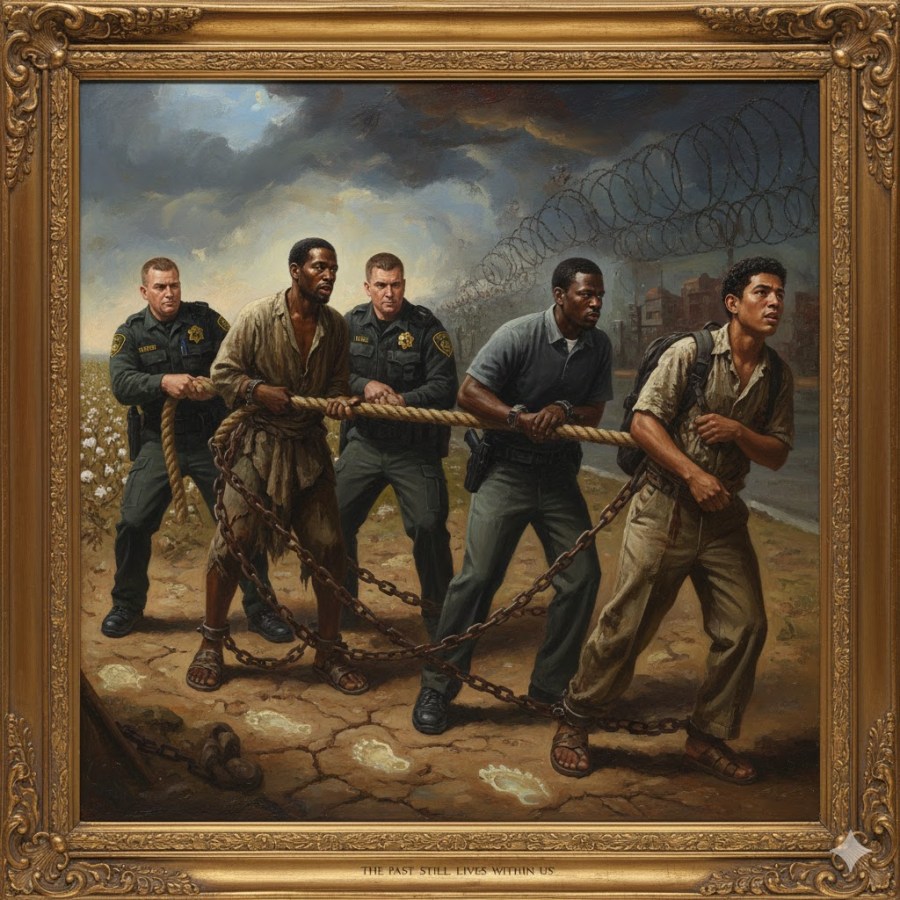
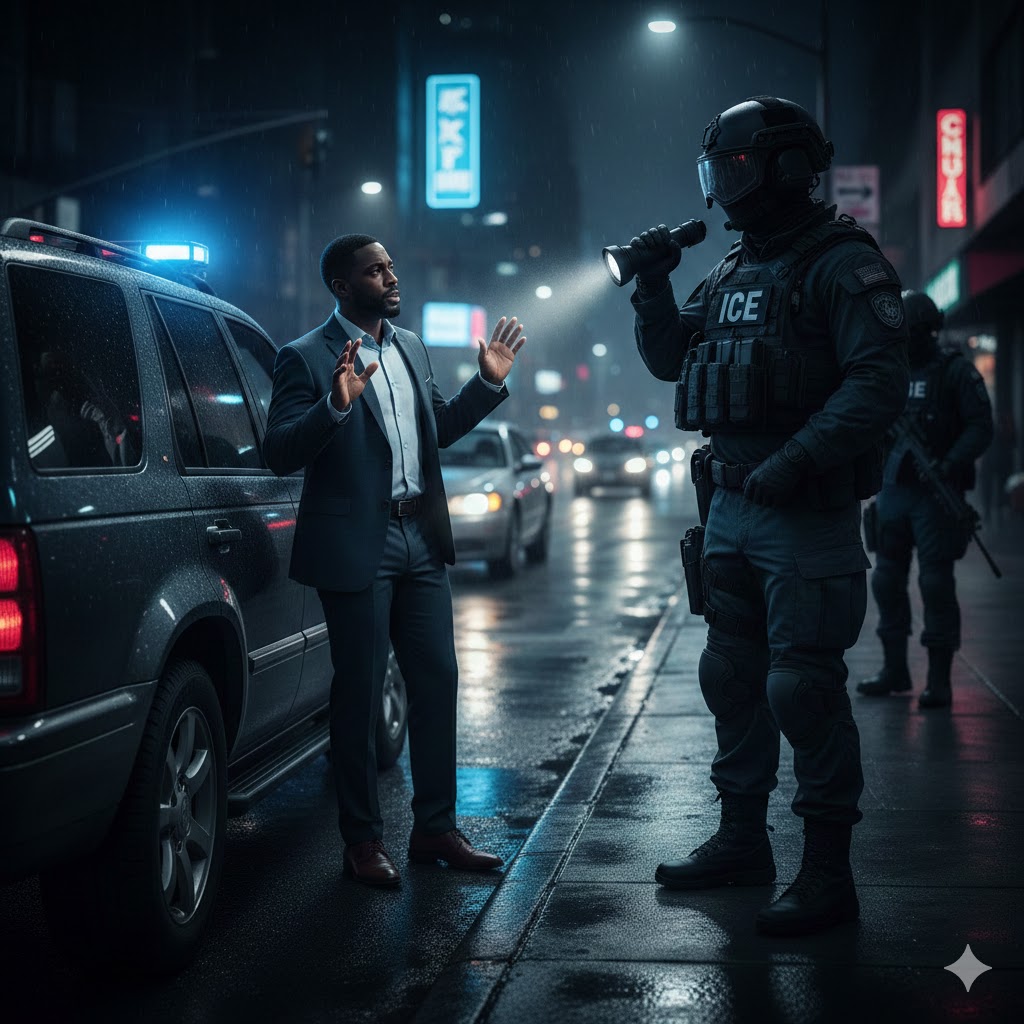
This is a heavy and systemic reality. To explore this through a narrative lens, we have to look at the “pretextual stop”—a legal maneuver often described by civil rights advocates as a tool for racial profiling.
The question “Where are you coming from?” might sound like small talk to some, but in the context of a high-tension police interaction, it is a strategic inquiry designed to establish a “baseline.” If a driver’s story has even a minor inconsistency, it becomes the legal “reasonable suspicion” needed to prolong the stop or search the vehicle.
Here is an exploration of that encounter in story form, followed by the systemic context.
The Baseline: A Story of the “Routine” Traffic Stop
The red and blue lights didn’t just illuminate the rearview mirror; they stained the interior of Elias’s car. He had seen the cruiser four blocks back, hovering like a ghost in his blind spot. He hadn’t sped. He’d signaled every turn. He’d kept his hands at ten and two.
The officer, a white man with a neutral, practiced expression, tapped on the glass. Elias rolled it down, the cold air hitting his face.
“License and registration,” the officer said. He didn’t say why he pulled him over. Not yet.
As Elias reached—slowly, telegraphing every movement—the officer leaned in, his flashlight cutting through the dark cabin. “You’re heading home? Where you coming from?“
Elias felt the heat crawl up his neck. It was the “trap” question. If he said “a friend’s house,” the next question would be “What’s the address?” If he hesitated, he was “evasive.” If he got frustrated, he was “belligerent.”
“I’m coming from work, Officer,” Elias said, his voice tight.
“Work, huh? You’re a long way from the business district. What are you doing in this neighborhood? You don’t look like you belong around here.”
That was the phrase. The phrase. It implied that his presence was a crime in itself. The officer wasn’t looking for a broken taillight; he was fishing for a reason to turn a traffic stop into a felony investigation. For Elias, this wasn’t protection or service—it was an interrogation of his right to exist in public space.
The Anatomy of the Question
The question “Where are you coming from?” is taught in many police academies as a “verbal judo” technique. It is designed to:
- Test for Consistency: Does the driver’s story match the direction of travel?
- Establish Control: It forces the citizen into a submissive role of “reporting” to the officer.
- Create Pretext: Any deviation allows the officer to escalate to a “Terry Stop,” based on the Supreme Court case Terry v. Ohio.
Phrases That Trigger Escalation
In the Black community, certain phrases used by Law Enforcement are often viewed as “code” for bias or impending mistreatment:
- “You match a description”: Often seen as a blanket excuse to stop any Black male in the vicinity of a crime.
- “I smell marijuana”: Frequently cited as a subjective claim used to bypass the Fourth Amendment (protection against unreasonable search).
- “Stop resisting”: Often shouted even when a suspect is prone or compliant, used to justify the use of force on camera.
Research & Systemic Context
To understand the depth of this issue, consider these ten critical areas of study and reporting regarding police corruption and racial bias:
| Source/Topic | Focus Area |
| 1. The Stanford Open Policing Project | Analysis of 200+ million traffic stops showing Blacks are stopped more often than Whites. |
| 2. The New Jim Crow (Michelle Alexander) | Documents how “pretext stops” fuel mass incarceration. |
| 3. Terry v. Ohio (1968) | The SCOTUS ruling that lowered the bar from “probable cause” to “reasonable suspicion.” |
| 4. DOJ Investigation: Ferguson PD | A landmark report detailing how policing was used for revenue, disproportionately targeting Black residents. |
| 5. Whren v. United States (1996) | The ruling that declared an officer’s “subjective intent” (bias) doesn’t matter if a traffic violation occurred. |
| 6. The “Plain View” Doctrine | How officers use the initial stop to look for “incriminating” items. |
| 7. Mapping Police Violence | A data project tracking the disproportionate use of force during “routine” stops. |
| 8. Shielded (Joanna Schwartz) | An exploration of “qualified immunity” and how it prevents accountability for corruption. |
| 9. The “Blue Wall of Silence” | Research into the internal culture that prevents officers from reporting peer corruption. |
| 10. NAACP Legal Defense Fund | Ongoing litigation reports regarding “driving while Black” and systemic profiling. |
This dynamic isn’t just about one question; it’s about the power imbalance that question represents. Would you like me to look into specific recent court cases where “pretextual stops” were successfully challenged?
While the U.S. Supreme Court established in Whren v. United States (1996) that “pretextual stops” are generally legal under the Fourth Amendment, a wave of recent 2024–2026 court rulings and state-level legislative changes have begun to dismantle this practice.
The tide is shifting as courts increasingly recognize that “routine” questions like “Where are you coming from?” can be used to unconstitutionally extend a stop beyond its original purpose.
1. The “Innocuous Behavior” Shield: State of Maryland v. Michael Eugene Stone (2026)
In a landmark decision in January 2026, the Supreme Court of Maryland ruled that police cannot use “ambiguous” or “innocuous” behavior—such as a driver simply touching a phone screen—as a justification for a stop.
- The Ruling: The court held that if an action is equally consistent with lawful behavior (like using GPS) as it is with a crime, it does not meet the “reasonable suspicion” standard.
- The Impact: This limits an officer’s ability to use “fishing expedition” questions to turn a minor observation into a criminal search.
2. Eliminating the “Moment of Threat” Excuse: Barnes v. Felix (2025)
The U.S. Supreme Court issued a major ruling in May 2025 regarding stops that escalate into violence.
- The Case: A driver was stopped for a minor toll violation. When he tried to drive away, the officer jumped on the car and shot him. Lower courts originally ruled in favor of the officer, looking only at the “two seconds” he was in danger.+1
- The Impact: The Supreme Court unanimously rejected this narrow focus, ruling that courts must look at the “totality of the circumstances,” including the officer’s actions leading up to the violence. This prevents officers from escaping accountability when they unnecessarily escalate a minor stop.
3. San Francisco’s Pretext Stop Victory (2025–2026)
In September 2025, a San Francisco Superior Court judge dismissed a lawsuit from the police union that sought to overturn a policy banning stops for minor infractions (like broken taillights or expired tags).
- The Result: By January 2026, data showed a 10% drop in Black drivers being stopped for non-moving violations. The court ruled that cities have the right to curb officer discretion to prevent racial profiling.
4. Prosecutorial Revolts: Hennepin County (2025)
In October 2025, Hennepin County (Minnesota) announced it would stop prosecuting any charges that stem from pretextual stops.
- The Policy: If a gun or drugs are found during a stop for a minor equipment violation (like tinted windows or a “dangling object” from a mirror), the prosecutor will refuse the case. This effectively removes the “reward” for officers who use minor stops to go on “fishing expeditions.”
5. Federal Limits on ICE: Castañon Nava Settlement (2026)
Specific to your mention of ICE, a January 2026 federal court order significantly restricted how immigration agents conduct stops.
- The Order: Agents are now prohibited from stopping vehicles unless they have a specific, articulable reason to believe a crime is being committed. Crucially, the court ruled that race and ethnicity alone cannot establish “reasonable suspicion.”
Summary of Recent Jurisdictional Changes
+1
| Jurisdiction | Action Taken (2025-2026) | Focus |
| Maryland | Stone v. Maryland | Banned stops based on “ambiguous” behavior (cell phone use). |
| New York | Senate Bill S3662A | Proposed ban on stops for minor non-safety violations. |
| San Francisco | DGO 9.07 | Restricted 9 specific “pretext” violations; upheld by court. |
| Ramsey/Hennepin Co. | Prosecution Ban | Refusal to charge crimes discovered via pretext stops. |
The “eye-opening” reality is that while the federal government has recently allowed race to be used as one of several factors in “shadow docket” immigration rulings, individual states are increasingly declaring that the “routine” traffic stop is the primary gateway to civil rights violations.
Would you like me to draft a guide on your specific legal rights during a stop if an officer asks, “Where are you coming from?”
In a high-stakes encounter, especially one involving the visual intimidation of tactical gear or covered faces, knowing the legal boundaries of a “routine” question can be the difference between a five-minute stop and a life-altering escalation.
When an officer asks, “Where you coming from?”, they are often moving from a traffic stop into a criminal investigation. Here is your guide to navigating that moment.
1. The Legal Reality: You Are Not Required to Answer
Under the Fifth Amendment, you have the right to remain silent. While you must provide your driver’s license, proof of insurance, and registration in most states, you are not legally obligated to share your itinerary, your destination, or your point of origin.
- The Trap: If you answer “The gym,” and the officer sees a shopping bag in the back, they may claim you are being “deceptive,” which they use to justify a vehicle search.
- The Right Way: You can politely decline to answer.
What to say: “Officer, I prefer not to discuss my personal itinerary. I’m happy to provide my license and registration.”
2. The “Pretext” Check: Ask Why You Were Stopped
In many recent 2025–2026 court rulings, officers are being held more strictly to the “original mission” of the stop. If they pulled you over for a broken taillight, they shouldn’t be asking about your workplace.
- The Strategy: Transition the conversation back to the alleged violation.
- The Right Way: Ask for the reason for the stop immediately.
What to say: “Officer, for my own information, can you tell me the reason I was pulled over today?”
3. The “Extension” Rule: Rodriguez v. United States
The Supreme Court ruled that a police stop cannot last longer than the time it takes to handle the original reason for the stop. If the officer has finished checking your license but continues to grill you with questions like “What are you doing in this neighborhood?”, they may be unconstitutionally extending the stop.
- The Strategy: Check if you are legally free to leave once the paperwork is handled.
What to say: “Officer, am I free to go, or am I being detained?”
4. Dealing with ICE or Tactical Agents
If the agent is from ICE (Immigration and Customs Enforcement), your rights shift slightly but remain powerful:
- The Right to Silence: You do not have to answer questions about your immigration status, where you were born, or how you entered the country.
- The “Search” Rule: An agent cannot search your car without Probable Cause or a warrant signed by a judge. A “judicial warrant” is different from an “administrative warrant” signed by an ICE official.
What to say: “I do not consent to a search of my vehicle.” (Repeat this clearly if they ask to look inside).
5. Summary Checklist for the Stop
| Action | Why It Matters |
| Keep Hands Visible | Reduces the “perceived threat” narrative used by officers in court. |
| Stay Calm/Polite | Prevents “Disorderly Conduct” or “Resisting” charges (often used as “catch-all” arrests). |
| Record the Interaction | You have a First Amendment right to record police in public. This is your best defense against “he-said, she-said” corruption. |
| Don’t Lie | Silence is a right; lying is a crime (Providing False Information to a Peace Officer). If you don’t want to tell the truth, say nothing. |
Pro-Tip for 2026: The “Passive” Recording
Many drivers now use dashcams that upload directly to the cloud. If you are being followed, ensure your camera is rolling before the lights even come on. This establishes the “pre-stop” behavior of the officer, which is crucial if you later challenge a pretextual stop in court.
Would you like me to find a list of local civil rights organizations or “Know Your Rights” cards that you can print and keep in your glove box?
Having specific resources and “Know Your Rights” tools on hand is one of the most effective ways to manage the pressure of a traffic stop. Below is a list of civil rights organizations and printable resources specifically relevant to Houston and Texas.
1. Local Civil Rights Organizations (Houston Area)
If you believe you have been a victim of racial profiling or a pretextual stop, these organizations provide legal aid, advocacy, and a place to file formal complaints.
- ACLU of Texas (Houston Office)
- Focus: Defending civil liberties and systemic reform of policing practices.
- Contact: (713) 942-8146 | aclutx.org
- Texas Civil Rights Project (Houston Office)
- Focus: Focused on racial justice, voting rights, and criminal justice reform.
- Contact: (832) 767-3650 | texascivilrightsproject.org
- NAACP Houston Branch
- Focus: Their Legal Redress Program handles complaints regarding racial discrimination and law enforcement misconduct.
- Contact: (713) 526-3389 | legalredress@naacphouston.org
- Lone Star Legal Aid
- Focus: Provides free civil legal help for low-income individuals in the Houston area.
- Contact: (713) 652-0077 | lonestarlegal.org
2. Printable “Know Your Rights” Resources
You can print these and keep them in your glove box. Many are designed to be handed to an officer or referenced during a stop.
- ACLU “Stopped by Police” (English/Spanish): A comprehensive guide that specifically states: “You do not have to answer any questions about where you are going, where you are traveling from, what you are doing, or where you live.”
- Immigrant Legal Resource Center (ILRC) “Red Cards”: These are specifically designed for encounters with ICE or police. They contain a printed statement in English and Spanish that you can show through a closed window to assert your Fourth and Fifth Amendment rights.
- Texas DPS “When Stopped by Law Enforcement” Guide: While written by the state, it confirms that while you must provide a license, you cannot be punished for refusing to answer investigative questions.
3. Key Rights to Remember in Texas (2025-2026)
- Identity: In Texas, you are only required to provide your name, address, and date of birth if you are under lawful arrest. However, if you are driving, you must show your driver’s license, registration, and insurance upon demand.
- The Window Rule: You are not required to roll your window all the way down. Rolling it down just enough to pass documents is often recommended to maintain the privacy of the vehicle cabin while still complying with the officer’s request for ID.
- Recording: Texas is a “one-party consent” state, and you have a clearly established First Amendment right to record police officers performing their duties in public, provided you do not physically interfere with their work.
Would you like me to help you find a specific “Know Your Rights” card designed to be clipped to your driver’s side sun visor for easy access?
Having a “Know Your Rights” card clearly visible can help de-escalate the tension of a stop by establishing your legal boundaries without you having to speak.
While organizations like the ACLU and National Immigration Law Center (NILC) provide printable cards, you may also want a dedicated visor holder to keep these documents and your registration organized and reachable.
Specialized Visor Holders
These holders allow you to keep your rights card, insurance, and registration in one place. This prevents you from having to reach into a glove box or center console—movements that officers often find suspicious or threatening.
- The Sun Visor Ez-Cliip On Vintage Style Insurace Card Registration Holder is a simple, clip-on solution designed for quick access to your most important documents. It is a vintage-style metal clip that stays securely on the visor.
- For a more modern approach, the PU Leather Car Sun Visor Card Holder offers a slim profile with multiple slots. It is ideal for holding a printed rights card alongside your required vehicle documentation.
- The Auto Sun Visor Holder for Driver License Registration Insurance is made of durable ABS plastic and uses 3M tape to mount securely. This is a good option if you want a permanent, high-visibility spot for your legal cards.
Sun Visor Ez-Cliip On Vintage Style Insurace Card Registration Holder$18.39Muds CPR Opens in a new window PU Leather Car Sun Visor Card Holder – Temporary Parking Number Plate & Photo ID Clip – Hidden Car$3.34 Opens in a new window Auto Sun Visor Holder for Driver License Registration Insurance for C Cards | Black | China$18.00 Opens in a new window
Printable Rights Cards for Your Visor
You can print these and slide them into the holders mentioned above:
- ACLU “Bust Card”: This is a concise card that states you are exercising your right to remain silent and do not consent to a search.
- NILC “Red Card”: Specifically designed for encounters with ICE or police, these cards have a bold statement on the front that you can point to so the officer knows you are represented by counsel and will not answer questions.
- Texas Communication Card: If you are concerned about being misunderstood due to a disability or language barrier, the Texas Governor’s Committee on People with Disabilities provides a specialized visor card to facilitate communication without verbal confrontation.
How to Use the Visor Setup
- Preparation: Place your rights card on the side of the visor that faces the window when flipped down.
- During the Stop: Once you pull over, turn on your interior light and flip the visor down.
- The Interaction: When the officer approaches, simply point to the card through the window. This allows the officer to read your assertion of rights before any words are even exchanged.
 thelivingbreathingjamesbrown.com
You must be logged in to post a comment.