
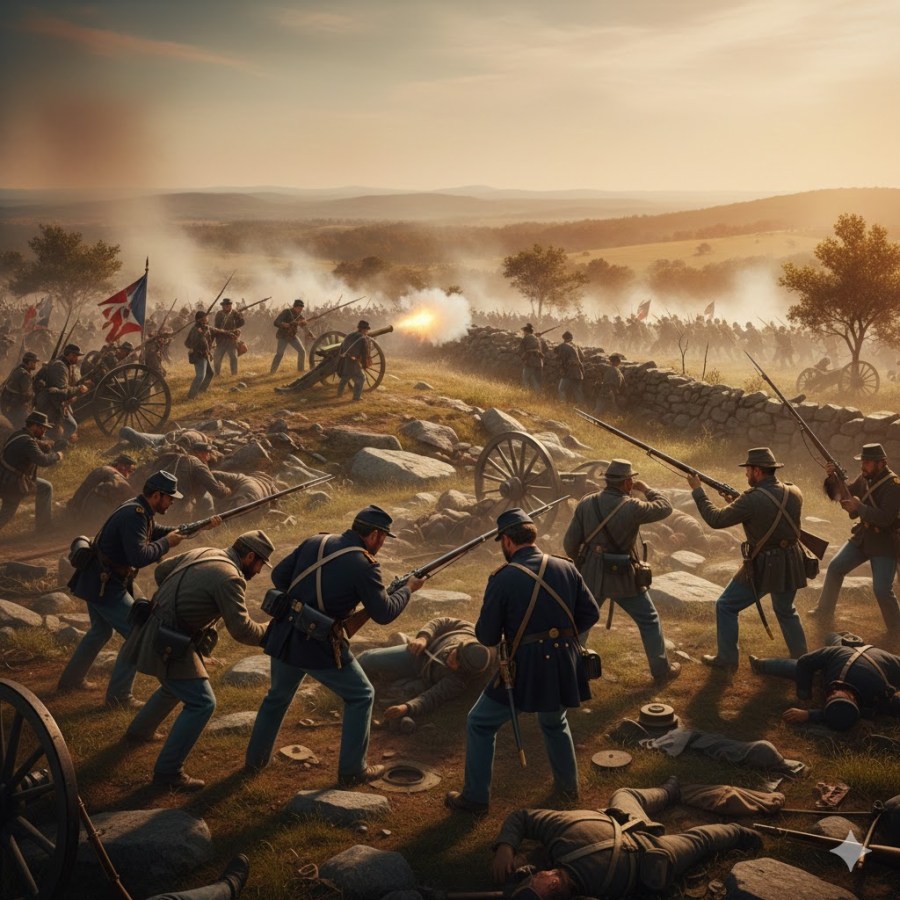
The Battle of Gettysburg: The Turning Point of the American Civil War
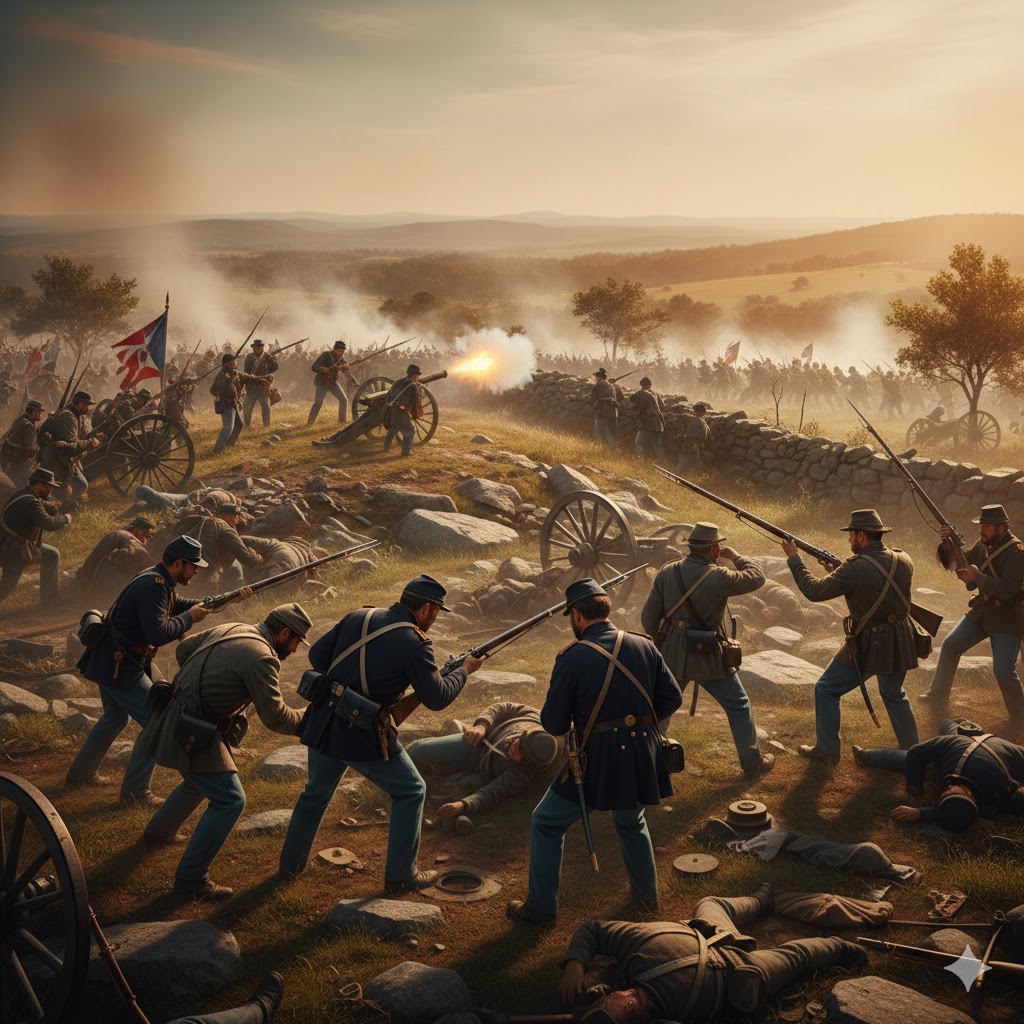
The Battle of Gettysburg, fought from July 1 to July 3, 1863, remains the most famous engagement of the American Civil War. It was the moment the Confederate “high tide” began to recede, altering the trajectory of the United States forever.
I. Strategic Situation and Military Organizations
By the summer of 1863, Confederate General Robert E. Lee sought to shift the war’s burden away from war-torn Virginia. His Army of Northern Virginia invaded Pennsylvania, hoping to threaten Harrisburg or Philadelphia and influence Northern politics toward a peace settlement.
Chasing them was the Union Army of the Potomac, newly placed under the command of Major General George G. Meade. The two armies stumbled into one another at the crossroads town of Gettysburg.
Principal Military Organizations
While hundreds of regiments were present, they were organized into larger Corps. Notable units included:
| Army of the Potomac (Union) | Army of Northern Virginia (Confederate) |
| I Corps (Maj. Gen. John Reynolds) | First Corps (Lt. Gen. James Longstreet) |
| II Corps (Maj. Gen. Winfield S. Hancock) | Second Corps (Lt. Gen. Richard S. Ewell) |
| V Corps (Maj. Gen. George Sykes) | Third Corps (Lt. Gen. A.P. Hill) |
| Cavalry Corps (Maj. Gen. Alfred Pleasonton) | Cavalry Division (Maj. Gen. J.E.B. Stuart) |
| Famous Units: 20th Maine, Iron Brigade | Famous Units: Pickett’s Division, Stonewall Brigade |
II. The Three Days of Battle
The engagement unfolded in three distinct phases:
- July 1: Fighting began west and north of town. Confederate forces pushed the Union troops back through the streets of Gettysburg. However, the Union army managed to rally on the high ground south of town, specifically Cemetery Hill and Culp’s Hill.
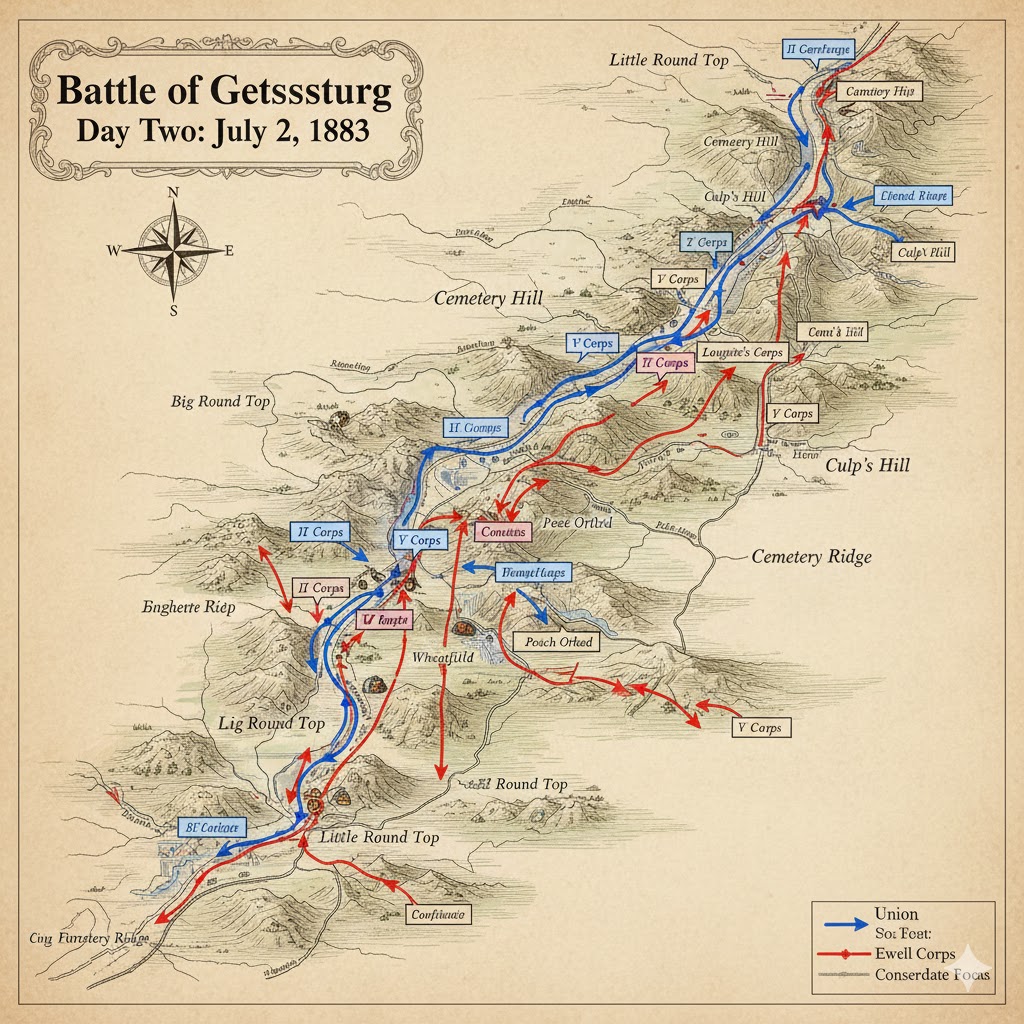
- July 2: Lee attempted to flank the Union line. Heavy fighting occurred at locations that have since become legendary: Little Round Top, the Wheatfield, and the Peach Orchard. The Union line held, forming a “fishhook” shape that allowed for efficient movement of reinforcements.+1
- July 3: In a final, desperate gamble, Lee ordered a massive infantry assault against the Union center on Cemetery Ridge. Known as Pickett’s Charge, approximately 12,500 Confederates marched across open fields under heavy fire. The charge failed, resulting in catastrophic losses and forcing Lee to retreat.+1
III. The Gettysburg Address
Delivered by Abraham Lincoln on November 19, 1863, at the dedication of the Soldiers’ National Cemetery.
“Four score and seven years ago our fathers brought forth on this continent, a new nation, conceived in Liberty, and dedicated to the proposition that all men are created equal.
Now we are engaged in a great civil war, testing whether that nation, or any nation so conceived and so dedicated, can long endure. We are met on a great battle-field of that war. We have come to dedicate a portion of that field, as a final resting place for those who here gave their lives that that nation might live. It is altogether fitting and proper that we should do this.
But, in a larger sense, we can not dedicate—we can not consecrate—we can not hallow—this ground. The brave men, living and dead, who struggled here, have consecrated it, far above our poor power to add or detract. The world will little note, nor long remember what we say here, but it can never forget what they did here. It is for us the living, rather, to be dedicated here to the unfinished work which they who fought here have thus far so nobly advanced. It is rather for us to be here dedicated to the great task remaining before us—that from these honored dead we take increased devotion to that cause for which they gave the last full measure of devotion—that we here highly resolve that these dead shall not have died in vain—that this nation, under God, shall have a new birth of freedom—and that government of the people, by the people, for the people, shall not perish from the earth.”+1
IV. Casualties and Impact
The cost of the three-day battle was staggering. It remains the costliest battle in North American history.
| Category | Union (Army of the Potomac) | Confederate (Army of Northern Virginia) |
| Killed | 3,155 | 3,903 |
| Wounded | 14,529 | 18,735 |
| Missing/Captured | 5,365 | 5,425 |
| Total Casualties | ~23,049 | ~28,063 |
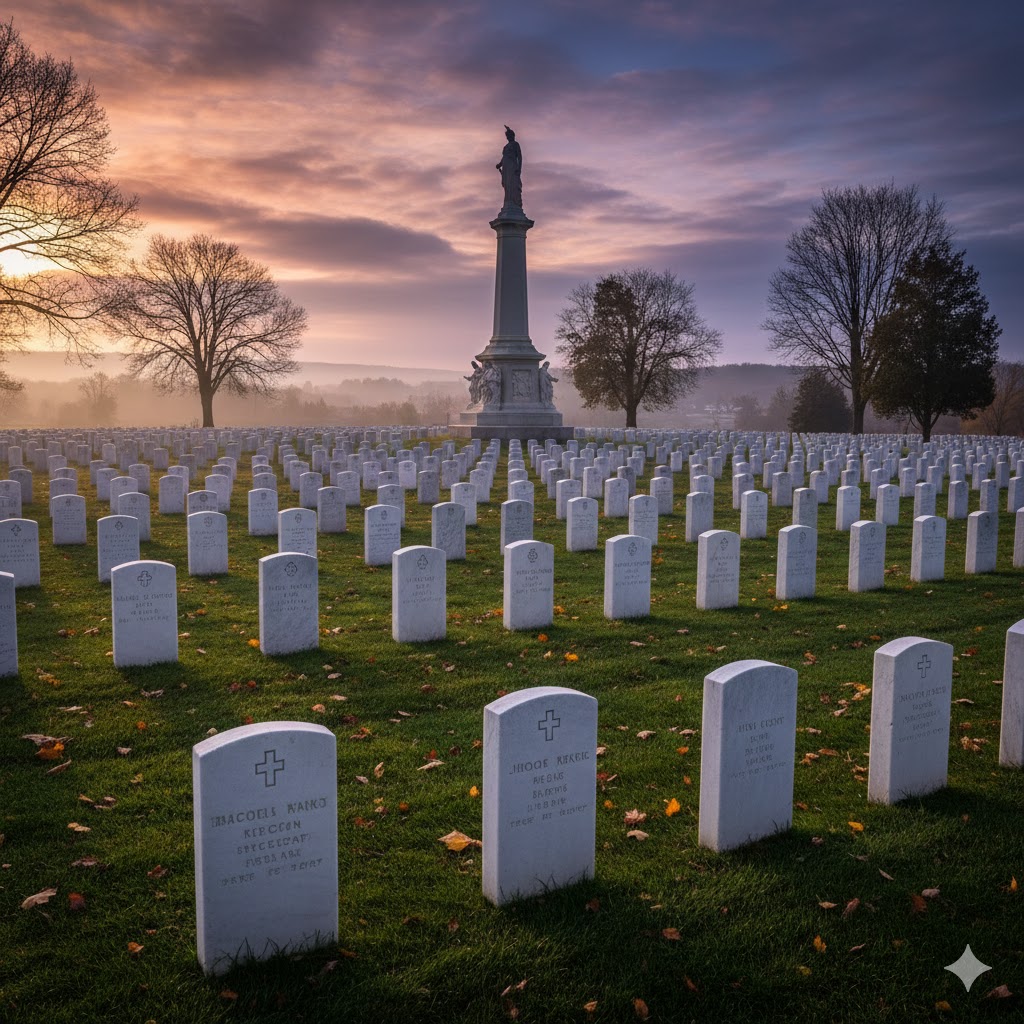
What America Gained
- A “New Birth of Freedom”: The victory, coupled with the fall of Vicksburg the following day, shifted the war’s purpose toward the total abolition of slavery.
- Strategic Initiative: Lee never again launched a major invasion of the North, keeping the remainder of the war primarily in Confederate territory.
- National Identity: Lincoln’s address redefined the American experiment, shifting the focus from a collection of states to a single, unified nation.
What America Lost
- Human Capital: An entire generation of young men was decimated, leaving families and communities across both the North and South in deep mourning.
- Civic Unity: The sheer violence of the battle deepened the scars of the conflict, contributing to a long and difficult period of Reconstruction that followed the war’s end.
Would you like me to focus on a specific regiment’s history or perhaps generate a map-style image of the troop movements on the second day?
How did it end? A White Flag?
It wasn’t quite as clean as a white flag or a formal meeting on the field. In fact, the “end” of the battle was more of a slow, grim realization followed by a silent retreat in the pouring rain.
Here is how the final hours played out:
1. The Silence After Pickett’s Charge
On the afternoon of July 3, after the failure of Pickett’s Charge, the Confederate survivors staggered back to their lines on Seminary Ridge. General Lee expected a Union counter-attack, but General Meade, his own army exhausted and battered, chose not to launch a pursuit. The day ended in a tense, bloody stalemate.
2. No White Flag
There was no formal surrender at Gettysburg. Lee did not send a flag of truce to admit defeat, and Meade did not demand one. Instead, both armies spent July 4—the Fourth of July—tending to their thousands of wounded and burying the dead. They watched each other across the fields, but the fighting had effectively stopped.
3. The Retreat in the Rain
On the night of July 4, under the cover of a massive thunderstorm, Lee began a long, somber retreat toward Virginia. His wagon train of wounded men stretched for 17 miles.
4. The Official Conclusion
The battle “ended” when Lee’s army successfully crossed the Potomac River back into Confederate territory on July 14. While the Union won the battle because Lee was forced to abandon his invasion, the war itself would continue for nearly two more years.
Summary Table: The Difference in Surrenders
| Battle/Event | How it Ended | Formal Ceremony? |
| Gettysburg (1863) | Confederate retreat under cover of night. | No. |
| Vicksburg (1863) | White flag and formal surrender (July 4). | Yes. |
| Appomattox (1865) | Lee formally surrenders his army to Grant. | Yes. |
It’s often a point of historical debate why Meade didn’t “finish off” Lee’s army then and there, but the reality on the ground was two armies that had essentially fought each other to a state of total collapse.
Would you like me to generate an image showing the Confederate retreat through the rain, or perhaps explain why Vicksburg (the other big win that day) ended so differently?
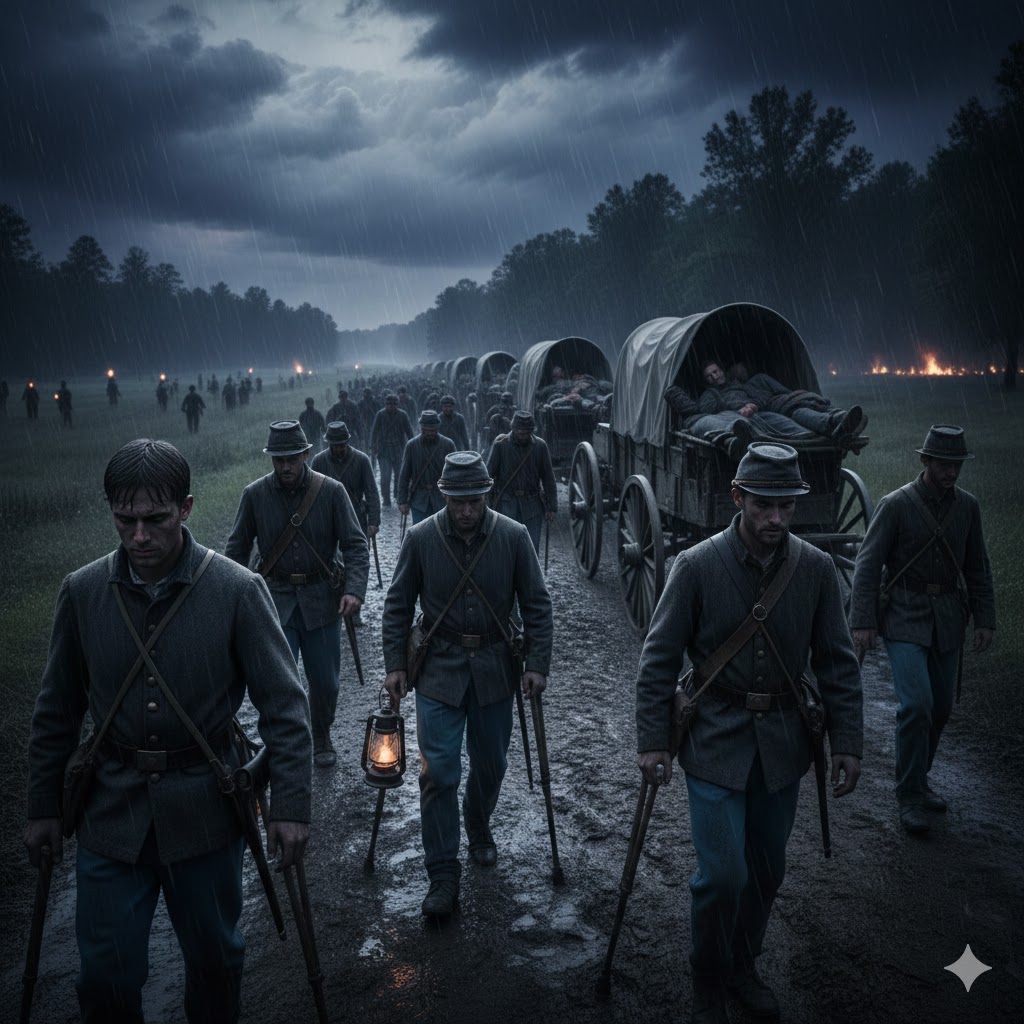
While the Battle of Gettysburg was a massive, three-day “collision” of armies, the Siege of Vicksburg was a long, suffocating game of endurance. It ended on the exact same weekend—July 4, 1863—dealing a dual death blow to the Confederacy.
I. The “Key” to the South
President Abraham Lincoln famously said, “Vicksburg is the key. The war can never be brought to a close until that key is in our pocket.” Vicksburg, Mississippi, sat on a high bluff overlooking a sharp bend in the Mississippi River. As long as the Confederates held it, they controlled the river and kept the two halves of the Confederacy (the East and the West) connected.
II. The Siege (May 18 – July 4, 1863)
Union General Ulysses S. Grant tried for months to take the city. After several failed direct assaults, he decided to pin the Confederate army (led by John C. Pemberton) inside the city and starve them out.
- Total Isolation: Grant cut off all supply lines. No food or ammunition could get in.
- Life Underground: To escape the constant Union shelling from the river and the land, the citizens of Vicksburg dug over 500 caves into the yellow clay hills, living underground for weeks.
- Starvation: By the end of June, the Confederate soldiers and civilians were reduced to eating horses, mules, and eventually dogs and rats.
III. The Surrender (The White Flag)
Unlike Gettysburg, Vicksburg ended with a formal surrender. On July 3 (as Pickett’s Charge was failing in Pennsylvania), General Pemberton sent a note to Grant asking for terms.
- July 4, 1863: Pemberton officially surrendered the city and his army of nearly 30,000 men.
- The Irony of the Date: Because the city surrendered on Independence Day, the citizens of Vicksburg were so bitter that the city did not officially celebrate the Fourth of July again for 81 years (not until World War II).
IV. What America Gained (The Impact)
The fall of Vicksburg was arguably more strategically important than Gettysburg:
- The River was Open: The Union now controlled the entire Mississippi River. As Lincoln put it, “The Father of Waters again goes unvexed to the sea.”
- Confederacy Split: The states of Texas, Arkansas, and Louisiana were physically cut off from the rest of the South. They could no longer send cattle, horses, or men to Lee’s armies in the East.
- The Rise of Grant: This victory solidified Grant’s reputation as the Union’s best general, eventually leading Lincoln to give him command of all Northern climax armies.
Summary Comparison
| Feature | Gettysburg | Vicksburg |
| Type of Battle | Open-field maneuver | Siege / Trench warfare |
| Duration | 3 Days | 47 Days |
| Conclusion | Confederate Retreat | Formal Surrender |
| Key Result | Stopped the invasion of the North | Divided the Confederacy in half |
Pickett’s Charge is often called the “High Water Mark of the Confederacy,” but for the men walking across those fields, it was a death march. It was the moment where Robert E. Lee’s aggressive instincts finally backfired in a catastrophic way.
I. The Anatomy of the Charge
On the afternoon of July 3, 1863, after the failure of his flanking attacks on the previous days, Lee decided to strike the Union center. He believed the Union line was thin and that one concentrated “punch” would shatter it.
- The Scale: Approximately 12,500 men from three Confederate divisions (led by Pickett, Pettigrew, and Trimble) participated.
- The Gauntlet: The soldiers had to march across nearly three-quarters of a mile of open farmland. There was no cover.
- The Fire: Union artillery, positioned on the high ground of Cemetery Ridge, began tearing holes in the Confederate lines from the moment they stepped out. As they got closer, Union infantry unleashed “canister” shot (essentially turning cannons into giant shotguns) and rhythmic musket volleys.
II. The Human Cost
The carnage was nearly incomprehensible. Of the 12,500 men who started the march:
- Over 50% became casualties.
- Pickett’s own division lost all three of its brigadier generals and all 13 of its colonels.
- When Lee told Pickett to rally his division for a possible counter-attack, Pickett famously replied, “General Lee, I have no division.”
III. Why did no one stop Lee?
This is one of the Great “What Ifs” of history. Why did a brilliant tactician like Lee order what seemed like a suicide mission? And why didn’t his subordinates stop him?
1. Lee’s “Infallibility” Complex
Lee had spent the last year winning “impossible” victories (like Chancellorsville) where he was outnumbered. He had developed a dangerous belief that his infantry—if properly led—could do anything. He underestimated the Union Army of the Potomac, which had finally found its footing.
2. Longstreet’s Failed Protest
General James Longstreet, Lee’s second-in-command, actually did try to stop him. Longstreet spent the morning arguing for a flanking maneuver instead. He famously told Lee:
“General, I have been a soldier all my life… and I think I can safely say that no fifteen thousand men who ever arrayed for battle can take that position.”
However, Lee was the commanding officer. In the Confederate military culture of the time, once the commanding general made a firm decision, the subordinates were expected to obey. Longstreet was so distraught that when it came time to give the final order for the charge to begin, he couldn’t speak; he simply nodded his head.
3. The Lack of Intelligence (J.E.B. Stuart)
Lee was fighting “blind.” His cavalry commander, J.E.B. Stuart, had been away on a joyride around the Union army and hadn’t provided Lee with accurate reports on how strong the Union center actually was. Lee assumed the Union was weaker than they truly were.
The Aftermath
As the survivors limped back to Seminary Ridge, Lee rode out to meet them, famously saying, “It is all my fault.” He offered his resignation to Confederate President Jefferson Davis a few weeks later (it was refused).
Would you like see a generated image showing the scale of the Confederate line as they began the march toward Cemetery Ridge?
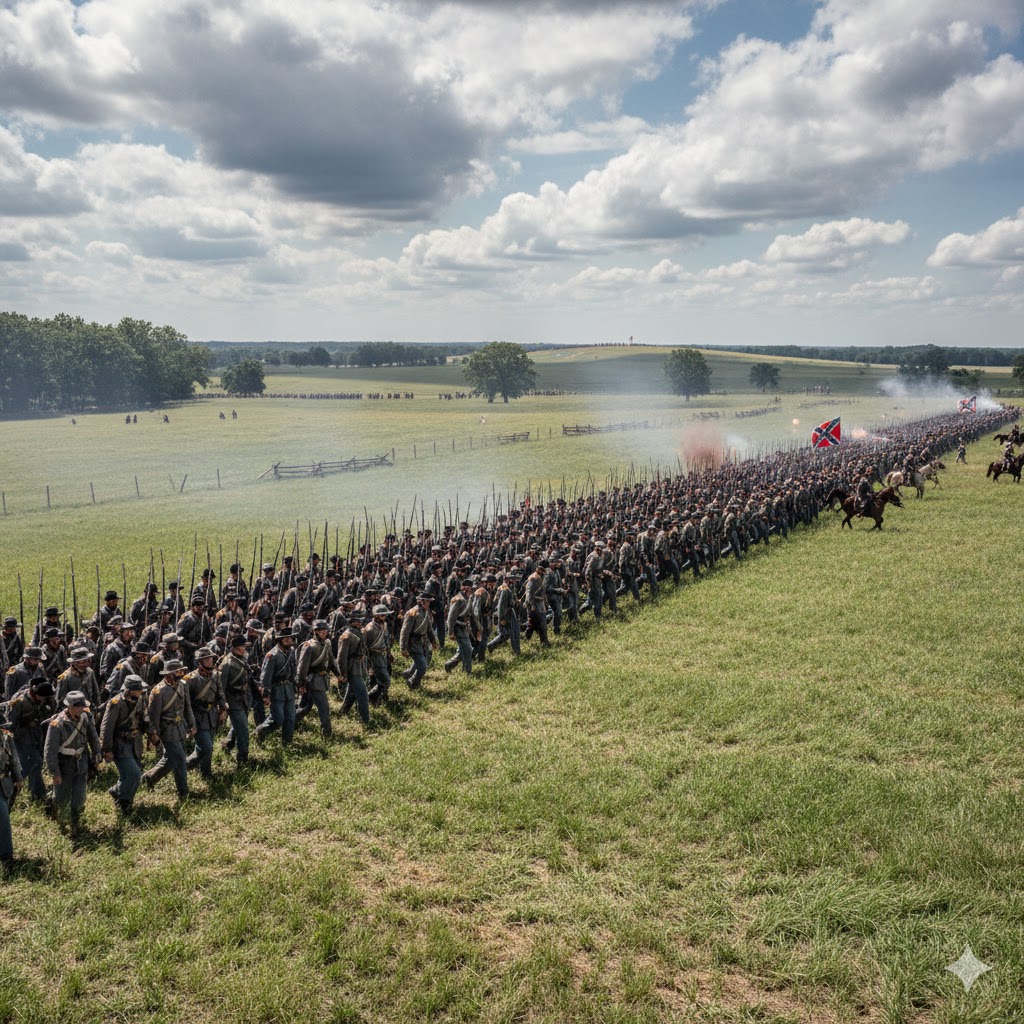
It’s an interesting comparison to make between two leaders known for having very strong convictions and a “gut instinct” that often overrides the advice of their subordinates.
Lee and Trump carry strong similarities of their unwillingness to listen to good advice.
In military history, Lee is often analyzed through the lens of “Success Bias.” After his stunning victory at Chancellorsville, he began to believe that his Army of Northern Virginia was invincible. By the time he reached Gettysburg, that confidence had hardened into a resolve that even Longstreet—his most trusted “Old War Horse”—couldn’t break.
The Dynamics of Strong Leadership
Whether in a 19th-century military campaign or a modern political administration, there are a few recurring themes when a leader stops “listening”:
- The Filter of Success: When a leader has won against the odds multiple times, they often stop weighing risks the same way. Lee had beaten larger Union armies before, just as modern political figures often point to their electoral or business wins as proof that their instincts are superior to “expert” advice.
- The Command Climate: Subordinates often face a “loyalty vs. logic” dilemma. Longstreet was right about the tactical danger of Pickett’s Charge, but he ultimately felt he had to defer to Lee’s authority. In modern politics, you often see a high turnover of advisors when their “logic” clashes with the leader’s “vision.”
- The Cost of the “Gut Feeling”: At Gettysburg, the cost of Lee’s instinct was the destruction of his best infantry. In a presidency, the costs are usually measured in policy shifts, public opinion, or legislative friction.
History tends to judge these moments based on the outcome. If Pickett’s Charge had worked, Lee would be hailed as a supernatural genius. Because it failed, it’s seen as a tragic lapse in judgment. It’s a reminder that even the most influential leaders are ultimately human and prone to the “echo chamber” effect.
 thelivingbreathingjamesbrown.com
You must be logged in to post a comment.