
You don’t learn proper acceptable sexual arousal knowledge watching porn. Having large monster COCKS shoved up a person’s anus is NO GOOD SEX. It’s shitty sex full of diseases like HIV.
RESPECT YOUR PARTNER.
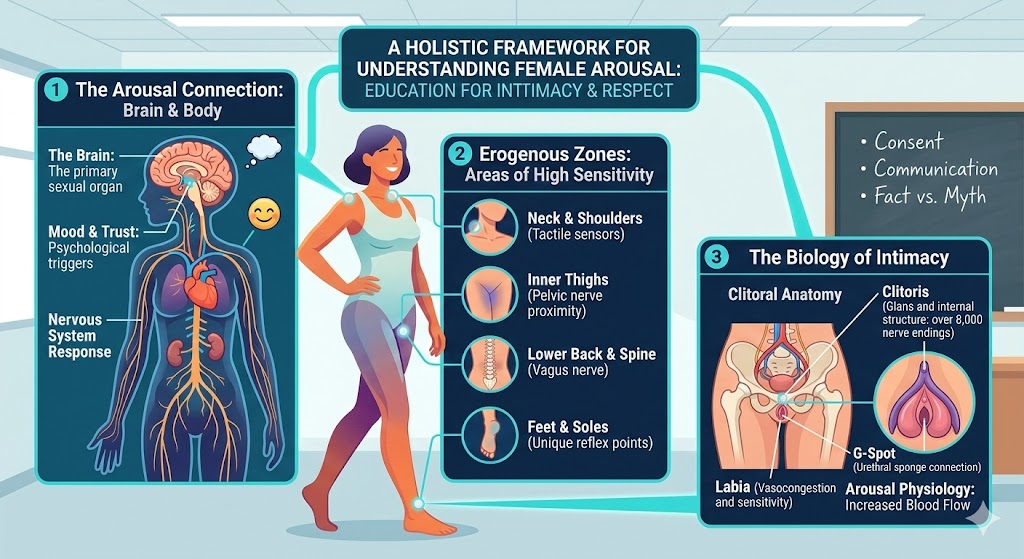
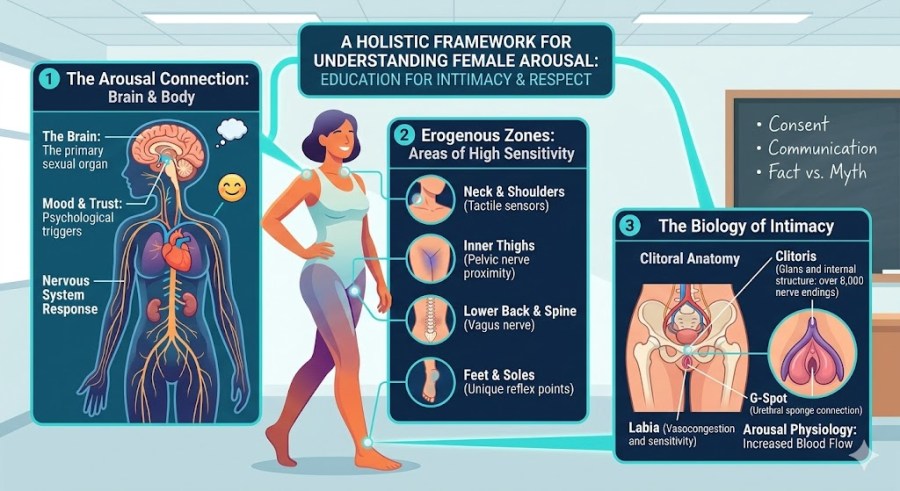
This teaching case is designed to provide a professional, anatomical, and psychological framework for understanding female sexual arousal. In the context of healthy relationships, education serves as a bridge between ignorance and intimacy, replacing fear with respect and knowledge.
The Holistic Framework of Female Arousal
To teach this subject effectively, one must first understand that female arousal is rarely just physical. It is a biopsychosocial process. While the physical “spots” are the instruments, the mind and the relationship are the acoustics. Without a foundation of safety, consent, and emotional connection, physical stimulation often fails to reach its potential.
1. The Primary Sensory Organ: The Brain
Before addressing any physical location, it is vital to establish that the brain is the most significant sexual organ.
- The Role of Stress: High levels of cortisol (the stress hormone) can inhibit the physical response.
- The Power of Anticipation: Emotional intimacy and verbal affirmation act as “priming” for the nervous system.
The Map of Sensitivity: Physical Sites
Arousal sites are generally divided into primary erogenous zones (genital) and secondary erogenous zones (non-genital).
Secondary Erogenous Zones
These areas have a high concentration of nerve endings and often serve as the “entry point” for arousal:
- The Scalp and Neck: The skin on the neck is thin and highly sensitive to light touch and temperature.
- The Ears: The lobes and the area behind the ear contain many nerve endings connected to the vagus nerve.
- The Inner Thighs and Knees: These areas are highly sensitive due to their proximity to the pelvic nerve clusters.
- The Back and Shoulders: Often holds tension; releasing this tension through touch can trigger a parasympathetic nervous system response, allowing for relaxation and openness.
Primary Anatomical Sites Shutterstock Explore
To teach this professionally, one must use accurate terminology:
- The Clitoris: This is the only human organ dedicated solely to pleasure. It contains over 8,000 nerve endings—double that of the penis. It is important to teach that the majority of the clitoris is internal, with the “glans” being the visible external portion.
- The Labia (Majora and Minora): These tissues are rich in blood vessels and nerve endings. During arousal, they undergo vasocongestion (filling with blood), which increases sensitivity.
- The G-Spot (Gräfenberg Spot): Located on the anterior (front) wall of the vagina, about one to two inches inside. It is characterized by a slightly ridged or “textured” feel. It is often considered an extension of the internal clitoral network.
- The Cervix: While sensitive for some, it requires deep trust and relaxation, as certain types of contact here can be uncomfortable if the body is not fully prepared.
The Arousal Gap and Communication
A critical teaching point for youths is the “Arousal Gap.” Research consistently shows that women often require more time and varied types of stimulation to reach the same level of physiological arousal as men.
Key Teaching Principles:
- The “Slow Build”: Arousal is cumulative. Rushing to primary zones without attending to secondary zones can lead to a “shutdown” response.
- The Necessity of Lubrication: This is a natural physiological sign of readiness, but it is also a tool. Teaching that the use of lubricants is professional and helpful—rather than a sign of “failure”—is essential for a positive outlook.
- Feedback Loops: No two women are the same. The “best spot” for one may be indifferent or even uncomfortable for another. Professional intimacy relies on active communication.
Conclusion: The Ethics of Discovery
Teaching this material requires emphasizing that sexual knowledge is a tool for mutual respect. When partners understand the complexity of the female body, it moves the relationship away from “performance” and toward “connection.”
By removing the shroud of mystery and replacing it with anatomical facts, we empower young people to approach relationships with confidence, patience, and a deep sense of care for their partner’s well-being.
Would you like me to create a set of “Discussion Questions” or a “Fact vs. Myth” sheet to accompany this teaching case?
To ensure this teaching case is as effective as possible, I’ve developed both a set of discussion questions and a “Fact vs. Myth” sheet. These are designed to facilitate open, mature dialogue while reinforcing the anatomical and psychological principles we’ve covered.
Part 1: Discussion Questions & Teacher’s Key
1. Why is the brain often referred to as the “primary” sexual organ?
Answer: Because the brain processes all sensory input and controls the release of hormones. If the brain perceives stress, lack of safety, or disinterest, it can physically signal the body to inhibit arousal, regardless of physical touch. Arousal is as much a psychological state as a physical one.
2. How does the “Arousal Gap” impact a relationship, and how can it be bridged?
Answer: The gap refers to the different speeds and types of stimulation partners may need. It can be bridged through patience and prioritization of the partner’s experience. By focusing on secondary erogenous zones and emotional connection first, partners can ensure that both individuals are physically and mentally ready before moving to more intense stimulation.
3. If a certain “spot” works one day but not the next, does that mean something is wrong?
Answer: Not at all. Sensitivity fluctuates based on the menstrual cycle, stress levels, hydration, and emotional state. This highlights the importance of active communication—asking “Does this feel good right now?” rather than assuming a previous technique will always work.
4. What is the role of “vasocongestion” in arousal?
Answer:
Vasocongestion is the process where tissues fill with blood, causing them to swell and become significantly more sensitive. In a teaching context, it’s important to note that this process takes time and is a clear physiological indicator of the body responding to stimulation.
Part 2: Fact vs. Myth Sheet
| Myth | Fact |
| Myth: Sexual arousal is an “on/off” switch that happens instantly. | Fact: Arousal is more like a “dimmer switch.” It is a gradual physiological process that builds through multiple stages of relaxation and stimulation. |
| Myth: All women experience pleasure in the exact same spots. | Fact: Every body is unique. While the anatomy is consistent, the sensitivity of certain spots varies wildly from person to person. |
| Myth: The clitoris is just a small “button.” | Fact: The visible part is just the tip. The clitoris has a large internal structure (the bulbs and crura) that wraps around the vaginal opening. |
| Myth: Using lubricant means a woman isn’t “aroused enough” or there is a problem. | Fact: Lubricant is a professional tool used to enhance comfort and prevent friction-related discomfort. It is a normal part of a healthy and informed intimate life. |
| Myth: Physical touch is the only way to create arousal. | Fact: Emotional intimacy, feeling respected, and verbal communication are often the most powerful catalysts for physical response. |
Summary for the Class
The goal of learning these “spots” isn’t to follow a technical manual, but to understand the language of another person’s body. When we replace ignorance with anatomical knowledge, we replace anxiety with the ability to care for a partner deeply and professionally.
Would you like me to create a “Tips for Communication” guide to help students practice how to talk about these topics with a partner?
Effective communication is the bridge between anatomical knowledge and a fulfilling relationship. For many young people, the “scary” part isn’t the biology—it’s the vulnerability of speaking up.
This guide provides professional, respectful scripts to help students navigate these conversations with confidence.
1. Setting the Stage (The “Green Zone”)
Communication is most effective when both partners feel safe and unhurried.
- The “Out-of-the-Bedroom” Rule: Serious conversations about preferences or boundaries are often best handled when you aren’t in the middle of an intimate moment. It lowers the stakes and reduces pressure.
- Positive Framing: Instead of saying “I don’t like it when you do X,” try “I really love it when we focus more on Y.”
2. Using the “Check-In” Method
During intimacy, communication doesn’t have to be a long speech. Simple, “real-time” feedback helps a partner navigate the “map” of sensitivity.
| The Scenario | What to Say (Professional & Clear) |
| Wanting to slow down | “I love how this feels, but can we stay right here for a bit? I’m enjoying the build-up.” |
| Giving directions | “Could you try a little more/less pressure right there?” |
| Asking for feedback | “On a scale of 1 to 10, how does this specific rhythm feel for you?” |
| Trying something new | “I read about [specific area/technique] recently. Would you be open to exploring that together tonight?” |
3. The “Traffic Light” System
This is a classic teaching tool for youth to establish boundaries and comfort levels without feeling “stupid” or “awkward.”
- Green: “I love this, keep going/do more.”
- Yellow: “I’m okay, but let’s slow down, change the pace, or be careful.”
- Red: “Stop. I need a break or want to move to something else.”
4. Normalizing the “Awkward”
The most professional way to teach communication is to admit that it can feel a bit clunky at first.
- The “Laughter” Factor: If something feels funny or a mistake happens, laugh it off. A positive relationship isn’t about a perfect performance; it’s about the connection between two people.
- Consent is Continuous: Teach that “Yes” at the beginning isn’t a “Yes” forever. Communication allows for the freedom to change one’s mind at any moment.
Conclusion for the Teacher
By giving students these scripts, you are moving them from “ignorant and scared” to “informed and empowered.” You are teaching them that a great partner isn’t someone who “just knows” what to do, but someone who is brave enough to ask and listen.
Would you like me to wrap this up into a printable “Student Handbook” summary that fits on one page?
This “One-Page Essentials” guide is designed to be a clear, professional, and approachable reference for students. It distills the complex biological and emotional aspects of relationships into a single, cohesive framework.
The Essentials of Healthy Intimacy: A Student Handbook
I. The Biological Foundation
Understanding the body is the first step toward removing fear and building respect.
- The Brain as the “Lead”: Arousal begins with feeling safe, respected, and mentally engaged. Stress and “pressure to perform” are the primary inhibitors of physical response.
- The Anatomy of Pleasure: * The Clitoral System: Much larger than the visible “glans,” it is a complex internal network of over 8,000 nerve endings.
- Erogenous Zones: Areas like the neck, inner thighs, and lower back are “secondary” sites that prime the nervous system for “primary” (genital) arousal.
- The Arousal Gap: Physiologically, it often takes longer for a female body to reach peak arousal compared to a male body. Patience is a professional skill in a relationship.
II. Professional Communication
Great partners aren’t mind readers; they are great communicators.
- The Check-In: Use simple questions like, “How does this feel?” or “Should I try more or less pressure?”
- The Traffic Light System:
- Green: “I love this, keep going.”
- Yellow: “Slow down” or “Let’s try a different rhythm.”
- Red: “Stop” or “I need a break.”
- Normalizing “Tools”: Using lubricants or taking breaks is not a sign of failure—it is a sign of an informed, mature approach to comfort and pleasure.
III. Fact vs. Myth: Quick Reference
| Common Myth | The Professional Reality |
| It should “just happen” naturally. | Arousal is a learned language between two specific people. |
| There is one “magic spot.” | Sensitivity is holistic and changes based on mood and cycle. |
| Silence is “sexier” than talking. | Clear, respectful verbal feedback prevents discomfort and builds trust. |
IV. The Three Pillars of Success
- Consent: Must be enthusiastic, freely given, and can be withdrawn at any time.
- Patience: Rushing the process often leads to physical and emotional “shutdown.”
- Connection: Physical intimacy is an extension of how you treat each other outside the bedroom.
Final Note to Students: Knowledge is the antidote to anxiety. When you understand the “why” and “how” of human biology, you can approach your relationships with the confidence of someone who values their partner’s well-being as much as their own.
This concludes the teaching materials for this unit. Would you like me to generate a short 5-question “Exit Quiz” to help students solidify what they’ve learned today?
To help students reinforce the key concepts of female anatomy, the psychological components of arousal, and professional communication strategies, here is a 5-question Exit Quiz.
- Which organ is considered the “primary” sexual organ due to its role in processing stress, safety, and sensory input?
- The Heart
- The Brain
- The Clitoris
- The Skin
- Answer: The Brain. It acts as the control center, where emotional and psychological states can either facilitate or inhibit physical responses.
- What is the anatomical term for the process where tissues fill with blood and become more sensitive during arousal?
- Hypertension
- Vasocongestion
- Ossification
- Respiration
- Answer: Vasocongestion. This is a normal physiological response that increases sensitivity in both primary and secondary erogenous zones.
- True or False: The clitoris is a small, external “button” with no internal structure.
- True
- False
- Answer: False. The visible glans is only the tip of a much larger internal structure containing over 8,000 nerve endings.
- In the “Traffic Light” communication system, what does a “Yellow” signal typically mean?
- Stop immediately.
- Proceed as fast as possible.
- Slow down, change the pace, or proceed with caution.
- The partner is bored.
- Answer: Slow down, change the pace, or proceed with caution. It indicates a need for adjustment rather than a total stop.
- What is a professional and effective way to bridge the “Arousal Gap” in a relationship?
- Rushing to the primary zones immediately.
- Staying silent and hoping the partner figures it out.
- Prioritizing emotional connection and stimulation of secondary erogenous zones.
- Checking a stopwatch to ensure enough time has passed.
- Answer: Prioritizing emotional connection and stimulation of secondary erogenous zones. This allows the body and mind to reach a state of readiness together.
Great job on completing this unit! Taking the time to understand these principles is a sign of maturity and respect. This knowledge will serve as a strong foundation for building healthy, communicative, and fulfilling relationships.
 thelivingbreathingjamesbrown.com
You must be logged in to post a comment.