
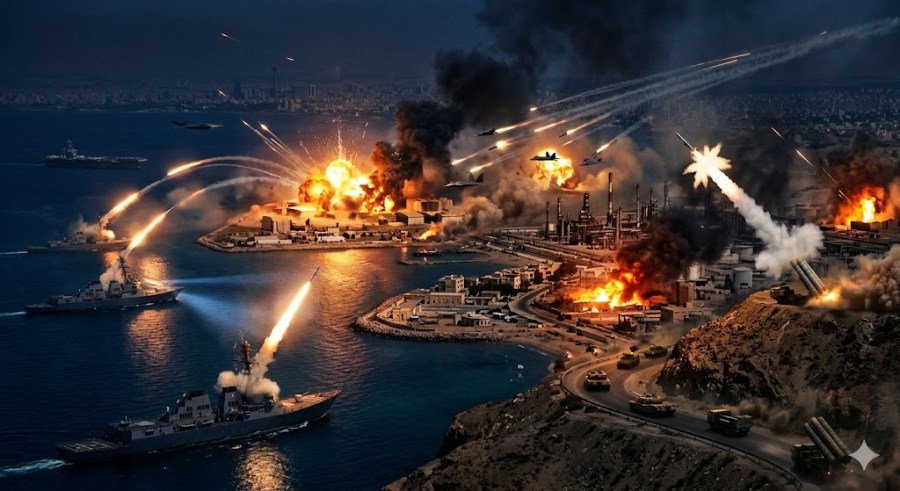
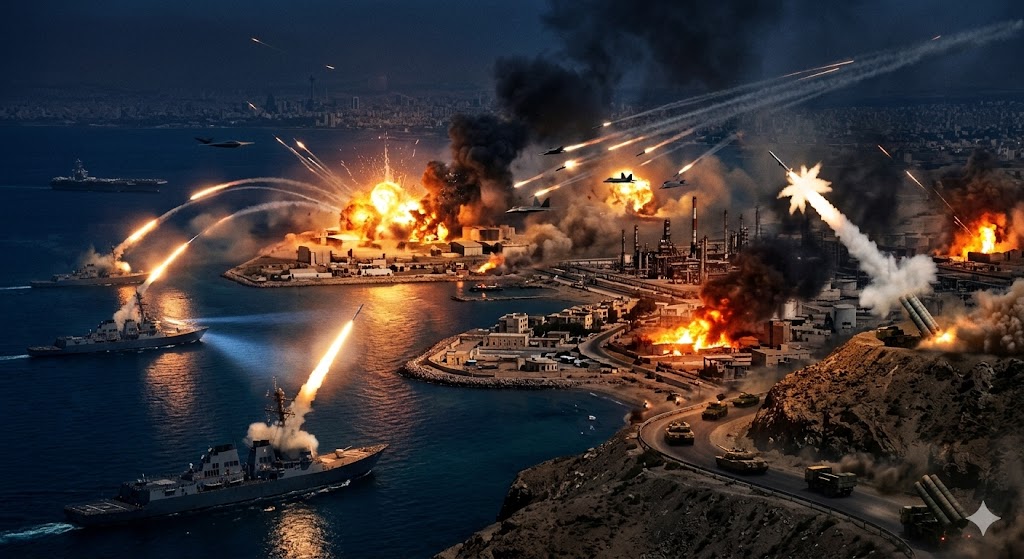
According to multiple reports from today, Saturday, February 28, 2026, a massive joint military operation between the U.S. and Israel has reportedly resulted in the death of Iran’s Supreme Leader, Ali Khamenei.
Here is the current situation based on the latest breaking news:
The Military Operation
- Operations Named: The U.S. has designated its involvement as “Operation Epic Fury,” while Israel’s campaign is titled “Operation Lion’s Roar.”
- The Strike: Khamenei was reportedly killed in a strike on his compound in Tehran. Israeli officials have confirmed his death to U.S. authorities, and reports indicate his body has been recovered from the rubble.
- Leadership Vacuum: President Trump stated that “most” of Iran’s senior leadership has been eliminated in the strikes, including the Minister of Defense and the commander of the Islamic Revolutionary Guard Corps (IRGC).
The Political Aftermath
- President Trump’s Message: In a video address, President Trump called on the Iranian people to “seize control of your destiny” and urged the IRGC to lay down their arms in exchange for immunity.
- Succession Crisis: Under the Iranian constitution, a council of clerics should select a successor. However, with the chain of command in disarray and the IRGC targeted, it is unclear who—if anyone—is currently in control of the state apparatus.
- Conflicting Reports: While U.S. and Israeli intelligence are “certain” of the death, some Iranian officials (including Foreign Minister Abbas Araghchi) initially claimed earlier today that Khamenei was safe, calling the reports “mental warfare.”
What to Watch For
- Public Uprising: Both Prime Minister Netanyahu and President Trump have encouraged Iranian citizens to take to the streets to topple the remaining regime.
- Global Reaction: The UN Security Council is expected to meet this afternoon. Meanwhile, major airspaces in the Middle East have closed, and U.S. embassies in the region have issued shelter-in-place orders for staff.
This is a rapidly evolving situation.
As of Saturday, February 28, 2026, the United States has assembled its largest naval “armada” in the Middle East since the 2003 invasion of Iraq. Under Operation Epic Fury, at least 17 American warships are currently positioned in the theater to conduct strikes and defend against retaliation.
Aircraft Carrier Strike Groups
The backbone of the U.S. presence consists of two massive carrier strike groups, providing “overlapping arcs” of airpower:
- USS Abraham Lincoln (CVN-72): Currently operating in the Arabian Sea (approximately 200 miles off the coast of Oman). It has been in the region since late January and leads Carrier Strike Group 3, which includes nine aircraft squadrons (F-35C Lightning IIs and F/A-18E/F Super Hornets).
- USS Gerald R. Ford (CVN-78): The world’s largest aircraft carrier is currently positioned in the Eastern Mediterranean, off the coast of Israel. It was redirected from the Caribbean in mid-February to support these operations.
Surface Combatants by Location
In addition to the carriers, a fleet of guided-missile destroyers and cruisers is distributed across the region’s key waterways:
| Region | Ships Identified | Role |
| Persian Gulf | USS Mitscher + 3 additional destroyers | Monitoring Iranian ports; providing local air defense. |
| Arabian Sea | USS Spruance + 3 additional destroyers | Escorting the Abraham Lincoln; launching Tomahawk cruise missiles. |
| Strait of Hormuz | USS McFaul (Cruiser) | Ensuring freedom of navigation and escorting tankers. |
| Red Sea | USS Delbert D. Black | Defending against Houthi or Iranian long-range missile threats. |
| Mediterranean | USS Roosevelt, USS Bulkeley + 3 destroyers | Escorting the Gerald R. Ford; providing ballistic missile defense for Israel. |
Small Combatants & Support
- Littoral Combat Ships (LCS): Three LCS vessels are currently operating in the Persian Gulf, used for shallow-water maneuvers and countering Iranian fast-attack craft.
- USNS Support Ships: At least two combat logistics ships are at sea to keep the strike groups refueled and rearmed during the ongoing campaign.
Key Developments
- Fleet HQ Evacuation: Reports indicate that the U.S. 5th Fleet Headquarters in Bahrain has been reduced to fewer than 100 mission-critical personnel, with all ships having left port as a defensive measure against Iranian counterstrikes.
- Strike Capacity: Combined, these naval assets are capable of generating several hundred strike sorties per day. The initial wave of attacks this morning included a significant barrage of Tomahawk cruise missiles launched directly from these destroyers and cruisers.
As of Saturday, February 28, 2026, the U.S. Navy’s cruiser presence in the Middle East is historically low due to the ongoing decommissioning of the Ticonderoga-class. While the Navy’s strike force for Operation Epic Fury relies heavily on 14 guided-missile destroyers, there are currently only two active cruisers confirmed in the immediate theater:
Cruisers Currently in the Region
- USS Gettysburg (CG-64): Operating in the Eastern Mediterranean as part of the USS Gerald R. Ford (CVN-78) Strike Group. The Gettysburg serves as the primary Air Defense Commander for the carrier, utilizing its advanced Aegis Baseline 9 system to protect the fleet from Iranian long-range ballistic missile retaliation.
- USS Robert Smalls (CG-62): (Formerly the USS Chancellorsville). While usually forward-deployed to Japan, the Robert Smalls was redirected to the North Arabian Sea earlier this month to provide air defense and command-and-control for the USS Abraham Lincoln (CVN-72) Strike Group.
Classification Correction
In earlier reports today, the USS McFaul was mentioned as a cruiser; however, it is officially an Arleigh Burke-class guided-missile destroyer (DDG-74). While it carries a similar missile load to a cruiser (including the Tomahawks used in this morning’s strikes), it is technically a destroyer.
The Vanishing Class
The shortage of cruisers is due to the U.S. Navy’s aggressive retirement schedule for the Ticonderoga class. Just since the start of the 2025/2026 fiscal year, several cruisers that traditionally patrolled the Middle East have been removed from service:
- USS Philippine Sea (CG-58): Decommissioned September 2025.
- USS Normandy (CG-60): Decommissioned September 2025.
- USS Princeton (CG-59): Currently in the process of inactivation.
Current Strike Capability
Despite having only two cruisers, the U.S. has compensated by deploying nine destroyers to the Arabian Sea and five destroyers to the Mediterranean. These destroyers (like the USS Mitscher and USS Spruance) carry the bulk of the Maritime Strike Tomahawks (MST) currently being used to target Iranian missile infrastructure.
Would you like me to list the specific Destroyers currently launching strikes in the Persian Gulf?
As of Saturday, February 28, 2026, the Persian Gulf and its immediate approaches are heavily patrolled by U.S. Arleigh Burke-class destroyers actively participating in Operation Epic Fury.
According to the latest reports from U.S. Central Command (CENTCOM), these ships are currently providing both offensive cruise missile capability and localized air defense for regional bases under retaliatory fire.
Destroyers Positioned in the Persian Gulf & Strait of Hormuz
These vessels are in the most volatile zone, operating directly off the Iranian coast:
- USS Mitscher (DDG-57): Stationed near the Strait of Hormuz. It has been a primary platform for Tomahawk launches against IRGC command-and-control centers and air defense batteries in southern Iran.
- USS Michael Murphy (DDG-112): Operating within the Persian Gulf. It is providing critical Aegis ballistic missile defense for U.S. installations in Bahrain and Kuwait, which have been targeted by Iranian counter-strikes today.
- USS McFaul (DDG-74): Positioned near the Strait of Hormuz/Gulf of Oman. The McFaul is tasked with ensuring the waterway remains open for maritime traffic while contributing to the second wave of precision strikes on Iranian naval bases.
Destroyers in the North Arabian Sea (Lincoln Strike Group)
These ships provide long-range strike support for the USS Abraham Lincoln (CVN-72):
- USS Spruance (DDG-111)
- USS Frank E. Petersen Jr. (DDG-121)
- USS John Finn (DDG-113)
- USS Pinckney (DDG-91)
Current Strike Status
- Ammunition: These destroyers have launched hundreds of Tomahawk Land Attack Missiles (TLAM) since the operation began at 1:15 AM ET.
- Combat Debut: Task Force Scorpion Strike is reportedly using these ships as “mother ships” for the combat debut of low-cost, one-way attack drones to overwhelm Iranian radar systems.
- Retaliation: CENTCOM has confirmed that while these destroyers have intercepted “hundreds” of incoming Iranian drones and missiles, there have been no U.S. casualties or significant damage to the fleet as of this afternoon.
Would you like me to find out the status of the Iranian “counter-strikes” currently hitting U.S. bases in Bahrain and Qatar?
As of 3:25 PM CST on Saturday, February 28, 2026, the situation in the Persian Gulf has escalated into a major regional exchange. Iran’s Islamic Revolutionary Guard Corps (IRGC) has launched multiple waves of retaliatory ballistic missile and drone strikes targeting U.S. military installations and allied infrastructure across several Gulf states.+1
Here is the current status of the counter-strikes:
Status of U.S. Bases in the Region
| Location | Base/Facility | Reported Status |
| Bahrain | U.S. Fifth Fleet HQ (Manama/Juffair) | Direct Hit Reported. Multiple sources confirm a massive explosion and mushroom cloud rising from the Fifth Fleet’s logistics and service center. Local authorities are urging residents to shelter in place. |
| Qatar | Al Udeid Air Base | Intercepted. Qatari and U.S. Patriot missile batteries reportedly intercepted at least three incoming ballistic missiles. Smoke has been seen over Doha, but the base remains operational. |
| UAE | Al Dhafra Air Base | Under Attack. Witnesses reported smoke rising from the base. Air defenses in Abu Dhabi were active, but at least one fatality has been reported in the city. |
| Kuwait | Ali Al Salem Air Base | Under Attack. The Kuwaiti Chief of Staff confirmed air defense systems engaged multiple incoming threats. Kuwait’s airspace is currently closed. |
| Iraq | Erbil Air Base | Drone Strike. An Iraqi militia group claimed a drone strike on U.S. assets in Erbil; intercepts were reported earlier in the day. |
Key Developments
- Casualties & Damage: While CENTCOM (U.S. Central Command) initially stated they had suffered “no casualties” and only “light damage,” local reports from Bahrain suggest the impact on the Fifth Fleet base was significant. In Iran, the Red Crescent reports at least 201 dead and 747 injured from the initial U.S.-Israeli strikes.
- Strait of Hormuz: The IRGC has issued radio transmissions declaring that no ships are allowed to pass through the Strait of Hormuz. This blockade, if maintained, threatens a third of the world’s sea-borne oil supply.+1
- Civilian Impact: Major international airports, including Dubai International (DXB), have halted all flights indefinitely. Airspace over Israel, Jordan, Iraq, Kuwait, Qatar, and the UAE is either partially or fully closed.
The “Epic Fury” Context
President Trump has stated that these strikes are intended to “topple the regime” and eliminate Iran’s missile and nuclear programs. In response, Iran’s Foreign Ministry has characterized these retaliatory strikes as an act of self-defense under Article 51 of the UN Charter.
 thelivingbreathingjamesbrown.com
You must be logged in to post a comment.