
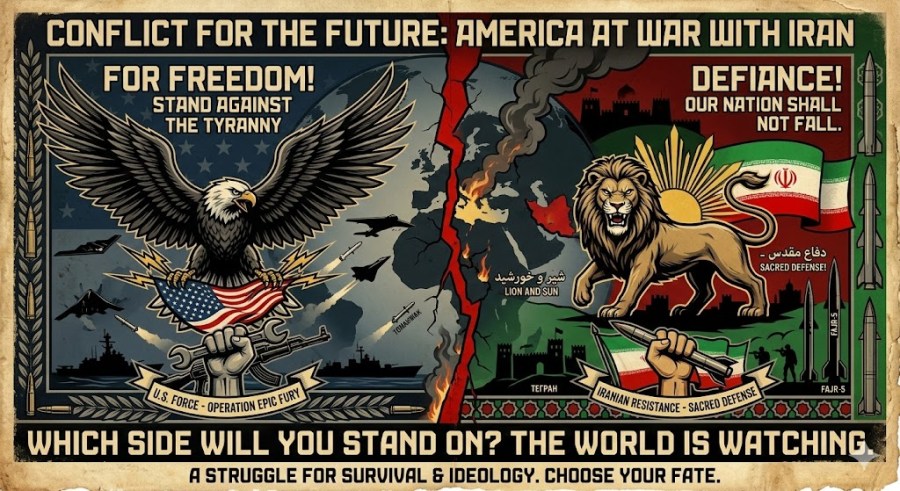
The question of whether a President needs permission from Congress to go to war is one of the most significant “gray areas” in American law. While the Constitution and the War Powers Resolution of 1973 provide a framework, the reality often depends on how a President interprets their own authority.+1
Here is the breakdown of how this works in the context of the current strikes:
1. The Constitutional Conflict
The U.S. Constitution splits war-making power between two branches:
- Congress (Article I): Has the sole power to “Declare War” and to fund the military.
- The President (Article II): Is the “Commander in Chief,” giving them the authority to direct the military and respond to “imminent threats” to national security.
2. The War Powers Resolution of 1973
This law was created to prevent “forever wars” started without Congressional input. It allows a President to send troops into combat without prior approval, but with strict conditions:
- The 48-Hour Rule: The President must notify Congress within 48 hours of starting military action.
- The 60-Day Clock: Hostilities must end within 60 days unless Congress officially authorizes a continuation or declares war.
3. How It’s Being Applied Today (Operation Epic Fury)
For the current strikes in Iran, the Trump administration is using a familiar legal strategy:
- “Imminent Threat” Justification: The White House and Secretary of State Marco Rubio have argued that Iran’s nuclear progress and missile capabilities posed an “irreversible and immediate threat” to U.S. lives and interests. Under this interpretation, the President has the constitutional right to act preemptively to defend the country without waiting for a vote.
- Notification vs. Permission: The administration notified the “Gang of Eight” (top leaders from both parties and intelligence committees) shortly before the strikes began. To the White House, this fulfills the legal requirement for “consultation,” even though it wasn’t a request for “permission.”
4. Can Congress Stop It?
Congress is currently deeply divided.
- Supporters: Many, like House Speaker Mike Johnson and Senate Majority Leader John Thune, argue the President’s actions are a necessary response to “evil actions” and don’t require a new vote.
- Opponents: Senators like Tim Kaine and Mark Warner argue that an open-ended operation aimed at “regime change” is an unconstitutional act of war that requires a formal declaration.
Historically, even when Congress passes a resolution to stop a war, the President can veto it. To override that veto, Congress needs a two-thirds majority—a very high bar that has rarely been met in war-powers history.
The UN Security Council meeting is starting now. Would you like me to summarize the global response and whether any nations are calling for immediate sanctions?
The emergency UN Security Council (UNSC) session convened today, February 28, 2026, at 4:00 PM EST, amidst what is being described as the most significant military escalation in the Middle East in decades. The meeting has been characterized by sharp divisions, with the world’s major powers essentially splitting into two camps.
The UN Leadership Response
Secretary-General António Guterres opened the session with a stark warning, stating that the region is on “the brink of a potential wider conflict with grave consequences.”
- Condemnation of All Sides: Guterres condemned the U.S.-Israeli strikes for violating international law, but also criticized Iran’s retaliatory strikes on Bahrain, Qatar, and the UAE as a violation of those nations’ territorial integrity.
- The “Negotiation” Plea: He called for an immediate cessation of hostilities and a return to the diplomatic table, warning of “destruction on an unimaginable scale.”
Global Stance & Calls for Sanctions
The council is currently deadlocked, with the “Permanent Five” (P5) members taking opposing sides:
| Group | Countries | Position |
| The Critics | Russia, China | Demanding Sanctions Against U.S./Israel. Russia called the strikes a “preplanned act of armed aggression” and is pushing for a resolution to condemn the “unilateral use of force.” China expressed “high concern” and demanded an immediate halt to the operation. |
| The Supporters | U.S., UK | Defending “Preemptive Self-Defense.” The U.S. and Israel argued the strikes were necessary to prevent an “irreversible” nuclear and missile threat. They are currently blocking any attempt at a formal condemnation. |
| The “Negotiators” | France, Germany | Calling for Restraint. While not directly participating in the strikes, they have urged a return to the “Geneva format” for negotiations, though they noted that the Iranian regime now has “no other option” but to negotiate in good faith. |
Specific National Reactions
- Australia & Canada: Formally backed the U.S. and Israel, stating that the operation was necessary to prevent Iran from obtaining a nuclear weapon.
- Ukraine: President Zelensky voiced strong support, calling Iran “Putin’s accomplice” and praising “American resolve.”
- Norway & Spain: Both nations took a harder line against the U.S., with Norway’s Foreign Minister stating the strikes “broke international law” as they did not meet the legal threshold for a “preemptive” attack.
- The Arab League: Issued a stinging condemnation of the Iranian counter-strikes, calling the hits on Gulf nations a “blatant violation of sovereignty.”
Sanctions Status
As of this hour, there are no new UN-wide sanctions being passed because of the reciprocal veto power of the U.S. and Russia. However:
- “Snapback” Sanctions: UN nuclear sanctions that were “snapped back” in late 2025 remain in full effect.
- Unilateral Sanctions: The UK and EU are reportedly preparing a new round of domestic sanctions targeting any remaining IRGC leadership and entities involved in the recent “Lion and Sun Revolution” crackdowns in Iran.
As of Saturday evening, February 28, 2026, Prime Minister Benjamin Netanyahu’s grip on power is in a complex, high-stakes state of “survival vs. strength.” While he has faced immense pressure to resign over the last two years, the current military operation has—at least for the moment—shifted the political landscape in his favor.
1. The “Rally Around the Flag” Effect
With Operation Roaring Lion (as Israel calls it) in full swing today, Netanyahu is experiencing a temporary surge in political unity.
- Opposition Support: Former critics like Naftali Bennett and Benny Gantz have publicly stated they stand with the government and the IDF during this offensive.
- National Security Dominance: By leading a decapitation strike that reportedly killed Ali Khamenei, Netanyahu is leaning into his “Mr. Security” persona, attempting to override the long-standing criticism regarding the security failures of October 7, 2023.
2. Pre-Operation Vulnerability
Just days ago, Netanyahu’s position looked incredibly precarious:
- The “Resignation” Polls: Polls from earlier this month showed that over 70% of Israelis believed he should take responsibility for past security failures and resign.
- Judicial & Conscription Crises: His government has been teetering on a “looming crisis” regarding a draft bill that would exempt ultra-Orthodox men from IDF service—a major liability for his coalition.
- Protests: Tens of thousands of protesters were still gathering outside his Jerusalem residence as recently as late January 2026, demanding his resignation and snap elections.
3. The Trump Factor
Netanyahu’s political life is currently tied closely to President Trump. Their “hand-in-glove” coordination on the current strikes has framed Netanyahu as the essential partner for American interests in the region. This partnership makes it difficult for his domestic rivals to move against him while a major war with Iran is ongoing.
The Verdict: Is he about to lose power?
- In the Short Term: No. The state of emergency and the scale of the war with Iran make a leadership change during the strikes highly unlikely. The “Board of Peace” and opposition leaders are prioritizing the war effort over internal politics.
- In the Long Term: Uncertain. Scheduled elections are set for October 2026. Once the active bombing campaign ends, the public’s focus is expected to return to his corruption trials and the “internal contract” issues that were tearing his coalition apart before today’s strikes.
 thelivingbreathingjamesbrown.com
You must be logged in to post a comment.