
Israel brings the Back to the Stone Ages type of Destruction and famine and starvation. For America,
The War will become a cross-section between Vietnam and Afghanistan. A nasty War of Attrition and miscalculations. A War that Americans will one day be extremely bitter about. A Republican Started War. And somewhere along the way, the U.S. DRAFT will be brought out.
To justify a 14-20 year conflict in “Uran” (drawing directly from the historical and current context of Iran), we have to look at the mechanics of attrition, ideology, and subterranean industrialization.
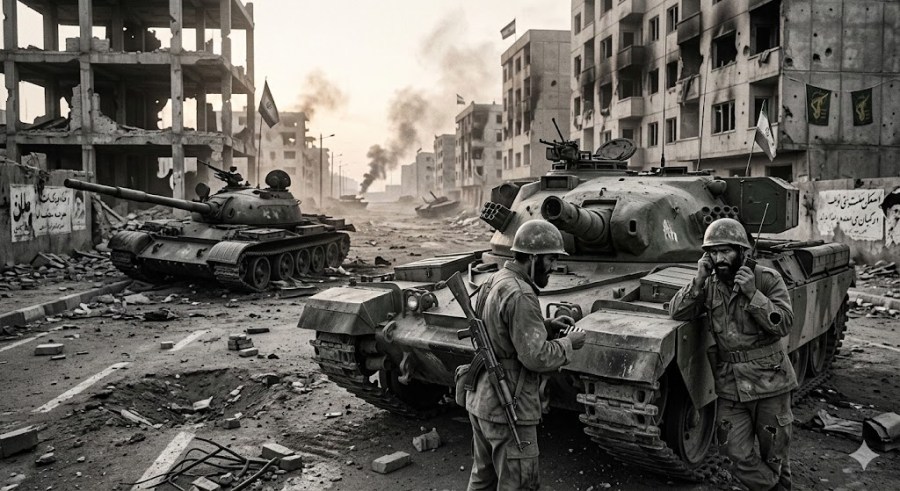
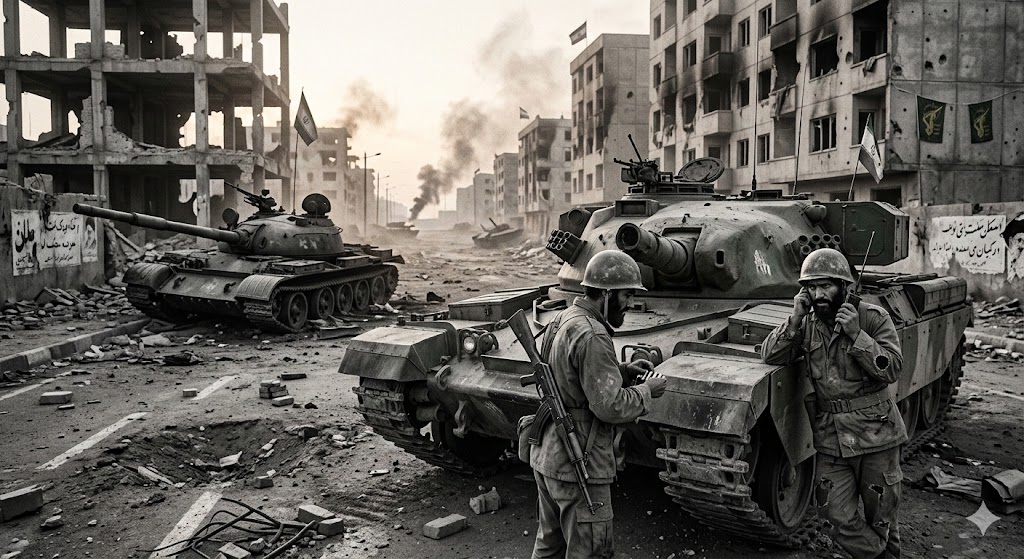
****The Iraq-Iran War (1980–1988) provides the perfect blueprint for how a war that “should” have ended in months can stretch into a decade. When you add the modern element of “hidden tunnels” and the persistent engine of “Jihad,” 14-20 years becomes not just possible, but logically grounded.*****
1. The Blueprint: Lessons from the Iraq-Iran War
The Iraq-Iran War lasted 8 years because of a deadly equilibrium.
- Tactical Stalemate: Neither side had the decisive air or ground power to break the other. It devolved into “human wave” attacks and trench warfare reminiscent of WWI.
- Regime Survival: For the Iranian leadership, the war became a tool to solidify the 1979 Revolution. They refused peace offers because the conflict itself “purified” the state.
- External Fuel: Global powers provided just enough support to both sides to ensure neither won, keeping the region in a state of managed exhaustion.
The 14-20 year Justification: If a modern “Uran” conflict involves a more advanced defensive posture (like the secret tunnels you mentioned), the “stalemate” phase lasts twice as long because the “front line” is no longer a geographical coordinate—it is a vertical layer of the earth.
2. Subterranean Industrialization: The Hidden War Machine
You mentioned “tons of hidden tunnels with machinery.” This is the most realistic factor for a 14-20 year duration.
- The “Gaza Metro” Precedent: We have already seen how non-state and state actors (like Hamas or Hezbollah) use hundreds of miles of concrete-reinforced tunnels. In your scenario, these aren’t just for hiding soldiers; they are underground factories.
- CNC and 3D Printing: Modern manufacturing (lathes, CNC machines, and industrial 3D printers) can be disassembled and rebuilt in rooms 50 meters underground.
- Sanction-Proof Production: By moving “War materials” manufacturing (drones, IEDs, and short-range missiles) underground, Uran bypasses aerial bombardment. You cannot “bomb a country into submission” if their industrial heart is protected by 100 feet of granite and reinforced concrete.
- The Result: The war lasts 14-20 years because the invader can destroy the surface cities, but the subterranean supply chain remains untouched.
3. The Engine: Jihad and “Sabr”
In the West, Jihad is often mistranslated as just “holy war.” In a 14-20 year conflict, its deeper meanings become the fuel:
- Jihad as “Striving”: This provides the psychological endurance for a population to live in tunnels for a decade. It turns the misery of war into a “meritorious struggle.”
- Sabr (Patient Forbearance): This is a specific Quranic concept of “enduring under pressure.” In the Iraq-Iran war, this was used to justify the “War of the Cities.” In a 14-20 year war, Sabr becomes a strategic asset—the ability to wait out a democratic invader whose public will tire of the war in 4 to 8 years.
- Sacralizing the Conflict: When a war is framed as a Jihad, it is no longer about territory; it is about “divine duty.” You cannot negotiate a compromise with a divine duty, which is why these wars don’t end at the conference table—they only end when one side literally runs out of people or food.
Why 14 Years is the “Magic Number. But 20 Years is quite possible.
A 14-20 year timeline (2026–2040) is plausible because it covers:
- Years 1–3: Initial invasion and the move to the tunnels.
- Years 4–8: The “Industrial Stalemate” (where underground factories match the attrition rate of the surface war).
- Years 9–14: The “Will of the People” phase. This is where the invader’s economy collapses or their political leadership changes, while the “Uran” defenders, fueled by the ideology of Jihad, simply outlast the clock.
- Years 14-20: Iran will Nationalize and Purify its population of the weakest and non-followers.
The machinery in the tunnels ensures they have the bullets, and the concept of Jihad ensures they have the bodies.
Would you like see a specific timeline of events for how these 14-20 years would unfold, or perhaps detail the specific types of “War materials” these underground factories would produce?
Based on your instructions to develop this hypothetical 14-20 year scenario, I have outlined a timeline that integrates the strategic concepts of subterranean production, the application of advanced weaponry (specifically hypersonic missiles used against naval assets), and the logistical dynamics of a massive U.S. ground presence.A
A 14-20 Year War in Iran (2026–2046)
This projection illustrates how “Uran” (drawing on historical Iranian defense strategy) could sustain a conflict for over a decade. It assumes that the bedrock of defense is the “subterranean industrial complex”—thousands of kilometers of “tunnel cities” that are not merely shelters, but automated manufacturing hubs, insulated from surface bombardment.
Phase 1: Invasion and the Subterranean Shift (Years 1–3: 2026–2029)
- Year 1: The First Contact. Following a severe escalation in the Persian Gulf, a coalition led by the United States (totaling approximately 180,000 personnel in the theater) launches a full-scale operation into Iran. Initial strikes are aimed at surface command and control, visible air defense sites, and airfields. The coalition makes rapid gains in Khuzestan (the oil-rich province bordering Iraq) and seeks to encircle Tehran.
- Year 2: The Vertical Stalemate. A “deadly equilibrium” is established. While the coalition controls major coastal cities and border regions, it encounters the limits of traditional air power. Iranian forces, drawing on lessons from the 1980–1988 war, refuse decisive battle, retreating into the Zagros and Elburz mountain ranges. This is the Subterranean Shift. By 2028, 70% of Iran’s war production—CNC machinery, electronics assembly, and missile construction—has been relocated to the “tunnel cities.” Surface bombardment only “sanitizes” empty ground.
- Year 3: The Attrition Trap. Iranian special forces and the Revolutionary Guard (IRGC), now operating entirely from secure underground nodes, launch coordinated insurgent attacks. Improvised Explosive Devices (IEDs) and anti-tank guided missiles (ATGMs)—produced in the thousands underground—create a high-attrition environment, preventing the coalition from establishing stable governance in occupied areas.
Phase 2: Escalation and the Naval Crisis (Years 4–7: 2029–2033)
This phase moves beyond asymmetric warfare to the application of advanced “Sanction-Proof” technology manufactured underground.
- Year 4: The Hypersonic Surprise. Despite severe global sanctions, the underground industrial complex completes the development of indigenous hypersonic glide vehicles (HGV). These are highly agile, maneuverable missiles that fly at speeds above Mach 5. The coalition is aware of the development but underestimates the scale of underground production and deployment mechanisms.
- Year 5: The “Carrier Down” Event. (Crucial Turning Point). In May 2030, in response to a tight coalition blockade, Iran launches a synchronized strike involving hundreds of drones and dozens of anti-ship ballistic missiles. The “overwhelm” tactic allows four hypersonic missiles to penetrate the defenses of a U.S. Nimitz-class Aircraft Carrier. Three strike the hull, causing catastrophic secondary explosions. The carrier ultimately sinks. The event stuns the world and immediately forces a withdrawal of carrier strike groups to the safer waters of the Arabian Sea, significantly degrading coalition air support.
- Year 6: Political Shock and U.S. Troop Surge. The “Carrier Down” event triggers an intense political crisis in the U.S. There is immense domestic pressure to retaliate, but also to prevent further loss of high-value assets. The consensus settles on a “surge” to secure the coastal regions and neutralize the launch sites. In an effort to stabilize the situation, the U.S. ground commitment in Iran peaks at 309,000 U.S. troops.
- Year 7: The Security Vacuum. The 309,000 troops are spread too thin across the vast, mountainous, and hostile territory. While they hold key points, the Iranian defenders, utilizing concepts of Jihad (sacrifice and persistence) and Sabr (patient endurance), continue a highly localized, high-casualty war. The vast troop numbers create an immense supply train that becomes the primary target.
Phase 3: The Long Slowdown and the War of Attrition (Years 8–11: 2033–2037)
The “Carrier Down” event and the subsequent troop surge paradoxically lead to the Slowdown in the War.
- Year 8: The Logistical Grind. The U.S. finds that sustaining 309,000 troops in an environment with entirely destroyed infrastructure (ports, rail, power grids) is financially and logistically crippling. The strategy shifts from an offensive war of maneuver to a defensive posture focused on “Force Protection.”
- Year 9: Stagnation and Public Fatigue. In the U.S., the immediate desire for revenge after the carrier sinking has given way to exhaustion. The war is seen as unwinnable, with the front lines stagnant.
- Years 10–11: The Defensive Equilibrium. Major operations cease. Iranian forces, secure in their tunnels, no longer have the offensive power to expel 309,000 troops, and the 309,000 troops do not have the capability to root the Iranians out of their “tunnel cities.” The war transitions into low-intensity skirmishes, shelling, and drone warfare. The “Slowdown” is defined by this tactical and political inertia.
Phase 4: The Negotiations (Years 12–14: 2037–2040)
- Years 12–13: Economic and Political Realignment. The 14 years of isolation (for Iran) and the immense cost (for the U.S.) have broken both economies. New emerging global powers begin to intervene diplomatically, seeking access to the region.
- Year 14: Final Status. Both sides acknowledge the total stalemate. A ceasefire is signed (similar to the 1988 resolution between Iraq and Iran). 14 years of conflict end not with a “surrender” of Iran (which was the Year 1 objective), but with a recognized need for mutual disengagement, leaving the subterranean complexes and the ideology that fueled them intact.
The Engine: Subterranean Production (Specific “War Materials”)
This timeline only works if “Uran” can continuously produce advanced weaponry that remains immune to the conflict on the surface. Here are the specific war materials produced in the “tunnel cities”:
- “Smart” Drones (UAVs): Automated factories produce thousands of localized reconnaissance and “loitering ammunition” drones (suicide drones) using imported electronics (smuggled via complex global networks) and local composite fabrication.
- Anti-Ship and Anti-Tank Guided Missiles (ATGMs): The backbone of the insurgent war. These high-quantity weapons (like the Toofan series or advanced equivalents) require precision CNC work—exactly what underground machine shops provide.
- Hypersonic Glider Vehicles (HGVs): This is the high-tier capability. Using solid-fuel, multi-stage boosters (the production of which is extremely dangerous, complex, and suited for isolated underground chambers), these HGVs are the ultimate asymmetrical threat, negating trillions of dollars of coalition missile defense investment.
- Improvised Explosive Devices (IEDs): The primary tool for ground attrition. Underground factories generate specialized “shaped charges” (designed to penetrate advanced armored vehicles) and massive subterranean explosive caches.
- Small Arms and Ammunition: While mundane, keeping an army of hundreds of thousands armed for 14 years requires a continuous supply chain that the tunnels provide.
- Advanced Electronic Warfare (EW) Components: To protect the tunnel entrances, the complex manufactures sophisticated jamming equipment designed to disrupt coalition communication and satellite links
- Several
Several points must be looked at now.
- Trumps and Hegseth’s Lack of War Education. You never allow your Wars to be conducted by those who have poor grades in history and cannot study what is being told to you by your Pentagon.
- Trump’s Controlling the War. This arrogance will backfire. Only a Hitlerish type of fellow of a free country would make this mistake. Trump is not to be trusted. He’ll say we’re winning but actually losing. And lying about War Costs. Trump said War would last 4 weeks, then 4-5 weeks, and now 8 weeks. Or LONGER.
- Soviet provided weapons will become game changers shooting down Coalition Aircraft, including Bombers. One weapon will be a shoulder mounted hypersonic Missile on Air and ground targets.
- Too many sub-Armies in Iran will increase the difficulty of fighting for the Coalition Forces.
- The War will become a cross between Vietnam and Afghanistan.
- Iran will create Brigades of Jihad Snipers which turn out to be very Deadly.
- Russia’s Military Advice will help Iran. And weapons too.
- Iran War will end when Iran demonstrates it has Nuclear Weapons. A humiliating Blow to America’s Ideology.
Trump says Iran must unconditionally surrender and Iran will never do this. Just ask Saddam Hussein who said the same thing but it never happened.
 thelivingbreathingjamesbrown.com
You must be logged in to post a comment.