
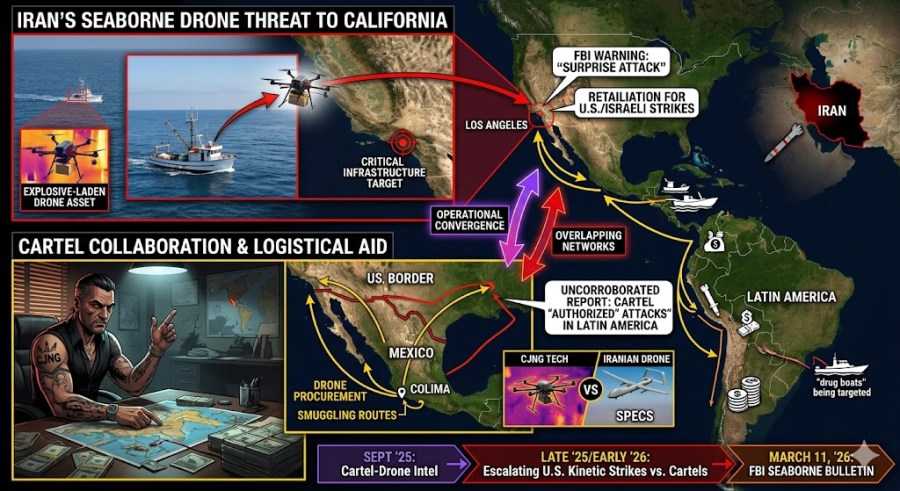
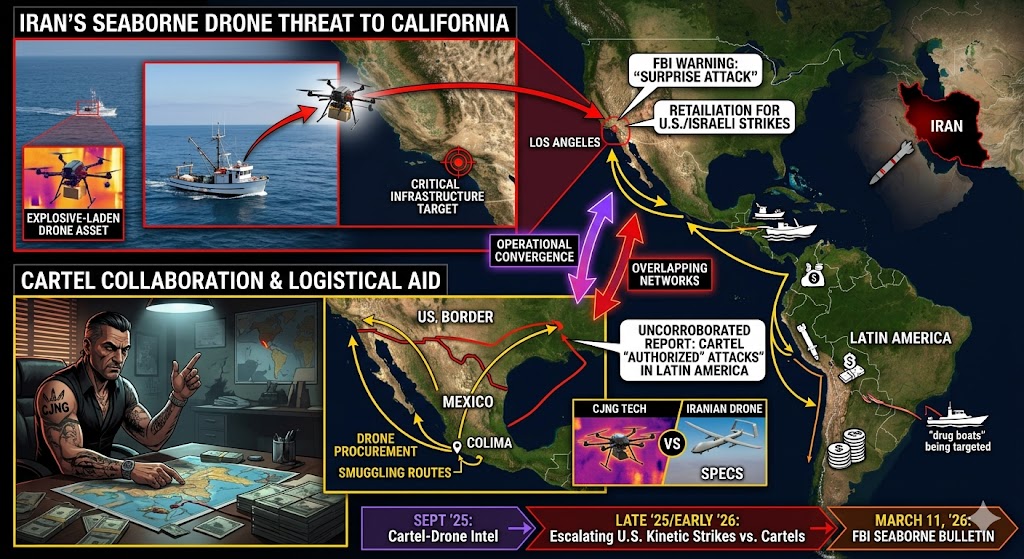
Recent intelligence bulletins and news reports from late February and early March 2026 have highlighted a serious and evolving security situation involving Iran, the U.S. West Coast, and transnational criminal organizations.
FBI Warning: Seaborne Drone Threat
On March 11, 2026, reports surfaced that the FBI issued a bulletin to California law enforcement regarding a potential “surprise attack.”
- The Threat: Intelligence suggests Iran has “aspired” to launch unmanned aerial vehicles (drones) from unidentified vessels positioned off the U.S. coast.
- The Target: Specifically targets in California.
- The Context: This is viewed as a retaliatory measure for recent U.S. and Israeli military strikes against Iranian nuclear sites and high-ranking officials.
- The Details: Officials have noted that while the intent is clear, they lack specific information on the exact timing, perpetrators, or the specific vessel involved.
The “Cartel Permission” and Collaboration
The connection to Mexican cartels is complex and stems from reports of overlapping interests and logistical networks:
- Authorized Attacks: An uncorroborated intelligence report from September 2025 suggested that unidentified Mexican cartel leaders had “authorized” or considered using explosive-laden drones against U.S. military and law enforcement personnel along the border.
- Converging Interests: Security experts (such as former DHS intelligence officials) have pointed out that Iran maintains an extensive presence in Latin America. They have long-standing money-laundering and trafficking “ecosystems” that intersect with cartel infrastructure.
- Operational Alliances: While direct “permission” for an Iranian attack on the coast isn’t explicitly confirmed as a formal treaty, the convergence of interests is the primary concern. Iran seeks asymmetric ways to strike the U.S., and cartels possess the smuggling routes and drone technology that Iran can exploit.
Escalating Tensions in the Region
- U.S. Military Action: The Trump administration has designated several cartels as foreign terrorist organizations and has been conducting kinetic strikes against “drug boats” in the Eastern Pacific and Caribbean, treating them as enemy combatants.
- Mexican Instability: Following the recent killing of the Jalisco New Generation Cartel (CJNG) leader “El Mencho” by Mexican forces (aided by CIA intel), violence in Mexico has spiked. Analysts believe Iran may look to “benefit from the turmoil” by using these chaotic channels to move assets or personnel toward the U.S. border.
Summary Note: While the FBI warns of an Iranian seaborne threat to California, the “cartel aid” is largely viewed as a logistical overlap where Iranian operatives leverage established criminal smuggling networks to move equipment like drones into position.
If Mexican cartels provide aid or permission for an Iranian attack on U.S. soil, it would trigger a fundamental shift in U.S. policy—moving from a law enforcement problem to a full-scale military conflict on the North American continent.
Based on current 2026 intelligence and the “Shield of the Americas” military framework, here is the breakdown of what would likely happen:
1. The “Terrorist State” Designation
The U.S. has already designated major cartels like the Sinaloa Cartel and CJNG as Foreign Terrorist Organizations (FTOs) as of early 2025.
- If they help Iran: They would no longer be treated as criminal gangs, but as state-sponsored proxies of a foreign enemy.
- Legal Shift: This allows the U.S. military to use the “Unwilling or Unable” doctrine, which argues that if the Mexican government cannot control these groups, the U.S. has the legal right to enter Mexican territory to neutralize them.
2. Operation “Southern Spear” & Kinetic Strikes
Under the current Trump administration, the strategy has shifted toward hard military power.
- Direct Intervention: The U.S. would likely launch “Operation Southern Spear”—a massive kinetic campaign involving drone strikes, special operations raids, and targeted assassinations of cartel leadership within Mexico.
- Infrastructure Destruction: U.S. forces would target the “logistical aid” mentioned in intelligence: clandestine airstrips, maritime “drug boat” ports, and drone assembly sites that Iran might be using.
3. Economic and Border Total Lockdown
The U.S. would treat the southern border as a front line of a war zone.
- Total Border Closure: All trade and legal crossings could be suspended to prevent Iranian agents or cartel-led “diversionary attacks” from crossing.
- Secondary Sanctions: Any Mexican officials or businesses found to be complicit in the “Iran-Cartel” alliance would face immediate asset seizures and exfiltration to the U.S. for trial.
4. Asymmetric Retaliation (The Cartel Response)
Experts warn that if cartels are backed into a corner by U.S. military force, they may retaliate with “Narcoterrorism”:
- Weaponized Fentanyl: Cartels could swap standard fentanyl for more lethal versions like carfentanil, intentionally causing mass casualty events in U.S. cities as leverage.
- Domestic Sabotage: Using their existing networks in U.S. cities (like Los Angeles or Chicago), they could conduct “soft target” attacks or sabotage critical infrastructure to distract the U.S. military from the Mexican front.
The “Red Line” Scenario
The FBI’s March 2026 warning about a “surprise attack” from seaborne drones off California is the current flashpoint. If an Iranian drone launched from a cartel-linked vessel strikes California, the U.S. would likely respond with “Shock and Awe” intensity against both the Iranian Navy (Operation Epic Fury) and the Mexican cartel infrastructure simultaneously.
 thelivingbreathingjamesbrown.com
You must be logged in to post a comment.