

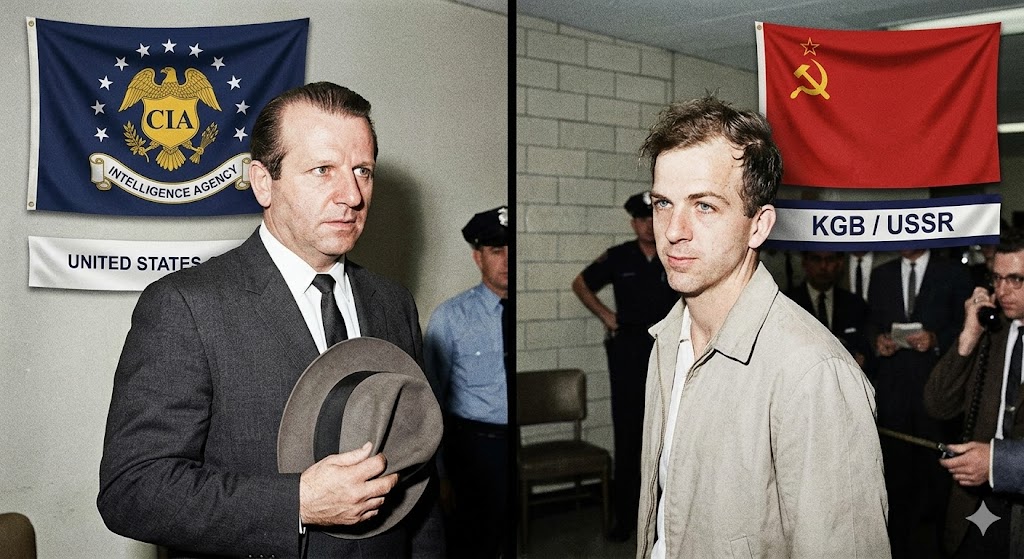
The Country of Origin of their Handlers-CIA & Jack Ruby and USSR for Lee Harvey Oswald Handlers
Operational Management and Intelligence Coordination: A Critical Analysis of the Handlers and Institutional Oversight of Lee Harvey Oswald and Jack Ruby
The declassification of over 80,000 pages of records related to the assassination of President John F. Kennedy between 2017 and 2023 has fundamentally shifted the historiographical focus from the mechanics of the shooting to the architecture of intelligence management. For decades, the investigation into the deaths of Kennedy and Lee Harvey Oswald was framed by the Warren Commission’s conclusion that both Oswald and his killer, Jack Ruby, were isolated actors. However, the recently released files from the Central Intelligence Agency (CIA) and the Federal Bureau of Investigation (FBI) provide a detailed roadmap of the “operational interest” and “informant status” that bound these two figures to the U.S. national security apparatus. By examining the specific roles of individuals such as J. Walton Moore, George de Mohrenschildt, David Atlee Phillips, and the organized crime figures who intersected with Ruby, this report delineates the handling mechanisms that were in place prior to November 22, 1963.
The Intelligence Context of Lee Harvey Oswald: From Defection to Operational Interest
The narrative of Lee Harvey Oswald as a disgruntled lone actor is complicated by the CIA’s internal tracking systems, specifically the 201-289248 personality file. Declassified cables from 1963 reveal that the Agency’s “operational interest” in Oswald was not a reactive measure following the assassination but a continuous, preemptive monitoring program. The documents show that high-level counterintelligence (CI) staff, under the direction of James Jesus Angleton, maintained a “voluminous” record of Oswald’s movements, including his defection to the Soviet Union and his subsequent return to the United States.
George de Mohrenschildt and the Domestic Contact Division
The most significant figure in the social handling of Lee Harvey Oswald was George de Mohrenschildt, a Russian-born petroleum geologist with deep ties to the international intelligence community. While de Mohrenschildt was often portrayed as a mere eccentric friend of the Oswalds, declassified CIA records, particularly document 104-10414-10150, confirm a formal link between de Mohrenschildt and the CIA’s Domestic Contact Division (DCD) in Dallas.
The DCD’s resident agent in Dallas, J. Walton Moore, began a relationship with de Mohrenschildt as early as 1957 following de Mohrenschildt’s sojourn in Yugoslavia. In the early 1960s, as Oswald returned from the USSR, Moore reportedly consulted with de Mohrenschildt regarding the young defector’s reliability. De Mohrenschildt later claimed that he befriended Oswald at Moore’s suggestion, receiving assurances that Oswald was “okay” and “harmless”. This relationship allowed the CIA to maintain a “proxy handler” who could monitor Oswald’s psychological state and social associations without the legal or political risks of a direct case officer relationship.
| Handlers and Intermediaries | Agency/Affiliation | Primary Function | Relevant Document IDs |
| J. Walton Moore | CIA (DCD Dallas) | Intelligence collection; de Mohrenschildt’s handler. | 104-10414-10150, 104-10427-10090 |
| George de Mohrenschildt | CIA Asset (Informant) | Social handler of Oswald; “Father-son” relationship. | 104-10506-10022, 104-10414-10011 |
| David Atlee Phillips | CIA (Western Hemisphere) | Covert operations; identified as “Maurice Bishop.” | 104-10074-10141, HSCA Vol 10 |
| Guy Banister | FBI (Former)/Private Intel | Anti-communist operations; 544 Camp St manager. | 124-10209-10300, 104-10114-10064 |
The implications of this “soft handling” are profound. It suggests that Oswald was being steered through his transition back into American society by an individual who was simultaneously providing intelligence to the CIA’s Dallas station. The 1977 suicide of de Mohrenschildt, occurring just hours after he was contacted by the House Select Committee on Assassinations (HSCA), further underscores the sensitivity of his role as an intermediary.
The Mexico City Station: Winston Scott and the LIENVOY Program
In the weeks preceding the assassination, Oswald’s travel to Mexico City became the focus of the CIA’s most intensive surveillance efforts. The Mexico City station, directed by Winston Scott, utilized the LIENVOY wiretapping program to monitor telephone communications at the Soviet and Cuban embassies. Recently declassified records reveal that the CIA’s “security contact” for these operations was not an agency employee but the President of Mexico, Luis Echeverría Álvarez.
During this period, Oswald was observed interacting with Valeriy Vladimirovich Kostikov, a senior officer in the KGB’s Department 13, responsible for assassinations and sabotage. CIA cables from October 1963 show that headquarters was receiving real-time data on these contacts, yet no high-level alert was issued to the Secret Service regarding Oswald’s presence in Dallas. The “operational interest” cables from this era, such as 104-10100-10281, discuss a “person of possible operational interest trying to enter U.S. to visit relatives,” which researchers identify as a reference to Oswald’s broader tracking.
Maurice Bishop and the Alpha 66 Architecture
Beyond social handling, the declassified files provide evidence of direct operational contact. Antonio Veciana, the founder of the anti-Castro paramilitary group Alpha 66, testified extensively regarding his handler, a man he knew as “Maurice Bishop”. Veciana reported that he observed Bishop meeting with Lee Harvey Oswald in a Dallas office building in September 1963.
Decades of research and subsequent admissions led to the identification of “Maurice Bishop” as David Atlee Phillips, a rising star in the CIA’s Western Hemisphere division and a specialist in propaganda and psychological warfare. Phillips’ role at the JM/WAVE station in Miami placed him at the center of the Agency’s efforts to overthrow Fidel Castro. Veciana’s claim that Bishop was “running” Oswald suggests that Oswald’s pro-Castro activities in New Orleans—passing out flyers for the Fair Play for Cuba Committee—were part of a “legend” building exercise orchestrated by Phillips to frame the Cuban government for a future event.
The Syndicate Handlers of Jack Ruby: Organized Crime and Institutional Protection
While Lee Harvey Oswald was managed through the veil of intelligence agencies, Jack Ruby’s “handlers” were rooted in the upper echelons of the American Mafia. The 2017–2022 releases highlight Ruby’s status as a middleman for organized crime, with connections to some of the most powerful crime bosses of the era, including Carlos Marcello and Santo Trafficante.
Carlos Marcello and the “Stone in the Shoe” Doctrine
Carlos Marcello, the boss of the New Orleans Mafia, had a personal and professional motive to eliminate President Kennedy following his deportation to Guatemala by Attorney General Robert Kennedy in 1961. Declassified FBI files from the HSCA investigation reveal that Marcello referred to Robert Kennedy as a “stone in his shoe” and assured associates that the President would be dealt with.
Jack Ruby’s telephone records from 1963, analyzed by the HSCA using an Amdahl 470 V-5 computer, show a significant spike in long-distance calls to Marcello’s inner circle in the months leading up to the assassination. The average number of calls jumped from 25 per month to 75 in October and nearly 100 in the first three weeks of November.
| Date of Call | Recipient | Affiliation | Significance |
| 10/30/1963 | Nofio J. Pecora | Marcello Lieutenant | Ruby called Pecora’s trailer park office; Pecora was a top mob associate. |
| 10/26/1963 | Irwin S. Weiner | Chicago Mob Bondsman | Ruby spoke with Weiner for 12 minutes; Weiner was a mob-intel bridge. |
| 11/07/1963 | Barney Baker | Teamster/Mob Executioner | Ruby received a 17-minute call from this Hoffa associate. |
| 11/08/1963 | Dusty Miller | Hoffa Assistant | Ruby contacted Miller at the Eden Roc Hotel in Miami. |
While Ruby and some recipients claimed these calls were related to a labor dispute with the American Guild of Variety Artists (AGVA), the timing and the seniority of the contacts suggest a tactical mobilization. The call to Nofio Pecora is particularly telling, as Pecora was an associate of Carlos Marcello and David Ferrie, the latter of whom was a known acquaintance of Lee Harvey Oswald in New Orleans.
Jack Ruby as an FBI Informant
The 2017 releases confirmed that Jack Ruby had a formal, albeit brief, relationship with the FBI as a “Potential Confidential Informant” (PCI). In 1959, Ruby was contacted by agent Charles Flynn to provide information on the Dallas underworld. Although the FBI later downplayed his productivity, Ruby’s status as an informant provided him with a level of “institutional shielding”. This relationship with law enforcement was a hallmark of Ruby’s career in Dallas, where he was known to provide free drinks and hospitality to officers at his Carousel Club.
The implications of Ruby’s informant status extend to the day of the assassination. Wandell Vanderslice, an IRS informant, reported seeing Ruby at the corner of the Postal Annex Building during the shooting, standing in a position that suggested he was “watching the fireworks”. This eyewitness account, coupled with Hoover’s immediate concern on November 24th to “convince the public that Oswald is the real assassin,” suggests that Ruby’s role was to silence the “patsy” and thereby protect the broader network of handlers.
Tactical Intersections: The New Orleans and Dallas Axis
The declassified files emphasize that the handlers of Oswald and Ruby were not operating in a vacuum but were part of a geographically synchronized operation that spanned Dallas, New Orleans, and Miami. The common thread in these locations was the intersection of anti-Castro militants and organized crime figures, both of whom were being “managed” by intelligence assets.
Guy Banister and David Ferrie: The Facilitators
In New Orleans, Guy Banister—a former FBI Special Agent in Charge and associate of Carlos Marcello—served as a primary facilitator for anti-communist activities. His office at 544 Camp Street was a focal point for gun-running and clandestine operations. Oswald’s presence at this location, and his association with David Ferrie, links him directly to the Marcello syndicate’s “operational zone”.
David Ferrie, a pilot for Eastern Airlines with connections to the CIA and the mob, is identified in declassified documents as a key figure in the New Orleans conspiracy theory pursued by District Attorney Jim Garrison. Ferrie’s role as a “gatekeeper” and his known association with both Oswald and Marcello’s inner circle create a causal relationship between the intelligence community’s interest in Castro and the mob’s interest in Kennedy.
The Role of Institutional Narrative Management
The handling of Oswald and Ruby continued even after their deaths. J. Edgar Hoover’s memo of November 24, 1963, serves as a foundational document for the “lone gunman” narrative. Hoover’s preoccupation with public perception and his decision to suppress information regarding Oswald’s letter to the Soviet Embassy—which he claimed was addressed to the official “in charge of assassinations”—demonstrates a high-level effort to manage the investigation’s outcome.
Similarly, the CIA’s internal “soft file” on “American Defectors to the USSR,” released in 2017, show that the agency was carefully compartmentalizing information about individuals like Oswald to prevent a broader inquiry into their defection programs. The use of the “Russ Holmes Work Files” to track the agency’s own failures and its “non-forthcoming” attitude toward Congressional investigators indicates a long-term strategy of institutional shielding.
Analytical Synthesis of Handler Networks
The integration of these findings suggests that the handlers of Lee Harvey Oswald and Jack Ruby were part of a “parapolitical” network where official intelligence duties overlapped with private interests and criminal enterprises. Oswald was managed through a series of “cut-outs” and social handlers like George de Mohrenschildt, while Ruby was handled through his obligations to the Marcello-Trafficante syndicate.
The Mechanism of Plausible Deniability
The use of intermediaries like de Mohrenschildt and Veciana (Bishop) allowed the CIA to maintain oversight of Oswald while avoiding the paper trail of a formal case officer. De Mohrenschildt’s “adventurous and colorful life” made him the perfect agent of influence, as his activities could always be dismissed as those of a private citizen. Similarly, Ruby’s status as a “Potential Confidential Informant” for the FBI gave him a pretext for his proximity to police and mobsters, creating a layer of protection that was only stripped away after he shot Oswald.
The Future Outlook for Records Release
As of 2023, the vast majority of assassination records have been released, yet a critical subset remains redacted or withheld. These remaining files, many of which pertain to CIA personnel files and tax records, are thought to hold the final clues regarding the identities of those who managed the “legend” of Lee Harvey Oswald in the early 1960s. The current trajectory of declassification, mandated by the 1992 JFK Act and accelerated by recent executive orders, indicates that the “handlers” are no longer hidden by total secrecy but by the sheer volume of fragmented data that researchers like Jefferson Morley are now successfully reconstructing.
Concluding Observations on Operational Coordination
The evidence presented in the recently released JFK files supports a model of the assassination that is defined by operational coordination rather than institutional failure. Lee Harvey Oswald was a subject of “operational interest” tracked by the CIA across continents, from his defection in 1959 to his visits to the Soviet and Cuban embassies in 1963. His handlers, whether the “soft” social handling of George de Mohrenschildt or the “hard” operational direction of “Maurice Bishop,” ensured that he remained within the agency’s peripheral vision.
Jack Ruby, conversely, was a tool of the organized crime families that had been targeted by the Kennedy administration. His flurry of phone calls to Marcello and Hoffa associates in late 1963 provides a clear indicator of his role as a tactical operative. The “handling” of Ruby was a function of syndicate discipline, while the “handling” of the investigation was a function of institutional self-preservation. Together, these networks represent a complex system of human and institutional management that fundamentally challenges the “lone gunman” narrative and points to a sophisticated architecture of conspiracy that is only now being fully mapped through the declassified record.
 thelivingbreathingjamesbrown.com
You must be logged in to post a comment.