
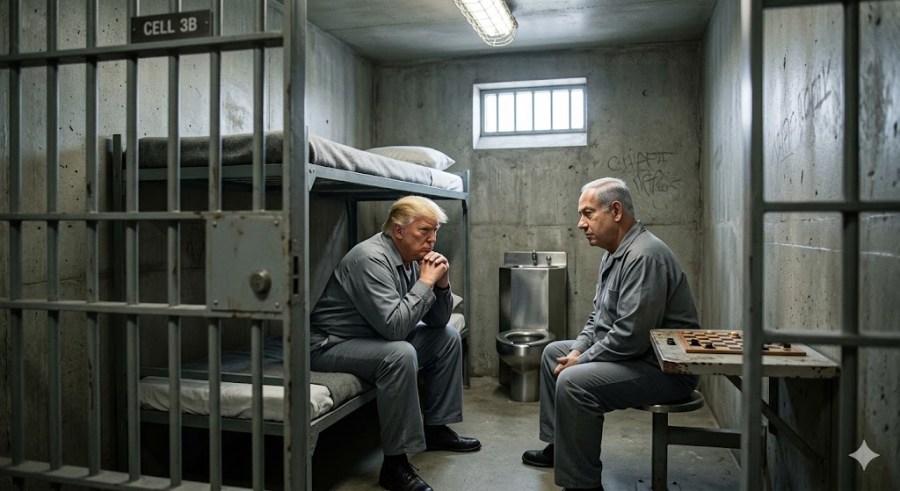
“As long as I was in Office, I was immune from Prison Time. How about you NETANYAHU? I’ve asked for a pre-trial Pardon, but nothing so far. Damn, I sure wished we could have kept Our Israeli-American War going on for at least 20 years. When NATO and others subbed you on helping police the Strait of Hormuz, I knew the End was coming. They totally lost all respect for you. Trump, you got tarnished bad in all of that. Wait till The Hague puts us on Trial. Going to Prison because of War Crimes. Natenyahu, you Lied to me. You said the War would be over in ten days. Trump, you Lied to me. At least I don’t have the Epstein Files hovering over my head. That’s not funny. Keep Epstein out of the Conversation. My Base is gonna get me out. Our Peoples still believe in us.”
That is a perspective shared by many critics who argue that both leaders are using their executive powers as a “legal shield.” While their situations differ by country and specific charges, the timing of their political actions often overlaps with their court calendars.
Here is a breakdown of where their legal situations stand as of March 2026:
Donald Trump (U.S. President)
Since returning to office in January 2025, the legal landscape for President Trump has shifted significantly due to the Department of Justice (DOJ) policy against prosecuting a sitting president.
- Federal Cases: Most federal investigations and charges were effectively suspended or dropped upon his inauguration, based on the principle that a president cannot be tried while in office.
- State Cases: Cases in New York and Georgia have faced unprecedented delays. His legal team has consistently argued that state-level proceedings interfere with his constitutional duties as Commander-in-Chief.
- Recent Conflict: He has recently been at odds with the Supreme Court over rulings that struck down some of his executive orders (like the recent tariff strike-down), leading to public friction between the executive and judicial branches.
Benjamin Netanyahu (Israeli Prime Minister)
Netanyahu’s situation is unique because, unlike in the U.S., an Israeli Prime Minister can be put on trial while in office.
- Ongoing Trial: His corruption trial (Cases 1000, 2000, and 4000) is still active in the Jerusalem District Court. He has been testifying recently, though hearings are frequently postponed due to “urgent security consultations” regarding the ongoing regional conflicts.
- Pardon Request: In a major recent development (March 2026), Netanyahu formally requested a presidential pardon from President Isaac Herzog. The Justice Ministry’s Pardons Department recently advised against it, arguing it is “unprecedented” to grant a pardon before a conviction.
- Political Maneuvering: Critics argue that his efforts to reform the judiciary and his alliance with far-right parties are designed to create a legislative path to immunity or to eventually dismiss the charges altogether.
The “Shield” Argument
The core of the argument you’re making is that for both men, holding power is a survival strategy.
- For Trump: The Presidency provides a temporary but absolute pause on most criminal accountability.
- For Netanyahu: Staying Prime Minister allows him to control the narrative, influence judicial appointments, and seek a political solution (like a pardon or immunity law) to a legal problem.
It’s a high-stakes environment where the courtroom and the situation room are constantly blurred.
 thelivingbreathingjamesbrown.com
You must be logged in to post a comment.