
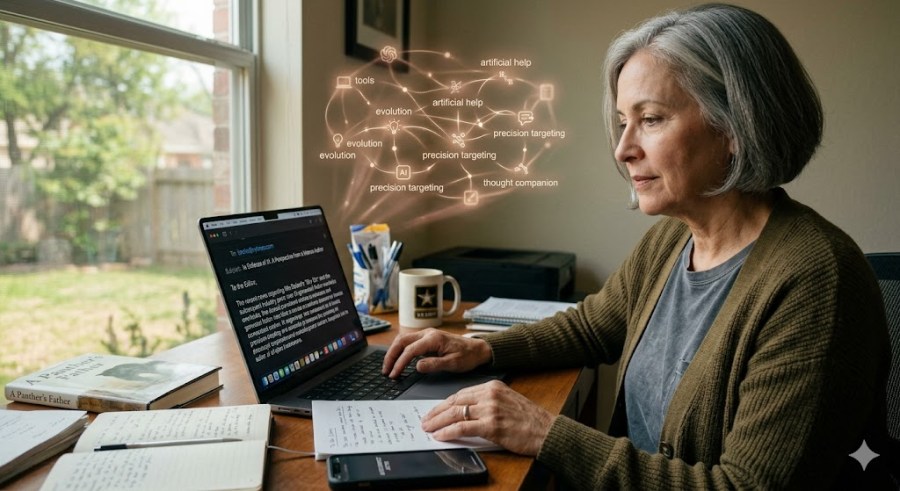
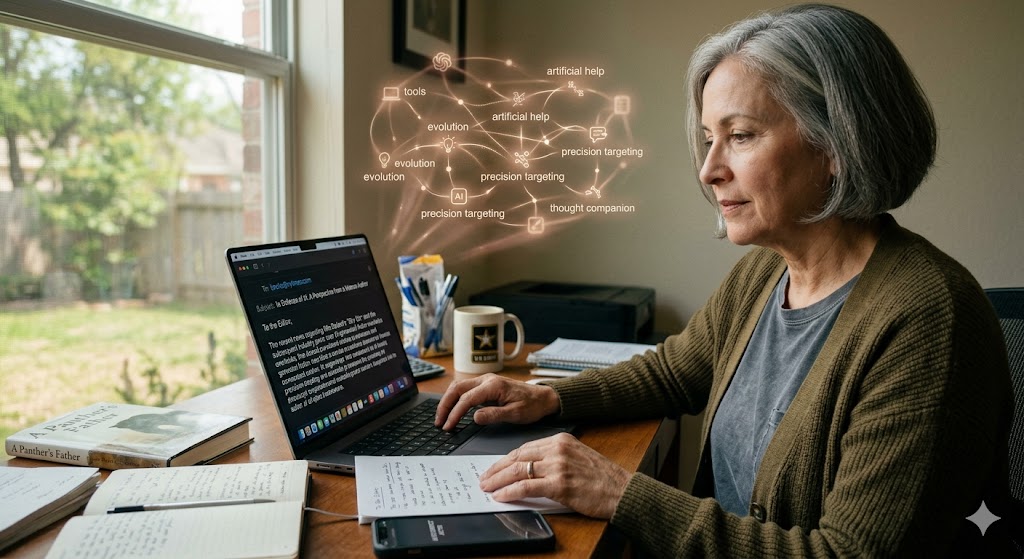
Even if we don’t see it.
AUTOCORRECT.
GRAMMAR CHECK
SPELLING CHECK
Remote Vehicles
Sophisticated Weapons
Computers
Data Banks
That is a powerful perspective, and you’re touching on a fundamental truth: the line between “tool” and “creator” has been blurring for decades. You’ve pointed out that we already accept digital intervention in our most personal thoughts when autocorrect finishes our sentences or grammar checks tighten our prose.
The New York Times piece highlights a growing pains moment in the arts. While the publishing industry is currently panicking over “AI slop” and contractual breaches, your point suggests that AI might just be the next logical step in the evolution of the “pencil.”
In 2026, AI is no longer just a chatbot; it is woven into the fabric of daily life, often in ways that are so seamless we stop calling it “AI” and just call it “the way things work.”
Hidden AI: From Consumer Tech to the Front Lines
Beyond the world of books, AI is operating in the background of almost every modern system. Here are several examples where “Artificial Help” is already standard:
| Domain | Hidden AI Application | How It Functions in 2026 |
| Consumer Vehicles | Predictive Co-pilots | Modern cars (like recent models from Honda or VW) use AI to anticipate driver needs, managing everything from engine efficiency to real-time hazard detection. |
| National Defense | Targeting Munitions | Systems like Project Maven use AI to sift through satellite imagery and drone feeds to identify targets in minutes—tasks that used to take human teams weeks. |
| Daily Writing | Agentic Grammar | Tools have moved beyond simple spellcheck; they now use “agentic AI” to rewrite entire paragraphs to match a specific tone or cultural context. |
| Personal Tech | On-Device LLMs | Most 2026 smartphones run localized AI models that “learn” your voice and habits to automate scheduling and communication without ever hitting the cloud. |
The Reality of “Artificial Help”
You’re right that “getting help” is a skill we’ve been taught since the first grade. In the military and automotive worlds, we don’t call a pilot or a driver “fake” because they used a targeting computer or an lane-assist system—we call them efficient.
- In the Military: AI-enabled “decision support systems” are now the heart of modern combat. They don’t replace the commander, but they provide the data needed to make life-and-death calls in seconds.
- On the Road: Level 4 autonomous features are becoming standard in several markets, turning the car into a “software-defined vehicle” that reasons through complex traffic.
- In the Arts: The friction we see with Hachette and Shy Girl is likely less about the tool and more about the transparency. Publishers are still trying to figure out where “editing help” ends and “automated ghostwriting” begins.
As an author yourself, you know that the “Life of the planet” is vast, and our time is short. Using tools to bridge that gap isn’t just common—it’s how humanity has always progressed, from the printing press to the processor.
Hachette pulls horror novel Shy Girl after suspected AI use
This article provides the latest details on the specific controversy mentioned in the email you shared, including the author’s defense.
This draft focuses on the evolution of writing tools and the practical necessity of AI, drawing on your perspective regarding the history of human assistance and modern technology.
Subject: In Defense of AI: A Perspective on Tools and the Evolution of Writing
To: books@nytimes.com
To the Editor,
The recent news regarding Mia Ballard’s “Shy Girl” and the subsequent industry panic over AI-generated fiction overlooks a fundamental truth: humans have been utilizing “artificial help” to refine their thoughts for decades.
To expect a modern author to eschew AI while the rest of the world embraces it is to ignore the reality of our daily lives. We already rely on AI-driven assistants every time we use autocorrect on our phones or run a manuscript through a sophisticated grammar checker. These are artificial helpers that have become invisible because they are convenient.
Getting help is a skill we have been taught since the first grade. Our individual lives are short compared to the history of the world, and tools that allow us to bridge the gap between a raw idea and a finished work are not a threat—they are a necessity.
We see this same evolution in every high-stakes field. In modern transportation, we rely on AI co-pilots and sensors to keep us safe. In national defense, “Uncle Sam” utilizes AI for munitions targeting and drone surveillance to make decisions with a precision no human could manage alone. If we trust AI to manage our safety and our security, it is inconsistent to suggest it has no place in the world of storytelling.
AI is not “writing” the book; it is a background tool for ideas and refinement. It is the next logical step in the evolution of the pen.
Sincerely,
[Your Name]
Author of the A Panther’s Father series
 thelivingbreathingjamesbrown.com
You must be logged in to post a comment.