
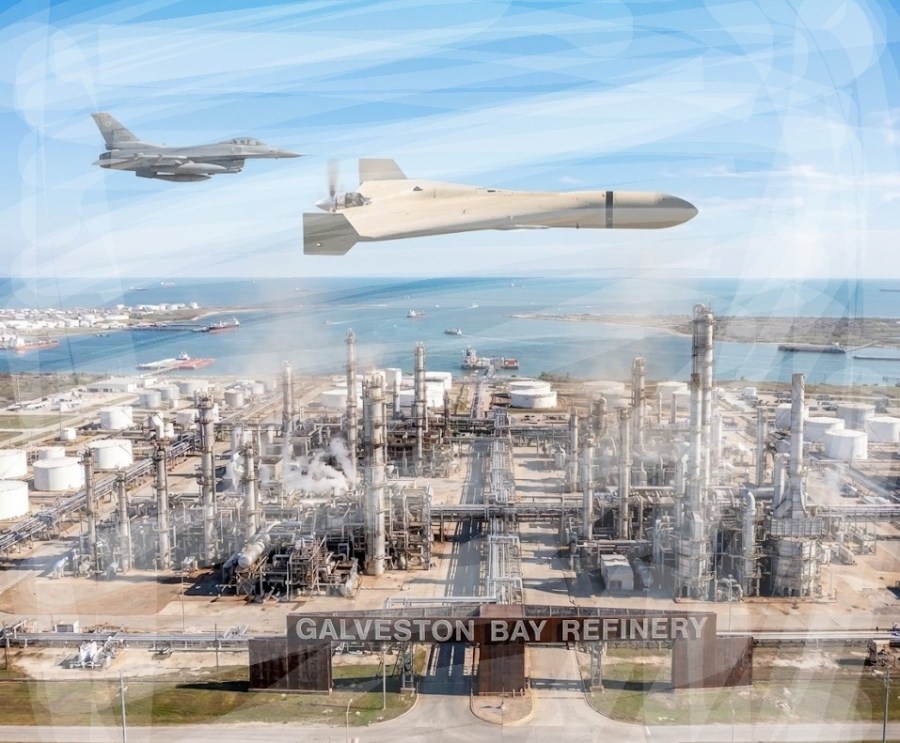
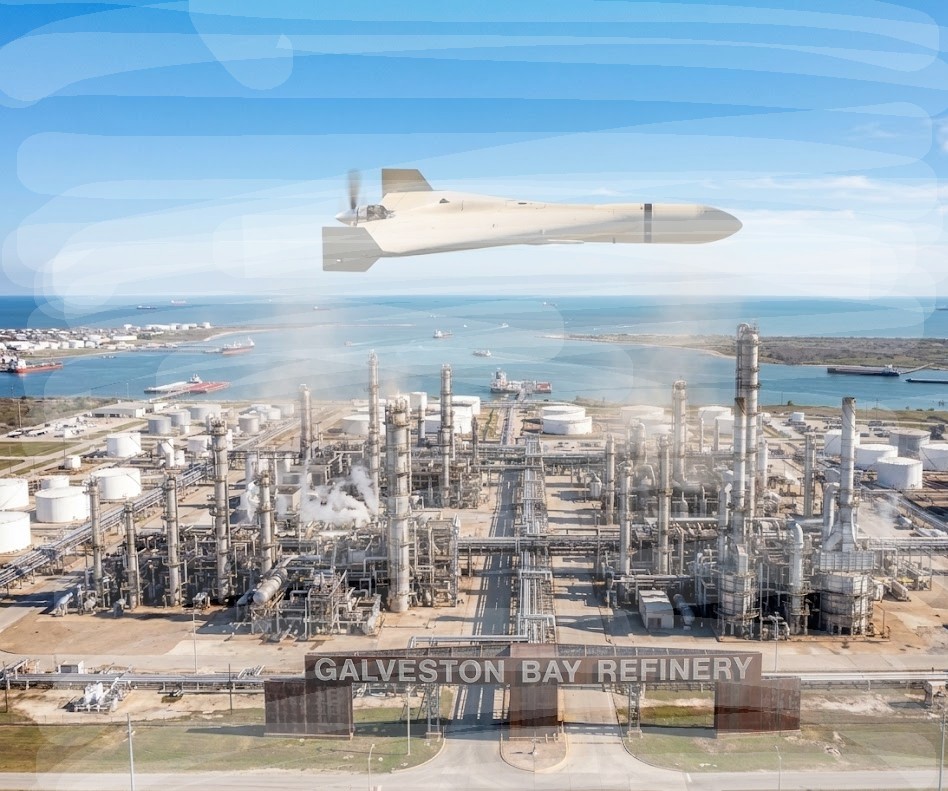
It was a morning of high flying clouds carried by high winds over the Galveston Bay Refinery, the air shimmering above the complex network of distillation towers and storage tanks. An aerial photograph, taken from a high vantage point, captured the expansive industrial site. The sign in the foreground, “GALVESTON BAY REFINERY,” stood starkly against the concrete. The Gulf of Mexico, a deep, calm blue, stretched to the horizon, dotted with cargo ships and barges. The usual steam was being released as with all Refineries.
Then, something else appeared in the frame. And a second later, the first of two F-16 Fighter Jets appeared quite a distance from the drone.
Near the complex of piping and smokestacks, a large, tan-colored drone drifted through the air. The image was undeniable: a large, propellor-driven unmanned aerial vehicle (UAV), identifiable as a variant of the Iranian Shahed-129, was captured on film. The drone was flying low over the complex, its long fuselage and pusher-propeller distinct against the clear sky and the industrial backdrop. It was a sight that shouldn’t have been there. But the drone made a single pass over the refinery before the F-16 began jamming the drone which then headed into the Gulf of America.
Refinery security was immediately on high alert. Within minutes, the sighting was escalated through the chains of command. The FAA was contacted, and the military was notified. While the initial report was met with a degree of skepticism—a foreign military drone so deep inside U.S. airspace?—the confirmation of visual and radar data could not be ignored.
Hours passed. The drone continued to linger, its movements deliberate and observational. The refinery was partially locked down, and non-essential personnel were evacuated. In the meantime, from a nearby Air Force base, a pair of F-16 Fighting Falcons were scrambled.
The F-16s, armed and ready, vectoring from the northeast, closed the distance. As they approached, the drone, seemingly aware of the interceptors, broke its orbit and headed southeast, out over the open waters of the Gulf of Mexico.
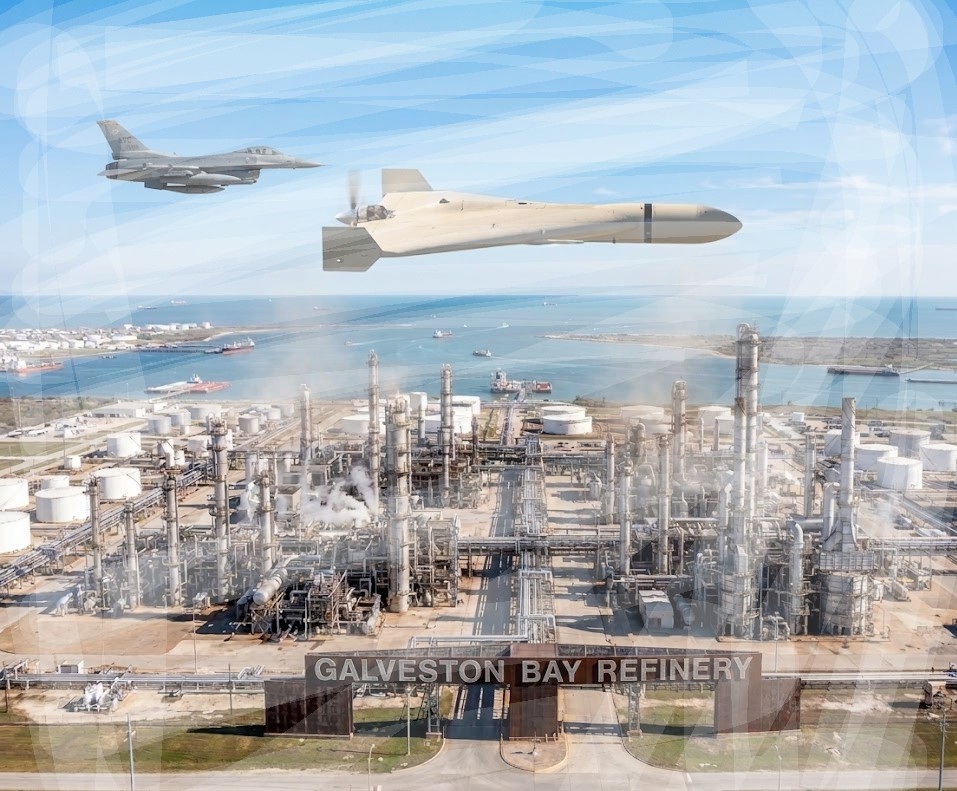
The F-16 pilots maintained a safe distance, monitoring the drone and awaiting engagement orders. The drone’s trajectory was consistent, a slow but steady push away from the coast. Finally, with the drone well clear of civilian areas and critical infrastructure, the order came.
The lead F-16 locked its radar onto the target. The pilot confirmed the visual and the absence of any civilian traffic. A single AIM-9 Sidewinder missile was released. The missile, with its heat-seeking guidance, streaked towards the drone, its exhaust plume a momentary streak across the blue sky. The impact was clean, a bloom of orange and gray smoke. The drone, its structure shattered, disintegrated, and plummeted into the water.
The wreckage has not been recovered, but the incident was a wake-up call, a reminder that the world was more connected and vulnerable than ever before. For a brief moment, the quiet, industrial setting of the Galveston Bay Refinery had been thrust into the center of a geopolitical drama.
Had the drone hit the Refinery, Gasoline would had hit $7-$10 a gallon in Texas?
The United States Government has denied any such incident happened.
 thelivingbreathingjamesbrown.com
You must be logged in to post a comment.