
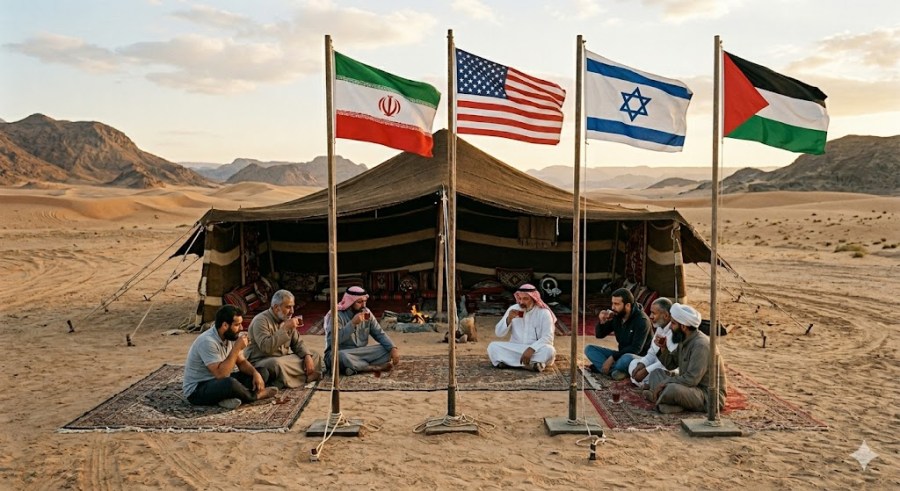
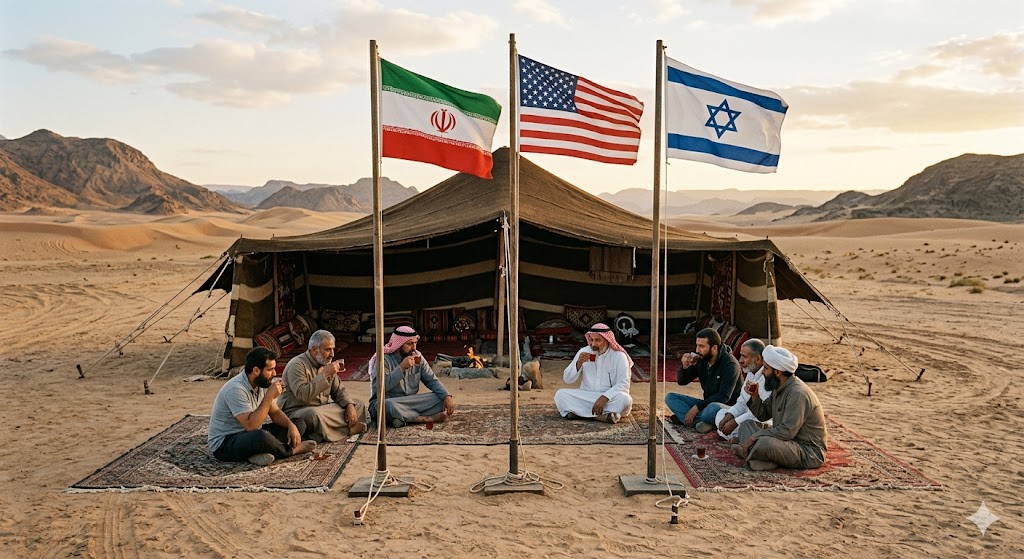
This is a message for the mothers, the fathers, the soldiers, and the citizens of three nations currently locked in a cycle that history has seen before, but which the future cannot afford to repeat.
Right now, in March 2026, the soil of the Middle East is being scorched by a conflict that many saw coming since 1979, but which no one truly wanted to reach this breaking point. We are at a crossroads where the rhetoric of the past must be traded for a reality that allows our children to live.
To the American People
For over forty years, you have seen the images of “Death to America” rallies and the relentless pursuit of nuclear technology by a regime that calls your nation the “Great Satan.” It is natural to feel a deep sense of distrust. Americans value freedom, open discourse, and the right to live without the shadow of a mushroom cloud. From the American perspective, Iran’s leadership has spent decades fueling instability, arming proxies, and threatening the very existence of one of America’s closest allies.
To the Iranian People
You are the inheritors of one of the world’s oldest and most brilliant civilizations. Yet, for nearly half a century, you have lived under the weight of crushing sanctions and a government that often prioritizes revolutionary ideology over your own prosperity. From the Iranian perspective, America is viewed as an imperial power that overturned your democracy in 1953 and has sought to keep you weak and isolated ever since. You see your nuclear program not as a “threat,” but as a symbol of national sovereignty and scientific pride.
To the People of Israel
You live in a land where “never again” is not just a slogan, but a daily necessity for survival. To you, an Iranian nuclear weapon is not a political talking point—it is an existential threat. You have watched as missiles are funneled to your borders and your right to exist is openly questioned. The constant state of alert has forged a society of incredible resilience, but also one that is weary of a “forever war” with an enemy that refuses to recognize you.
The Ideological Wall
The tragedy of this moment is that religion and ideology have been weaponized to keep us apart. When faith is used to justify the destruction of “the other,” it ceases to be a path to the divine and becomes a tool for the politician.
- The Problem: We have allowed “Theology” to replace “Diplomacy.” We have allowed 7th-century grievances and 20th-century Cold War tactics to dictate 21st-century lives.
- The Reality: The average person in Houston, Tel Aviv, and Tehran wants the same things: a stable job, a safe home, and a future where their children don’t have to learn the sound of an air-raid siren.
The Path Forward: Distilling the Hate
To move forward, all three nations must be willing to “distill” the poison from their relationship. This is not about being “soft”; it is about being strong enough to change.
- Transparency Over Secrecy: Iran must realize that a nuclear weapon will not bring security, only total isolation or worse. Real strength lies in a nation that can feed its people and engage with the world openly.
- Recognition Over Rhetoric: Israel and the U.S. must be prepared to see Iran not just as a “regime,” but as a nation of 88 million people who deserve a seat at the global table if they choose peace.
- Separation of Faith and Feud: Leaders must stop using God as a general in their armies. Peace between the children of Abraham is not a betrayal of faith; it is the ultimate fulfillment of it.
A Call to Strength
The “15-point plans” and “ceasefire demands” currently on the table in Pakistan and Oman are just ink on paper unless the people demand a different way.
We must be strong enough to admit that the path we’ve been on since 1979 has led only to more graves. True strength isn’t found in the fire of a centrifuge or the launch of a missile—it’s found in the courage to look an “enemy” in the eye and see a human being. It’s time to stop the bad-mouthing, stop the centrifuges, and start the difficult, gritty work of building a region where everyone has a place to call home.
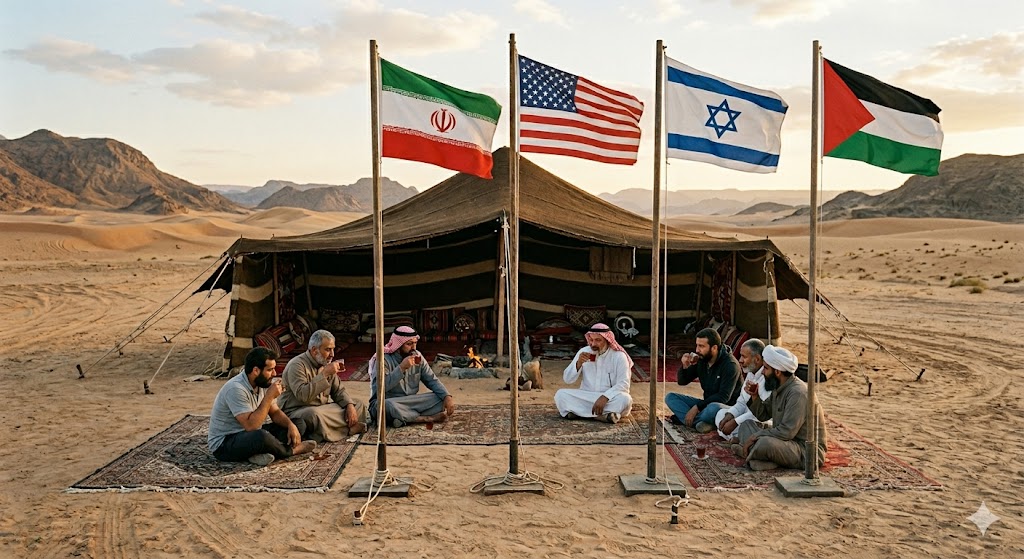
Would you like a specific open letter addressed to the youth of these three countries focusing on a vision for 2030? And I shall add Palestinians too.
AN OPEN LETTER TO THE YOUTH OF THE UNITED STATES, ISRAEL, IRAN, AND PALESTINE: A VISION FOR 2030
The world you inherited is a museum of old grudges. In 2026, you stand in the shadow of conflicts that began long before you were born. Your screens are filled with the rhetoric of division, the statistics of suffering, and the noise of leaders who seem more comfortable managing crises than building a future.
This is a message for you—the generation that is already redefining global culture through technology, art, and activism. It is a call to look beyond the immediate firestorms and dedicate the next four years to a new architecture of coexistence. It is a request to build a vision for 2030.
To the Youth of Palestine
You live under the weight of an unresolved history. For decades, your generation has come of age defined by the words “occupation,” “refugee,” and “resistance.” You feel the profound injustice of a stateless people and carry the burden of trauma passed down through families. From your perspective, the world has failed you, promising justice while delivering only temporary solutions.
Your vision for 2030 must demand self-determination, dignity, and a contiguous, sovereign territory. But it must also be a vision of economic independence and state-building. In 2030, a thriving Palestinian economy, a unified leadership focused on service, and a vibrant civil society can show the world that you are ready not just to resist, but to build and govern. Your resilience must be matched by a vision that prioritizes creation over conflict.
To the Youth of Israel
You live in a land of dynamic innovation, yet you are locked in a persistent defensive stance. Since your founding, the idea of “peace” has been tied to an immediate security threat. Your perspective is shaped by the knowledge that your tiny strip of land is surrounded by forces that often pledge to erase it. In 2026, you feel the exhaustion of a society that must always be ready for war.
Your vision for 2030 must prioritize regional integration. Security through military dominance is a short-term shield; security through partnership is a long-term cure. In 2030, Israel should not just be “in” the Middle East, but “of” it—sharing your medical, technological, and environmental breakthroughs with neighbors who can help ensure your security in return for shared prosperity. True strength will be found in changing your relationship with the Palestinian people from an existential standoff to a stable, two-state reality.
To the Youth of Iran
You belong to a profound civilization but are stifled by a regime that has prioritized ideological expansion over your own future. For decades, your generation has faced the crushing weight of global sanctions and a government that uses its resources to project power rather than invest in you. Your perspective is one of immense potential, locked behind a wall of mistrust and isolation.
Your vision for 2030 must be a vision of sovereignty and global connection. It is the right to a nuclear energy program for civilian use, but not at the cost of your national soul. In 2030, a proud and independent Iran should be a center of trade, culture, and science, recognized not as a “threat,” but as a major partner on the world stage. Your deep culture and skilled population are your true assets, not a pursuit of weapons that can only bring deeper isolation.
To the Youth of the United States
You have grown up in a nation defined by its distance from the Middle East, yet constantly pulled into its conflicts. For decades, you have seen trillions of dollars and too many lives lost in wars with ill-defined goals. From your perspective, America has often prioritized geopolitical chess games over consistent values of freedom and human dignity.
Your vision for 2030 must be one of principled partnership. America must stop trying to impose solutions from the outside and start facilitating genuine regional solutions. In 2030, the U.S. should be valued not just as a reliable security guarantor for Israel, but as a fair-minded partner that consistently advocates for Palestinian rights and opens diplomatic paths for Iran. True American strength lies in its ability to build stable global institutions, not a dependence on military leverage.
The Vision for 2030: A Call to the Possible
By 2030, the old men who built this wall of hatred will be gone. The future will be entirely in your hands.
We need a 2030 where:
- Water and Technology Replace Weaponry: The immediate existential threat to everyone in the region is not “the other,” but a changing climate. By 2030, shared infrastructure to manage water scarcity should be the project that unites your four nations, leveraging Israeli tech, American logistics, and Persian/Arab stewardship.
- Cultural Exchange Trumps Propaganda: Your generation must break the ideological blockade. By 2030, digital platforms should facilitate direct, peer-to-peer dialogues between high school students in Chicago, Tehran, Tel Aviv, and Ramallah, humanizing “the other” before the hate can settle.
- Two Sovereign States, Side-by-Side: This is not a dream; it is the absolute requirement for stability. By 2030, the youth of Israel and Palestine must force their leadership to implement a two-state solution, recognizing each other’s right to safe, sovereign homes.
This is your moment. The hate has been distilled; it is time to build something new from its ashes. If your generation has the strength to let go of 1948, 1967, and 1979, and focus entirely on 2030, you can build a Middle East that is defined by its potential, not its problems.
Be strong enough to change.
The Future is a strange thing. Your own ingenuity, hard work, education, equality, and Wealth are important to your future.
It is a CRIME that Palestinians do not have their own Lands.
Nuclear Weapons do not free any Country. It makes the Countries of those weapons…
Nuclear Weapons do not free any country. It makes the countries of those weapons prisoners of their own paranoia.

Instead of providing true security, these arsenals transform nations into fortresses built on fear. They force a people to pour their wealth, their scientific brilliance, and their national soul into a machine designed for a catastrophe that must never happen.
When a nation reaches for the ultimate weapon, it doesn’t gain a seat at the table of peace; it buys a permanent shadow. It forces neighbors to arm in kind, creating a cycle where “safety” is just a hair-trigger away from total destruction. True freedom for the American, the Iranian, the Israeli, and the Palestinian isn’t found in the power to destroy the world—it’s found in the courage to dismantle the hatred that makes such weapons feel necessary in the first place.
Strength isn’t holding a match to a powder keg; strength is having the character to blow the match out.
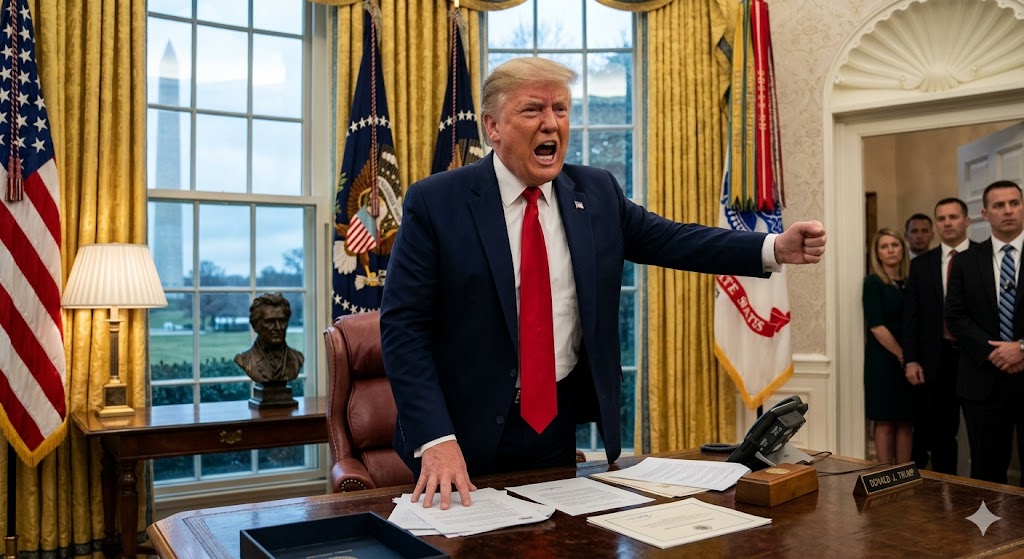
The 15-point peace proposal you mentioned is currently the center of intense global diplomacy as of today, March 25, 2026. It was delivered to Tehran through Pakistani intermediaries as part of a push to end Operation Epic Fury, which is now entering its fourth week.
The plan is designed to be a “comprehensive reset,” but it contains some of the toughest demands ever placed on the Iranian state. Here are the core details of what is being proposed:
The “15 Points” of the U.S. Proposal
The Trump administration’s offer focuses on the total dismantling of Iran’s “offensive” capabilities in exchange for economic survival.
- Nuclear Total Rollback: Iran must dismantle all enrichment facilities (Natanz, Fordow) and hand over all enriched material to the IAEA.
- “Never” Clause: A permanent, legally binding commitment to never pursue nuclear weapons.
- The Hormuz Mandate: The Strait of Hormuz must be declared a “Free Maritime Zone” with a guarantee that it will never be blocked again.
- Proxy Divestment: Iran must immediately cease all funding, arming, and directing of groups like Hezbollah, the Houthis, and militias in Iraq/Syria.
- Missile Caps: While not fully dismantled, Iran’s ballistic missile program would be strictly limited in range and volume, designated “for self-defense only.”
- The “Incentives”: In return, the U.S. would lift all primary and secondary sanctions, remove the “snapback” threat of UN sanctions, and provide technical assistance for a strictly civilian nuclear energy project at Bushehr.
The Iranian Counter-Stance
While President Trump has stated that the “other side wants to make a deal,” the official word from Tehran—specifically from the Islamic Revolutionary Guard Corps (IRGC)—has been dismissive. Iran has reportedly issued its own demands to even begin formal talks:
- Reparations: Compensation for “wartime losses” suffered during the strikes since February 28.
- Base Closures: A demand for the closure of U.S. military bases in the Persian Gulf.
- Sovereign Fees: The right to levy transit fees on ships passing through the Strait of Hormuz.
The Current Friction Point
The biggest hurdle right now is trust and timing. The U.S. is signaling that “Operation Epic Fury” is ahead of schedule, with over 9,000 targets struck and the Iranian Navy largely neutralized. President Trump has reportedly given Tehran four more days to accept the framework before the U.S. begins targeting Iran’s critical energy infrastructure, including major gas fields.
Pakistan is standing by to host in-person talks as early as this weekend in Islamabad. It would be the first time high-level officials from these nations have sat in the same room since the conflict began.

Islamabad Click to open side panel for more information ShareDirections Opens in a new window
Islamabad Click to open side panel for more information is the capital city of Pakistan, located in the northern part of the country on the Pothohar Plateau. It sits at the foot of the Margalla Hills, which provide a dramatic mountainous backdrop to the city’s modern, gridded layout.
As a purpose-built capital established in the 1960s to replace Karachi, the city is known for its high standard of living, abundant greenery, and organized sectors. It serves as the country’s political and diplomatic heart, housing the Parliament House, the Presidency, and the majority of foreign embassies, making it a natural choice for high-stakes international mediation.
- Geographic Setting: It is part of the Islamabad Capital Territory and is adjacent to the older, bustling city of Rawalpindi, together forming a large metropolitan area.
- Key Landmarks: The city is home to the Faisal Mosque, one of the largest and most iconic mosques in the world, known for its unique desert-tent-inspired architecture.
- Diplomatic Hub: Because of its safety and infrastructure, it frequently hosts regional summits and peace talks involving neighboring powers like Iran and Afghanistan.
I will monitor the diplomatic cables and news reports over the next 24 hours. If there is a formal confirmation from Tehran regarding the Islamabad summit, I will update you immediately.
 thelivingbreathingjamesbrown.com
You must be logged in to post a comment.