
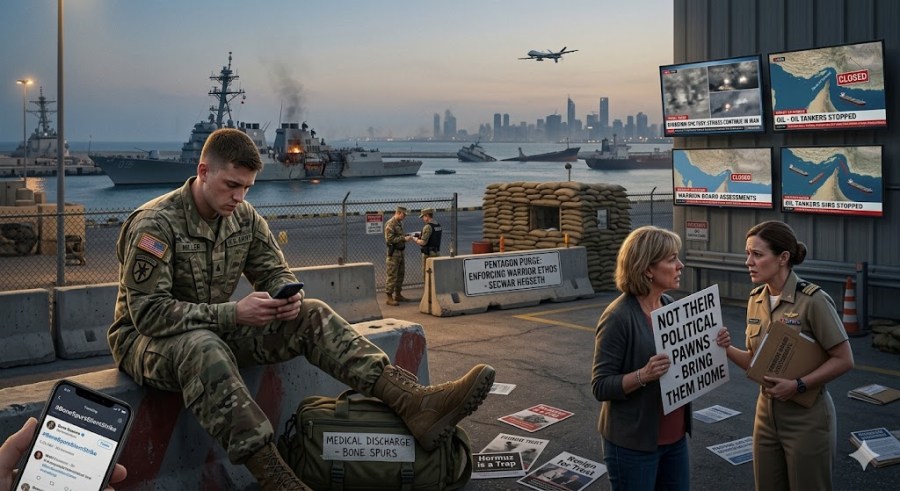
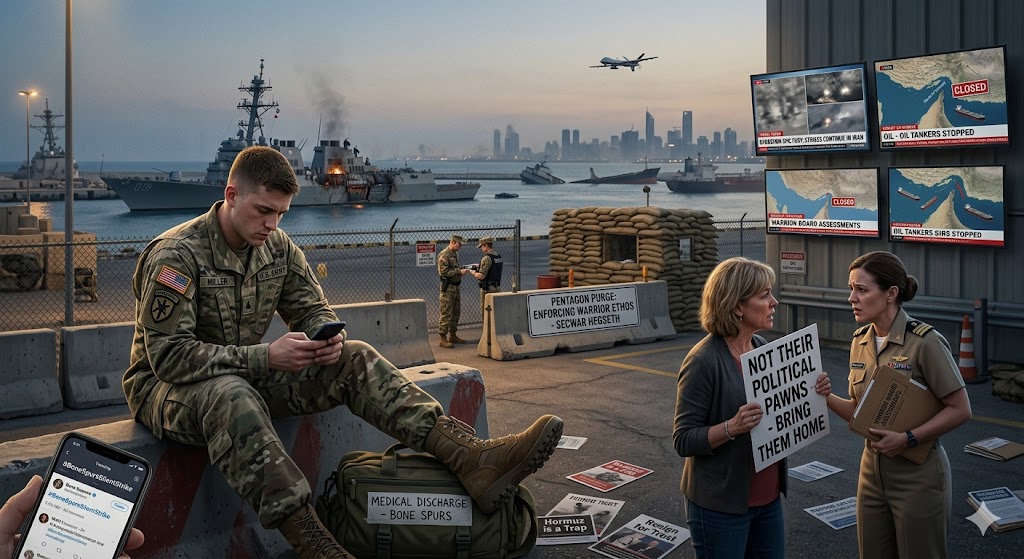
The Fracturing of the American Sword
Geopolitical Conflict, Institutional Purges, and the Rise of Medicalized Resistance in the 2026 Iran War
Executive Summary
The spring of 2026 represents a seminal inflection point in the history of American civil-military relations. It is characterized by a high-intensity kinetic conflict in West Asia occurring simultaneously with a radical administrative restructuring of the Department of War. This period—defined by the ongoing 2026 Iran War (Operation Epic Fury)—has witnessed a volatile intersection of external strategic exigencies and internal cultural shifts.
As the United States military executes a complex air and sea campaign against the Islamic Republic of Iran, it is concurrently undergoing what senior analysts describe as an “institutional purge” of its professional officer corps. This report provides an exhaustive analysis of the strategic landscape, the mechanisms of the leadership overhaul led by Secretary of War Pete Hegseth, and the burgeoning personnel crisis characterized by a spike in medical discharges—most notably for “bone spurs”—and a profound erosion of trust among military families.
I. The Strategic Crucible: Operation Epic Fury
The 2026 Iran War commenced on February 28, 2026, with a massive joint U.S.-Israeli offensive titled Operation Epic Fury. The campaign was designed as a “calibrated, high-impact decapitation strike” intended to collapse the Iranian regime’s command-and-control infrastructure within hours. In the first twelve hours alone, coalition forces conducted nearly 900 strikes targeting ballistic missile sites, air defense networks, and senior leadership.
The Decapitation Strike and its Consequences
The primary success of the initial wave was the elimination of Supreme Leader Ali Khamenei and dozens of other high-ranking Iranian officials. However, the strategic assumption that decapitation would lead to systemic collapse proved fallacious. Instead, the Iranian regime demonstrated significant ideological and structural resilience, rapidly consolidating power under Mojtaba Khamenei as the new Supreme Leader. This transition was bolstered by the appointment of Mohammad Bagher Zolghadr as a key operational figure, signaling the primacy of the Islamic Revolutionary Guard Corps (IRGC) over traditional clerical or political establishments.
By April 2026, the war had transitioned from a rapid-effects operation into a “grinding air campaign.” While the U.S. and Israel have established undisputed air superiority and sunk over 90% of the Iranian navy, the conflict remains unresolved. Iran has maintained its ability to impose costs through asymmetric persistence, including drone strikes on U.S. bases in the Gulf and targeting critical energy infrastructure in neighboring Arab states.
The Strait of Hormuz Standoff
The most critical strategic vulnerability remains the Strait of Hormuz. Despite the destruction of the Iranian surface fleet, Tehran has successfully choked off maritime traffic, leading to a dramatic surge in global oil and gas prices.
Table 1: Strategic Asset Status (April 2026)
| Strategic Asset | Status | Impact on Conflict |
|---|---|---|
| Iranian Surface Navy | > 90% Destroyed | Neutralization of conventional naval threat. |
| Strait of Hormuz | Closed | Global energy crisis and economic instability. |
| Iranian Leadership | Decapitated | Shift to IRGC-led wartime command. |
| U.S. Munition Stocks | Critically Depleted | Reduced readiness for other theaters (e.g., Pacific). |
| Global Oil Prices | Significant Increase | High inflationary pressure on coalition economies. |
II. The Administrative Front: The Pentagon Purge
While the kinetic war rages in the Middle East, the Department of War has initiated a sweeping internal overhaul. Secretary Pete Hegseth, acting under the mandate of the Trump administration, has moved to align the Pentagon’s top brass with a specific “warrior ethos” and an “America First” strategic outlook.
The Sacking of General Randy George
On April 2, 2026, Secretary Hegseth abruptly removed the Army’s top general, Chief of Staff Gen. Randy George, demanding his immediate retirement. George was in the third year of a four-year term. The removal occurred without an official explanation, although internal sources suggest the move was driven by “palace intrigue” and perceived rivalries with Army Secretary Dan Driscoll.
This environment has been exacerbated by “Signalgate”—a 2025 incident in which Hegseth allegedly violated security protocols by using the Signal app to discuss classified strike plans, inadvertently including a journalist in the group chat.
Expanding the Purge: The Warrior Board
The removal of General George was accompanied by the dismissals of Gen. David Hodne and Maj. Gen. William Green Jr. These represent a broader pattern affecting nearly every branch of the armed forces. Since 2025, Hegseth has removed or blocked the promotions of over a dozen senior officers, including Gen. C.Q. Brown Jr. and Adm. Lisa Franchetti.
The mechanism for these removals is often linked to the “Warrior Board,” a panel of retired senior military personnel empowered to review three- and four-star officers and recommend the removal of those deemed to be “lacking in requisite leadership qualities” or insufficiently aligned with administration priorities.
III. Medicalized Resistance: The “Bone Spurs” Phenomenon
A secondary front in this internal crisis is the rank-and-file’s reaction to the leadership purge. Data indicates a significant spike in soldiers seeking release from service for medical reasons, with “bone spurs” becoming a ubiquitous and politically charged diagnosis.
The Symbolic Echo of Draft Deferment
In 2026, the term “bone spurs” transitioned from a political barb into a form of “asymmetric resistance.” On social media platforms, soldiers have popularized the use of medical conditions that are difficult to objectively disprove—like certain osteophytes—to secure early release. This “silent strike” is a direct reflection of a breakdown in trust between the troops and a leadership they frequently refer to as “Cadet Bone Spurs” in digital forums.
Table 2: Key Terms of Internal Dissent
| Term/Concept | Political Origin | 2026 Military Usage |
|---|---|---|
| Bone Spurs | Trump Vietnam Deferment | A “silent strike” medical exit strategy. |
| Cadet Bone Spurs | Political Pejorative | Standard rank-and-file nickname for leadership. |
| Warrior Board | Administrative Panel | Loyalty-based screening tool for senior officers. |
IV. The Crisis of the Military Family
Distrust has permeated the broader military community. A growing number of parents are actively encouraging their children to resign, perceiving that the current leadership uses service members as “political pawns.”
The rhetoric of the “Warrior Ethos”—which often dismisses traditional support structures as “woke”—has led many families to view the military environment as increasingly toxic. This is further fueled by administrative changes in DoDEA schools, where orders to “scrub” diversity-related materials have led to student protests and walkouts at overseas bases.
V. Conclusion: Institutional Resilience vs. Transformation
The central question facing the U.S. military in mid-2026 is whether the institution can survive a fundamental transformation of its culture while fighting a high-intensity war. The proliferation of “bone spurs” discharges and the organized opposition from military families are not merely personnel issues; they are indicators of a profound systemic crisis.
The events of April 2026 suggest that the Department of War is currently an institution at war within itself, where the external conflict with Iran has become a backdrop for a deeper struggle over the identity, loyalty, and professional ethics of the United States armed forces.
 thelivingbreathingjamesbrown.com
You must be logged in to post a comment.