The Artemis II Scientific Report: Mankind’s Return to the Deep
Subject: Space Launch System (SLS) Block 1 & Orion Mission IntegrityMission Date: April 1 – April 10, 2026
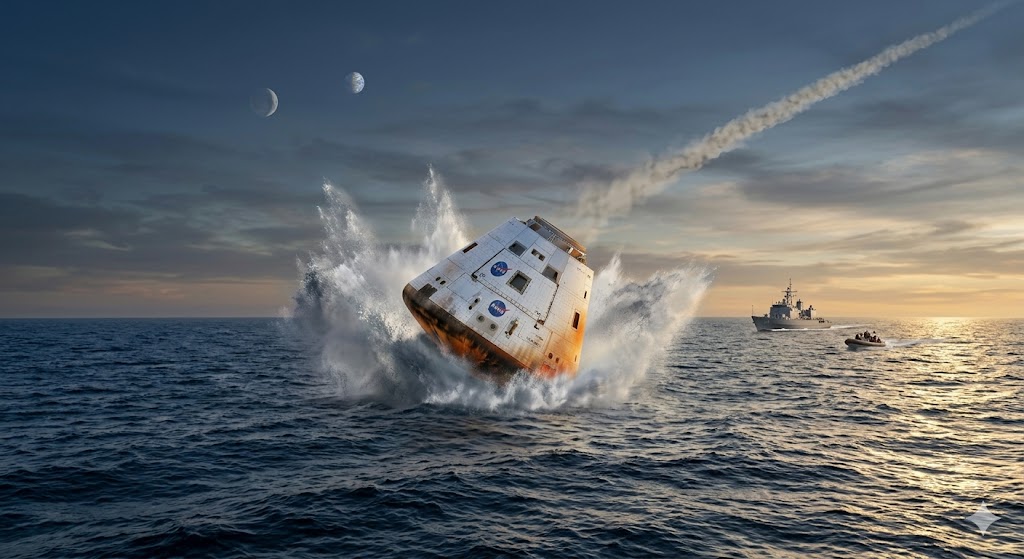
Status: Mission Complete / Successful Splashdown
I. The Colossus: Rocket Specifications
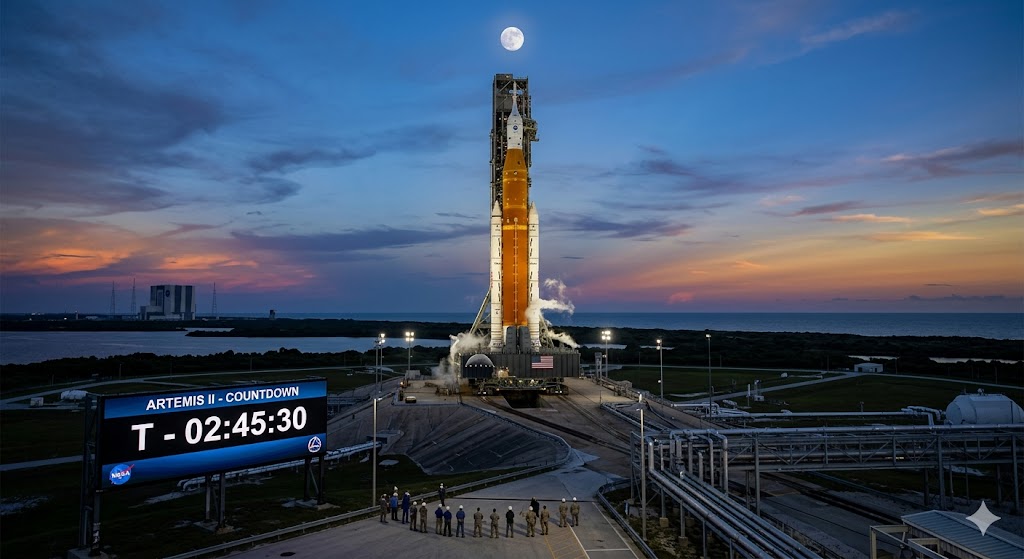
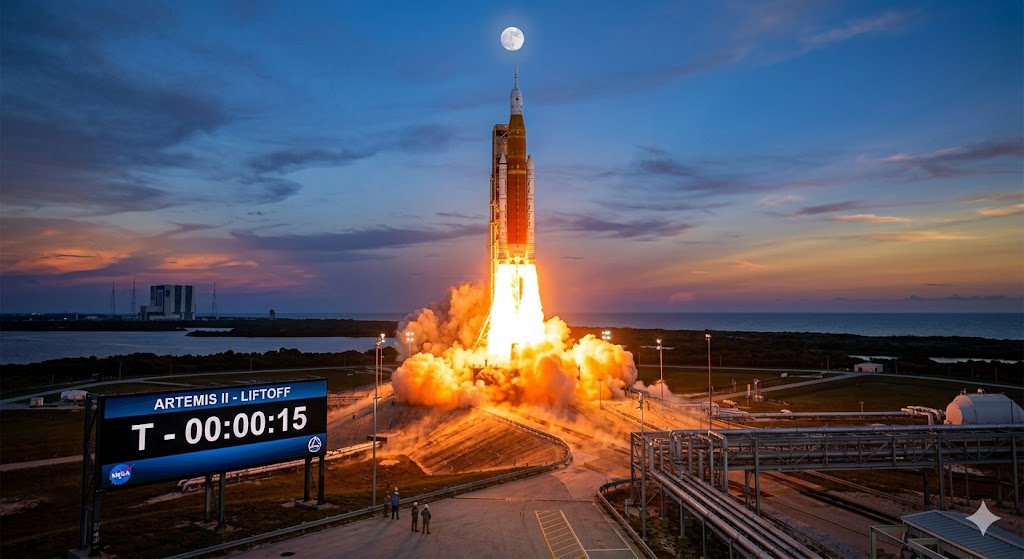
The Space Launch System (SLS) Block 1 is the most powerful operational rocket in human history, standing 322 feet tall—towering over the Statue of Liberty. At liftoff, it weighs a staggering 5.75 million pounds when fully fueled.
1. The Core Stage (The Backbone)
Dimensions: 212 feet tall and 27.6 feet in diameter.
Fuel Composition: It houses two massive tanks containing 733,000 gallons of super-cooled propellant.
Liquid Hydrogen (LH2): 537,000 gallons cooled to -423°F.
Liquid Oxygen (LOX): 196,000 gallons cooled to -297°F.
Propulsion: Four RS-25 engines (shuttle-derived).
Engine Size: 14 feet long and 8 feet wide.
Thrust: Each engine produces 512,300 pounds of vacuum thrust (operating at 109% of its original rated power).
2. Solid Rocket Boosters (The Muscle)
Two twin five-segment boosters provide more than 75% of the total thrust during the first two minutes of flight.
Height: 177 feet.
Thrust:3.6 million pounds per booster.
Combined Liftoff Power: Together with the core stage, the SLS generates 8.8 million pounds of maximum thrust—15% more than the legendary Saturn V.
3. Interim Cryogenic Propulsion Stage (ICPS)
Once in space, the ICPS takes over to push the crew toward the Moon.
Engine: A single RL10C-2 engine.
Thrust:24,750 pounds.
Fuel: Liquid Hydrogen and Liquid Oxygen.
II. The Mission: Artemis II Flight Profile
This 10-day mission was the first crewed test of the Orion spacecraft in deep space.
Launch & Earth Orbit: Following a flawless liftoff, the crew performed “High Earth Orbit” maneuvers to test life support and manual proximity operations.
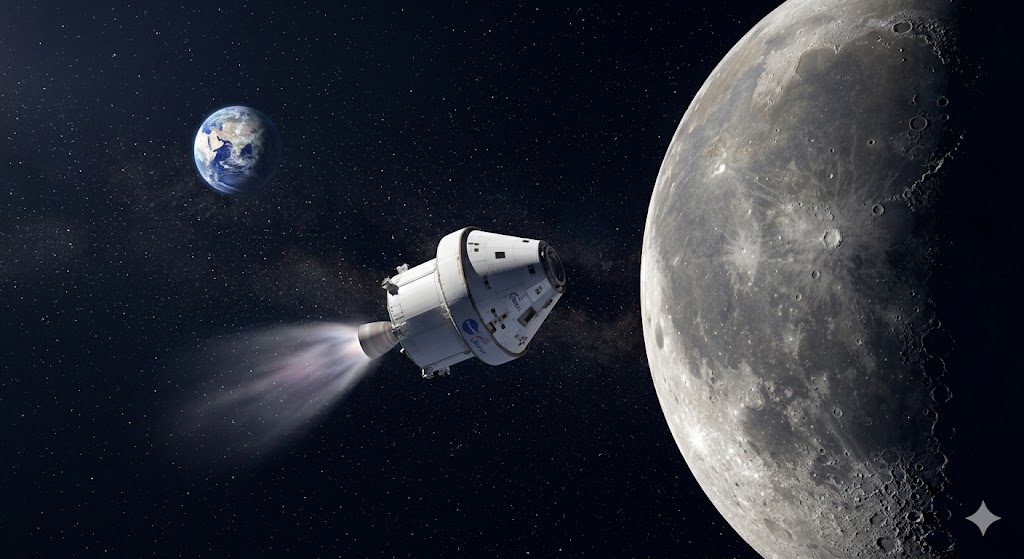
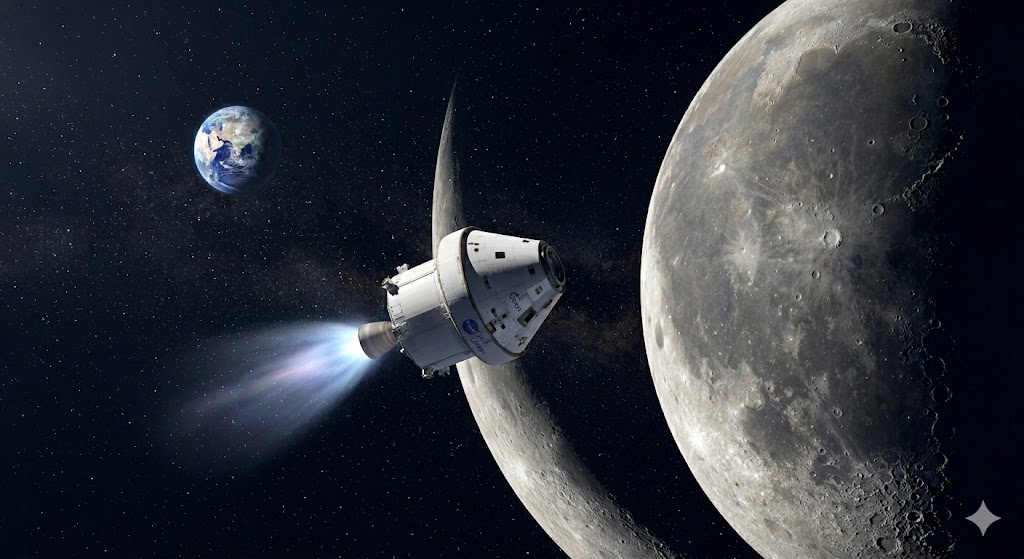
Trans-Lunar Injection (TLI): The Orion spacecraft executed a burn to slingshot toward the Moon, reaching speeds of Mach 33 (24,500 mph).
The Lunar Flyby: On April 6, 2026, the crew passed behind the Moon, breaking the record for the farthest humans have ever traveled from Earth—252,756 miles.
The Return: The spacecraft utilized a “free-return trajectory,” using the Moon’s gravity to whip the capsule back toward Earth without needing a second major engine burn.
III. Scientific and Engineering Outcomes
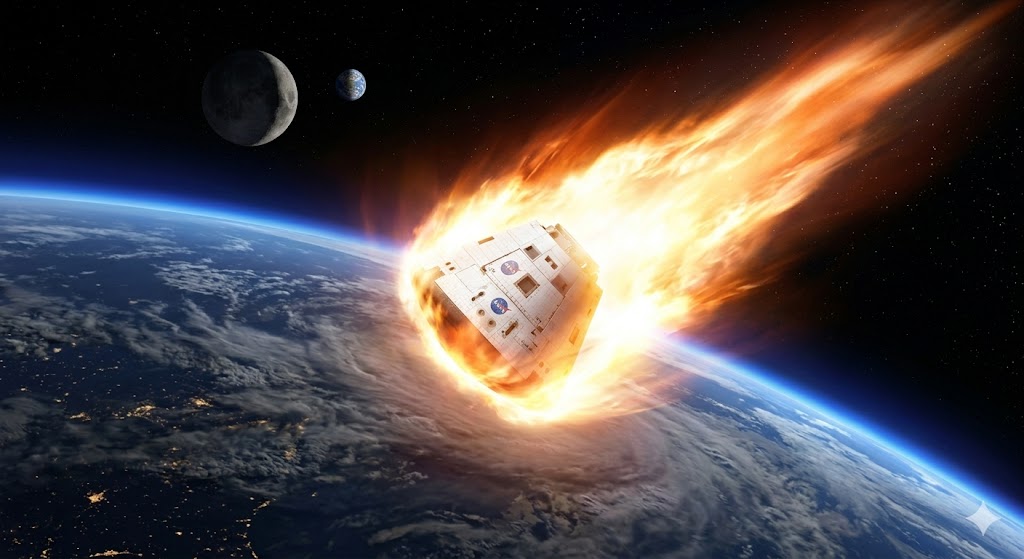
The Heat Shield Challenge: Upon re-entry on April 10, the Orion heat shield endured 5,000°F while traveling at 25,000 mph. Data shows the shield performed within 2% of pre-flight predictions.
Communications: A crucial test of the Optical Laser Communications system allowed the crew to transmit high-definition photos of the Moon’s far side (specifically the Orientale Basin) back to Earth in near real-time.
Radiation Monitoring: Advanced sensors inside the cabin provided the first detailed maps of the radiation environment humans encounter when passing through the Van Allen belts and deep space.
IV. Conclusion: The Gateway is Open
Artemis II has proven that the SLS and Orion are flight-ready for human crews. This mission wasn’t just a flight; it was the final “checkride” before Artemis III, which will land the first woman and next man on the lunar South Pole in 2028.
For the Scientists: The propulsion efficiency and structural integrity of the Block 1 configuration have been validated for lunar payloads of up to 27 metric tons.
For the Young: You are the Artemis Generation. This rocket was built for you to see further, dream bigger, and eventually walk on the red dust of Mars. The record has been broken, and the path is clear.
Getting to the Moon and back is less a single arithmetic problem and more a series of distinct mission phases, each governed by specific equations of classical mechanics.
For the Artemis II mission—a crewed free-return trajectory lunar flyby—the mathematics must account for launching from Earth, maneuvering into a path that swings around the Moon using gravity as a natural brake/accelerator, and returning precisely into Earth’s atmosphere.
Here is a breakdown of the mathematical framework required for each major stage of the journey.
Phase 1: Launch and Orbit Insertion (SLS & Orion)
The first math challenge is conquering Earth’s gravity and reaching a stable parking orbit. This is governed by the Tsiolkovsky Rocket Equation and basic Orbital Velocity.
1. The Rocket Equation
This equation determines how much velocity a rocket can gain based on its fuel mass. A rocket must change its total velocity (Δv, delta-v) enough to reach its destination.
Δv=Veln(mfm0)
Δv is the total change in velocity required.
Ve is the effective exhaust velocity of the engine (related to engine efficiency, or Isp).
m0 is the initial mass of the rocket (full of fuel).
mf is the final mass of the rocket (empty of fuel).
ln is the natural logarithm.
2. Orbital Velocity Equation
To stay in orbit at a certain height, a spacecraft must move at a specific speed where gravity and centrifugal force balance.
vorbit=rGME
vorbit is the velocity needed to maintain orbit.
G is the gravitational constant (6.674×10⁻¹¹m3kg−1s−2).
ME is the mass of Earth (5.972×1024kg).
r is the radius of the orbit (measured from the center of Earth, not the surface).
Phase 2: High Earth Orbit (HEO) Staging
Unlike the Apollo missions, which launched almost directly from Low Earth Orbit (LEO) toward the Moon, Artemis II uses an unconventional approach to test its systems and ensure crew safety before committing to deep space.
The Plan: After reaching an initial orbit, the Interim Cryogenic Propulsion Stage (ICPS) performs a burn to raise Orion’s maximum height (apogee) into a High Earth Orbit (HEO) of approximately 60,000 km (37,000 miles).
The Math: This orbital change requires a specific change in velocity (Δv), calculated using the Vis-viva equation, which relates a spacecraft’s speed to its orbital semi-major axis (total energy).
Phase 3: Trans-Lunar Injection (TLI)
This is the burn that commits the crew to leaving Earth’s orbit and heading toward the Moon. TLI is a Hohmann Transfer, but a complex one because it involves a “free-return trajectory.”
The Hohmann Transfer (The Conceptual Framework)
The simplest way to go between two stable circular orbits is a Hohmann Transfer.
Conceptual formula for the Δv needed to transfer:Δvtransfer=Δv1+Δv2Δvtransfer=(rstartGME)(rstart+rtarget2rtarget−1)(Simplest case, ignoring plane changes)
Artemis II’s Complexity: The Free-Return Trajectory
Artemis II uses a special kind of transfer called a free-return trajectory. The math here is far more complex than a standard Hohmann transfer and requires computational n-body problem simulations.
The “Math”: Rather than performing a burn to get to the Moon and another burn to get home, the trajectory is mathematically calculated so that if no further engines are fired after the TLI burn, the spacecraft will use the Moon’s gravity to “slingshot” it back towards Earth. This requires incredibly precise vector calculations to make sure the spacecraft arrives behind the Moon at exactly the right point, speed, and angle.
Phase 4: Lunar Flyby and the return Home
At the peak of this free-return trajectory, the spacecraft is moving at its slowest relative to Earth, but it still has substantial speed (vapproach) relative to the Moon.
1. Conservation of Energy
As the spacecraft approaches the Moon, it exchanges potential energy (from falling into the Moon’s gravity well) for kinetic energy (speed).
21mvsc2−rMGMMm=Constant
vsc is the spacecraft speed.
MM is the mass of the Moon.
rM is the distance from the Moon’s center.
2. The Gravity Assist (Conceptual)
This is not a single simple equation but a vector addition. The Moon’s gravity bends the spacecraft’s velocity vector.
vfinal=vinitial+vchange_by_gravity
If calculated correctly, the change in direction puts the spacecraft on a path directly back to a tiny keyhole in Earth’s atmosphere.
Phase 5: Re-entry and Splashdown
This is the reverse of launching. The spacecraft must discard almost all of its massive energy. The math here is about aerodynamics and heat management, which is described by fluid dynamics and Newton’s Second Law.
1. Atmospheric Drag Equation
The atmosphere provides the necessary force to slow the capsule from ~25,000 mph (at the upper atmosphere) to a few mph at splashdown.
Fd=21ρv2CdA
Fd is the drag force (the breaking force).
ρ is the atmospheric density (which changes dramatically with altitude).
v is the spacecraft velocity relative to the air.
Cd is the drag coefficient (how “un-aerodynamic” the blunt heat shield is).
A is the cross-sectional area of the heat shield.
2. Deceleration (Newton’s Second Law)
This drag force creates a huge deceleration (measured in Gs), which the heat shield must survive.
a=mcapsuleFd
A precise math model must calculate exactly how much energy is being shed to ensure the angle of attack is steep enough to slow down, but not so steep that the G-forces or temperatures exceed human or capsule limits.

 thelivingbreathingjamesbrown.com
You must be logged in to post a comment.