
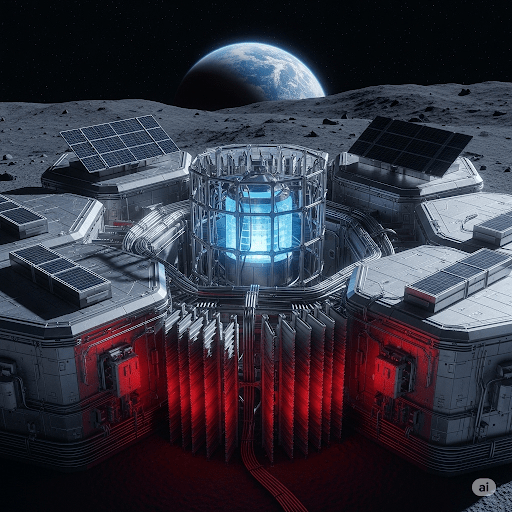
The call for a nuclear reactor on the Moon is more than just a technological pursuit; it is a declaration of a new space race, a grand geopolitical drama unfolding across the silent lunar landscape. This ambitious vision, championed by the administration, seeks to position the United States as the undisputed leader in lunar exploration and industry. The very concept is a response to the growing ambitions of other nations, particularly China and Russia, who have their own plans to establish a lunar base with a nuclear power source. The directive is clear: the first to deploy such a system may effectively claim a “keep-out zone,” a strategic foothold on the Moon’s most resource-rich and sunlit regions.
This bold gambit hinges on the efforts of NASA and its burgeoning partnerships with private companies, a dynamic that has reshaped modern space exploration. NASA’s Artemis program, the overarching framework for returning humans to the Moon, is the vehicle for this enterprise. While NASA has long studied the concept of fission surface power, the current push accelerates and expands the program, setting a new, more aggressive timeline and increasing the power requirements from a 40-kilowatt system to a more powerful 100-kilowatt reactor. This increased power is not merely for life support but to fuel the heavy-duty machinery required for In-Situ Resource Utilization (ISRU)—the process of extracting and refining resources like water ice from lunar soil, which would be used to create rocket fuel and breathable air.
Enter SpaceX and its visionary founder, Elon Musk. While Musk has often expressed a singular focus on Mars, the company’s Starship rocket is a crucial, if unproven, piece of this lunar puzzle. Starship is designed to be a fully reusable, heavy-lift launch system capable of delivering massive payloads to the Moon and Mars. A lunar nuclear reactor, weighing several tons, would be an ideal payload for such a vehicle. However, the drama of this collaboration is heightened by the fact that Starship has not yet demonstrated the capability for a soft lunar landing. Recent test flights have shown remarkable progress, but the journey to a successful, reliable lunar landing is fraught with technical challenges and the ever-present risk of catastrophic failure. The prospect of launching a nuclear reactor on a vehicle still in its development phase adds a layer of high-stakes tension to the entire project. Musk, for his part, has long been a vocal proponent of nuclear power on Earth, calling its shutdowns “madness,” and it is this same belief in nuclear energy’s potential that likely underpins his company’s role in this lunar endeavor.
The risks associated with this undertaking are immense and multifaceted. The most immediate is the simple, brutal reality of spaceflight: a launch failure on Earth could lead to the dispersal of radioactive material, creating a terrestrial disaster even before the mission leaves the planet’s atmosphere. On the Moon, a landing failure, a scenario made more plausible by the recent string of failed lunar missions by private companies, could scatter the reactor’s components across the lunar surface, contaminating a future landing site. Beyond the physical risks, there are profound geopolitical and environmental concerns. The Outer Space Treaty of 1967 prohibits countries from claiming territory in space, but the establishment of a nuclear-powered base could create a de facto claim by establishing a “safety exclusion zone.” This could lead to escalating tensions and legal disputes with other nations, particularly as the Moon’s most desirable locations for resources and sunlight are finite.
Ultimately, this project is a high-stakes, high-wire act—a collision of political will, technological ambition, and the unforgiving reality of space. It is a story of a nation betting on its technological prowess to secure a future in space, with NASA and its commercial partners as the key players, and the Starship rocket as the central, yet uncertain, vehicle of destiny. The outcome of this grand and dramatic push will not only determine the future of America’s lunar ambitions but may well define the next chapter of humanity’s relationship with the cosmos.
That’s an interesting question that bridges science fiction with the real world. The movie you’re likely thinking of, where something hits the Moon and causes it to break up or go off course, is using a much grander scale of destruction than what a real-world nuclear reactor could ever achieve.
The short answer is no, a nuclear reactor exploding on the Moon could not cause a catastrophe here on Earth.
Here’s why the two scenarios are so vastly different:
- Scale of Energy: The event you described in the movie, where a piece of the Moon is torn off, would require an unimaginable amount of energy—the kind of energy that can only be generated by a cosmic collision on a planetary scale. The Moon is an immense celestial body, with a mass of over 73 quintillion metric tons. The amount of energy needed to significantly alter its mass or orbit would be equivalent to billions of the most powerful nuclear bombs ever detonated, all going off at once. A nuclear reactor, in contrast, is a small, controlled power source.
- Nature of the Explosion: A nuclear reactor explosion is not the same as a nuclear bomb detonation. A reactor does not produce a powerful blast wave capable of destroying its surroundings. Instead, a catastrophic failure would result in a meltdown, where the core overheats and releases a large amount of radioactive material. On the Moon, with no atmosphere, this material would spread across the lunar surface, creating a localized radioactive hazard, but it would not create a shockwave that could affect the Moon itself, let alone Earth.
- Lack of Atmosphere: Earth’s atmosphere is what makes a nuclear event here so dangerous through fallout. There is no atmosphere on the Moon to carry radioactive dust and debris through the air to Earth. The radiation would be contained to the vacuum of space around the Moon’s surface.
Therefore, while an exploding reactor on the Moon would be a disaster for any lunar base or crew in the vicinity, it would be a purely localized catastrophe. It would not have the power to alter the Moon’s orbit, tear off a piece of its surface, or cause any kind of global disaster on Earth. The risks are confined to the lunar environment itself.


You must be logged in to post a comment.