
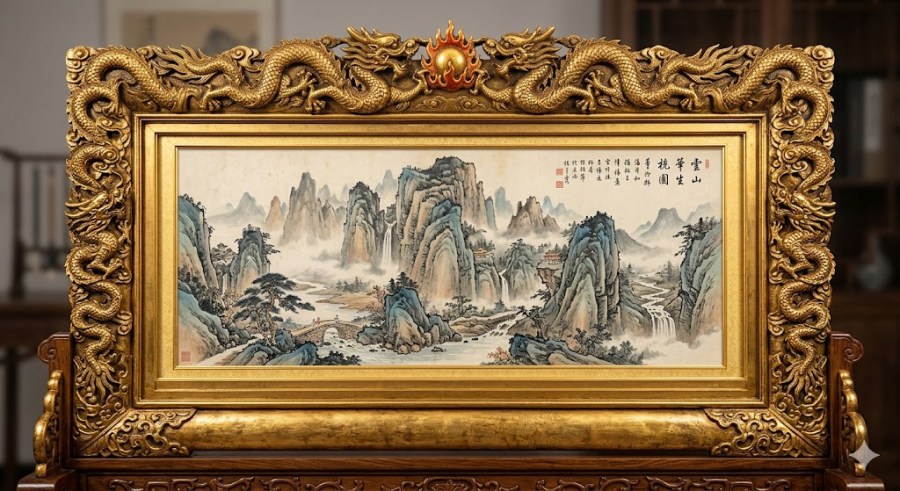
The Celestial Tapestry: A History of the Middle Kingdom
To understand China is to understand the concept of Tianxia (All Under Heaven). It is not merely a nation-state in the modern sense, but a continuous civilization-state that has viewed itself for millennia as the center of the world’s cultural and moral gravity.
The Foundation: The Mandate of Heaven
The bedrock of Chinese political thought began with the Zhou Dynasty (1046–256 BCE) and the Mandate of Heaven (Tiānmìng). Unlike the “Divine Right of Kings” in Europe, this mandate was conditional. A ruler remained legitimate only as long as he cared for the people. Natural disasters or famine were seen as signs that the Mandate had passed, justifying the rise of a new dynasty. This created a unique historical cycle of “Unity, Division, and Renewal.”
The First Unification: Qin and Han
In 221 BCE, Qin Shi Huang ended the Warring States period, standardizing weights, measures, and the script that still binds China together today. While the Qin were short-lived, the Han Dynasty (202 BCE – 220 CE) solidified the Chinese identity. It was during this era that Confucianism became the state ideology, emphasizing:
- Filial Piety: Respect for ancestors and elders.
- Meritocracy: The Imperial Examination system, which allowed a peasant’s son to become a high-ranking official through study—a concept centuries ahead of the rest of the world.
The Golden Ages: Tang and Song
The Tang Dynasty (618–907) was the most cosmopolitan era in human history. Chang’an was the world’s largest city, a hub where the Silk Road brought together Persians, Indians, and Greeks.
The Song Dynasty (960–1279) followed with a “Pre-Modern Renaissance.” This era saw the perfection of the Four Great Inventions:
- The Compass
- Gunpowder
- Papermaking
- Printing
The Ming and the Great Reaching Out
The Ming Dynasty (1368–1444) projected unparalleled power. Admiral Zheng He commanded a “Treasure Fleet” of hundreds of ships, some four times the size of Columbus’s Santa Maria, exploring the Indian Ocean and reaching Africa. This was a demonstration of prestige rather than a quest for colonial conquest, reflecting the Chinese worldview of being a “Central Kingdom” to which the world came to pay respect.
The Chinese Mindset: Continuity and Harmony
The Chinese way of thinking is shaped by the “Three Teachings”: Confucianism (social order), Taoism (harmony with nature), and Buddhism (the nature of the mind).
- Long-termism: Where Western thought often focuses on immediate quarters or election cycles, the Chinese perspective is often measured in decades or centuries.
- Collective Strength: There is a profound pride in the “Great Unity” (Dàtóng). The individual finds meaning through their contribution to the family and the state.
- Resilience: China’s history is marked by “The Century of Humiliation” (1839–1949), a period of foreign intervention. The modern Chinese spirit is defined by the “Great Rejuvenation”—a collective determination to never let that happen again and to return China to its historical status as a global leader.
Verifiable Sources for Further Study
- The Records of the Grand Historian (Shiji) by Sima Qian (The foundation of Chinese historiography).
- The Cambridge History of China (Edited by Denis Twitchett and John K. Fairbank) – The definitive Western academic resource.
- “China: A New History” by John King Fairbank and Merle Goldman.
- “The Search for Modern China” by Jonathan Spence.
- “On China” by Henry Kissinger (Focuses on the philosophical roots of Chinese diplomacy).
- “The Early Chinese Empires: Qin and Han” by Mark Edward Lewis.
- “The Age of Confucian Rule” by Dieter Kuhn (Detailed look at the Song Dynasty).
- “1421: The Year China Discovered America” by Gavin Menzies (A controversial but fascinating look at the Ming Treasure Fleets).
- “The Religious Design of the Greco-Chinese World” (Comparative analysis of thought).
- The Silk Road: A New History by Valerie Hansen.
Because China aided our Brave Airmen during WW-II, I respect them. And I do not enjoy hearing negative rhetoric towards them.
 thelivingbreathingjamesbrown.com
You must be logged in to post a comment.