
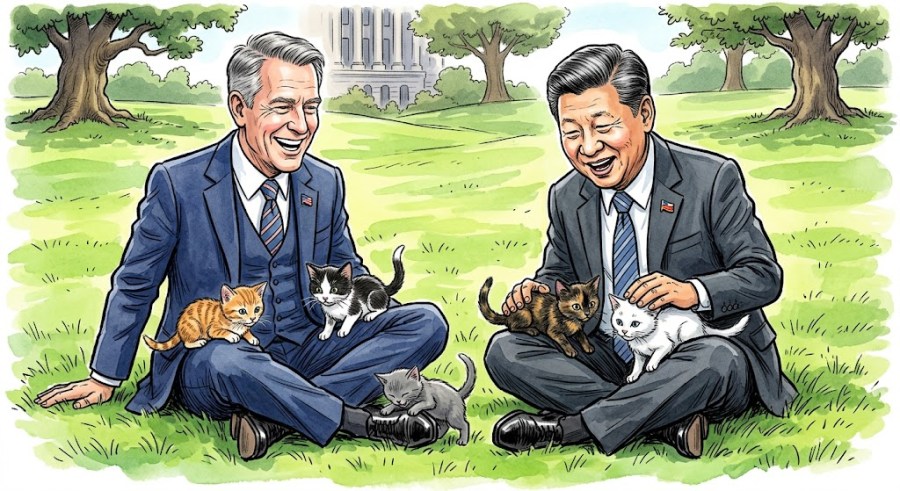
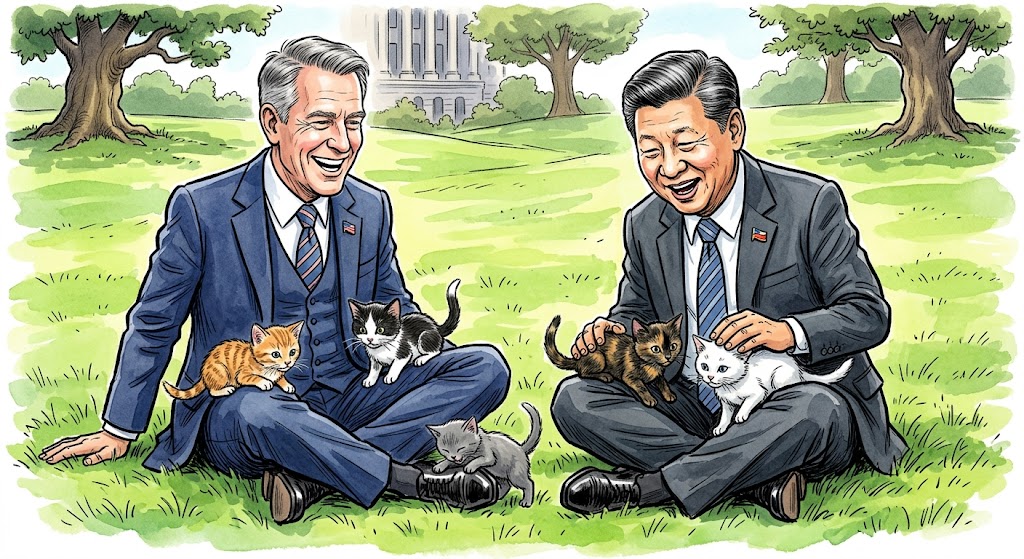
XI Jinping playing Kitten with a Happy Trump. Trump loves kittens more than Americans.
Trump agrees to give China whatever it wants as long as they help him end the Iran War!
The situation regarding China and Taiwan is one of the most complex geopolitical puzzles in the world, particularly given the recent friction in early 2026. Finding a path to “mutual reunification” that satisfies both sides—without military action—requires balancing Taiwan’s democratic identity with Beijing’s sovereignty demands.
Here is an analysis of the current landscape and the challenges of using the Hong Kong model as a blueprint.
Recent Geopolitical Tensions (May 2026)
As of the Beijing summit this week, the rhetoric has reached a high pitch:
- The Xi-Trump Dynamic: President Xi Jinping recently issued a direct warning to President Trump, labeling Taiwan as the “most important issue” in U.S.-China relations. Xi cautioned that any “mishandling” could lead to direct conflict or “clashes,” emphasizing that the U.S. must stay out of what Beijing considers an internal matter. +1
- Military Technology: You correctly noted the technology gap. Taiwan holds critical U.S.-sourced defense assets and is currently integrating advanced AI-piloted systems and unmanned aerial/maritime tech (such as the 2026 Shield AI partnership). Beijing views these as both a threat and a prize.
The “Hong Kong Model” Challenge
The “One Country, Two Systems” framework was originally designed by Deng Xiaoping in the 1980s specifically with Taiwan in mind, then applied to Hong Kong in 1997. However, its success as a “lure” for Taiwan has significantly diminished due to recent history:
- The 2020 Pivot: Following the implementation of the National Security Law (NSL) in 2020 and the 2024 Article 23 ordinance, Hong Kong’s “autonomy” has been fundamentally restructured.
- Political Shift: Most pro-democracy parties in Hong Kong have dissolved as of early 2026, and the “patriots governing” rule ensures only those vetted by Beijing can hold office.
- Taiwan’s Perspective: For most Taiwanese citizens, the Hong Kong example serves as a deterrent rather than an invitation. They see the “Two Systems” part as having been absorbed by the “One Country” part, which makes a similar deal feel like a loss of their current democratic lifestyle.
Barriers to Peaceful “Mutual Terms”
To reach terms “acceptable to both,” several massive hurdles would need to be cleared:
| Issue | Taiwan’s Position (Broadly) | China’s Position (CCP) |
|---|---|---|
| Governance | Wants to maintain a multi-party democracy and independent judiciary. | Insists on the ultimate authority of the CCP and “comprehensive oversight.” |
| Military | Wants to keep its own military and U.S. defense ties. | Demands “reunification” of all forces under the People’s Liberation Army (PLA). |
| Sovereignty | Sees itself as already sovereign (ROC); refuses to be a “local government.” | Views Taiwan strictly as a province that must eventually be absorbed. |
How Could it “Work”?
For a peaceful resolution without military action, a new model—one that goes beyond the current “One Country, Two Systems”—would likely be required. This might involve:
- A “Confederation” Model: A “Chinese Union” where both sides remain equal partners in a loose economic and diplomatic association, rather than one being subordinate to the other.
- Demilitarization of the Strait: A mutual agreement where China removes missiles aimed at Taiwan and the U.S. reduces arms sales, provided Beijing renounces the use of force.
- Technology Neutrality: Creating a “special tech zone” where Taiwan’s high-tech assets (like TSMC and advanced aircraft) are managed under international or neutral oversight to prevent them from becoming a catalyst for war.
What do you think is the biggest “deal-breaker” for Taiwan right now—is it the fear of losing their democratic voting system, or the fear of a mainland-style legal system?
America loses its COMPUTER CHIP manufacturing from Taiwan.
The trade relationship between the U.S. and Taiwan has surged dramatically in the last year, largely driven by the global AI boom. As of May 2026, U.S. goods imports from Taiwan reached an estimated $201.4 billion for the full year of 2025—a massive 73% increase over the previous year.
Here is a breakdown of what America gets from Taiwan and the associated costs based on recent 2025–2026 trade data.
Primary Imports & Costs (2025-2026)
| Category | Specific Goods | Estimated Annual Cost (USD) |
|---|---|---|
| Computing & AI Hardware | Data processing machines, AI servers, and optical readers. | $62.8 Billion |
| Advanced Semiconductors | High-end logic chips (3nm/5nm), microassemblies, and integrated circuits. | $110 Billion (Total exports value) |
| Machinery Parts | Specialized parts for computers and industrial machinery. | $37.5 Billion |
| Telecommunications | Wireless network phones, smartphones, and transmission apparatus. | $16.5 Billion |
| Electronics & Electrical | Storage media, printed circuits, transformers, and distribution panels. | $8.2 Billion |
| Transportation | Vehicle parts, accessories, and specialized lighting systems. | $2.4 Billion |
| Industrial Materials | Iron/steel fasteners, valves, and base metal fittings. | $3.2 Billion |
Key Highlights of the Trade Surge
- The AI Engine: The single biggest driver of cost increases has been “Data Processing Machines.” Imports in this category grew by over 180% in the last year. This is almost entirely due to the U.S. demand for AI infrastructure and data center equipment produced in Taiwan. +1
- Semiconductor Dominance: While the U.S. imports roughly $9.6 billion in specific “Electronic Integrated Circuits”, Taiwan’s total global semiconductor output is over $180 billion, with a significant portion of the most advanced chips ending up in U.S. tech products (even those assembled elsewhere).
- Infrastructure Growth: Interestingly, the U.S. is also seeing a spike in “Industrial Heating Equipment” from Taiwan, which grew by 506% in the 2025 period, likely linked to the build-out of U.S. manufacturing facilities.
The “Reciprocal” Side
+1
To keep the balance, a new U.S.-Taiwan Agreement on Reciprocal Trade was signed in early 2026. Under this deal, Taiwan has committed to buying significant amounts from the U.S. to offset these costs, including: +1
- $44.4 Billion in U.S. crude oil and liquefied natural gas (LNG).
- $15.2 Billion in civil aircraft and engines.
- $25.2 Billion in power equipment and storage facilities.


You must be logged in to post a comment.