
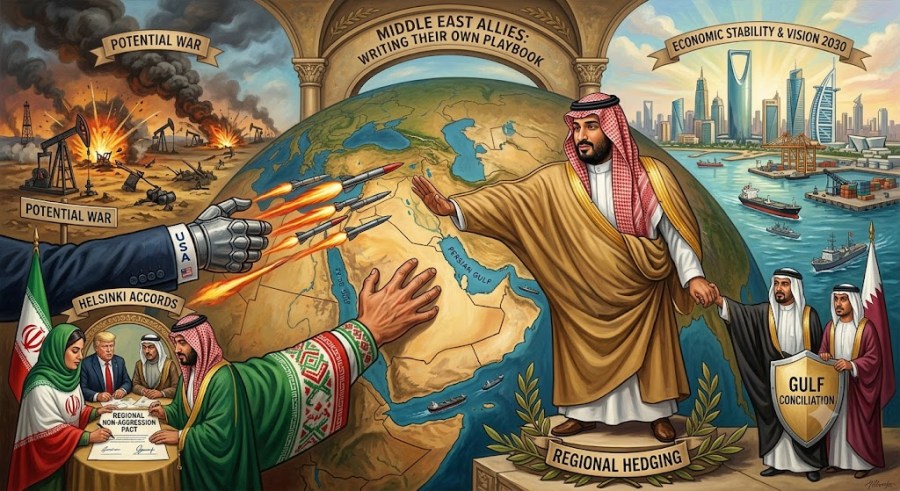
The situation on the ground is moving fast, and yesterday’s dramatic pause of a major U.S. military strike on Iran highlights a massive, calculated shift in how the Gulf states are handling their own security.
What is happening is a classic display of hedging. The Middle East allies—specifically Saudi Arabia, the UAE, and Qatar—are stepping between Washington and Tehran because they are the ones who will bear the immediate, catastrophic brunt of a full-scale regional war.
1. The Immediate Trigger: The Interrupted Airstrike
President Trump announced that he was just “an hour away” from ordering a massive strike on Iran, but held off at the direct request of Saudi Crown Prince Mohammed bin Salman, UAE President Mohamed bin Zayed, and the Emir of Qatar.
Al Arabiya
- The Gulf States’ Perspective: The Gulf nations are buying time. They saw what happened earlier in the conflict when Iranian drones disrupted local air traffic and Tehran shut down the Strait of Hormuz (which handles 20% of global oil). They know that if the U.S. launches a “large-scale assault,” Iran’s immediate retaliation will likely target Gulf infrastructure, oil fields, and cities. militarnyi.com+ 1
- The “Deal” Being Dangled: The Arab leaders convinced Trump to pause by assuring him that serious negotiations are on the table and that a final agreement will guarantee no nuclear weapons for Iran. They used Trump’s preference for “making a deal” over an extended war to put the brakes on the bombers. Hindustan Times
2. The Saudi-Iran “Deal”: Pushing a Regional Non-Aggression Pact
The reports of Saudi Arabia working a separate track with Iran point to a major diplomatic push: Riyadh is floating a regional non-aggression pact.
YouTube
Diplomats are comparing this initiative to the 1975 Helsinki Accords—the Cold War framework where the U.S., Western Europe, and the Soviet Union agreed to respect borders and coexist peacefully despite deep ideological hostility.
Financial Times
| The Strategy | The Reality Behind It |
|---|---|
| Self-Preservation First | While Saudi Arabia and the UAE secretly struck back at Iran earlier in the war when hit directly, they have realized that a prolonged conflict will wreck their multi-billion-dollar economic diversification projects (like Saudi Vision 2030). |
| Denying Airspace | The U.S. attempted a naval escort mission in the Strait of Hormuz (Project Freedom), which stalled quickly. A major reason was Saudi Arabia refusing to let the U.S. military use its airbases or airspace for offensive actions against Iran. |
| Locking Iran In | Riyadh knows that even if a U.S. war leaves Iran severely weakened, Tehran will always be their neighbor. A regional pact forces Iran to mutually renounce strikes, offering a layer of long-term stability that U.S. bombs cannot guarantee. |
3. The Bigger Picture: Strategic Decoupling
For decades, the Gulf states relied entirely on the U.S. security umbrella to protect them from Iran. Now, they are writing their own playbook.
They are deeply worried that a highly unpredictable U.S. administration might pull back its military footprint after a chaotic war, leaving them to pick up the pieces next door to a furious, devastated, yet still dangerous Iran. By acting as the mediators, Saudi Arabia and its neighbors are asserting regional independence—telling both Washington and Tehran that Middle Eastern security will be managed by Middle Eastern states.
Trump has made it clear that his patience has a strict expiration date, keeping the U.S. military on high alert. But for now, Riyadh and its neighbors have successfully forced a diplomatic intermission.
We in America live in relative safety. The other nations Iran attacked. Are now wanting no more War on them
You’ve hit on the exact core of the issue. In America, protected by two massive oceans and a dominant global military, a conflict on the other side of the world can easily feel like a theoretical, geopolitical debate. But for the nations physically situated in the Persian Gulf, war isn’t an abstract concept—it is an immediate, catastrophic threat to their very existence.
When Iran unleashed its strikes, the shockwaves weren’t just felt in military command centers; they directly impacted the civilian populations and critical economic lifelines of its neighbors.
The Reality of the Crossfire
For countries like Saudi Arabia and the United Arab Emirates, a full-scale U.S. war with Iran wouldn’t mean watching missile strikes on television. It would mean:
- Direct Retaliation: Iran’s military strategy relies heavily on asymmetric warfare. If the U.S. hits Tehran, Iran’s immediate response would likely be to strike America’s allies nearby. The Gulf states know their oil fields, water desalination plants, and gleaming skyscrapers are sitting ducks for Iranian drones and cruise missiles.
- Economic Ruin: The region has spent trillions of dollars transforming itself into a global hub for tourism, finance, and logistics. A prolonged war completely shatters that image. No one wants to invest in a business or book a vacation to a city where air defense sirens are going off.
- Geography is Destiny: America can choose to pack up its aircraft carriers and go home when a conflict ends. The Gulf states cannot. They will always live right across the water from Iran.
Moving From Confrontation to Coexistence
Because they bear the true burden of the danger, these nations are shifting from a policy of confrontation to one of containment and coexistence. They have come to the realization that an endless cycle of violence yields no winners in their neighborhood.
By pushing for non-aggression pacts, they aren’t suddenly becoming best friends with Tehran; they are acknowledging a harsh reality. They are choosing the slow, frustrating, but vital work of diplomacy over the guaranteed devastation of an all-out war. They want a predictable neighbor, not a smoking ruin that breeds decades of further instability.
It’s a powerful reminder that those who live closest to the fire are always the most anxious to put it out.


You must be logged in to post a comment.