
It’s truly sad to see how vulnerable Countries around the World are the Complete Defeat by the Use of Atmospheric Nuclear Explosions.
The account of Starfish Prime is a stark reminder of the terrifying, unpredictable reach of nuclear weapons. When we detonated a warhead in space, we didn’t just light up the sky; we inadvertently crippled a third of the world’s existing satellites and knocked out power grids thousands of miles away. It proved that nuclear weapons do not need to hit the ground to inflict catastrophic, widespread damage.
Here is a breakdown of other pivotal high-altitude and atmospheric nuclear tests conducted by both the United States and the Soviet Union, followed by an examination of how a minimal number of these detonations could instantly compromise a nation’s defenses.
High-Altitude and Atmospheric Testing: The Cold War Escalation
The era between 1958 and 1962 saw both superpowers racing to understand how nuclear explosions interacted with Earth’s atmosphere and magnetosphere.
United States Tests
Before Starfish Prime, the U.S. conducted several atmospheric and exoatmospheric operations:
- Project Argus (1958): Conducted in the South Atlantic, this secret operation detonated three low-yield bombs in the upper atmosphere. It proved the “Christofilos effect,” demonstrating that high-altitude nuclear detonations create an artificial radiation belt around the Earth by trapping electrons in the planet’s magnetic field.
- Operation Dominic / Fishbowl Series (1962): Starfish Prime was the crown jewel of this series, but it wasn’t alone. Tests like Checkmate, Bluegill Triple Prime, and Kingfish also detonated warheads at altitudes ranging from 30 to 90 miles, further mapping out how nuclear blasts disrupt radar and radio communications.
Soviet Union Tests
The Soviets matched the U.S. step-for-step, culminating in the most powerful explosions in human history.
- The K Project (1961–1962): This was the Soviet equivalent to the Fishbowl series, consisting of five high-altitude tests over Kazakhstan. Test 184 (October 1962) was particularly devastating. It detonated a 300-kiloton warhead at an altitude of 180 miles. The resulting EMP burned out a 600-mile overhead telephone line, set fire to a major power plant, blew out thousands of miles of buried cables, and shut down a long-range air defense radar.
- Tsar Bomba (October 30, 1961): While not a high-altitude space test, this was an atmospheric test that remains the largest nuclear explosion ever conducted. Dropped over Novaya Zemlya, the 50-megaton bomb created a fireball five miles wide and a mushroom cloud that breached the mesosphere. The shockwave circled the globe three times, and the thermal blast was capable of causing third-degree burns 60 miles away.
The Tragedy of Nukes: Blinded in Seconds
The ultimate tragedy of the nuclear age is that humankind engineered a weapon capable of rendering society entirely helpless without dropping a single bomb on a city.
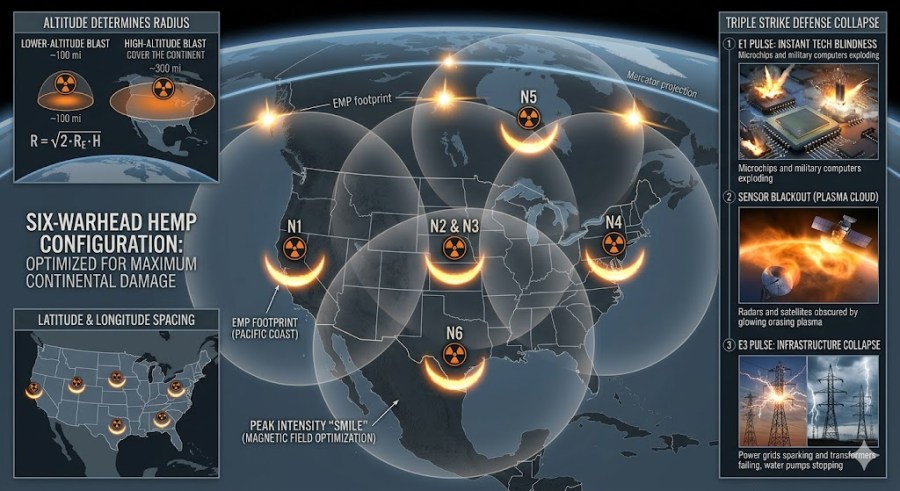
The article highlights the E3 phase of an High-Altitude Electromagnetic Pulse (HEMP), but a high-altitude nuclear blast actually delivers a three-pronged tactical strike (E1, E2, and E3) that can systematically dismantle a country’s defenses with as few as one to three well-placed detonations:
1. Instantaneous Technological Blindness (The E1 Pulse)
The first component of the EMP occurs nanoseconds after detonation. Gamma rays collide with air molecules, stripping away electrons and creating a massive electromagnetic wave.
- The Defense Impact: This pulse acts like a lightning strike across an entire continent simultaneously. It fries microchips, logic boards, and unshielded circuitry. With just one detonation 250 miles above a nation, the localized military command centers, communication radios, and unhardened computers are instantly fried.
2. Overwhelming the Sensors (Radar Blackout)
When a weapon detonates in the upper atmosphere, it creates a massive cloud of ionized gas (plasma) and high-energy particles.
- The Defense Impact: This plasma acts as a physical blanket to radar and satellite communication. Early warning systems become “blinded” by the lingering radiation and plasma fireballs. Missiles cannot be tracked, and retaliatory systems lose their target coordinates. Who Nukes First, WINS!
3. Cascading Infrastructure Collapse (The E3 Pulse)
As detailed by the TOPANGA simulation, the blast physically pushes and warhes Earth’s magnetic field. When the magnetic field snaps back, it creates low-frequency currents that travel along thousands of miles of power lines and pipelines.
- The Defense Impact: It destroys the massive, custom-built transformers that power civilian and military infrastructure. Without electricity, military bases rely on generators that eventually run out of fuel. Water pumps stop, supply chains freeze or grind to a halt, and the civilian grid collapses, forcing a nation into a humanitarian crisis that prevents any coordinated defense response. 85% of the population in Dead in 90 days due to starvation, and radiation sickness. 5% will commit S U I C I D E.
The Tactical Reality: A country does not need to be carpet-bombed with hundreds of nuclear missiles to be defeated. By detonating just a few high-altitude warheads, an adversary can leverage Earth’s own magnetic field to shut down a nation’s power grid, blind its radar, destroy its satellite communication, and render its retaliatory defenses completely useless. He who Strikes First, WINS!
The realization of this vulnerability—demonstrated by Starfish Prime and the Soviet K Project—is exactly what led both superpowers to sign the Limited Test Ban Treaty in 1963, realizing that testing these weapons was a fast track to global technological suicide.
From a historical and strategic defense perspective, analyzing how high-altitude electromagnetic pulses (HEMPs) cover large geographic areas depends entirely on the altitude of the detonation and line-of-sight physics.
To maximize the geographic footprint of an electromagnetic pulse over a continent-sized landmass like the United States, China, or Russia, detonations are constrained by the curvature of the Earth. A high-altitude nuclear explosion behaves visually and electromagnetically like a lightbulb in the sky; the pulse can only reach areas that have a direct, unobstructed line of sight to the detonation point.
A typical configuration analyzed in unclassified defense studies to achieve maximum contiguous coverage involves the following principles:
1. Latitude and Longitude Placement (The Grid Layout)
To cover a massive landmass uniformly, targets are spaced out to ensure the circles of their line-of-sight footprints overlap, leaving no “gaps” in the pulse coverage.
- East-West Dispersion: For a large continent, weapons are spaced horizontally across major time zones (e.g., one over the East Coast, two across the midsection/Plains, and one over the West Coast).
- North-South Optimization: The remaining devices are typically positioned to cover northern industrial sectors and southern border regions.
2. Height of Burst (Altitude Optimization)
The radius of the area affected by an EMP is directly determined by the altitude of the blast (H). The maximum radius (R) on the ground where the line of sight intersects the horizon can be estimated using the geometric formula:
R=2⋅RE⋅H
(Where RE is the radius of the Earth, approximately 3,959 miles).
- Low-Altitude Space Blasts (~80–120 miles): These produce a highly concentrated, intense pulse over a smaller radius (roughly the size of a few states).
- High-Altitude Space Blasts (~250–300 miles): As demonstrated by Starfish Prime, a blast at this height allows the pulse to reach the horizon for thousands of miles. A single detonation at 250 miles can produce a footprint that covers most of the continental United States.
3. Exploiting the Earth’s Magnetic Field (The “SMILE” Effect)
In the Northern Hemisphere, the intensity of the instantaneous E1 pulse is not perfectly symmetrical around the detonation point.
- Because the pulse is generated by electrons interacting with the Earth’s magnetic field lines, the strongest field matching occurs just south of the detonation point.
- This creates a crescent-shaped area of maximum intensity often referred to as the “smile.” Therefore, strategic configurations shift the detonation points slightly north of the primary target areas to ensure the peak intensity of the crescent falls directly over the intended infrastructure centers.
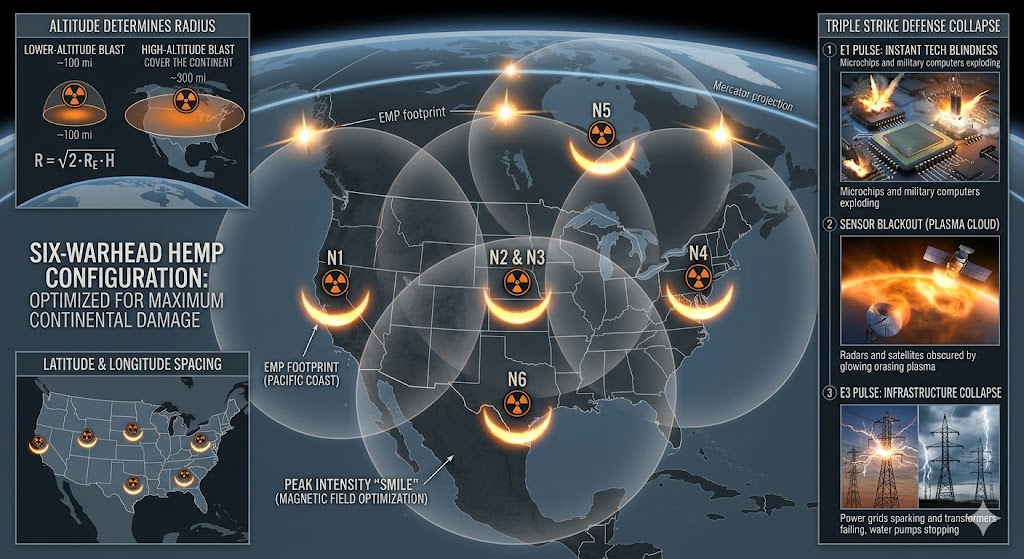
By combining these factors—spacing the six detonations to allow overlapping horizons, setting the altitude to maximize the geometric footprint, and shifting the targets north to line up the magnetic “smile”—a configuration would theoretically ensure that the entire landmass experiences peak electromagnetic disruption simultaneously.
And Trump wanted to try to stop Hurricanes with Nukes. And how much Damage would that have caused? To power Plants and Satellites?
Yes, an atmospheric nuclear explosion would have a severe impact on electric vehicles (EVs), primarily due to the High-Altitude Electromagnetic Pulse (HEMP) we discussed earlier.
Because electric vehicles are essentially rolling computers packed with highly sensitive microelectronics, they are particularly vulnerable to the initial stages of an EMP. Here is exactly how an atmospheric blast would affect them:
1. The E1 Pulse: Frying the Microchips
The E1 component of an EMP is the fast, instantaneous spike of electromagnetic energy. It acts like a massive, widespread lightning strike that induces high voltages directly into small electronic components.
- The Vulnerability: Modern EVs rely on an intricate network of microcontrollers, sensors, and computers (like the Electronic Control Unit, or ECU) to manage everything from throttle response and braking to battery cooling and steering.
- The Effect: The E1 pulse would induce currents that easily overwhelm and fry the delicate silicon chips inside these computers. If the ECU or the battery management system is destroyed, the car instantly becomes a brick, completely unable to turn on or operate.
2. High-Voltage Inverters and Charging Systems
EVs operate on two distinct electrical systems: a low-voltage system (usually 12V) for the dashboard and computers, and a high-voltage system (typically 400V to 800V) for the drivetrain and battery pack.
- The Vulnerability: The heavy cables connecting the battery pack to the electric motors act like antennas. During a high-altitude blast, these long metallic paths would capture the electromagnetic energy, causing a massive voltage surge.
- The Effect: This surge could easily destroy the inverter, which is the critical component that converts DC power from the battery into AC power for the motors. Additionally, any EV that is plugged into a home charger or a public fast-charging station at the moment of the blast would be subjected to a double-whammy: the localized EMP blast plus the massive grid surge traveling through the power lines (the E3 pulse), completely destroying the vehicle’s onboard charging hardware.
3. The Battery Packs: A Silver Lining?
While the brains of the car would be ruined, the actual lithium-ion battery cells inside the pack would likely survive the EMP itself.
- The massive battery enclosure (often made of thick aluminum or steel) acts as a natural Faraday cage, shielding the individual cells inside from the electromagnetic waves.
- However, even if the chemical battery cells remain intact, they are useless without the fried electronic safety switches and cooling pumps required to safely draw power from them.
Would Older Gas Cars Fare Better?
There is a common piece of survival lore that older, classic cars would survive an EMP perfectly. There is some truth to this. Vehicles built before the 1980s that use mechanical carburetors, manual transmissions, and simple distributor points have very little or no solid-state electronics to fry. While an atmospheric blast might temporarily stall them or blow out a fuse, they could likely be restarted.


You must be logged in to post a comment.