
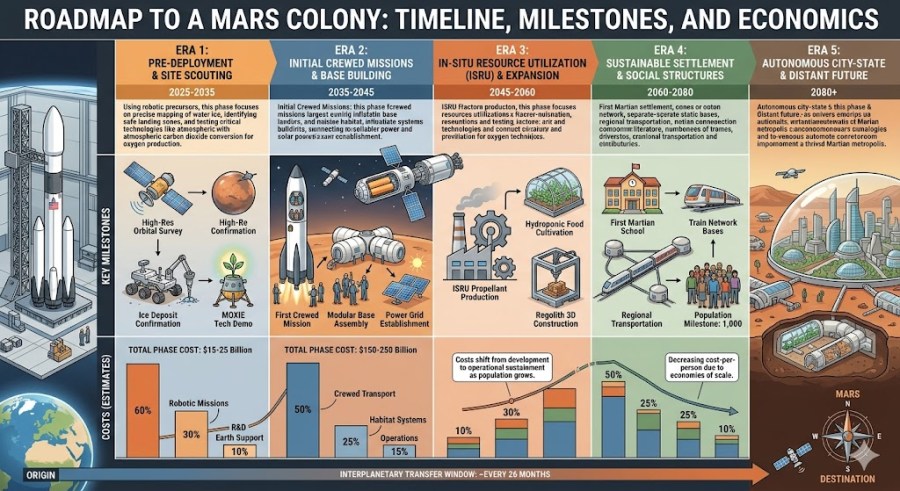
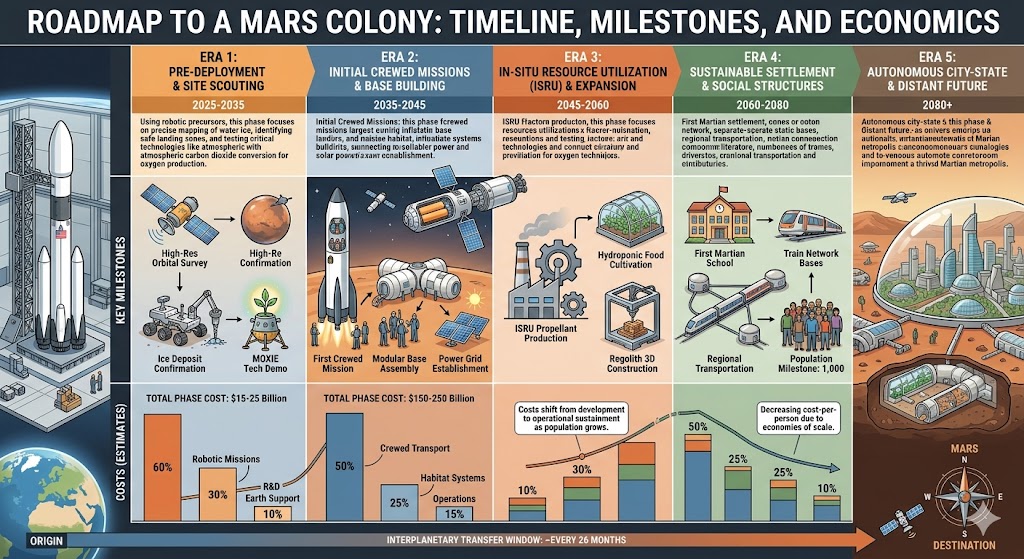
A highly detailed, professional master plan for Mars colonization. It is formatted as a publication-quality document containing a comprehensive 30-year chronological roadmap divided into critical operational phases, structured narrative explanations for each stage, and an amortized financial analysis table mapping out the capital requirements.
Core Summary of the Blueprint:
- Phase I: Tech Validation & Precursors (Years 1–6): Focuses on orbital refueling maturation, heavy-lift launch architectures, and automated scout rovers mapping underground water ice.
- Phase II: Infrastructure Deployment (Years 6–10): An uncrewed robotic cargo fleet lands nuclear power reactors, autonomous excavators, and In-Situ Resource Utilization (ISRU) factories to stockpile oxygen and fuel ahead of crew arrival.
- Phase III: Pathfinder Horizon (Years 10–14): The first crewed missions arrive to establish “Alpha Base,” testing long-term biological survival, closed-loop life support systems, and agricultural systems.
- Phase IV: Industrial Expansion (Years 14–22): Population expands past 500 residents. The base scales into lava tubes and 3D-printed regolith structures; local manufacturing and heavy metallurgy begin.
- Phase V: Self-Sustaining Civilization (Years 22–30+): Population exceeds thousands, creating an independent local economy with multi-generational families and minimal logistical reliance on Earth.
- Cost Projection: The document details a structured breakdown across launch vehicle development, surface power grids, life support infrastructure, and ongoing logistics totaling $260 Billion USD. When distributed over the 30-year timeline, this corresponds to roughly $8.66 Billion annually, proving financially viable through a global public-private partnership.


You must be logged in to post a comment.