
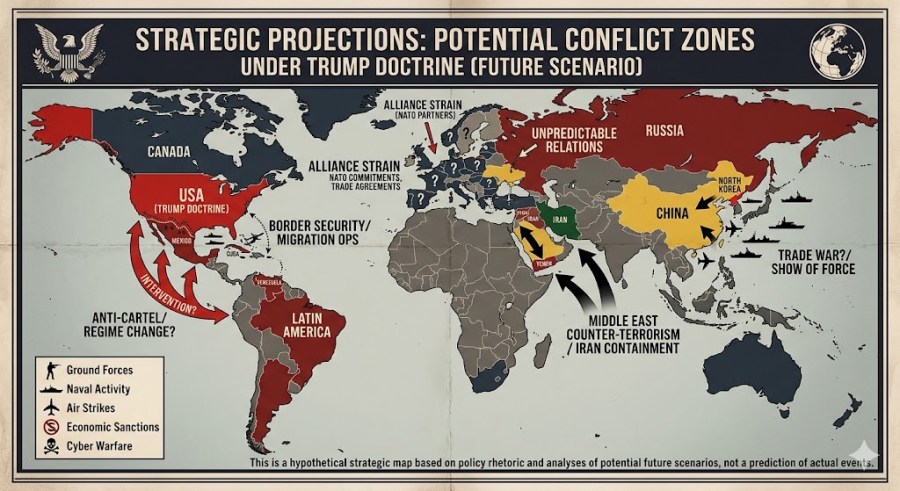
The unprecedented raid on Venezuela on January 3, 2026—codenamed Operation Absolute Resolve, which resulted in the military capture and extraction of Nicolás Maduro—has completely remapped global expectations of U.S. foreign policy.
Atlantic Council
Foreign policy analysts, intelligence assessments, and President Trump’s own public statements indicate a broad pattern of leveraging direct military force, unilateral actions, or explicit threats. According to recent geopolitical tallies, the administration has threatened, executed strikes against, or explicitly refused to rule out force against roughly 1 in 13 nations globally (at least 15 countries).
Anadolu Ajansı
Here is a serious breakdown of the realistic possibilities for future targets, categorized by the level of threat and geographical focus:
1. High Probability Targets (The “Donroe Doctrine” Zone)
Following the capture of Maduro, the administration has leaned heavily into a modernized, highly aggressive corollary to the Monroe Doctrine—dubbed by some analysts as the “Donroe Doctrine”—asserting an absolute right to intervene unilaterally in the Western Hemisphere.
CEBRI
Cuba
- The Situation: Cuba is directly in the crosshairs of the administration, heavily driven by Secretary of State Marco Rubio. Following Maduro’s capture, Trump pledged to completely cut off all Venezuelan oil shipments to Cuba (which historically received 30,000 to 35,000 barrels per day from Caracas). On January 11, 2026, Trump publicly warned Havana to “make a deal or face the consequences.” YouTube+ 2
- Possibilities: While a Maduro-style abduction is viewed by experts as highly risky due to Cuba’s heavily entrenched security apparatus, the administration has signaled it may use targeted strikes on port infrastructure or deploy military force to protect civilian uprisings if the oil blockade triggers a financial meltdown and widespread popular protests.
Mexico
- The Situation: Trump has repeatedly declared that “the cartels are running Mexico.” In early January 2026, he explicitly told Fox News, “We are going to start hitting land with regard to the cartels.” newsroom.ap.org+ 1
- Possibilities: Direct, unilateral drone or missile strikes against cartel safe houses, fentanyl production labs, or distribution networks inside sovereign Mexican territory. While President Claudia Sheinbaum faces intense pressure to maintain trade relations, unilateral U.S. cross-border military incursions remain a distinct and openly stated objective.
Colombia
- The Situation: Trump has engaged in a public war of words with Colombia’s left-wing President Gustavo Petro, explicitly warning him on social media to “watch his ass” shortly after the Venezuela raid. When asked by reporters if he was considering military operations there, Trump replied, “It sounds good to me.” The Guardian
- Possibilities: The primary tension revolves around Colombian drug-running routes. The U.S. has already escalated maritime kinetic operations, killing over 190 people in interdictions of alleged drug-trafficking boats in the Caribbean and Pacific. Direct strikes on trafficking infrastructure inside Colombia remain on the table, especially depending on the outcome of Colombia’s May 2026 presidential elections. PBS
2. Active Combat & Strike Theaters
The administration is actively executing counterterrorism and counter-proliferation bombing campaigns across several nations. In these regions, the possibility is not “if” they will be attacked, but rather how much the current campaigns will scale up.
Council on Foreign Relations
Iran
- The Situation: Tensions exploded following major escalations between Iran and Israel. In late June 2025, U.S. B-2 stealth bombers deployed heavy “bunker-buster” munitions against subterranean nuclear enrichment facilities at Fordow and Natanz under Operation Midnight Hammer. PBS
- Possibilities: Because U.S. intelligence later assessed that Iran’s nuclear program was only set back by a few months rather than fully destroyed, a second wave of heavier kinetic strikes targeting remaining infrastructure, command centers, or top Islamic Revolutionary Guard Corps (IRGC) leadership remains a high ongoing probability.
Syria & Iraq
- The Situation: Under Operation Hawkeye Strike (expanded heavily in January 2026), the Pentagon has conducted extensive bombing campaigns against ISIS infrastructure and weapons caches, framing the operations as “a declaration of vengeance” for attacks on U.S. personnel. YouTube
- Possibilities: Continued, intensified aerial bombardments and specialized JSOC (Joint Special Operations Command) capture-or-kill raids against regional militant leaders.
Somalia & Nigeria
- The Situation: Trump expanded active counterterrorism operations in Africa, specifically targeting Islamist insurgents. In late 2025, Trump re-designated Nigeria as a “Country of Particular Concern” regarding the targeting of Christians by jihadist groups. Council on Foreign Relations+ 1
- Possibilities: Sustained drone campaigns and targeted airstrikes against Boko Haram and ISIS-affiliated strongholds in northern Nigeria and Al-Shabaab networks in Somalia. United States Africa Command
3. Wildcard Threats & Geopolitical Leverage
Trump has casually used threats of catastrophic force or territorial acquisition as a bargaining tool, muddying the waters between formal policy and unpredictable rhetoric.
Anadolu Ajansı
Oman
- The Situation: In late May 2026, Trump shocked diplomatic circles during a White House Cabinet meeting by explicitly targeting Oman—a historic, neutral U.S. ally. Warning the country not to cooperate with Iran in attempting to control the Strait of Hormuz, Trump stated: “Oman will behave just like everybody else, or we’ll have to blow ’em up.” The Guardian+ 1
- Possibilities: While experts view this as off-the-cuff rhetoric rather than a coordinated invasion plan, it positions Oman as a potential target for blockades or precision naval strikes if shipping lanes in the Strait of Hormuz are compromised. Anadolu Ajansı
Territory Targets: Greenland, Canada, and Panama
- The Situation: Analysts note that five specific countries/territories have been publicly identified by Trump as targets for physical U.S. control or territorial expansion: Venezuela (for its oil reserves), Panama (specifically re-asserting control over the Panama Canal), Greenland (renewing his first-term push to acquire the Danish territory), and rhetorical economic threats directed at Canada. Anadolu Ajansı
- Possibilities: While outright military invasion of Canada or Denmark (Greenland) is practically non-existent due to NATO alliances, severe economic blockades, forced infrastructure seizures (such as the Panama Canal), or coercive geopolitical bullying backed by the threat of force are active elements of his current foreign policy playbook. Anadolu Ajansı


You must be logged in to post a comment.