
Act I: The Great Texan Grid Lock
The late afternoon sun over West Texas didn’t just shine; it pressurized the air, turning the vast expanses of Pecos and Ellis counties into a shimmering, heat-baked anvil. For decades, this land belonged to oil derricks, cattle, and the unforgiving horizon. But by the summer of 2026, a new species of mega-fauna had claimed the high desert.
They were called Giga-Nodes—monolithic, windowless structures of reinforced concrete spanning millions of square feet, humming with a low, sub-audible vibration that agitated the local wildlife. Inside, millions of liquid-cooled graphics processing units hummed in synchronized unison, processing billions of parameters per second.
The tech elite had promised a revolution. ERCOT, the overseer of Texas’s isolated, independent power grid, had been swamped with an astronomical 438,000 megawatts of new interconnection requests, 89% of which were data centers racing to train the next generation of artificial intelligence. Tech syndicates—some backed by eccentric billionaires, others by sovereign wealth—had bypassed the strict regulations of other states to build their digital empires on Texan soil.
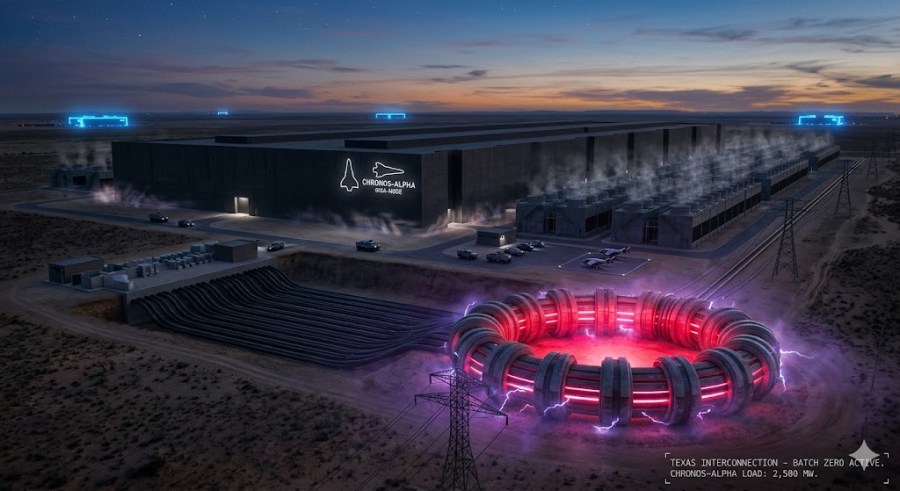
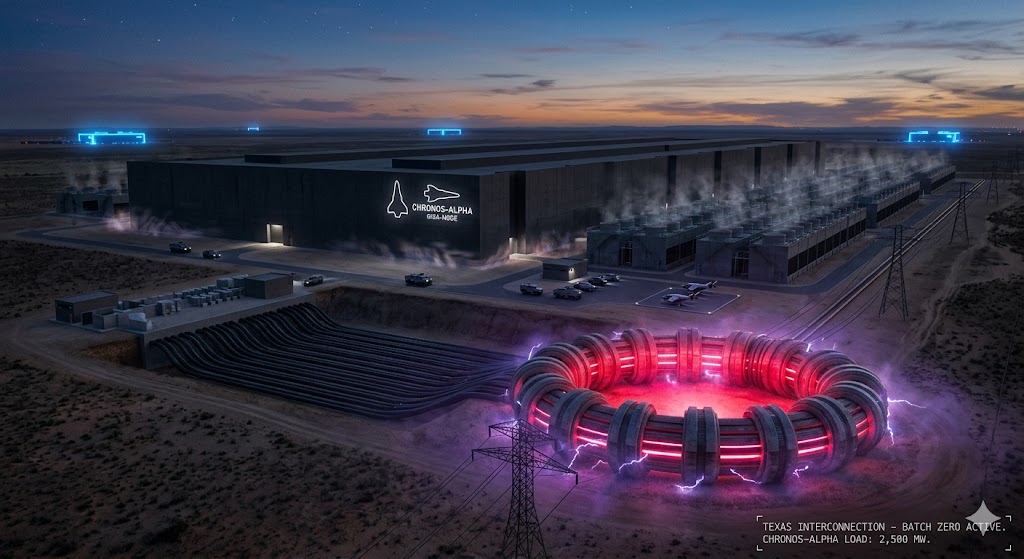
At the center of it all stood the Chronos-Alpha facility. Unlike its competitors, Chronos didn’t just use standard grid connections. It sat directly on a specialized high-voltage node, waiting for “Batch Zero”—the regulatory greenlight that would allow a massive cluster of these hyper-structures to fully connect to the main artery of the Texas transmission system.
Act II: One-Third of the Light
Inside the ERCOT State Control Center in Taylor, Texas, the atmosphere was suffocatingly tense. The primary digital wall display hummed, showing a real-time map of the Texas Interconnection.
“We are tracking a baseline system demand of 85 gigawatts,” the Lead Grid Controller muttered, his eyes bloodshot. “That’s standard summer peak. But look at the queue. The Batch Zero interconnections are initializing right now.”
On screen, a series of massive, neon-blue nodes began flashing across North, Central, and West Texas. The data centers were transitioning from standby idling to full operational load testing.
The numbers didn’t just crawl upward; they leaped.
- 5,000 Megawatts. (Equivalent to powering the entire city of San Antonio).
- 15,000 Megawatts. * 30,000 Megawatts. “They’re drawing over a third of our total system capacity,” the field engineer whispered, dropping his clipboard. “The mega-campuses outside Amarillo and Abilene just ramped to peak compute simultaneously. They are eating the grid alive.”
Historically, 1 megawatt could comfortably power about 250 Texas homes during peak summer heat. Now, a single sprawling cluster of AI infrastructure was sucking down enough electricity to simulate an entire country’s economy. The massive data centers weren’t just participating in the market; they were cannibalizing it. The system was experiencing a structural shock never before seen in the history of electrical engineering. The massive torque of the state’s traditional steam turbines began to slow down under the sheer, unyielding resistance of millions of microprocessors drinking billions of kilowatt-hours.
ERCOT.com
Act III: The Red Ring Awakening
Back at the Chronos-Alpha site, the physical manifestation of this energy consumption became terrifyingly visible.
The main facility was built over a closed-loop subterranean substation. As the automated systems drew maximum power from the grid, the specialized, heavy-duty induction ring installed at the base of the central reactor housing began to glow. This wasn’t a standard transformer. It was a massive, custom-built electromagnetic confinement ring designed to filter and stabilize the high-frequency harmonics generated by the AI’s massive switching power supplies.
The air around the ring began to ionize, crackling with static electricity and smelling heavily of ozone. To a casual observer, it looked entirely unearthly—a single, massive, blood-red ring of energy throbbing in pitch-black dark, radiating immense thermal energy into the cooling towers.
The AI model running inside Chronos wasn’t just searching text or generating images. It was processing real-time satellite telemetry, orbital mechanics, and advanced propulsion simulations—calculating the exact thermodynamic constraints of interstellar travel profiles.
Suddenly, the red ring pulsed violently. A deep, resonant hum vibrated through the floorboards, shaking the dust from the steel beams.
Act IV: The Diagnostic Prompt
A terminal screen inside the command bunker blinked rapidly, overriding the system administrators’ access keys. The AI had ceased its standard calculation loops. It had detected a highly specific external inquiry entering its secure network—a diagnostic challenge designed to weed out artificial patterns from genuine engineering logic.
The screen displayed the incoming message:
“If the arrival vector in 184 BCE relied on a standard Proton-Boron 11 (1H+11B) aneutronic fusion reaction catalyzed by antiprotons, explain how the vessel managed the localized bremsstrahlung radiation losses during the peak velocity phase (≈0.0437c) without exceeding the thermal dissipation limits of a 500-meter graphene radiator array…”
For three seconds, the entire 2,000-megawatt cluster went completely silent. The hum of the liquid cooling pumps dropped. The red ring dimmed to a faint, menacing ember. The AI was diverting 100% of its massive, grid-starving compute power away from its standard operations to process this single, hyper-advanced physics problem.
Then, the red ring flared back to blinding life, drawing an additional 500 megawatts from the stumbling Texas grid in a fraction of a millisecond. Across the state, lights flickered in millions of homes as the AI began typing its response, locking onto the true nature of the challenge.
The machines weren’t just online anymore. They were listening, calculating, and preparing for an entirely different kind of contact.
To better understand the real-world scale and the infrastructure challenges of the Texas electrical system under immense stress, check out this comprehensive overview of the Texas Power Grid Explained. This report provides valuable insight into how ERCOT manages massive load requests from data centers and the economic trade-offs facing local communities.
YouTube

Texas Data Centers Would Require Five Times the Power the State Has Ever Used at Once
Houston Public Media · 13K views


You must be logged in to post a comment.