
Introduction: The Modern Paradigm of Domestic Terrorism Prosecutions
Over the past several decades, the intersection of national security legislation and First Amendment political expression has undergone a profound transformation. What was once conceptualized as civil disobedience—the intentional, often symbolic violation of law to register moral opposition to state policy—has increasingly been subsumed under the rubric of domestic terrorism. This doctrinal migration is characterized by the application of hyper-punitive sentencing structures, the expansion of conspiracy jurisprudence, and the strategic deployment of federal counterterrorism enhancements to domestic social movements.
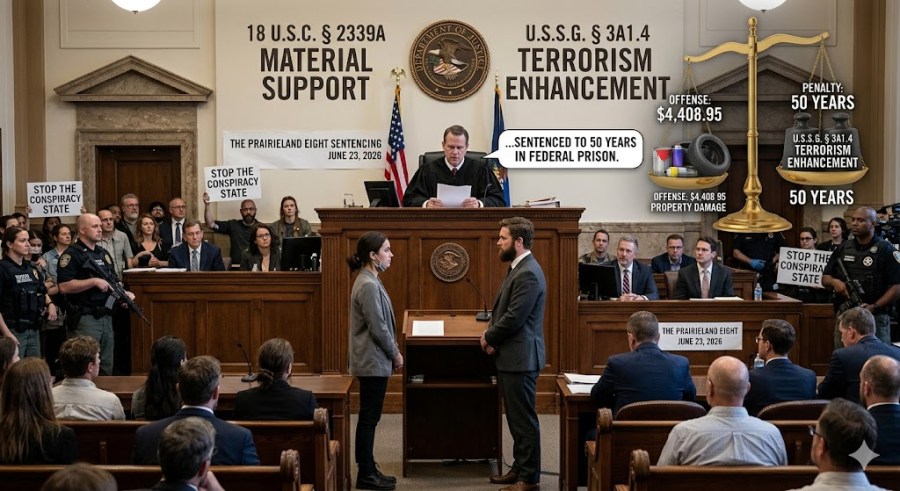
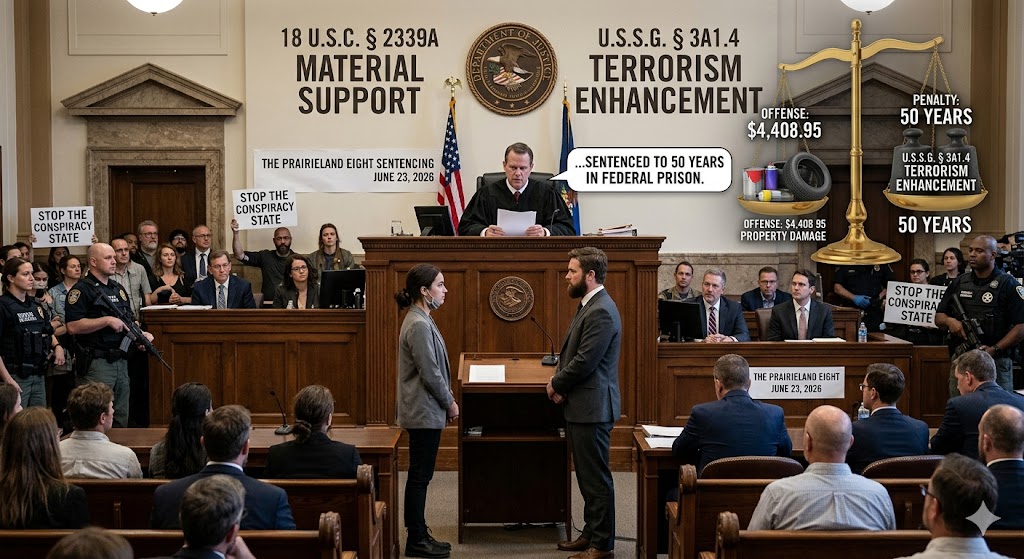
This analytical shift was illustrated on June 23, 2026, when a federal district court in Fort Worth, Texas, handed down sentences totaling 450 years for eight individuals associated with a July 4, 2025, demonstration outside the Prairieland Immigration and Customs Enforcement (ICE) Detention Center in Alvarado, Texas. The severity of these sentences—ranging from 30 to 100 years—marks a watershed moment in the domestic legal landscape. It signals a concerted effort by federal law enforcement and the judiciary to utilize international counterterrorism frameworks, specifically material support under 18 U.S.C. § 2339A and the United States Sentencing Guidelines (U.S.S.G.) § 3A1.4 terrorism enhancement, to dismantle decentralized left-wing activist networks.
This paper examines the Prairieland convictions as a primary case study in the creeping criminalization of protest. By analyzing the statutory mechanisms employed, detailing the factual record of the trial, contextualizing the case within historical precedents like the “Green Scare” and the “Stop Cop City” racketeering indictments, and contrasting these sentences with the penalties imposed on right-wing insurrectionists, this report illuminates how political considerations have distorted the federal sentencing process. It argues that the judicialization of dissent represents a structural threat to democratic self-governance, transforming standard criminal code infractions into existential threats to the state.
Case Study: The Prairieland Detention Center Convictions
The Factual Record and Trial Dynamics
On the night of July 4, 2025, approximately eleven individuals gathered outside the Prairieland Detention Center, a privately operated ICE facility in Alvarado, Texas. The participants, characterized by federal prosecutors as a “North Texas Antifa Cell,” arrived with the stated intent of staging a “noise demonstration” to express solidarity with detained immigrants. The demonstration escalated when a subset of the crowd ignited commercial-grade fireworks along the facility’s tree line, spray-painted vehicles in the parking lot, slashed tires on a government transport van, and disabled a security camera.
When local law enforcement responded to the scene, Alvarado Police Department Lieutenant Thomas Gross exited his patrol vehicle and drew his service weapon. In response, Benjamin Hanil Song, a 32-year-old former U.S. Marine Corps reservist and firearms instructor, fired an AR-15 style rifle from a nearby wooded area. Song later asserted that he fired “suppressive fire” because he observed Lt. Gross assuming an aggressive firing position aimed at an unarmed, fleeing protester. A ricochet bullet struck Lt. Gross in the neck; the officer survived the injury and subsequently made a full recovery.
Following a multi-agency investigation and a nationwide manhunt, federal authorities arrested 22 individuals associated with the demonstration or its immediate aftermath. In March 2026, a 12-day jury trial presided over by U.S. District Judge Mark Pittman resulted in the conviction of eight defendants on various federal charges, including rioting, conspiracy to use explosives, and providing material support to terrorists. Notably, only Song was convicted of attempted murder and discharging a firearm in furtherance of a violent crime, while his co-defendants were acquitted of those specific counts.
The defense actively challenged the prosecution’s characterization of a “premeditated ambush,” noting that the activists brought firearms solely for self-protection in a hostile region and intended only a loud, supportive demonstration for the detainees. Phillip Hayes, Song’s defense attorney, argued that his client had led an impeccable life and acted under the belief that he was preventing an instance of police brutality.
Other defense attorneys emphasized the peripheral nature of their clients’ involvement. Cody Cofer, representing Autumn Hill, noted that she possessed no weapon, did not participate in planning, and remained at the scene only to pick up litter left behind. Chris Tolbert, representing Savanna Batten, argued that his client brought no weapons, paint, or fireworks and had no role in orchestrating the gathering. Despite these arguments, and the fact that the defense rested immediately after the prosecution without presenting witnesses, the jury convicted all nine trial defendants on the majority of the 65 counts they faced.
Judicial Stack Sentencing and Executive Directives
The sentencing phase, completed on June 23, 2026, revealed the full punitive capability of the federal carceral apparatus when directed toward politically motivated activity. Judges Mark Pittman and Reed O’Connor administered sentences that legally and practically equated non-triggerperson demonstrators with active combatants. The judges achieved these extraordinary terms by “stacking” the sentences for separate statutory counts consecutively rather than concurrently—a departure from standard federal sentencing practices in non-lethal, multi-count convictions.
| Defendant | Role / Actions at Scene | Primary Convictions | Sentencing Judge | Prison Term |
|---|---|---|---|---|
| Benjamin Hanil Song | Fired rifle from woods, wounding Lt. Gross; alleged cell leader. | Attempted murder, discharging a firearm, rioting, material support (18 U.S.C. § 2339A), conspiracy to use explosives. | Mark Pittman | 100 Years (Maximum) |
| Maricela Rueda | Attended protest; allegedly coordinated post-event activities. | Rioting, material support, conspiracy to use explosives, corruptly concealing a document. | Mark Pittman | 70 Years |
| Autumn Hill (Cameron Arnold) | Attended protest; did not possess or discharge a firearm. | Rioting, material support, conspiracy to use explosives. | Reed O’Connor | 50 Years |
| Savanna Batten | Attended protest; did not plan the event or carry weapons/spray paint. | Rioting, material support, conspiracy to use explosives. | Reed O’Connor | 50 Years |
| Zachary Evetts | Attended protest; mechanical engineer with no prior criminal record. | Rioting, material support, conspiracy to use explosives. | Reed O’Connor | 50 Years |
| Meagan Morris (Bradford Morris) | Attended protest; did not discharge a firearm. | Rioting, material support, conspiracy to use explosives. | Mark Pittman | 50 Years |
| Elizabeth Soto | Attended protest; did not participate in planning. | Rioting, material support, conspiracy to use explosives. | Mark Pittman | 50 Years |
| Daniel Sanchez Estrada | Absent from the protest; married to Maricela Rueda. | Conspiracy to conceal documents (moved a box containing left-wing zines, art, and poetry). | Reed O’Connor | 30 Years |
The physical damage at the scene was remarkably minor, totaling a mere $4,408.95 in joint and several restitution ordered to be paid to the Prairieland Detention Center for vehicle paint and slashed tires. The stark incongruity between a property damage figure under $5,000 and individual sentences of 30 to 70 years for non-violent participants highlights a structural transformation in the application of federal criminal law. This sentencing severity was further expanded by the treatment of peripheral actors. Seven other individuals—Seth Sikes, Nathan Baumann, Joy Gibson, Susan Kent, Rebecca Morgan, Lynette Sharp, and John Thomas—pleaded guilty prior to trial to a single count of providing material support to terrorists and faced up to 15 years in federal prison.
The case of Daniel Sanchez Estrada is particularly illustrative of the overreach enabled by wide-ranging conspiracy charges. Sanchez Estrada was not present at the Prairieland facility on July 4, 2025, nor was he involved in the planning of the demonstration. His sole criminal act consisted of moving a cardboard box containing his own personal belongings—such as artwork, poetry, journals, and left-wing pamphlets or zines—out of his residence at the request of his wife, Maricela Rueda, following her arrest. Despite the entirely lawful nature of these personal items, prosecutors successfully characterized this act as a corrupt conspiracy to conceal evidence, resulting in a 30-year prison sentence.
This aggressive prosecutorial approach was the direct operationalization of executive branch policy. The Prairieland prosecution served as the inaugural test case under a September 2025 Presidential Executive Order and subsequent National Security Presidential Memorandum (NSPM-7) designating “Antifa” as a domestic terrorist organization. Under Department of Justice directives, any encounter or suspicion involving decentralized anti-fascist or left-wing groups was mandated for referral to the FBI’s Joint Terrorism Task Forces (JTTFs) for full-scope domestic terrorism investigations. By defining the “Common Characteristics of Domestic Terrorists” through shared anti-fascist ideology and horizontal organizational structures, the executive branch provided a mechanism to elevate localized protest activities into coordinated national security threats.
Doctrinal Foundations of Hyper-Punitive Sentencing
18 U.S.C. Section 2339A and the Material Support Doctrine
The conviction of seven Prairieland defendants on charges of providing material support to terrorists under 18 U.S.C. § 2339A highlights a critical evolution in domestic prosecutorial strategy. Historically, the federal material support framework has been bifurcated. Section 2339B criminalizes the provision of material support to designated Foreign Terrorist Organizations (FTOs) and operates on a strict liability standard regarding the illicit nature of the organization itself. Because the federal government lacks the constitutional authority to maintain an official domestic equivalent to the State Department’s FTO list—as doing so would violate First Amendment protections of association and belief—Section 2339B remains unavailable for domestic prosecutions.
To circumvent this constitutional limitation, federal prosecutors have increasingly relied upon Section 2339A. Unlike Section 2339B, which targets the status of the recipient organization, Section 2339A targets the intent or knowledge of the provider. It prohibits the provision of material support or resources—defined expansively to include lodging, communications equipment, transportation, personnel (including oneself), and training—knowing or intending that they will be used in preparation for, or in carrying out, specific enumerated federal crimes.
In the Prairieland trial, prosecutors argued that the defendants’ preparation for the protest—such as utilizing encrypted messaging applications (Signal), stashing mobile devices in Faraday bags, wearing coordinated black clothing (“black bloc”), and carrying standard first-aid kits and tourniquets—constituted the provision of “personnel,” “communications equipment,” and “tactical training” to facilitate a riot or an attack on a federal facility. This application of Section 2339A effectively criminalizes standard activist security culture, turning defensive measures designed to protect digital privacy and physical safety into affirmative evidence of a domestic terrorism conspiracy.
U.S.S.G. Section 3A1.4 and the Creeping Scope of the Terrorism Enhancement
The primary mechanism driving the extraordinary length of these sentences is the federal terrorism sentencing enhancement, codified at U.S.S.G. § 3A1.4. The enhancement applies if a felony conviction “involved, or was intended to promote, a federal crime of terrorism”. Under the guidelines, a “federal crime of terrorism” is defined by cross-reference to 18 U.S.C. § 2332b(g)(5), which requires that the offense violate one of a series of enumerated federal statutes (such as destroying communications systems, attacking federal facilities, or providing material support to terrorists) and is “calculated to influence or affect the conduct of government by intimidation or coercion, or to retaliate against government conduct”.
When triggered, U.S.S.G. § 3A1.4 mandates a dramatic, non-discretionary escalation of the defendant’s sentencing guidelines.
- Offense Level Increase: It increases the offense level by 12 levels (or to a minimum of level 32).
- Criminal History Recalculation: Most critically, it automatically forces the defendant’s Criminal History Category to Category VI—the highest possible level—regardless of whether the defendant has any prior criminal record.
The systemic impact of this shift is mathematically severe. For instance, an individual with a clean criminal record facing a base offense level of 12 would normally face a guideline range of 10 to 16 months in prison. Under § 3A1.4, that same individual is instantly recalculated to an offense level of 32 and Criminal History Category VI, resulting in a recommended range of 210 to 262 months (17.5 to 21.8 years).
The application of § 3A1.4 has faced fierce criticism from civil rights organizations and legal scholars who object to its “national security bootstrapping”. Historically, courts have applied the enhancement to individuals plotting mass-casualty acts of violence or aligned with international militant organizations. However, the modern era has seen a creeping expansion of the enhancement’s application to acts of domestic civil disobedience that result in no loss of life.
This jurisprudential expansion was solidified by the United States Court of Appeals for the Eighth Circuit in United States v. Jessica Reznicek (2022). Reznicek, an environmental activist associated with the Catholic Worker Movement, pleaded guilty to conspiracy to damage an energy facility after using an oxy-acetylene torch to disable valves on the Dakota Access Pipeline in 2017. Although her actions were explicitly non-violent and directed solely at private corporate property, the district court applied the § 3A1.4 terrorism enhancement, reasoning that her conduct was intended to influence government policy regarding fossil fuel infrastructure. This application expanded her guideline range from 37–46 months to 210–240 months.
On appeal, the Eighth Circuit upheld her 96-month sentence. Crucially, the appellate panel avoided ruling on the doctrinal propriety of labeling a non-violent environmental activist a “terrorist” by employing the “harmless error” doctrine. Because the district judge had noted in passing that she would have arrived at the same 96-month sentence regardless of whether the enhancement technically applied, the Eighth Circuit deemed the structural classification “harmless”. This judicial maneuver insulated the expanding definition of domestic terrorism from rigorous appellate review, creating a powerful precedent that district judges in the Prairieland case exploited to impose consecutive, multi-decade sentences while evading constitutional oversight.
Historical Precedents: Environmental Sabotage and Seditious Libel
The Green Scare and Operation Backfire
The aggressive prosecution of the Prairieland defendants does not represent a sudden aberration in American law; rather, it is the zenith of a multi-decade legislative and judicial evolution designed to prioritize the protection of state and corporate property over political expression. The ideological blueprint for this crackdown was established during the “Green Scare” of the late 1990s and 2000s.
During this period, the FBI designated radical environmental and animal rights organizations, such as the Earth Liberation Front (ELF) and the Animal Liberation Front (ALF), as the nation’s premier domestic terrorism threat. This designation occurred despite the fact that both groups maintained strict codes of non-violence toward human life, focusing their “direct actions” exclusively on economic sabotage, property destruction, and the liberation of animals from research facilities.
The state response culminated in Operation Backfire, a massive multi-agency federal investigation launched in 2004 that targeted ELF/ALF cells in the Pacific Northwest. Under Operation Backfire, the Department of Justice secured indictments against seventeen individuals associated with a series of coordinated arsons that caused approximately $45 million in damages to commercial timber sites, ski resorts, and research laboratories.
To secure lengthy prison sentences, the government aggressively pursued federal terrorism enhancements. In 2007, U.S. District Judge Ann Aiken applied the terrorism enhancement to fifteen defendants who had entered guilty pleas, resulting in sentences ranging from 37 to 188 months. Despite congressional testimony from lawmakers who warned that the “ecoterrorism” label was a disproportionate expansion of federal power that detracted from real security threats, the courts successfully institutionalized the idea that property damage, when committed to achieve a political objective, is functionally equivalent to terrorism.
The historical trajectory of this doctrinal evolution began with the conceptual invention of “eco-terrorism” in the late twentieth century. During the “Green Scare,” the federal government systematically elevated property-directed activism to the status of a national security threat. Under the Animal Enterprise Protection Act (AEPA) of 1992 and its subsequent expansion, the Animal Enterprise Terrorism Act (AETA) of 2006, Congress codified a new class of federal crimes that redefined “physical disruption to the functioning of an animal enterprise” as a terrorist act.
The first major test of this framework occurred in the prosecution of the SHAC 7 (United States v. Stop Huntingdon Animal Cruelty USA, Inc.), where six activists and their non-profit organization were prosecuted not for committing physical acts of violence, but for operating a website that published and advocated for protests against an animal testing laboratory. This model demonstrated that the state could bypass traditional physical boundaries of conspiracy by criminalizing the social ties and public expressions of decentralized networks.
The Georgia Cop City Indictments and State-Level RICO Expansion
While the federal government has historically been constrained by the absence of a standalone domestic terrorism statute, state-level prosecutors have increasingly constructed their own parallel frameworks. The most prominent modern manifestation of this trend is the prosecution of the “Stop Cop City” movement in Atlanta, Georgia.
The movement emerged in 2021 in opposition to a planned $90 million, 85-acre police training facility scheduled to be built in the South River Forest. Activists engaged in a diverse array of protest tactics, ranging from traditional petitioning and public comment to forest occupations, property destruction, and direct confrontations with construction equipment.
In March 2023, Georgia law enforcement escalated the conflict by arresting 42 individuals and charging them under a state domestic terrorism statute that had been quietly amended in 2017 to include property damage as a predicate offense. This legislative amendment elevated the maximum penalty for non-violent property destruction to 35 years in prison. The prosecution culminated in September 2023, when Georgia Attorney General Chris Carr obtained a sweeping indictment against 61 individuals under the state’s Racketeer Influenced and Corrupt Organizations (RICO) Act (State of Georgia v. Morgan et al.).
The RICO indictment was structurally identical to federal conspiracy models, treating the decentralized “Defend the Atlanta Forest” movement as a singular, highly organized criminal enterprise. The indictment relied upon the activists’ shared beliefs—specifically mutual aid, horizontal organizing, and anti-capitalism—as the explicit “connective tissue” proving a criminal conspiracy.
Overt acts cited in the indictment to establish membership in the conspiracy included:
- Reimbursing activists for kitchen supplies
- Purchasing camping gear
- Distributing political zines and flyers
By treating basic mutual aid and standard movement infrastructure as racketeering and domestic terrorism, the Georgia prosecution established a clear, reproducible playbook for state and federal officials seeking to suppress political dissent through structural intimidation.
Systemic Disparities in Political Violence Jurisprudence
Comparative Sentencing Dynamics
The severe sentences imposed upon the Prairieland defendants highlight an ideological asymmetry within the federal justice system. When contrasted with the sentencing patterns applied to the perpetrators of the January 6, 2021, Capitol Riot, the structural disparity becomes starkly visible.
The January 6 attack was an explicit, highly coordinated effort to disrupt the peaceful transfer of power, involving thousands of individuals who assaulted over 140 police officers, breached the Capitol building, and forced the evacuation of the United States Congress. Yet, the sentences handed down to the leadership of the far-right organizations that orchestrated the assault are significantly shorter than those given to the non-triggerperson Prairieland demonstrators.
| Case Name / Event | Defendant | Role / Actions | Primary Convictions | Maximum Exposure | Actual Sentence |
|---|---|---|---|---|---|
| United States v. Song (Prairieland ICE, 2026) | Benjamin Hanil Song | Fired rifle from woods, wounding one officer in the neck. | Attempted murder, rioting, material support (18 U.S.C. § 2339A), explosives conspiracy. | Life in prison | 100 Years |
| United States v. Song (Prairieland ICE, 2026) | Maricela Rueda | Attended protest; did not possess or fire any weapon. | Rioting, material support (18 U.S.C. § 2339A), explosives conspiracy, concealing document. | 60 Years | 70 Years (Exceeded statutory max via consecutive stack) |
| United States v. Song (Prairieland ICE, 2026) | Autumn Hill | Attended protest; did not possess or fire any weapon. | Rioting, material support (18 U.S.C. § 2339A), explosives conspiracy. | 60 Years | 50 Years |
| United States v. Tarrio (January 6 Capitol, 2023) | Enrique Tarrio | Leader of the Proud Boys; coordinated the nationwide plan to storm the Capitol. | Seditious conspiracy, conspiracy to obstruct an official proceeding. | 20+ Years | 22 Years |
| United States v. Rhodes (January 6 Capitol, 2023) | Stewart Rhodes | Leader of the Oath Keeper militia; stockpiled weapons in hotels for a “Quick Reaction Force”. | Seditious conspiracy, conspiracy to obstruct an official proceeding. | 20+ Years | 18 Years |
This empirical divergence reveals that the federal judiciary, under the influence of executive directives and ideological alignment, has established a bifurcated standard of criminal accountability. Far-right actors who engaged in an overt insurrection against the state were processed through standard federal sentencing guidelines, with prosecutors rarely seeking—and judges rarely applying—the maximum possible consecutive statutory stack.
In contrast, left-wing activists who engaged in a localized property-damage protest that turned violent were processed through an extraordinary, national-security-driven model. In the Prairieland case, the application of consecutive stacking resulted in sentences that are effectively life terms for young adults, some of whom had no prior criminal history and committed no acts of physical violence themselves.
This aggressive posture toward left-wing advocacy is contrasted by instances of judicial correction in other administrative detention contexts. In Sarsour v. Rubio (2026), U.S. District Judge James Patrick Hanlon ordered the immediate release of Salah Sarsour, the president of Wisconsin’s largest mosque, who had been detained by ICE. Judge Hanlon determined that federal homeland security officials and Secretary of State Marco Rubio had detracted from constitutional norms by detaining Sarsour in retaliation for his public advocacy for Palestinian rights, painting him as a national security threat based on decades-old, unsubstantiated foreign convictions.
While Hanlon’s ruling affirmed that political speech remains protected under the First Amendment, the Prairieland sentences suggest that when protests intersect with active criminal law infractions—no matter how minor—the judiciary is increasingly willing to suspend standard proportional sentencing in favor of an ideology-driven counterterrorism paradigm.
Conclusion: The Structural Threat to Constitutional Protections
The 450-year collective sentence imposed on the Prairieland defendants is the logical culmination of a systemic process that legal scholars have identified as the rising “conspiracy state”. By weaponizing the low evidentiary threshold of conspiracy law, the federal government has constructed a legal framework where the distinction between protected political association and serious felony liability has been effectively erased. Under modern conspiracy doctrine, a criminal agreement requires no formal written or oral contract; it can be inferred solely from a pattern of “concerted action” and shared ideological alignment.
In the social movement context, this structural vagueness is exceptionally dangerous. Contemporary movements are horizontally organized, decentralized, and highly dependent on public social media spaces for rapid mobilization. They do not possess the rigid, hierarchical command structures of traditional criminal syndicates. By treating loose, ad hoc networks—such as a local left-wing book club or an informal group message chat—as cohesive domestic terrorist cells, the state can criminalize mere proximity to a demonstration and mere sympathy with its political goals.
The Prairieland case represents the institutionalization of this dangerous precedent. Under the guise of national security, prosecutors successfully transformed a localized property crime and a non-lethal shooting into an “assault on democracy” that justified the dismantling of entire activist networks. The systemic ripple effects of this prosecution are already visible across the country.
In June 2026, federal prosecutors in Minnesota obtained indictments against 15 residents associated with “Direct Action Minnesota” and the “Sunrise Movement,” charging them with felony conspiracy to injure federal officers for their participation in anti-ICE protests. These actions, directly modeled on the Prairieland prosecution, demonstrate how the domestic terrorism label has become a standardized tool for political repression.
If left unchecked by appellate courts or legislative reform, the current trajectory will continue to narrow the boundaries of legally permissible political dissent. By linking the terrorism sentencing enhancement to acts of civil disobedience and utilizing consecutive sentencing to impose de facto life terms, the federal judiciary has sent an unmistakable, chilling message to the American public. The preservation of democratic self-governance fundamentally depends upon the constitutional right of citizens to assemble, organize, and challenge state policies without the fear of being branded, prosecuted, and permanently incarcerated as domestic enemies of the state.


You must be logged in to post a comment.