
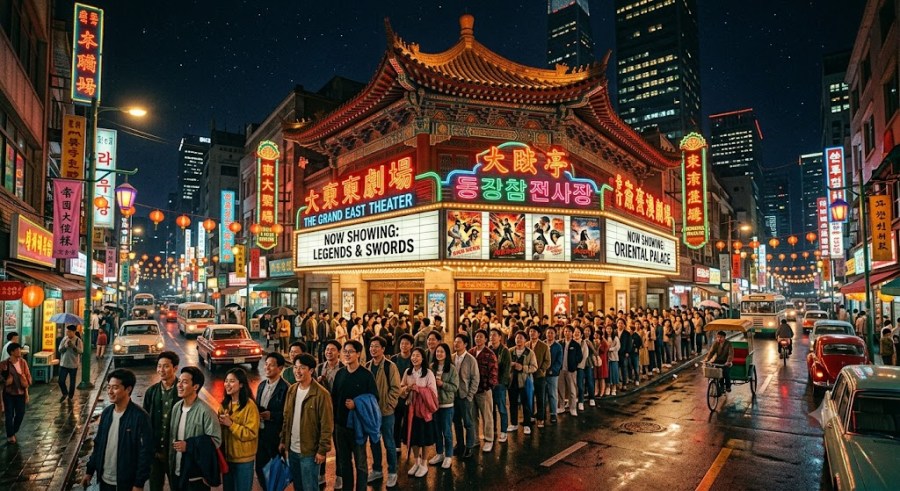
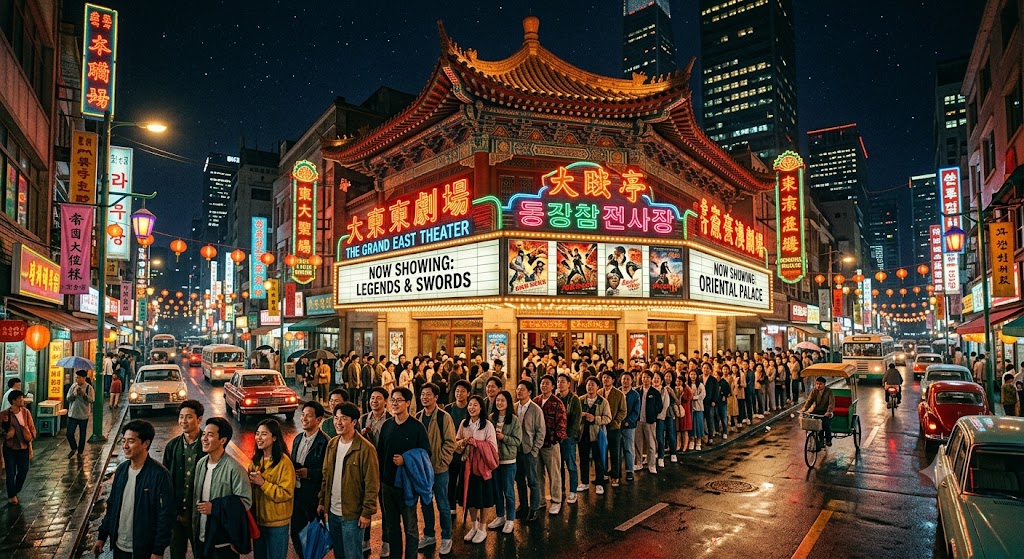
The theater of the East does not belong to a single country or a solitary style; it is an epic tapestry woven from the precision of Beijing opera, the fierce intensity of Tokyo’s samurai cinema, and the sweeping, modern emotional power of Seoul’s soundstages.
Far beyond the horizon of the ordinary world, where the neon lights of Hong Kong blend into the ancient mist of the Han River and the snow-capped peak of Mount Fuji, stands the Grand Pavilion of the Orient. Its pillars are made of lacquered red wood, its floors of polished black jade, and the roof is thatched with silver bamboo that hums when the wind blows.
Tonight, the greatest legends of East Asian cinema and stage are gathering for an unforgettable performance.
The Entrance of the Dragon and the Swordsman
The lights in the pavilion dim to a deep, dramatic crimson. The steady, rhythmic beat of a traditional Chinese hand drum echoes through the rafters.
Stepping out from the shadows of a bamboo screen is Toshiro Mifune. He looks exactly as he did in Akira Kurosawa’s masterpieces—rugged, commanding, with a gaze that could halt an army. He wears a dark, loose samurai kimono, his hand resting casually on the hilt of his katana. He doesn’t just walk onto the stage; he claims it, his deep, rumbling growl commanding absolute silence from the audience.
Before Mifune can draw his blade, a blur of motion cuts through the air from above. With a flawless, gravity-defying flip, Bruce Lee lands perfectly on the black jade floor. He is a coiled spring of pure energy, wearing his iconic smile, his nunchaku whistling a fierce melody through the air as he moves.
Mifune looks at the young master, a slow, respect-filled smile breaking across his weathered face. He sheathes his sword with a sharp clack. Bruce catches his weapon under his arm, bows deeply with martial precision, and snaps his fingers. The show has begun.
The Queens of Elegance and Emotion
The fierce rhythm of the martial arts masters softens into the sweeping, romantic strings of a traditional orchestra.
Walking down a grand spiral staircase is Gong Li, looking every bit the regal, breathtaking icon of modern Chinese cinema. She wears a magnificent, embroidered silk cheongsam that shimmers like liquid gold under the spotlight. Her presence is hypnotic—a perfect blend of tragic grace and unbreakable strength that once defined the golden age of international cinema.
Joining her from the opposite wing is Choi Eun-hee, the legendary grand dame of Korean cinema. With the poise of a classical stage actress, she moves with an understated, deeply moving dignity.
As the two women stand center stage, the backdrop transforms into a breathtaking projection of old Shanghai and historical Seoul. They don’t need a script; their expressions—a subtle tilt of the head, a lingering look of fierce determination—tell a story of survival, love, and the enduring spirit of generations of women who rebuilt empires.
The Kings of the Silver Screen
Suddenly, the orchestra swells into a suave, jazz-infused melody that sounds like a rainy night in 1960s Hong Kong.
Walking shoulder-to-shoulder into the spotlight are Leslie Cheung and An Sung-ki. Leslie moves with that effortless, heartbreaking charisma that made him the darling of both the music stage and the silver screen. His voice, smooth as silk, carries a melody that seems to capture the very soul of the city he loved. Beside him, An Sung-ki—the revered “National Actor” of Korea—provides a grounded, powerful presence, his warm, deeply expressive eyes reflecting decades of cinematic history.
They are joined by Ken Takakura, the ultimate symbol of stoic Japanese masculinity. Wearing a simple trench coat, Takakura stands like an immovable rock, his quiet demeanor speaking volumes more than a thousand pages of dialogue ever could.
Together, this trio of masters represents the heart of Asian storytelling: the perfect balance of raw vulnerability, deep honor, and magnetic charm.
The Grand Ensemble Finale
The music reaches a spectacular, cross-cultural crescendo. The traditional flutes of Japan, the dramatic opera gongs of China, and the soaring, cinematic percussion of Korea blend into a single, magnificent symphony.
The curtains part fully, and a galaxy of stars joins the front line:
- Chow Yun-fat steps forward, sliding a pair of classic sunglasses down his nose with a brilliant smile, tossing a handful of playing cards into the air that scatter like white blossoms.
- Hideko Takamine and Kinuyo Tanaka stand together, representing the pioneering women who gave Japanese cinema its emotional depth and artistic soul.
- Kang Soo-yeon, the brilliant star who first brought Korean cinema to the global stage, radiates a fierce, timeless brilliance under the house lights.
The entire stage becomes a brilliant mosaic of color, movement, and history. The actors bow, not just to the audience, but to each other—acknowledging the shared bond of artists who broke barriers, crossed borders, and taught the entire world how to watch a movie.
As the final curtain falls and the applause echoes like thunder across the jade pavilion, the screen fades to black. But the legacy remains permanently illuminated, burning brightly in the hearts of millions of fans across the globe.


You must be logged in to post a comment.