
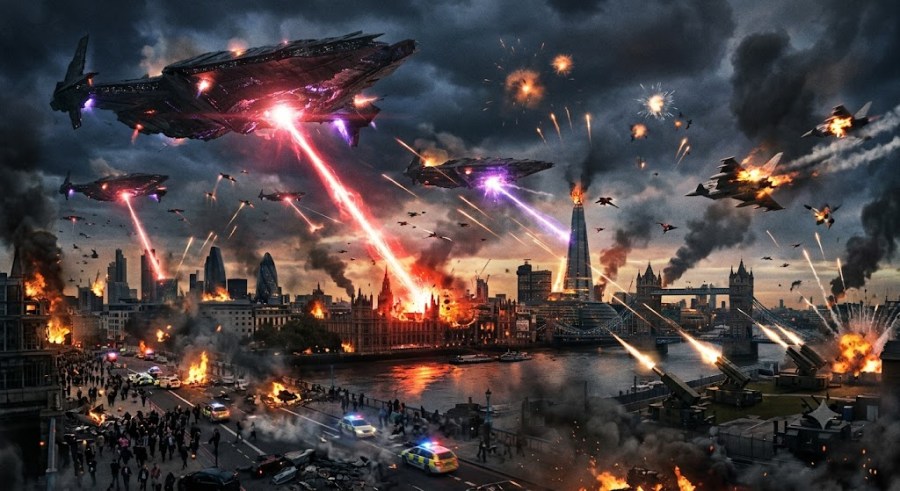
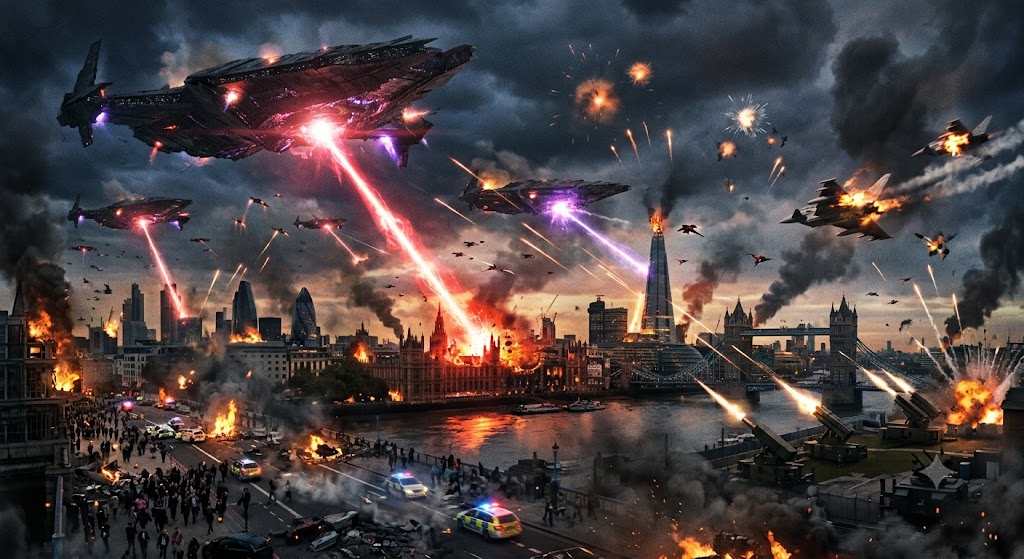
The message beamed out from the Arecibo observatory decades ago was meant to be a handshake. Instead, it was an invitation to a slaughter.
When the ships arrived, they didn’t hover over major cities or deliver grand ultimatums. They simply took position in the upper atmosphere—massive, jagged wedges of dark, non-reflective alloy that defied radar and swallowed the sun.
In Geneva, the United States scrambled to assemble an emergency summit, desperate for a unified global front or a line of communication with the invaders. But geopolitics doesn’t stop just because the sky falls. While President Trump attempted to orchestrate a grand peace talk from a secure bunker, Iran’s leadership flatly refused to participate, publicly stating they had no interest in negotiating a surrender alongside a man they considered a madman. The old world rivalries were still burning, even as the shadow of extermination grew.
Then, the true nightmare began.
The aliens didn’t launch thousands of fighters or drop ground troops. They used kinetic energy weapons—mass drivers that dropped hyper-dense rods from orbit at twenty times the speed of sound.
The devastation took less than ten hours.
The oceans became a graveyard. Forty percent of the world’s naval forces—including three entire American carrier strike groups, Russia’s Northern Fleet, and China’s newest surface combatants—were turned into twisted, boiling metal before they could even spin up their radar systems.
High above, the skies fared even worse. Seventy-five percent of all global air forces were annihilated on the tarmac. Automated orbital strikes targeted every major military airfield from Nevada to Vladivostok to Shandong. Satellites captured images of supersonic fireballs where elite fighter squadrons used to rest. Mankind’s ability to project power was severed in a single afternoon.
Inside a deeply buried command center, a secure, three-way video feed flickered to life.
Donald Trump stared at the monitors, the usual bravado entirely gone from his face. Across from him, Vladimir Putin sat in absolute, stony silence, looking at a map of Russia’s smoking western airfields. Next to him, Xi Jinping’s expression was grim, his knuckles white against his desk as reports detailed the destruction of the People’s Liberation Army Navy in the South China Sea.
For the first time in modern history, the three most powerful men on Earth were entirely speechless. The massive standing armies, the nuclear arsenals, the strategic brilliance of the world’s superpowers—it all meant nothing against an enemy that fought from the high ground of orbit.
“We have plenty of weapons left,” Trump muttered, his voice uncharacteristically hollow, “but we can’t hit what we can’t reach.”
Putin closed his eyes, leaning back. “Our radar can’t lock on. The missiles are blind.”
Xi looked directly into the camera. “We have less than twelve hours before they realize our ground forces are completely defenseless from above. If we do not find a vulnerability now, there will be no world left to govern.”
The screens went dead as another atmospheric shockwave rumbled through the bedrock above them. The clock was ticking, and humanity was entirely out of answers.
The global grid flickered, stabilized, and then died completely. With the destruction of seventy-five percent of the world’s air assets and nearly half of its naval tonnage, the orbital invaders shifted their focus to the nerves of human civilization: fiber-optic trunk lines, undersea cables, and satellite networks.
The silence that followed was heavy, suffocating, and absolute.
The War Room Beneath the Urals
Deep inside the Kosvinsky Mountain bunker, the static on the master tactical display finally cleared, replaced by a stark, low-resolution wireframe map of the Eurasian continent. Red markers—each indicating a catastrophic kinetic strike—blotted out the Baltic, Black, and Caspian seas.
Vladimir Putin did not look at his generals. He looked at the live telemetry of Russia’s mobile nuclear launchers, the Topol-M units scattered across the vast Siberian taiga.
“They targeted the stationary silos in the first three minutes,” a general whispered, his voice trembling under the weight of a collapsing empire. “But the mobile units are still operational, sir. They are hidden beneath the canopy.”
“They are not hidden,” Putin said, his voice a flat, dangerous rasp. “They simply have not bothered to drop rocks on them yet. If their sensors can track a submarine at three hundred meters depth through thermal displacement, they can see a truck in the woods.”
He looked back at the secure, triple-redundant satellite link that connected him to Washington and Beijing. The feed was lagging, the audio chopped by high-altitude electromagnetic interference.
“Donald,” Putin said, leaning toward the microphone. “Your Pentagon analysts always spoke of ‘prompt global strike.’ The enemy has achieved it. If we do not pool our remaining telemetry, we are firing blindly into the upper atmosphere.”
The Cheyenne Mountain Complex
Three thousand feet of solid granite above them was absorbing the concussive ripples of strikes hitting the American Midwest, but inside the bunker, Donald Trump was pacing the floor. The bravado that had defined decades of public life had hardened into an intense, erratic focus.
“The carriers are gone,” Trump said, stopping to point a finger at the Joint Chiefs. “The finest ships we ever built, gone in ten hours. I was told they had missile defense systems that could stop anything. Anything. Now I’m being told a piece of dense metal dropped from space just punched straight through the flight decks like paper.” Trump started crying like a baby. And he continued crying for a long long long long time. But finally he stopped. And he was heard saying, My Beautiful Money is gone.
“It’s kinetic bombardment, Mr. President,” the Chairman of the Joint Chiefs replied, rubbing his eyes. “No explosives. Just raw velocity. Ek=21mv2. At Mach 20, a telephone-pole-sized rod of tungsten hits with the force of a tactical nuclear weapon, but without the fallout. We can’t intercept it because there’s no thermal signature to track until it’s already entering the lower atmosphere.”
“I don’t care about the math,” Trump snapped, his voice dropping to a harsh whisper. “I care about retaliation. We have the three big subs—the Ohio-class—sitting off the coast of Alaska. They haven’t been touched because they were running completely silent. Can they reach the wedge over the Pacific?”
“The Trident missiles can reach orbit, sir, but their guidance systems require GPS or stellar tracking. The enemy has jammed the entire civilian and military spectrum. If we launch, we’re throwing darts in a hurricane.”
The screen blinked, and Xi Jinping’s face appeared through the grain. The Chinese leader looked remarkably calm, though the background behind him showed the chaotic flurry of the underground command post in the Western Hills of Beijing.
“President Trump, President Putin,” Xi said, his words measured through a mechanical translator. “We have isolated a anomaly. During the kinetic strikes on our naval yards at Qingdao, our coastal radar installations detected a brief, localized drop in the enemy’s cloaking field. It happens for a fraction of a second—exactly 1.4 seconds before a rod is deployed.”
The room went dead silent.
“They have to drop their defensive screening to open the launch bays,” Putin realized aloud.
“Correct,” Xi nodded. “But we cannot exploit it alone. Our remaining surface-to-air missile systems do not have the altitude capability. Your American SM-3 missiles do, but you lack the tracking coordinates because your satellites are blind.”
The Strait of Hormuz
While the three superpowers scrambled to find a seam in the alien umbrella, the Middle East had become a cauldron of chaos. The Iranian leadership, having rejected the Western emergency summit, found themselves facing a completely different nightmare. The invaders weren’t just striking military targets; they were systematically neutralizing the world’s energy choke points.
In the Persian Gulf, the water was thick with burning crude oil from destroyed offshore rigs. An Iranian Revolutionary Guard naval commander stood on the rocky cliffs overlooking the Strait, watching the burning remnants of his patrol fleets.
A shadow moved overhead—not a wedge, but a smaller, jagged recon drone that drifted silently through the black smoke of the burning refineries.
“They don’t want our oil,” the commander muttered to his lieutenant, his hand tight on binoculars that were useless against the glare of orbital fire. “They are just clearing the board. They are treating us like ants in a garden.”
The realized truth was bitter: the political divisions, the old treaties, the regional hatreds—none of it mattered to an enemy that viewed humanity not as a collection of nations, but as a biological infestation to be cleared before colonization could begin.
The Final Hour
Back in the American bunker, a technician shouted over the noise of the cooling fans. “Sir! We’ve got a massive spike over the Atlantic! One of the main wedges is shifting orbit. It’s descending toward the East Coast.”
Trump walked slowly back to the main console, looking at the blinking red vector line heading straight for Washington.
“Vladimir, Xi,” Trump said, looking at the split screens. “We’re out of time for a perfect plan. If those Chinese radar stations can feed the drop-times directly to our remaining subs in the Pacific, we can time a volley. We give them everything we’ve got the next time they open those bays.”
“It requires absolute synchronization,” Xi said. “We must route our radar data through old, shortwave radio frequencies to bypass their jamming.”
“We will assist with our remaining land-based tracking stations in Siberia,” Putin added, his hand hovering over the key to his own strategic reserve. “If we fail, the sky closes permanently.”
Above the planet, the massive, dark alien wedge began to tilt, its underside splitting open to reveal a glowing, cavernous launch bay aimed directly at the heart of the North American continent. Deep beneath the ocean, three iron cylinders groaned as their hatch covers blew open, waiting for a signal that had to travel around a broken world on the backs of radio waves from 1950.
Mankind was down to its last card, and the countdown had reached thirty seconds.
Only 30 seconds…
The static on the shortwave radio frequency hissed, a fragile thread of copper and air connecting three desperate men across a shattered globe.
“Ten seconds,” Xi Jinping’s voice cracked through the interference from the Western Hills of Beijing. “Data link is holding. We have the lock.”
“Siberian stations are echoing the telemetry,” Vladimir Putin replied, his thumb resting flat on the launch authorization terminal. “The trajectory is locked.”
Donald Trump stood motionless in front of the primary tactical map. The red vector line representing the descending alien wedge had paused directly over the Atlantic seaboard, a heavy, jagged shadow hanging twelve miles above the ocean. “Fire the birds,” Trump ordered, his voice remarkably quiet. “Give ’em everything.”
The Volley
Deep in the frigid waters of the North Pacific, three Ohio-class submarines groaned as high-pressure steam ejected thirty-six Trident missiles into the surf. The sea boiled as the solid-rocket boosters ignited, tearing out of the water and arching into the sky. Simultaneously, from the hidden valleys of the Russian Far East and the concrete bastions of central China, a swarm of land-based interceptors rose on pillars of blinding white flame.
They weren’t aiming for the ships. They were aiming for a mathematical window in space.
High above the atmosphere, the massive underbelly of the Atlantic wedge began to shift. The non-reflective alloy plates slid back like a camera shutter, revealing the vast, glowing launch bays. Inside, hyper-dense tungsten rods were being positioned for the final blow to Earth’s command structure.
1.4 seconds.
The alien cloaking field flickered out. For a fraction of a moment, the apex predator of the cosmos was blind, its soft underbelly exposed to the void.
The incoming missile swarm hit the gap.
It wasn’t a clean explosion. At orbital velocities, the kinetic impact of thirty-six thermonuclear warheads colliding directly with the open launch bays created a flash of light so intense it was visible from the surface during daylight. The chain reaction was instantaneous. The energy intended to drive the tungsten rods down was forced backward, tearing through the ship’s internal power core.
The great dark wedge buckled. A hairline fracture of blinding blue energy ripped across its hull, and then, with a silent, catastrophic shudder, the three-mile-long vessel split in two, its fragments tumbling out of orbit like dying stars.
The Horizon
Inside the Cheyenne Mountain bunker, the main tactical display flickered. The massive red icon over the Atlantic vanished.
A ragged cheer erupted from the technicians and generals along the back wall, but Trump didn’t join in. He kept his eyes on the screens showing Moscow and Beijing.
“We took one down,” Trump said, leaning over the console. “But look at the orbital tracking. The other three wedges… they aren’t dropping more rods. They’re pulling back.”
On the monitors, the remaining alien ships were shifting their vectors, rising higher into the exosphere, retreating away from the atmosphere and toward the cold safety of deep space. They hadn’t expected a virus to fight back with steel and fire. They had looked for an easy harvest; instead, they found a cornered beast that still knew how to bite.
“They are regrouping,” Putin said, his face etched with grim satisfaction as he looked at the satellite feed of the burning wreckage falling into the ocean. “They know we have the teeth to strike them now. They will think twice before they descend again.”
“We have bought ourselves time,” Xi said, his hand finally releasing the edge of his desk. “But the world we knew is gone. Our skies are clear, but our infrastructure is in ruins.”
Trump looked around the room, at the maps of the smoking oceans and the ruined airfields, and then back at the two leaders on the screen. The old geopolitical chess board had been smashed to pieces. The rivalries, the border disputes, the trade wars—none of it meant a damn thing anymore. There was only the planet below, and the dark void above.
“Then we start rebuilding,” Trump said, a hard, sharp glint returning to his eyes. “And the next time they look down here, they’re going to find a roof made of iron.”
Outside, across the quiet plains of Texas, the ruined coastlines of China, and the frozen steppes of Russia, millions of people crawled out of the storm cellars and bunkers, looking up at a bruised, smoky sky. The battle was over, the world was broken, but humanity was still here. But had mankind won or lost?
Is Victory Ours? Or do they have more sources?
Do we have another day of life? Or will the minutes ahead be our last?


You must be logged in to post a comment.