

The renewed breakout of the 2026 Iran War represents a catastrophic breakdown of the brief, Pakistan-brokered peace framework that collapsed after Washington declared the deal over. This latest phase of the conflict has shifted from purely targeting military installations near the coast to surgically cutting off Iran’s northern geopolitical and economic pressure valves.
Middle East Monitor
The targeted strikes on northern infrastructure indicate a shift from containing Iran regionally to isolating it globally.
WANA News
1. Analysis of Recent Key Targets
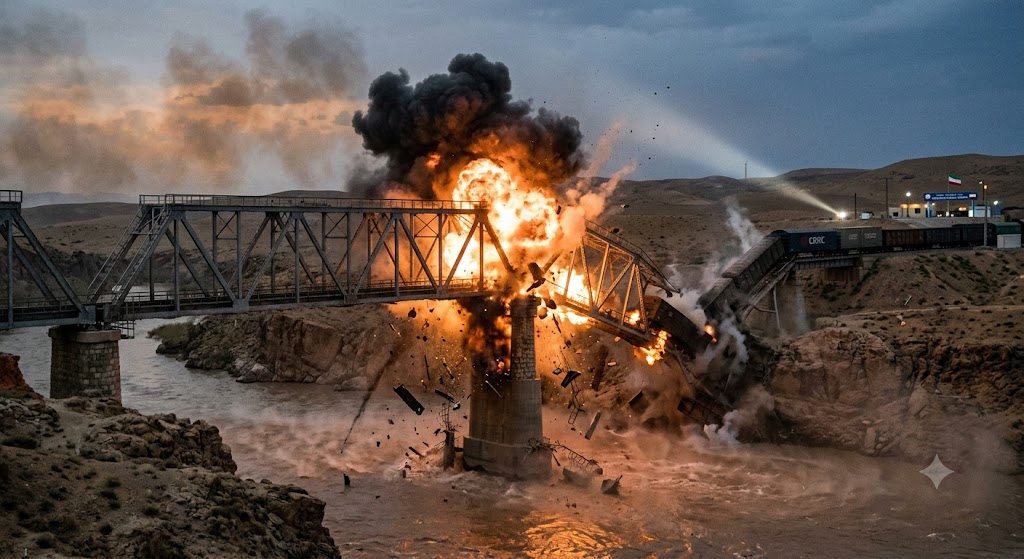
The Ogtay Khan Railway Bridge (Golestan Province)
The early morning cruise missile strike on the Ogtay Khan (Aq-Tappeh Khan) bridge in northeastern Iran is one of the most strategically significant infrastructure hits of the war.
Yeni Safak English – Yeni Şafak
- Why it’s a Lifeline: This bridge is a critical node on the international China–Kazakhstan–Turkmenistan–Iran rail corridor. Following the tight maritime blockade on Iranian ports, rail traffic along this corridor reportedly tripled. It serves as a core land artery for China’s Belt and Road Initiative (BRI) stretching from Xi’an directly to Tehran. WANA News+ 2
- The Russia-China Connection: Russia began heavily utilizing this exact route to transport goods to Iran. By severing this bridge, the U.S. has effectively choked off the primary overland supply chain that allowed Iran to bypass Western naval blockades and maintain an economic backdoor with Beijing and Moscow. WANA News
The Bushehr Nuclear Power Plant Strike
Strikes targeting the area around Iran’s sole active nuclear power plant in Bushehr add an incredibly volatile dimension to the conflict.
- The Strategic Value: While previous 2025 and early 2026 campaigns focused heavily on subterranean uranium enrichment sites like Natanz, Fordow, and Isfahan, hitting near Bushehr signals a willingness to pressure Iran’s operational civil-military nuclear infrastructure. Lawfare
- The Risks: Striking an active nuclear facility risks localized environmental fallout and crosses a severe red line, ensuring that any hope of a diplomatic off-ramp is dead for the foreseeable future.
2. Issues and Intentions for All Sides
United States: Choking the “Axis” Supply Chains
The U.S. decision to declare the peace framework “over” and launch Operation Epic Fury indicates a shift in objective. Washington is no longer just aiming to protect freedom of navigation in the Strait of Hormuz; it is actively attempting to cripple Iran’s logistical integration with competing superpowers. By striking the northern rail lines, the U.S. is sending a direct message to Beijing and Moscow that their investments and overland supply networks into the Middle East are no longer safe from American air power.
Yeni Safak English – Yeni Şafak
Iran: Survival via Strategic Depth
For Tehran, the stakes are existential. Following the assassination of Supreme Leader Ali Khamenei earlier this year, the regime is fighting for both internal stability and external survival.
Wikipedia
- Economic Resilience: Cut off from the global maritime economy, Iran has relied entirely on its land corridors to Russia and China to keep its economy on life support.
- Military Response: With its northern rail line disrupted, Iran is heavily incentivized to project asymmetric power. Expect a sharper reliance on drone and ballistic missile salvos targeting U.S. bases and Western-aligned Gulf states, alongside renewed attempts to tighten its grip on the Strait of Hormuz to force global energy markets into a tailspin. KALW
Israel: Eliminating the Multi-Front Threat
Israel views this war as the definitive window to permanently neutralize Iran’s nuclear ambitions and break its proxy networks. With the ongoing full-scale war against Hezbollah in Lebanon stretching Israeli forces, Israel’s core issue is time. They require the U.S. to heavily suppress Iran’s domestic missile stockpiles and infrastructure so that Tehran cannot overwhelm Israeli air defenses while the IDF is engaged on its borders.
Wikipedia
The Wildcards: Russia and China
The strike on the Golestan railway bridge directly harms Russian and Chinese strategic interests.
Yeni Safak English – Yeni Şafak
- Russia relies on Iran for military hardware and an alternative trade route to counter Western sanctions.
- China views the destruction of BRI infrastructure as a direct challenge to its economic footprint in West Asia. While neither is likely to enter the war directly with troops, expect heavily increased intelligence sharing, electronic warfare assistance, and rapid diplomatic shielding for Tehran at the UN. WANA News
The Immediate Outlook: Iran has a proven track record of rapidly repairing rail infrastructure—often restoring lines within days. However, the U.S. targeting of northern transport links proves this is now a war of economic attrition. By striking the northern borders and the nuclear coast simultaneously, the U.S. and Israel are attempting to force a multi-front collapse of the Iranian state’s capability to wage long-term war.
WANA News
Analyze the economic impact of the Strait of Hormuz blockade?
The economic impact of the Strait of Hormuz blockade during the 2026 Iran War represents what the International Energy Agency (IEA) has termed the “greatest global energy security challenge in history.” Because roughly 20% of the world’s petroleum and significant liquefied natural gas (LNG) volumes flow through this narrow choke point, its weaponization has triggered a massive geoeconomic shockwave. However, the crisis has unfolded in highly volatile phases rather than a straight line.
Wikipedia+ 1
1. Energy Market Whiplash and the Price Trajectory
When the blockade first went into effect following the outbreak of hostilities, the immediate loss of over 10 million barrels of oil per day caused massive market panic.
- The Initial Shockwaves: Physical crude prices briefly spiked near $150 per barrel, and Brent futures consistently hovered well over $100 to $110 per barrel through the spring. IEA
- The Market’s Adaptability: By late May and June, prices surprisingly pulled back into the $70–$80 range. This temporary relief was driven by aggressive drawdowns of global strategic petroleum reserves, record-high U.S. crude exports (surging to 13.1 million barrels per day), and the utilization of alternative routes like Saudi Arabia’s East-West pipeline.
- The July Flare-Up: With Washington declaring the mid-June ceasefire framework officially “over” following renewed Iranian attacks on tankers, Brent crude immediately surged nearly 6% to 7%, sitting right back around $78 to $80 per barrel. Crack spreads (the margin for refining crude into usable fuel) remain highly distorted, leaving consumer prices for gasoline, diesel, and jet fuel roughly 30% higher than pre-war levels. The Indian Express+ 1
2. Macroeconomic Fallout by Region
The Gulf Cooperation Council (GCC): A Broken Model
The blockade has caused a systemic collapse of the economic model for Gulf states like Kuwait, Iraq, Qatar, the UAE, and Saudi Arabia.
Wikipedia
- Stranded Supply & Force Majeure: When the strait closed, an estimated 6.7 to 10 million barrels per day of collective production was choked off overnight. QatarEnergy was forced to declare force majeure on its LNG exports after an Iranian strike severely damaged its industrial capacity. Wikipedia+ 1
- The Food Crisis: Paradoxically, the GCC states are suffering an acute import crisis. Because these desert nations rely on the Strait of Hormuz for over 80% of their caloric intake, the maritime blockade triggered a “grocery supply emergency.” Food imports were disrupted by up to 70%, forcing emergency airlifts of staples and causing regional food inflation to skyrocket between 40% and 120%. Wikipedia
Europe: Industrial Strain and Stagflation
Europe was hit by a brutal compounding effect. The cutoff of Qatari LNG coincided with historically low European gas storage levels (around 30%) following a harsh winter.
Wikipedia+ 1
- Skyrocketing Gas Benchmarks: Dutch TTF gas benchmarks nearly doubled. Wikipedia
- Industrial Deindustrialization: To cope with surging electricity costs, European chemical and steel manufacturers have slapped surcharges of up to 30% on products, raising fears of permanent domestic deindustrialization. Wikipedia
- Monetary Tightening: The European Central Bank (ECB) was forced to halt planned interest rate cuts, instead slashing GDP growth forecasts and warning of looming stagflation. Wikipedia
Asia: Extreme Vulnerability
Asia is historically the destination for 75% of the oil and 59% of the LNG that passes through Hormuz.
Wikipedia
- India, South Korea, and Thailand are absorbing the worst macroeconomic damage. India relies on the Persian Gulf for 40% of its crude and 60% of its LNG. The Indian Express
- Every $1 increase in a barrel of oil adds up to $2 billion to India’s annualized import bill. The closure has vastly widened current account deficits across Asian emerging markets and forced heavy reliance on more expensive freight, inflated insurance premiums, and fierce competition for non-Gulf barrels. The Indian Express
3. The Long-Term Structural Shift
Even if diplomatic backdoors somehow patch together a new ceasefire, the economic damage to the Strait of Hormuz’s status as a reliable global trade route is permanent.
- Sea Mines and Risk Assessment: Shippers are facing prohibitive war-risk insurance premiums due to hundreds of sea mines laid in the waterway. Tanker traffic has effectively frozen again as underwriters advise fleets to pause transit entirely. Council on Foreign Relations+ 1
- Tehran’s Economic Leverage: Iran has realized the immense financial value of the choke point. Iranian officials have floated plans to heavily monetize the waterway through aggressive transit fees and tolls, aiming to generate up to $40 billion annually—effectively replacing their lost oil export revenues. Council on Foreign Relations
The Bottom Line: The blockade has permanently altered the global energy map. It has accelerated Western and Asian efforts to bypass the Persian Gulf entirely, forcing massive capital reallocations into alternative pipelines, domestic stockpile infrastructure, and accelerated transitions toward alternative energy sources.
Council on Foreign Relations


You must be logged in to post a comment.