

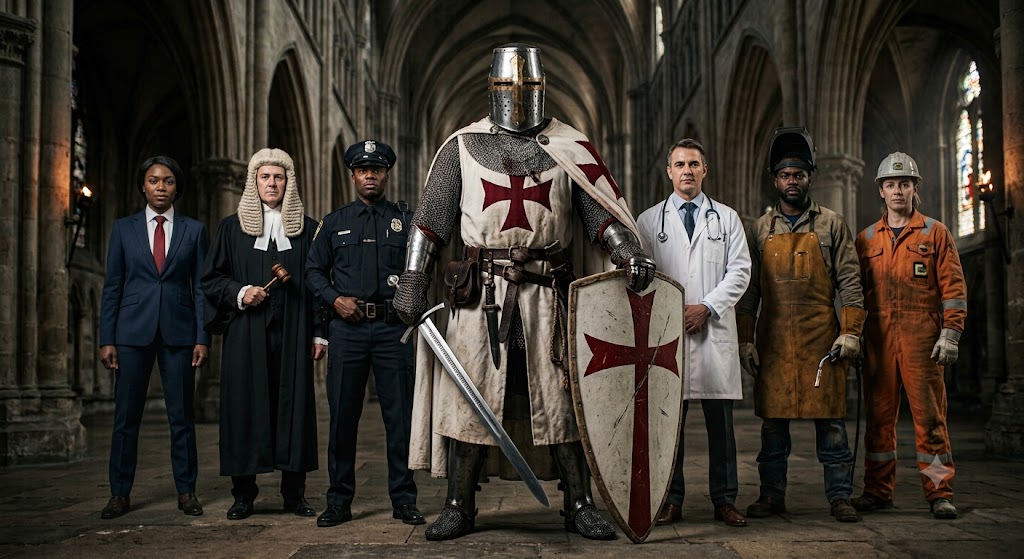
The Plumbline of Character: A History of Texas Masonry and the Knights Templar
For centuries, a persistent thread of fraternity, moral philosophy, and quiet service has woven its way through the fabric of Western civilization, eventually finding fertile soil in the rugged expanse of Texas. To understand the true history of Freemasonry and the Masonic Knights Templar is to look past the sensationalism, shadow-whispers, and modern internet myths. The real story is not one of hidden political control or esoteric conspiracy; rather, it is a history of foundational civic building and an enduring institutional commitment to a simple, profound goal: taking good men and making them better.
From its traditional roots in the medieval stone-masons’ guilds to the high chivalric degrees of the York Rite, and finally to the dusty, perilous frontiers of early Texas, Freemasonry has served as an anchor for character, charity, and leadership.
Part I: The Operative Foundations and Chivalric Transition
To understand Texas Masonry, one must first look across the Atlantic to the origin of the Craft. Freemasonry developed from the operative guilds of medieval stonemasons who built the great cathedrals of Europe. These men possessed specialized knowledge of geometry, architecture, and engineering—secrets they protected using passwords and signs so they could travel from town to town and secure work based on their proven skill level (Entered Apprentice, Fellow Craft, and Master Mason).
As the era of cathedral-building waned in the 17th and 18th centuries, these operative lodges began accepting “speculative” members—men of letters, science, and civic standing who were drawn to the lodges’ moral framework. The tools of the stone-cutter were transformed into symbols for building the human character:
- The Square to virtue the actions.
- The Compass to circumscribe desires and keep passions within due bounds.
- The Plumb to guide a man along the straight line of upright living.
The Chivalric Ascent: The York Rite and the Templars
As speculative Masonry formalized in Great Britain and America, a system of advanced degrees known as the York Rite developed. At the summit of this rite sits the Commandery of Knights Templar.
While speculative Masonry requires only a belief in a Supreme Being, allowing men of all faiths to meet on a common level, the Masonic Knights Templar uniquely adopted a Christian chivalric framework. It was structured to capture the noble spirit, courage, and self-sacrifice of the medieval warrior-monks who originally defended pilgrims in the Holy Land.
In the Masonic context, the sword was entirely divorced from physical warfare; instead, it became a symbol of a vow to defend the defenseless, support the destitute, and champion the Christian virtues of faith, hope, and charity. It created a modern knighthood centered on moral fortitude and brotherhood.
Part II: The Bedrock of the Lone Star Republic
When Anglo-American settlers began migrating to the Mexican territory of Coahuila y Tejas in the 1820s and 1830s, they brought their Masonic certificates in their saddlebags. In a wild, lawless territory devoid of established schools, hospitals, or social safety nets, Freemasonry provided an immediate, reliable standard of trust and honor among men.
The Charter Under the Oak
The formal history of Texas Masonry began under the shade of a massive wild peach oak tree near Brazoria in March 1835. Six Master Masons, including Anson Jones (later the last President of the Texas Republic), met in secret to apply to the Grand Lodge of Louisiana for a dispensation to form the first lodge in Texas: Holland Lodge No. 36.
[1835: Meeting under the Brazoria Oak] ──> [1836: Battle of San Jacinto] ──> [1837: Grand Lodge of Texas Formed]
During the Texas Revolution, the dispensation for Holland Lodge was carried in the saddlebags of John M. Allen. It was nearly lost during the retreat of the Texas army but survived to be delivered to Houston, where the lodge was formally opened. The ties of Masonry were tightly bound to the birth of the Republic:
- General Sam Houston, Stephen F. Austin, and William B. Travis were all active Masons.
- At the Battle of San Jacinto, the ideals of Masonic mercy were put to the test when several Mexican officers, including General Santa Anna himself, allegedly made Masonic signs of distress to secure safe passage and fair treatment as prisoners of war, appealing to a brotherhood that transcended national enmity.
In December 1837, representatives from the three lodges then existing in the republic (Holland No. 36, Milam No. 40, and McFarlane No. 41) met in Houston under the chairmanship of Sam Houston and formed the Grand Lodge of the Republic of Texas, electing Anson Jones as its first Grand Master.
Part III: The Shield of Chivalry on the Texas Frontier
As the Grand Lodge stabilized the civic foundations of Texas by building the state’s first public schools, academies, and orphanages, the advanced degrees of the York Rite began to take root. The chivalric ideals of the Commandery were perfectly suited for the rugged, dangerous conditions of early Texas, where courage and personal integrity were a man’s only true currency.
The historical timeline of the Commandery’s formal establishment in Texas highlights its rapid growth alongside the developing state:
San Felipe de Austin Encampment No. 1
1853
The first formal commandery of Masonic Knights Templar in Texas is established in Galveston, working under a charter from the Grand Encampment of the United States.
Formation of the Grand Commandery of Texas
1855
With three active local commanderies established (Galveston, San Augustine, and Palestine), delegates meet in San Antonio to form the Grand Commandery of Texas, establishing independent state-wide governance for the chivalric orders.
Post-Civil War Expansion & Reconciliation
1865-1880
In the bitter aftermath of the Civil War, Texas Commanderies serve as crucial centers for community healing, bringing together veterans from both sides of the conflict under a shared vow of brotherhood and charity.
The Texas Knight Templar was easily recognized by his distinct uniform, baldric, and ceremonial sword, but his true impact was felt in his community. Commanderies became synonymous with civic duty, leading public parades, laying the cornerstones of churches and courthouses, and quietly funding local relief efforts for widows, orphans, and victims of yellow fever epidemics.
Part IV: Dispelling the Shadows: The Truth vs. The Myth
Despite this legacy of public service and personal honor, Freemasonry and the Knights Templar have frequently been the targets of wild conspiracy theories and bitter condemnation. From the 19th-century Anti-Masonic movement to modern internet videos, critics have painted the fraternity as a sinister, clandestine group operating in the shadows.
To understand why these myths exist is to understand the nature of human tribalism and fear.
The Anatomy of Misunderstanding
- The Misconception of Secrecy: Masonry is often called a “secret society.” In truth, it is a society with secrets. Its meeting halls are clearly marked with the Square and Compasses, its members wear rings openly, and its grand lodges publish public journals. The only true “secrets” are the traditional modes of recognition (grips and passwords) used as a beautiful, living link to the medieval builders.
- The Echo Chamber of Ignorance: Most critics have never stepped inside a lodge or read an authentic Masonic monitor. They simply copy and paste the fabrications of others, often relying on long-discredited 19th-century hoaxes (such as the Taxil Hoax) or misinterpreting symbolic, allegorical language as literal doctrine.
- The Fear of the Level: Masonry brings men of different political parties, religious denominations, and social classes together to sit on the “Level” as equals. To rigid dogmatists and authoritarian systems throughout history—including Hitler, Mussolini, and Stalin, all of whom banned Masonry and persecuted its members—an organization that promotes free thought, equality, and universal brotherhood is viewed as an inherent threat.
Part V: The Modern Era: Making Men Better
Today, Texas Masonry and the Grand Commandery of Texas stand as a vibrant, living testament to the power of fraternal alignment. In an increasingly digital, isolated world where genuine honor and deep face-to-face brotherhood are scarce, the lodge and the commandery offer an anchor of stability.
The core mission has never wavered: it is an inspirational crucible designed to refine a man’s character. By engaging in the degrees, a man is constantly challenged to self-reflect, to master his vices, and to practice the cardinal virtues of Fortitude, Prudence, Temperance, and Justice.
[A Man's Raw Potential] ──(Masonic Light & Discipline)──> [A Refined Leader, Father, & Citizen]
Furthermore, the modern impact of Texas Masonry is felt through massive, quiet philanthropic endeavors. The Grand Lodge of Texas and its appendant bodies fund extensive charitable works, including:
- The Texas Masonic Home and School legacy.
- The Knights Templar Eye Foundation, which provides millions of dollars in grants for research and medical care to prevent blindness.
- Local scholarship funds, disaster relief operations, and community assistance programs across hundreds of Texas towns.
Conclusion: An Enduring Legacy
The true history of Texas Masonry and the Knights Templar is written in the stone of Texas courthouses, the pages of Texas history books, and the quiet, everyday actions of upright men. It is an organization that does not seek to change the world through political decree or hidden influence, but by changing the world one man at a time—polishing the rough ashlar of human nature until it fits perfectly into the grand temple of humanity.
For the mason who climbs the steps of the York Rite to don the mantle of a Knight Templar, the journey is a profound reminder that true nobility is not inherited by blood, but earned through character, service, and an unyielding commitment to leaving the world a little better than he found it.
YouTube features a massive collection of Knights Templar-inspired music, blending spiritual monastic chants with epic, orchestral battle themes. These arrangements recreate the atmosphere of medieval crusaders through heavy choirs, brass, and traditional folk instruments. [1, 2, 3, 4, 5]
Popular choices include:
- Monastic Chants: Listen to sacred vocal arrangements like the Knights Templar Chant Te Deum Laudamus on YouTube.
- Epic Orchestral Scores: Dive into long-form compilations with The Order’s Call Templar Battle Hymns on YouTube.
- Extended Collections: Explore the entire Templar Music Compilation on YouTube. [1]
 thelivingbreathingjamesbrown.com
You must be logged in to post a comment.