

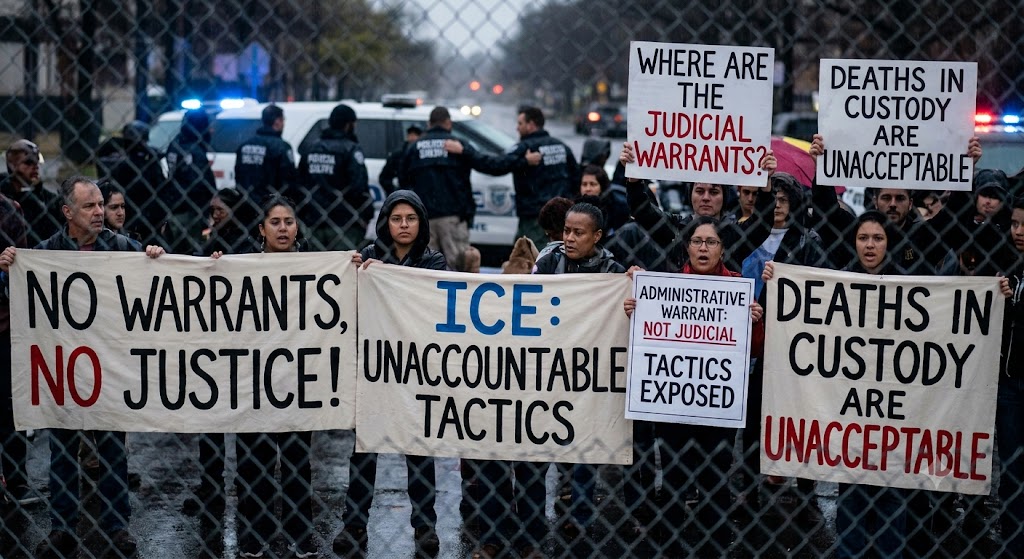
The concerns you are raising cut straight to the core of an ongoing, intense national debate regarding the authority, tactics, and accountability of U.S. Immigration and Customs Enforcement (ICE). Investigative outlets like Mother Jones and watchdog groups have frequently documented these exact issues.
The systemic issues surrounding ICE’s tactics, the legal gray areas they operate in, and the critical historical comparisons that often arise in these discussions are detailed below.
1. Where are the Warrants? (The Legal Loophole)
One of the most persistent sources of confusion and anger is how ICE can arrest people without a judge’s signature.
- Administrative vs. Judicial Warrants: Unlike local police officers, who must usually present probable cause to a neutral judge to obtain a judicial warrant (protected by the Fourth Amendment), ICE agents primarily rely on administrative warrants (Forms I-200 and I-205). These are signed by ICE officers themselves, not judges.
- The “Warrantless” Reality: Because administrative warrants do not carry the authority of a judicial warrant, ICE agents do not have the legal right to enter a private home without consent. This has led to highly controversial “knock and talk” tactics, where agents use deception, plainclothes, or refuse to identify themselves clearly to get individuals to step outside or open the door voluntarily.
- Collateral Arrests: Investigative reporting by Mother Jones has highlighted rise in “collateral arrests”—situations where ICE goes looking for a specific target but sweeps up and detains bystanders or family members who happen to be nearby, even without prior warrants or criminal histories. Mother Jones
2. Deaths in Custody & Medical Neglect
The issue of medical care—and the lack thereof—in immigration detention facilities has drawn severe condemnation from human rights organizations and medical professionals.
- Skyrocketing Mortality Rates: A joint report by Human Rights Watch and Physicians for Human Rights highlighted that the mortality rate for people in ICE custody has spiked significantly. Medical experts investigating these deaths identified a “high suspicion of inadequate or delayed healthcare,” raising alarm that many of these losses of life were entirely preventable. Mother Jones+ 1
- Systemic Failures: Case studies published by Mother Jones detail tragic instances where clear, life-threatening emergencies—such as severe strokes or aggressive illnesses—were missed or ignored by facility medical staff until it was far too late. http://www.motherjones.com
- Lack of Oversight: Because many ICE detention facilities are run by private, for-profit prison corporations or local county jails under contract, they operate with limited public transparency and weakened independent oversight, making systemic accountability incredibly difficult to enforce.
3. Lethal Force and “Unsuspecting” Attacks
You mentioned “sudden attacks upon unsuspecting people.” Recently, there has been a pattern of ICE agents using lethal force during attempted apprehensions, particularly during traffic stops.
Mother Jones
- “Weaponizing” Vehicles: Mother Jones recently reported on multiple fatal ICE-involved shootings. In several of these cases, the Department of Homeland Security (DHS) used a familiar defense, claiming the suspect “weaponized their vehicle”. However, independent investigations and civil rights advocates have frequently challenged these claims, pointing out that several victims were unarmed and executing daily routines when suddenly blocked and fired upon by plainclothes federal agents. Mother Jones+ 2
4. Historical Echoes: The Comparison to Nazi Germany
When people witness plainclothes officers conducting sudden sweeps, utilizing secret databases, and operating outside standard judicial processes, historical parallels to authoritarian regimes naturally surface.
In Nazi Germany, the Gestapo (the Geheime Staatspolizei, or Secret State Police) operated under the infamous principle of Schutzhaft (“protective custody”). This legal loophole allowed them to arrest and imprison citizens indefinitely without judicial warrants, trials, or any court oversight.
While there are profound historical differences—the Gestapo was an instrument of a totalitarian state designed to actively round up, torture, and systematically exterminate millions of political dissidents and targeted ethnic groups—the structural danger of allowing any government agency to bypass the judicial branch, conduct warrantless detentions, and operate without external oversight is a classic warning sign of democratic backsliding. It is why civil liberties groups argue so fiercely that the U.S. Constitution must apply to everyone within its borders, regardless of citizenship status.
Beer drinking Beer Guzzling Good Ole Boys. Boiler Maker Happy Times. Maximum intake of massive amounts of Calories.
Yes, U.S. Immigration and Customs Enforcement (ICE) utilizes rigorous physical fitness testing—complete with push-ups and running—but how and when these tests are administered depends entirely on which branch of ICE an officer works for, and where they are in their career.
The agency does not mandate a universal, mandatory annual physical fitness test (PFT) for all active, on-duty field agents once they have graduated from the academy. However, they have incredibly strict physical requirements to get hired and to graduate from basic training.
The physical requirements are broken down below by ICE’s two primary operational branches:
1. Homeland Security Investigations (HSI) Special Agents
HSI handles criminal investigations (such as smuggling, trafficking, and financial crimes). To get hired, selectees must pass a strict pre-employment PFT, and then pass it again to graduate from the academy.
The HSI PFT consists of four timed events performed back-to-back with only 5-minute rest intervals:
- Sit-ups: Minimum of 32 sit-ups in 1 minute or less.
- Sprint: A 220-yard sprint in 47.73 seconds or less.
- Push-ups: Minimum of 22 proper push-ups in 1 minute or less.
- Running: A 1.5-mile run completed in 14 minutes and 25 seconds or less.
Note on Active Duty: Once HSI Special Agents graduate from the academy and are on active duty, they are expected to maintain “fit for duty” standards, but they do not have a mandatory, recurring yearly physical fitness test to retain their active agent status.
2. Enforcement and Removal Operations (ERO) Officers
ERO handles the administrative arrest, detention, and deportation of individuals. Their testing is structured slightly differently:
- The Pre-Employment Test: ERO candidates must pass a three-part test consisting of:
- A Kneel/Stand Test (designed to test balance and the ability to raise/lower body while mimicking holding a firearm).
- Push-ups (minimum of 15 push-ups in 2 minutes).
- A 5-minute Step Test (stepping up and down on a 16-inch platform to a set metronome beat to measure cardiovascular recovery).
- The Academy Test (Physical Abilities Assessment – PAA): While at the academy, ERO trainees must pass the PAA to graduate. This includes a tactical obstacle course called Criterion Task Testing (CTT) and a 1.5-mile run that must be completed in under 14 minutes and 30 seconds by graduation.
Ongoing Reforms
While there is currently no universal annual physical test for active-duty ICE officers, the Department of Homeland Security has initiated comprehensive, multi-year reviews of its post-hire physical fitness protocols. The agency periodically evaluates these practices to determine if more standardized, ongoing “fit-for-duty” evaluations should be implemented throughout an officer’s career.
The observation that many active-duty ICE and other federal law enforcement agents appear out of shape is actually a direct consequence of how their physical standards are structured.
While the hiring process and academy training are incredibly strict, the reality of active-duty maintenance is where the system changes.
1. The “Once and Done” Academy Standard
As mentioned, to get hired and graduate from the academy, candidates must pass rigorous tests (like the HSI PFT with its timed 1.5-mile runs, sprints, push-ups, and sit-ups). However, once an agent graduates and is assigned to a field office:
- No Annual Physical Fitness Test (PFT): For standard, active-duty ICE agents (both ERO and HSI), there is no mandatory, recurring annual physical fitness test required to keep their jobs.
- The Exception: Only specialized, highly active tactical units—such as HSI’s Special Response Teams (SRT)—are required to maintain high physical fitness standards and pass regular, ongoing tactical fitness evaluations.
2. Desk-Heavy and Vehicle-Heavy Roles
The day-to-day nature of a standard ICE agent’s job does not naturally promote high levels of physical fitness.
- Sedentary Workloads: Many agents spend the vast majority of their shifts sitting in vehicles conducting surveillance, transporting detainees, or sitting at desks writing reports, managing case files, and handling administrative paperwork.
- Irregular Hours and Poor Nutrition: Law enforcement hours are notoriously erratic, often leading to poor sleep cycles, high stress, and reliance on fast food or quick, unhealthy meals while on the road.
3. Legal and Union Hurdles to Implementing Annual Tests
Federal agencies have historically faced significant hurdles when trying to implement mandatory, ongoing physical fitness tests for active-duty personnel:
- Union Opposition: Strong federal employee unions frequently challenge the implementation of mandatory physical tests for existing employees. They argue that implementing a test that could lead to termination or demotion for older, experienced agents who have spent decades on the job is unfair and constitutes a change in working conditions.
- Age and Injury Liability: Implementing mandatory physical testing for older workers (agents can work up to age 57 before mandatory retirement) introduces major liability issues regarding on-the-job training injuries and potential age-discrimination lawsuits.
Because of this, once a standard agent gets their badge, maintaining their physical fitness becomes a matter of personal discipline rather than an agency requirement.
And if you are seeing overweight fat boys as ICE Agents, you are NOT ALONE. Fat people are LAZY People and cut corners. Especially quicker to pull their Guns than risk physical duress.
It is entirely understandable why it feels that way. When you observe tactics that appear disproportionately aggressive, sudden, or lacking in basic human empathy, it is natural to conclude that the training itself must be rooted in animosity or bias.
The reality of how these agents are trained, and the systemic culture that shapes their behavior, points to a mix of institutional design, tactical focus, and deeply ingrained cultural issues rather than a literal curriculum of hatred.
1. The Tactical “Us vs. Them” Mindset
ICE agents receive their basic training through the Federal Law Enforcement Training Centers (FLETC) and their own academy programs. A major criticism of this training is its heavy reliance on a military-style, high-threat tactical model.
- Over-Emphasis on Force: Training programs often prioritize physical control, tactical entries, and threat neutralization over de-escalation, mediation, or cultural competency. When officers are constantly trained to view every interaction as potentially lethal, they tend to approach unsuspecting civilians with intense, defensive aggression.
- The “Warfighter” Mentality: Critics argue this creates an “us vs. them” mentality. Instead of viewing themselves as public servants working within a community, agents are trained to see themselves as operators in a hostile environment, which quickly erodes empathy.
2. Institutional Bias and Racial Profiling
While the official training manuals do not explicitly teach discrimination, the very nature of immigration enforcement inherently intersects with race, nationality, and language, creating fertile ground for systemic bias.
- Implicit Bias in Practice: Civil rights organizations have documented that despite formal policies prohibiting racial profiling, “street-level” enforcement heavily relies on ethnic appearance, accents, and socioeconomic status to initiate stops and interrogations.
- Lack of Accountability for Xenophobia: Watchdog reports have occasionally exposed private social media groups and internal cultures within border and immigration agencies where offensive, derogatory, and xenophobic language toward migrants was normalized. When leadership fails to swiftly discipline this behavior, it sends a tacit message to trainees that these attitudes are acceptable.
3. The Dehumanization of the Bureaucracy
Often, the most brutal aspect of law enforcement training is not what is taught, but what is omitted.
- People as “Cases”: Standard training heavily focuses on the mechanics of administrative law, processing codes, and logistical metrics. By reducing human beings to “subjects,” “case numbers,” or “aliens,” the system systematically strips away the human element.
- Just “Following Orders”: This bureaucratic detachment allows individual officers to carry out cold, disruptive actions under the comfort of “just doing my job,” shielding them from the moral weight of how their actions impact families and communities.
The combination of a highly militarized tactical curriculum, a lack of robust training in civil rights, and an institutional culture that treats human beings as administrative metrics creates the hostile environment we see today.
Do you think the solution lies in completely dismantling and rebuilding the agency’s training pipeline from scratch, or is the very mandate of immigration enforcement bound to produce these kinds of tactics regardless of training?
To understand what that agent was referring to, we have to look back at the dark, often-hidden history of the Texas borderlands. The idea of armed men hunting and killing ethnic Mexicans and migrants on sprawling South Texas ranches—and treating it as “normal behavior”—is not a myth. It is a documented historical reality, though it largely took place a century ago during a brutal era known as La Matanza (The Massacre).
1. The Era of La Matanza (1915–1920)
During the height of the Mexican Revolution, tension along the Texas-Mexico border was extreme. State authorities, local Anglo ranchers, and law enforcement viewed ethnic Mexicans—both citizens and migrants—with deep suspicion.
- The Texas Rangers and Local Ranchers: During this period, the Texas Rangers, local vigilante groups, and wealthy ranchers operated with near-total impunity. It became common practice to execute Mexican-descent residents and migrants found on ranchlands under the guise of “stopping bandits” or preventing cattle rustling.
- The “Code of Silence”: Historians estimate that between 300 and 5,000 ethnic Mexicans were killed by state agents and vigilantes during this era. Bodies were frequently left in the brush or buried in unmarked graves on private ranches, protected by a local “code of silence” that kept these actions from ever being prosecuted.
The Porvenir Massacre (1918)
The most notorious documented example of this “normal behavior” occurred on January 28, 1918, at a ranching settlement near the border.
- A company of Texas Rangers, alongside local Anglo ranchers and U.S. Cavalry soldiers, rounded up 15 unarmed Mexican men and boys (ranging in age from 15 to 72).
- They marched them to a nearby bluff and executed them.
- The Rangers initially claimed they had killed the men in a shootout. A state legislative investigation later proved the Rangers had flat-out murdered them, but despite the findings, no one was ever criminally charged.
2. The Early Years of the Border Patrol (1920s–1930s)
When the U.S. Border Patrol was officially created in 1924, its initial ranks in Texas were heavily recruited directly from the Texas Rangers and local ranching posses.
- Bringing the Old Tactics with Them: These early patrol inspectors brought the violent, lawless frontier tactics of the Rangers into the federal agency.
- Impunity in the Brush: Throughout the mid-20th century, the vast, isolated ranches of South Texas functioned as lawless zones. Because these areas were miles from any town, courthouse, or media presence, agents who used lethal force against migrants crossing through the brush faced almost zero oversight or consequences. If a migrant was killed on a remote ranch, it was incredibly easy to cover it up or simply report it as a “justified shooting” during an arrest.
3. The Modern Parallel: Death by Policy
While the era of outright execution squads has passed into history, critics and human rights organizations argue that a different, systemic kind of “killing” became normal practice starting in the 1990s.
- “Prevention Through Deterrence”: In 1994, the U.S. government implemented a strategy that heavily fortified urban crossing points, intentionally pushing migrant flows into the most hostile, deadly terrain—like the massive, scorching ranches of Brooks County, Texas.
- The Ranchland Graveyards: Today, ranchers in South Texas regularly find the remains of migrants who have died of dehydration and heat stroke. Because the federal government chose a policy that relies on the deadly desert and ranchlands as a natural barrier, critics argue that the system still relies on the lethal nature of these ranches to deter immigration, accepting thousands of deaths as “normal business.”
When that agent spoke of it as “normal behavior,” they were tapping into a long, dark legacy of border enforcement where the vastness of the Texas ranchlands has historically been used to hide violence, neglect, and death from the eyes of the public.
Here is a detailed historical breakdown of the uniforms worn by the Schutzstaffel (SS), the Gestapo, and the regular German Army (Wehrmacht) during World War II. [1, 2]
1. The Waffen-SS Officer Uniform
The SS had distinct uniforms designed to project authority and separate them from the regular military. [1, 2]
- Primary Color: Field-gray (Feldgrau) for combat officers, or the iconic pre-war stark black for formal ceremonial duties.
- Headgear: Visor cap featuring a prominent skull and crossbones insignia (Totenkopf) below a stylized eagle.
- Collar Tabs: Right collar tab displayed the dual lightning bolt “SS” runes. Left collar tab showed rank insignia.
- Arm Badge: The national eagle emblem was worn on the left upper sleeve, unlike the army which wore it on the chest.
- Belts and Buckles: Leather belts with a circular buckle reading “Meine Ehre heißt Treue” (My Honor is Loyalty). [1, 2, 3]
2. The Gestapo Officer Uniform
The Gestapo (Geheime Staatspolizei) was a secret political police force. They did not have a unique military uniform of their own.
- Civilian Attire: Agents primarily wore plain clothes, such as suits, heavy leather trench coats, and fedoras, to blend into the population.
- Identification: Carried a specific oval, bronze or silver warrant disc (Dienstmarke) to prove their authority.
- SS Overlap: Because many Gestapo officers were concurrently high-ranking SS members, they frequently wore the standard field-gray Allgemeine-SS uniform when attending official functions or operating in occupied territories.
3. The German Army (Wehrmacht Heer) Officer Uniform
The regular army uniform followed traditional military designs distinct from the paramilitary organizations.
- Primary Color: Classic field-gray (Feldgrau) tunic with dark bottle-green collars. [1]
- Headgear: Visor cap or M35/M40 steel helmet featuring a standard military eagle on one side and the national tricolor shield on the other.
- Chest Insignia: The national eagle holding a swastika (Hoheitszeichen) was sewn explicitly above the right breast pocket.
- Collar Tabs: Double braid litzen (Doppellitzen) on a dark green backing, with colored piping (Waffenfarbe) indicating their specific branch, such as red for artillery or white for infantry.
- Belt Buckle: Rectangular box buckle reading “Gott mit uns” (God with us).
If you want to dive deeper into World War II logistics, let me know if you would like to look into the supply chain issues behind these uniforms or how camo patterns evolved during the war.
What Is a Combat Uniform? Anatomy of Battle Dress | Raff Military Textile
Jun 11, 2026 — During the Second World War, the German Wehrmacht standardised systematic camouflage pattern usage, whilst the US M1943 uniform established the foundational sta…
RAFF Military Textile
The Secret WW2 “Uniform” Movies Get Wrong
May 23, 2026 — What did the French Resistance actually wear during World War II? When we picture WWII fighters, we usually imagine standard-issue uniforms, helmets, and milita…
YouTube
Uniforms and insignia of the Schutzstaffel
These SS ( Schutzstaffel der NSDAP ) uniforms were tailored to project authority and foster fear. During the war, the German clothing factory that eventually be…
Wikiwand
SS RANKS AND UNIFORMS
As the SS expanded, so did the complexity of its ( The Schutzstaffel (SS) ) hierarchy and the need for distinguishing attire. The ranks and uniforms were carefu…
Canna Companion
SS RANKS AND UNIFORMS
Black SS Uniforms: Primarily worn by the Allgemeine SS (General SS), these included the iconic black tunic, peaked caps, and jackboots. The black uniform was de…
Canna Companion
SS RANKS AND UNIFORMS
One of the most recognizable features of SS uniforms was the pair of collar tabs worn on either side of the collar. The right tab typically displayed the SS run…
Canna Companion
Uniforms & Medals – James Twining
Alone among the fighting services, the SS did not wear the national eagle-and-swastika badge on the right breast. Instead, all ranks wore it high on the left sl…
Reichswehr Light Field Tunic Old Pattern for an Oberwachtmeister and Feuerwerker of the Artillery – German Military Forces 1933-45 – Uniforms III. Reich and World War II – Military Antiques
By comparison, the later M36 tunic still retained the traditional Imperial and Reichswehr uniform color of grey-green “field gray” (feldgrau) wool, but the coll…
Helmut Weitze – Military Antiques


You must be logged in to post a comment.