
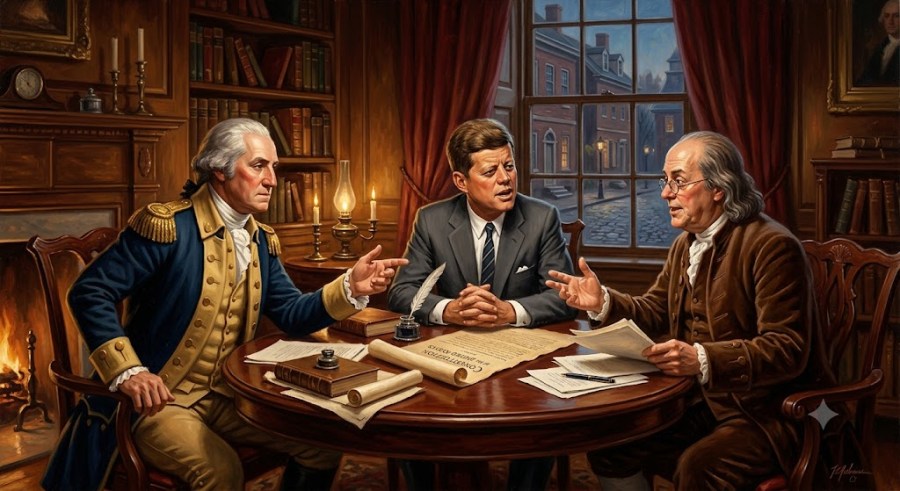

A Constitutional Conundrum: A Dialogue Across Eras
Setting: A quiet study outside time. A table with parchment, an inkwell, and a modern desk lamp.
Participants:
- George Washington: First President of the United States, Presiding Officer of the Constitutional Convention.
- Benjamin Franklin: Framer, diplomat, polymath, and elder statesman of the Revolution.
- John F. Kennedy: 35th President of the United States, author of Profiles in Courage, navigating the modern television and mass-media era of American politics.
Act I: The Virtue of the Office and the Spirit of Faction
Washington: (Pacing slowly, hands behind his back) When we gathered in Philadelphia in the summer of 1787, our primary anxiety was not merely how to structure power, but into whose hands that power would fall. We designed the Executive with the expectation that the nation would seek out individuals of unblemished character—men whose private virtue reflected their public integrity. If a citizen faces criminal judgment, conceals private transactions to manipulate public opinion, or incites resistance against the peaceful transfer of power… how does the constitutional fabric sustain such a strain?
Franklin: (Leaning back, adjusting his spectacles with a dry smile) My dear General, you always placed great faith in human nobility, whereas I have spent eighty-odd years observing human infirmity. In Philadelphia, we knew men were fallible. That is precisely why we wrote a Constitution, not a catechism. The qualifications for the presidency were deliberately kept minimal: natural-born citizenship, thirty-five years of age, and fourteen years a resident. We left the rest to the judgment of the electors—and ultimately, the people. If the electors choose a man burdened by misdeeds, the Constitution has not failed; it has simply reflected the exact temper of the populace.
Kennedy: (Leaning against the table, gesturing thoughtfully) Doctor Franklin is right about the mechanics, but General Washington touches on the modern reality. In the 20th century and beyond, the Presidency isn’t just an administrative office—it’s a moral platform magnified a million times over by radio, television, and instant media. When a leader faces felony convictions or challenges the certification of an election, it shatters the democratic consensus. The presidency relies heavily on legitimacy. Without public trust in the rules of the game, the entire apparatus stalls.
Act II: Law, Money, and Electoral Sovereignty
Washington: But what of the Oath of Office? To “preserve, protect, and defend the Constitution of the United States”? If an individual attempts to subvert the electoral process or uses coercive schemes to alter the outcome of an election, that strikes at the very heart of the social compact. In 1796, in my Farewell Address, I warned explicitly against the “cunning, ambitious, and unprincipled men” who would subvert the power of the people to usurp for themselves the reins of government.
Franklin: And yet, General, who decides what constitutes an usurpation once the election is concluded? If the legal system prosecutes a man, imposes fines or convictions, and the public—aware of every single one of those facts—still casts their ballots to elevate him to the Chief Magistracy, what then? To override the ballot box based on moral qualification alone, without explicit constitutional prohibition, would itself be an exercise in non-democratical authority. We feared monarchs, yes, but we also recognized that the people have the absolute right to make their own mistakes.
Kennedy: That’s the core paradox of modern democracy, Doctor. In my era, we saw how deep political divisions can blind voters to character flaws because they care more about party victory or political grievance. A man can buy silence regarding private misconduct, face criminal indictments, and still campaign successfully if he convinces a majority that the system itself is corrupted against him. When citizens lose faith in the judicial system or the press, standard disqualifiers stop working.
Act III: The Durability of the Republic
Washington: If character no longer serves as the primary filter for the Chief Executive, then the safety of the Republic must rely entirely on the institutional checks—the Congress, the Judiciary, and the rule of law. But if the magistrate himself views those institutions with contempt, the guardrails are tested to their absolute breaking point.
Kennedy: History shows us that institutions are tougher than they look, General, but only if citizens remain engaged. When crisis comes, it takes what I called “political courage”—leaders willing to place the Constitution above party loyalty. If a president with serious legal burdens takes office, the burden shifts entirely to Congress and the courts to enforce the boundaries of the Constitution without fear or favor.
Franklin: (Rising slowly) When I stepped out of Independence Hall in 1787, a lady asked me what we had created. I told her: “A republic, if you can keep it.” Notice I did not say “a republic, if only saints are elected.” The Constitution was engineered to withstand weak men, ambitious men, and even flawed men. The true danger is never just the character of the man in the White House—it is the apathy or tribalism of the citizens who put him there. If the voters elect a man with heavy burdens upon his name, it is a mirror held up to the nation itself.
Summary of Their Wisdom
| Leader | Core Perspective | Key Concern |
|---|---|---|
| George Washington | Civic virtue and adherence to the rule of law are paramount; subverting peaceful transfers of power threatens the Republic’s foundation. | The erosion of institutional norms and moral standards in leadership. |
| Benjamin Franklin | The Constitution establishes strict mechanics, not moral perfection; the ultimate choice—and responsibility—rests with the people. | Expecting perfection from human nature rather than relying on systemic checks. |
| John F. Kennedy | Modern media amplifies leadership flaws; legitimacy requires public trust, political courage, and strong institutional boundaries. | Partisan polarization causing citizens to lose faith in democratic processes. |
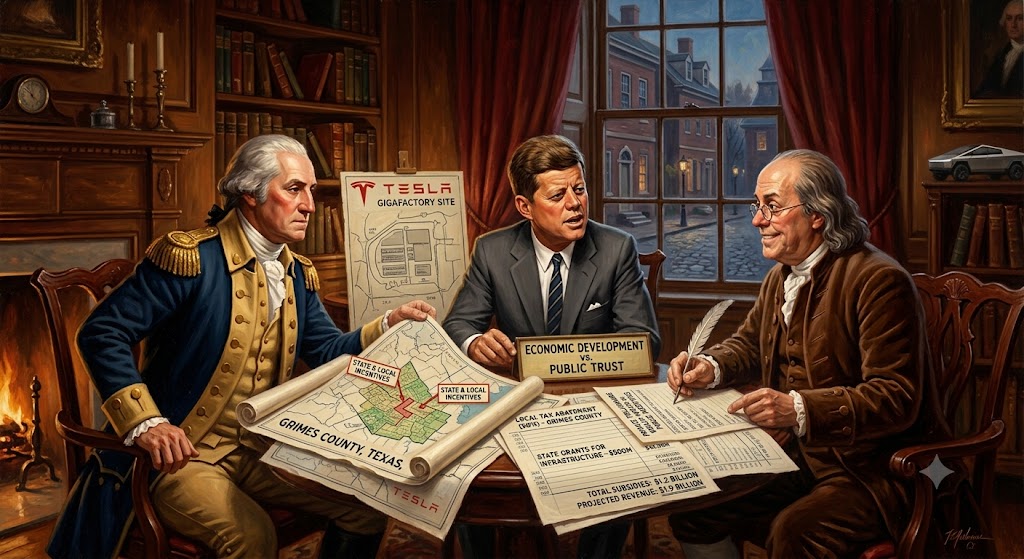
Act I: The Art of the Leverage—Playing States Against Each Other
Setting: The same timeless study. Papers, maps of modern industrial corridors, and financial ledgers are scattered across the mahogany table.
Washington: (Examining a ledger with a furrowed brow) I must confess my bewilderment. When a citizen or enterprise achieves immense prosperity, one would expect their contribution to the public treasury to reflect their vast stake in the nation’s security and order. Yet here we see a modern titan—a man commanding fortunes greater than the treasuries of entire kingdoms—paying negligible local taxes. How does a single individual negotiate tax abatements, property exemptions, and public infrastructure subsidies from local counties simply as a condition to set foot there?
Franklin: (Chuckling gently, dipping his quill) Ah, General, it is the ancient law of supply and demand, played out on the grandest stage of commerce. A man with billions in capital does not knock on a county’s door asking for a favor; he holds an auction. He announces to five different states and dozens of rural counties—such as Grimes or Travis in Texas—that he intends to build a vast manufactory. He then asks: “Who amongst you will offer the lowest tax burden, build my roads, and grant me the longest exemption from local levies?”
Kennedy: (Nodding, leaning forward) That’s the classic “race to the bottom,” Doctor. In the modern era, local governments—often small county commissioners or school boards—are desperate for job growth and prestige. When a billionaire threatens to take ten thousand manufacturing jobs to Oklahoma or Nevada instead, local leaders panic. They offer 10-year property tax abatements under state codes, free land, utility hookups, and direct state enterprise grants. The titan gets the deal because he holds all the leverage: mobility.
Act II: The Mechanics of the “Sweet Deal”
How Mega-Corporations & Billionaires Extract Local Tax Deals:1. The Multi-State Bidding War ↳ Announce a massive project ("Gigafactory") without naming the site to force states to compete against each other.2. Statutory Tax Abatements (e.g., Texas Chapter 312 / Local Ag Agreements) ↳ Negotiate 70% to 100% exemptions on property tax increases for up to 10 years.3. Payments in Lieu of Taxes (PILOT) & Infrastructure Grants ↳ Replace standard tax rates with small fixed fees while convincing local taxpayers to build the roads, water lines, and power grids.4. The "Job Creator" Political Shield ↳ Local officials promote the headline job numbers to win re-election, while the taxpayer absorbs the revenue shortfall.
Washington: But this appears inherently unfair to the established resident! The farmer who has tilled his land in Grimes County for forty years pays his full property assessment to support the local sheriff, roads, and schools. Yet a titan arrives with billions in capital and is granted a dispensation from those very same public duties? It creates a aristocracy of wealth exempted from the common burdens of citizenship.
Franklin: Fair or not, General, local magistrates view it through a cold arithmetic. They ask themselves: “Is 20 percent of something better than 100 percent of nothing?” If the billionaire builds elsewhere, the county gets zero new economic activity. If they grant him an abatement, they lose property tax on his new facility for ten years, but they hope to gain from sales taxes when his workers buy homes, food, and gasoline in the community.
Kennedy: The problem, Doctor Franklin, is that the arithmetic rarely works out as advertised for the public. Studies show that these massive subsidy packages often cost local taxpayers hundreds of thousands of dollars per job created. Furthermore, the billionaire uses his wealth to hire elite tax attorneys, lobbyists, and site selection consultants whose sole job is to exploit every loophole in state and federal tax codes—taking advantage of asset-backed loans, depreciation write-offs, and capital gains structures so he pays almost no personal income tax either.
Act III: Public Good vs. Private Empire
Washington: In my time, when we levied taxes, they applied to all subjects equally within a jurisdiction. To allow a private sovereign to dictate his own tax rate to a sovereign State strikes me as an inversion of authority. If a government surrenders its power to tax the wealthy, it surrenders its authority to govern them.
Kennedy: It threatens the very principle of equal sacrifice. When a country lets its wealthiest citizens opt out of funding public goods—education, roads, healthcare—while working families foot the bill, it deepens the public’s cynicism. People begin to feel the system is rigged, because, in many ways, the tax code has been written by and for those with the power to walk away.
Franklin: (Setting down his pen, looking over his spectacles) Yet we must remember: as long as states remain sovereign entities in a federal union, they will compete with one another for trade and industry. You cannot forbid a town from offering an incentive without stripping away its local governance. The only true remedy lies with the people and their representatives—to set ground rules so that no single man, no matter how wealthy, can hold the public treasury hostage.
Summary of Their Positions
| Leader | Analysis of Big-Tech/Billionaire Tax Deals | Core Concern |
|---|---|---|
| George Washington | Views tax dispensations for the ultra-wealthy as a erosion of equal civic duty and public sovereignty. | Creation of an untaxed economic aristocracy above local law. |
| Benjamin Franklin | Sees it as pragmatic market competition between local jurisdictions desperate for economic growth. | Municipalities offering more in subsidies than they ever recoup in real value. |
| John F. Kennedy | Highlights how corporate mobility and specialized tax law allow billionaires to shift the tax burden onto working families. | The loss of public trust when equal sacrifice under the law collapses. |


You must be logged in to post a comment.