
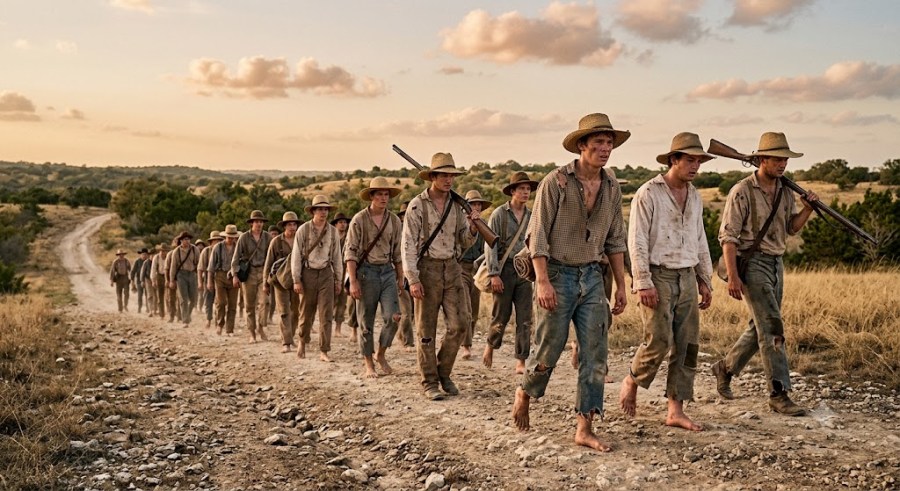
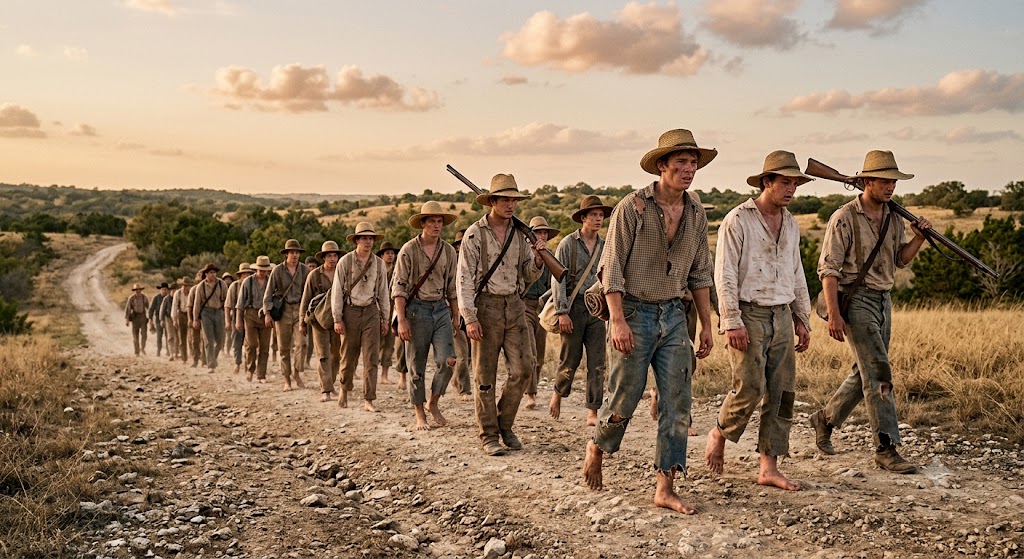
Young men, mostly farmers from Coryell County, Texas walking to Waco, Texas to begin their Service in a War they never asked for. And fear of being shunned by one’s family sent any make a fearful decision to fight others from other tates
In the crisp, uncertain early days of March 1861, just one week after Texas officially dissolved its bonds with the Union and tied its fate to the nascent Confederacy, a heavy stillness settled over the oak-crowned hills of Coryell County.
On a rocky limestone ridge overlooking the Leon River valley—on land that generations later would be swallowed up by the sprawling expanse of Fort Hood—a dozen men folk sat on the split-rail fences and rough-hewn oak benches outside the small timber-frame cabin of old Elija Vance. They were subsistence farmers, stock-raisers, and former Texas Rangers, men whose hands were calloused by the plow and scarred by cedar bark.
Among them sat young Jess Vance, just nineteen, his boots worn down to the thin leather lining; his cousin Luke; Asa Latham from down on Cowhouse Creek; and Thomas Oglesby, a quiet man whose family had cleared rocks off their forty acres with their bare hands.
The talk was not of politics, treaties, or grand economic theories. In all of Coryell County, hard-scrabble as it was, none of these families owned a single Black man, woman, or child. They worked their own dirt, birthed their own stock, and buried their own dead. Slavery was never once brought up.
Instead, the atmosphere throbbed with a raw, agonizing tension that split the gathering down the middle.
“It’s a fools’ war,” Thomas Oglesby muttered, staring down at his knuckles. “We fought the Comanches to hold this ground. We built Fort Gates. Now the Governor—old Sam Houston himself—says stay put. He wouldn’t sign their oath, and he knows more about Texas than any man breathing.”
“Houston’s old, Thomas!” blurted young Luke Vance, his face flushed with the feverish impatience of youth. “The state has spoken. The ordinance passed six-to-one in Gatesville! If the boys from Bell County and McLennan go, and we sit here hiding behind our mammas’ skirts, what will they say about the Vances? What will they say about Coryell County?”
“They’ll say you were smart enough not to die for rich men’s squabbles three states away,” Thomas fired back softly.
Luke stood up, his voice cracking with the terrible urgency that governed the frontier code. “If we don’t go, Thomas, we are marked. You know how news travels across these creeks. A man who stays behind when his county calls is a coward. Your cousins won’t look at you. Your own father won’t shake your hand at meeting. I’d rather take a Minie ball through the brisket than live forty years with my kin turning their backs on me when I walk into town.”
That was the true, unvarnished fear that hung over the porch. It wasn’t the fear of Union cannon or the dread of disease in distant camps. The unbearable, terrifying weight was the prospect of being shunned—of violating the unwritten Family Code, being branded a draft-dodger or a loyalist, and living out their days as an outcast among their own blood.
Yet, for some, like Luke and young Jess, there was also a wild, reckless excitement. They had lived quiet, isolated lives bounded by cedar brakes and corn rows. The prospect of marching off into history, under bright new banners, felt like answering a grand calling.
By the end of the day, the pressure of the Code won out. The decision was made.
Along with dozens of other young men from the settlement, they formed what would become Company C of the 6th Texas Infantry—a unit raised directly out of Coryell and neighboring central Texas counties.
They had no uniforms. They had no supply wagons. Many of the young men didn’t even have serviceable boots, their old footwear having rotted out on the rocky, thorn-strewn terrain of the Leon River valley. But they could not wait for government issue; to delay was to invite suspicion of cowardice.
The company stepped off on foot from Gatesville, bound for the mobilization point at Waco, more than thirty miles to the east across the rough, gravelly prairie.
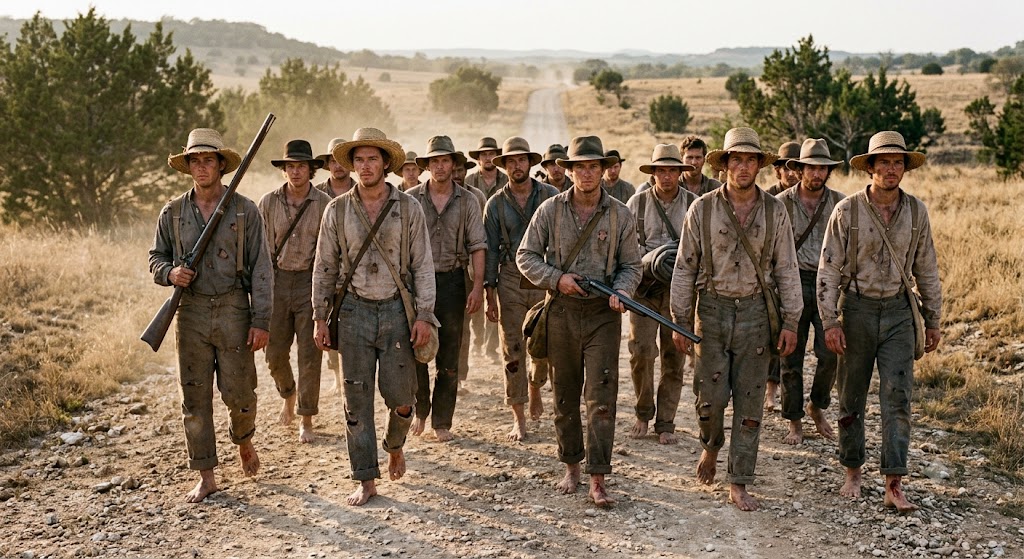
By the second day of the march, the flimsy leather soles of the few men who had shoes fell completely to pieces on the flint and limestone trails. Rather than lag behind, Jess Vance, Luke, Asa Latham, and over half the company stripped off their shredded footwear and walked the final twenty miles entirely barefoot.
Their feet were torn, bruised, and bleeding, leaving faint red smudges in the pale Texas dust. Yet not a single man complained or fell out of line. To slow down, to stop, or to ask for a ride in a passing farm wagon would have brought the very shame they were walking to escape.
When the ragged, dusty column finally marched down the main dirt street of Waco, the sight of them stopped the town in its tracks.
The citizens of Waco—accustomed to seeing well-appointed volunteers from the wealthier river plantations—watched in stunned silence as the Coryell County boys filed into the town square. They were exhausted, caked in sweat and trail dust, their feet bloodied and raw, yet they stood straight as pine posts, holding their chin up to show they had answered the call.
The townspeople did not cheer at first; a profound, humbling awe washed over the crowd. Women wiped tears from their eyes, and local merchants immediately ran to the doors of their shops. Within an hour, the citizens of Waco brought out dozens of pairs of work boots, thick woolen socks, and cobbler’s leather, handing them directly to the young men sitting on the courthouse steps.
It was a quiet, deeply humbling moment of grace. The boys from the hills had proven their grit before ever firing a shot.
They put on the shoes given to them by strangers, tied the laces tight, and prepared to march east toward the war that would consume so many of them.
Throughout it all, from the porch in Coryell County to the dusty square in Waco, none discussed slavery. They marched because the tide of their community had pulled them in, and because the terror of being outcast by their kinfolk was a fate far worse than dying on a distant battlefield. Being shunned was unacceptable to a young man’s code, and so they walked—barefoot through the flint—to keep their names untarnished at home.


You must be logged in to post a comment.