
Shadows Over the Brush Country: Tactical Herbicide Testing, Domestic Field Operations, and the Lasting Environmental Legacy in Texas
I. Historical Evolution: The “Rainbow Herbicides” and Domestic Testing
During the mid-20th century, the United States Department of Defense (DOD), in close collaboration with the U.S. Army Chemical Corps at Fort Detrick, Maryland, and the Department of Agriculture (USDA), initiated extensive research into synthetic plant growth regulators for military defoliation and crop destruction. Before the widespread deployment of defoliants in Southeast Asia under Operation Ranch Hand, military researchers tested dozens of chemical formulations to evaluate defoliation efficiency, canopy penetration, and kill-rates across varied ecological terrains.
Agent Orange Record+ 1
These chemical mixtures were color-coded based on the identification bands painted around their shipping drums, collectively known as the “Rainbow Herbicides”:
- Agent Pink & Agent Green: Early formulations containing high concentrations of 2,4,5-trichlorophenoxyacetic acid (2,4,5-T), heavily contaminated with 2,3,7,8-tetrachlorodibenzo-p-dioxin (TCDD or dioxin). Wikipedia
- Agent Purple: A 50/50 blend of 2,4-D and 2,4,5-T variants used extensively in early field trials.
- Agent Blue: An organic arsenic-based compound (cacodylic acid) designed specifically to destroy narrow-leaf grasses and food crops like rice.
- Agent White: A mixture of 2,4-D and picloram, used where long-term soil persistence was desired.
- Agent Orange: The ultimate operational standard—a 50/50 formulation of 2,4-D and 2,4,5-T n-butyl esters, prized for its rapid defoliation capabilities against dense broadleaf brush.
To determine how these formulas performed against hardwood forests, scrub brush, and arid foliage, the U.S. military conducted clandestine and open-air field tests across multiple domestic sites between 1944 and 1970. Operational testing grounds spanned Florida (Eglin Air Force Base, Bushnell Army Airfield), Puerto Rico, Hawaii, and extensive rural tracts across Texas.
II. Field Testing Protocols: Aerial Photography and Private Land Leases
The operational protocol for domestic testing mirrored agricultural crop-dusting, but with rigorous military documentation:
- Ranch and Farm Access Agreements: Chemical Corps evaluation teams secured permission from private landowners, farmers, and ranchers across rural Texas, under the guise of testing agricultural brush control and rangeland clearing agents.
- Pre-Spray Aerial Baseline: Low-altitude reconnaissance aircraft took high-resolution aerial photographs of the targeted pastureland, brush belts, and livestock water sources to establish a vegetation baseline.
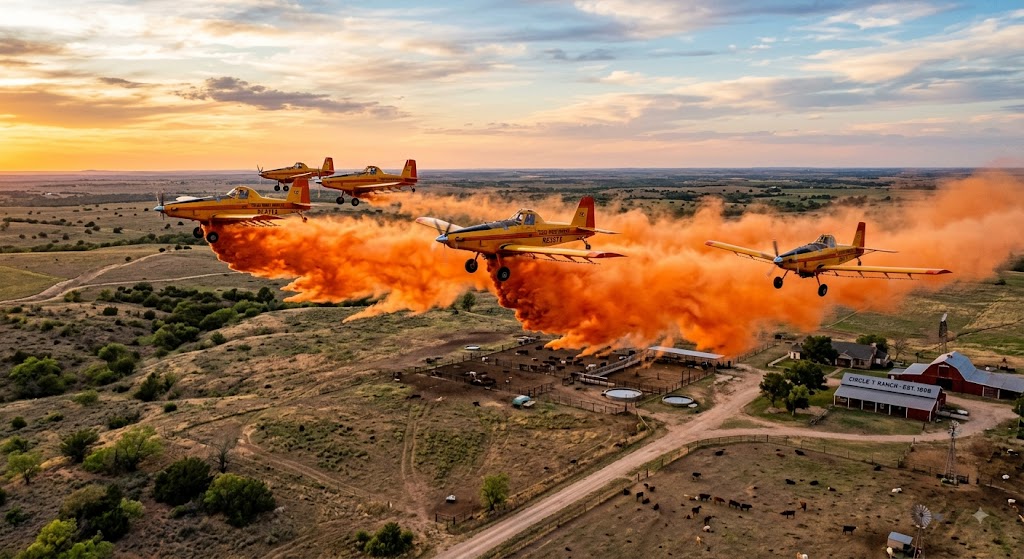
- Targeted Aerial Application: Modified aircraft or low-flying spray rigs applied the designated herbicide variant in dense, concentrated swaths across the target area.
- Post-Spray Damage Assessment: Within 24 to 48 hours, aerial photographic units returned to capture post-application imagery, tracking leaf drop, desiccation, and structural destruction of the plant canopy.
III. The Evant Incident: When Defoliation Went Horribly Wrong
While formal government reports emphasized controlled application parameters, field operations in rural Texas frequently collided with the unyielding reality of extreme chemical toxicity. Near Evant, Texas—a small community situated along the Coryell and Hamilton county lines—one such testing run brought field operations to a abrupt halt.
An elderly local rancher granted permission for test crews to fly a low-altitude spray mission over his acreage to test a potent, experimental herbicide formulation. The day following the spray run, the evaluation crew returned to take post-application assessment photographs and survey the ground location.
What they witnessed on the ground went drastically beyond normal plant defoliation:
- Total Environmental Collapse: Rather than a gradual shedding of leaves, the chemical agent caused immediate, violent desiccation of the entire plant canopy and surrounding range vegetation.
- Acute Livestock & Wildlife Distress: The systemic toxicity hit local cattle and native wildlife on the ranch, causing severe chemical burns, acute systemic distress, and catastrophic collapse.
- Psychological Breaking Point: The immediate devastation horrified the flight and field crew. Confronted with the destructive reality of what they had released onto civilian soil, the field operators broke down—one technician reduced to tears, refusing to speak of the disaster—and members of the testing unit refused to continue operations, quitting the program on the spot.
IV. Health Risks and Environmental Impact in Texas
The core hazard of Agent Orange and its predecessor variants was not merely the synthetic hormones (2,4-D and 2,4,5-T) themselves, but the byproduct generated during manufacturing: 2,3,7,8-TCDD (Dioxin). Dioxin is recognized as one of the most toxic synthetic compounds ever created.
Wikipedia
                 [ Synthetic Production of 2,4,5-T ]
                                 │
                   (High Heat Thermal Reaction)
                                 │
                                 ▼
                   [ 2,3,7,8-TCDD (Dioxin) Byproduct ]
                                 │
            ┌────────────────────┴────────────────────┐
            ▼                                         ▼
  [ Soil & Water Persistence ]             [ Human Bioaccumulation ]
  • Hydrophobic binding to clay            • Fat tissue storage
  • Watershed accumulation                 • Carcinogenesis & DNA damage
1. Water System Contamination
Dioxins are extremely persistent in the environment and insoluble in water, meaning they bind tightly to organic matter, soil particles, and aquatic sediments. When spray drift or heavy runoff carried these chemicals into Texas creeks, stock ponds, and subterranean aquifers, the contaminants remained locked in the local ecosystem for decades, bioaccumulating up the food chain.
Wikipedia
2. Oncological and Systemic Pathology
Direct exposure to these chemical variants has been linked by medical science and epidemiological studies to a wide spectrum of severe diseases:
Wikipedia
- Malignancies: Soft-tissue sarcoma, Non-Hodgkin’s lymphoma, Hodgkin’s disease, multiple myeloma, prostate cancer, and respiratory cancers.
- Metabolic & Neurological Damage: Type 2 diabetes mellitus, peripheral neuropathy, and chloracne.
- Genetic & Teratogenic Effects: Elevated rates of birth defects and reproductive complications among exposed populations. Wikipedia
Recognizing these severe long-term impacts, the Texas Legislature formed the Texas Veterans Agent Orange Assistance Program in 1981 through House Bill 2129. Administered by the Texas Department of Health, the state program conducted extensive epidemiological studies, cytogenetic testing, fat tissue analysis, and birth defect evaluations to document the damage inflicted on Texans exposed to tactical herbicides.
Texas Archival Resources Online
V. Ground Zero: The Aspermont Drift Incident
The human reality of domestic testing is captured in direct eyewitness accounts from the West Texas brush country outside Aspermont, Texas.
During an unannounced low-altitude aerial application, chemical mist drifted directly over civilian presence. The immediate physical impact was instantaneous and severe:
- Acute Chemical Burns: Direct dermal contact caused an immediate, burning sensation across exposed skin, requiring emergency measures—a father rushing his children home to submerge them in a bathtub to scrub the burning oily residue from their skin before it caused permanent tissue damage.
- Instantaneous Canopy Drop: The sheer concentration of the chemical variant was evident in its impact on the hardy native flora. Within hours, the thick leaves on the surrounding mesquite trees died, detached at the stem, and fell straight down to the red dirt, stripping the brush land bare.
VI. Documented Historical References
The following archival sources and historical registries document the testing, storage, and investigation of tactical herbicides and Agent Orange variants within Texas and across the United States:
- U.S. Department of Veterans Affairs (VA) – Herbicide Tests and Storage in the U.S.
- Description: Official Department of Defense (DOD) inventory detailing domestic locations where tactical herbicides (2,4-D, 2,4,5-T, Agent Orange, Agent Purple, and Agent Blue) were tested, evaluated, or stored. Confirms significant storage and handling operations at Texas installations, including Kelly Air Force Base (Yard 62, East Kelly area). VA Public Health+ 1
- Reference Link: VA Public Health – Domestic Herbicide Testing & Storage
- Texas State Library and Archives Commission – Texas Veterans Agent Orange Assistance Program Records (1981–1986)
- Description: Finding aid and archival inventory for House Bill 2129 records. Documents the Texas Department of Health’s investigation into herbicide exposure, featuring clinical research protocols on cytogenetic damage, fat tissue dioxin analysis, immune system evaluations, and regional birth defect trends among Texas residents. Texas Archival Resources Online
- Reference Link: Texas State Archives – Agent Orange Program Finding Aid
- Agent Orange Record – Military Testing Sites and Tactical Herbicides History
- Description: Comprehensive historical repository detailing early 1940s–1970s chemical warfare developments by the U.S. Army Chemical Corps at Fort Detrick. Tracks testing operations across agricultural research plots, air bases, and private range leases in Texas, Florida, and Rhode Island. Agent Orange Record+ 1
- Reference Link: Agent Orange Record – Military Sites Overview Agent Orange Record
- National Academies of Sciences, Engineering, and Medicine – Veterans and Agent Orange Studies
- Description: Multi-volume consensus reports evaluating clinical and epidemiological evidence regarding 2,3,7,8-TCDD toxicity, environmental transport in water and soil, and long-term health outcomes associated with herbicide exposure.


You must be logged in to post a comment.