

The Frostbite Laugh Track: A Dispatch on Slavic Gallows Humor and the Absurd
Gallows humor is the human instinct to tell a punchline while adjusting the noose. Nowhere has this art form been refined with such bleak, diamond-hard perfection as across the endless, permafrost-bitten expanse of the Russian steppe. To survive a landscape where winter lasts eight months and bureaucracy lasts forever, one does not simply develop a coping mechanism; one cultivates a romance with the absurd. In this corner of the world, tragedy is the house special, and irony is the only coin that never devalues.
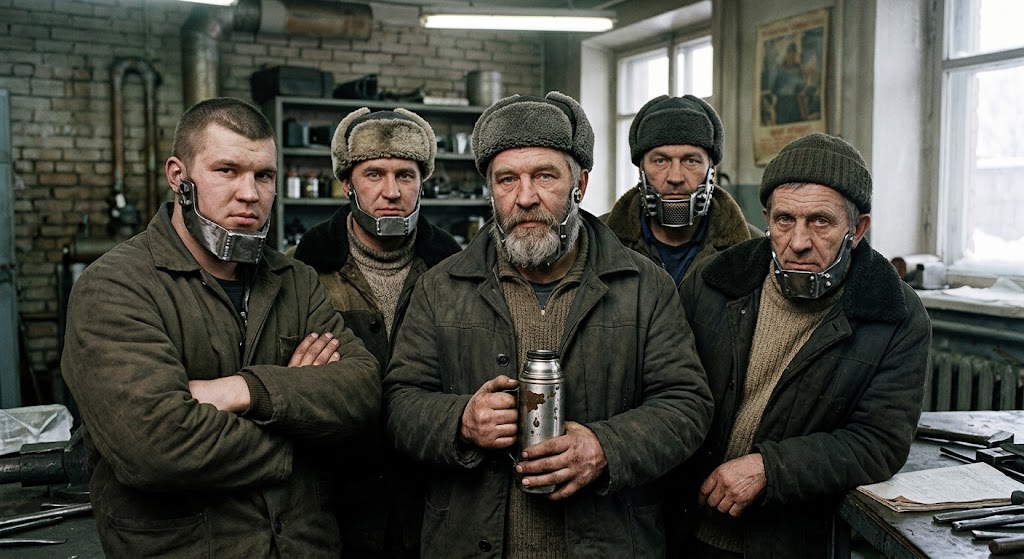
Injured Russian Soldiers surviving the Slavic War can pick out their own Steel Jaw. Some manually move the jaw to eat.

I. The Philosophy of the Iron Smile
Western gallows humor tends to be a sudden release of tension—a quick whistle past the graveyard. Russian black humor (cherny yumor), by contrast, is a furnished apartment built right inside the mausoleum.
Consider the quintessential anecdote of the old Soviet era: A man is waiting in a ten-year queue to buy a Lada. He finally pays his rubles, and the clerk stamps the paperwork. “Come back in ten years,” the clerk says. “Morning or afternoon?” asks the buyer. “What difference does it make? It’s ten years from now.” “Well,” says the man, “the plumber is coming in the morning.”
It is the humor of total inevitability. It assumes that doom is a scheduled appointment, and the only sensible response is to double-check the calendar.
II. Eerie Tales from the Frozen Periphery
When winter sets in, the horizon disappears into a flat, milky haze known as beloye bezumie—the white madness. In the towns built atop frozen mud, the stories told over kitchen tables blur the line between real-world paranoia and supernatural dread.
- The Station of Redundant Trains (Krasnoyarsk Oblasts): Local myth speaks of an abandoned junction near the Yenisei River where an unlisted freight train idles every third Tuesday at 3:14 AM. The engineer never steps down, but the boiler hums with the scent of boiled cabbage and old wool. If a traveler boards, they are not murdered; worse, they are handed a stamp and a ledger and assigned thirty years of unfiled railway invoices. To this day, night-shift switchmen leave an opened tin of sprats on the track as a tax to keep the ledger away from their own doorsteps.
- The Apartment that Memorized Its Tenants (St. Petersburg): In an old communal flat on Vasilievsky Island, the wallpaper in room number four peeled away to reveal not plaster, but thousands of small pencil tally marks. Every time a resident died or was dragged off into the night, the wallpaper reportedly grew slightly thicker and warmer to the touch. By 1978, the room was three feet narrower than when the building was constructed in 1904. The current tenant simply hangs a cheap rug over the wall and complains that the room “breathes too loud when it rains.”
- The Ice Fisherman of Lake Ladoga: Out on the black ice, where men sit in canvas tents above dark water, there is a tale of Pyotr. Pyotr dropped his hook into a drilled hole in 1962 and hooked something that did not fight like a pike, but steadily pulled back with the mechanical strength of a submerged locomotive. Rather than cut the four-kopek line, Pyotr sat down, braced his felt boots against the ice, and held on. Decades later, fishermen say you can still see a hunched figure carved out of blue rime ice, still clutching a wooden rod, waiting for the creature beneath to tire out first.
III. Strange Rituals, Peculiar Habits, and Fabricated Folklore
To understand the culture, one must look at the everyday habits that sit somewhere between strict superstition, sheer stubbornness, and outright madness. Some are deeply rooted customs; others are the inevitable legends whispered among outsiders.
- The Silent “Sit Before the Journey” (Prisest na dorozhku): Before leaving on any long trip, everyone in the household must suddenly stop packing, sit down on their suitcases or chairs, and stare silently at the floor for thirty full seconds. Ostensibly, this fools the household demons into thinking no one is leaving. In practice, it gives everyone a solemn half-minute to silently calculate just how miserable the upcoming train ride will be.
- The Midnight Salt-Curse: Real superstition dictates you never pass salt shaker-to-hand, lest you start a blood feud. Fabricated folklore takes it one step further: in remote villages, if salt spills toward the window, an elder must immediately spit three times over their left shoulder, swallow a clove of raw garlic, and apologize out loud to whatever is watching from the birch trees.
- The Winter Birch-Whipping of Inanimate Objects: In certain hyperborean logging towns, it is said that when an engine blocks or a generator freezes solid at fifty below, mechanics do not use wrenches. Instead, they gather dry birch branches soaked in brine, strip to the waist, and ritually thrash the engine block while screaming insults at its lineage until the metal warms up from sheer embarrassment.
- The Absolute Ban on Smiling at Strangers: Smiling at someone on the street without an explicit, notarized reason is universally regarded as a symptom of idiocy or espionage. A face must remain like wet concrete—impassive, durable, and ready to withstand artillery.
- The Tea Glass Holder (Podstakannik) as a Moral Anchor: A Russian will drink boiling black tea from a glass encased in heavy stamped metal while a blizzarding gale rips the roof off the dacha. To spill a single drop during a catastrophe is considered bad manners; to admit the tea is too hot is considered treason.
The Last Laugh
In the end, gallows humor is not about despair; it is the ultimate act of defiance. When you laugh at the dark, the cold, or the absurd hand you’ve been dealt, you strip the terror of its dignity. As the old Siberian proverb goes: “A pessimist says things couldn’t possibly get any worse. An optimist smiles and says, ‘Nonsense! Of course they can!'”


You must be logged in to post a comment.