
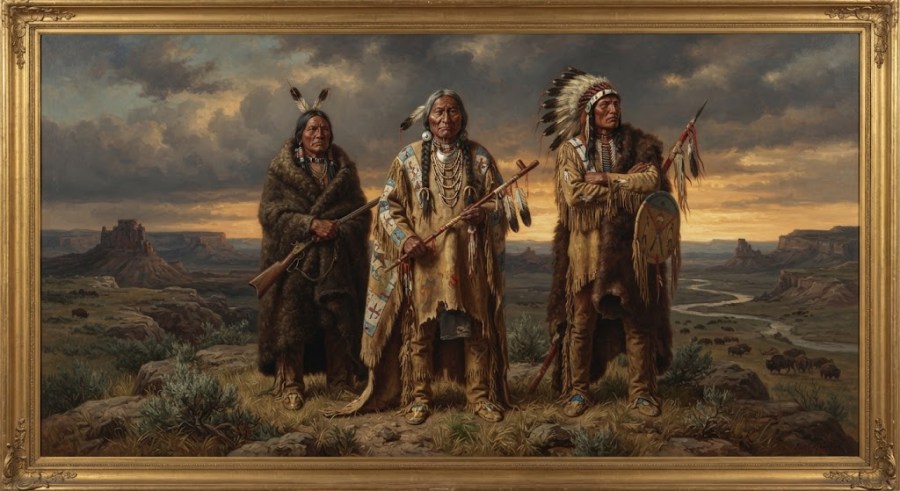
WAR LOOP, BUFFALO HUMP, YELLOW WOLF-Three Comanche Leaders
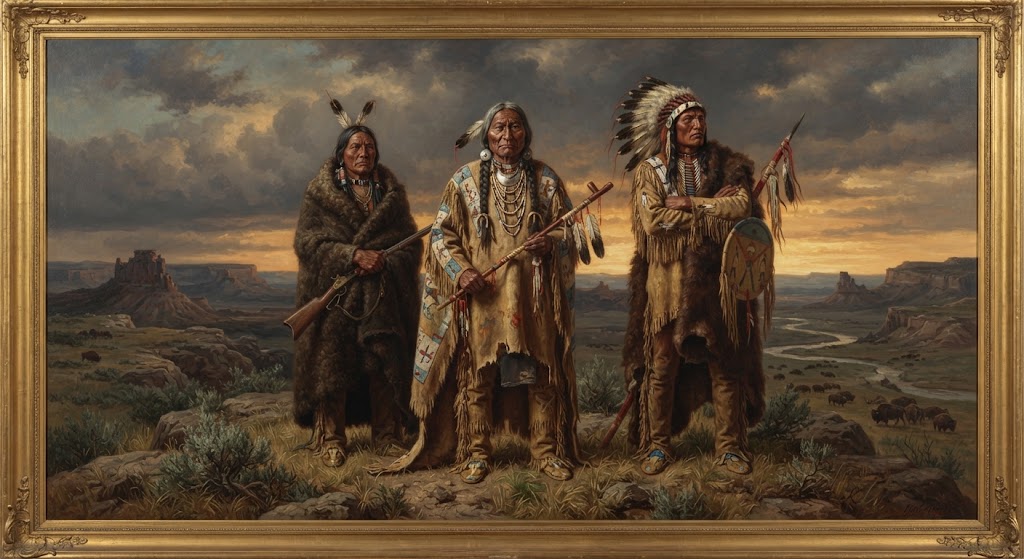
Left: War Loop — Armed with a frontier firearm and wrapped in a heavy winter robe, standing ready in the rugged terrain.
Center: Buffalo Hump (Potsʉnakwahipʉ) — The principal Penateka Comanche war chief, holding a traditional decorated pipe/stem, distinguished by his traditional braids and beaded buckskin tunic.
Right: Yellow Wolf (Isa-viah) — The formidable war leader, standing tall with a striking headdress, medicine shield, and lance, looking out across the plains.
I. War Loop: The Ghost of the Clear Fork
The scrub oak and limestone ridges along the upper Cowhouse and the Leon were places where a man learned to listen to the silence. If the blue jays stopped scolding in the thickets, or if the mustang herd out on the flat suddenly threw their heads up toward the north, War Loop didn’t need a scout to tell him what was coming.
He was a man who worked the shadows of the Penateka frontier—lean, silent, and intimately familiar with every dry wash and cedar brake from the Lampasas down to the Brazos. While the big councils argued over treaties with the Texans and the blue-coated soldiers at the forts, War Loop understood the unyielding math of the prairie: survival belonged to those who moved unseen and struck before the dust of their horses settled.
In the autumn of 1848, along the high ground where the Leon River cuts through the limestone, War Loop had watched the heavy wagon crawl across the prairie. He knew the tracks of those settlers; he knew they were planting roots into hunting grounds that had fed his people for generations. With fifteen picked braves behind him, he moved down the slope like smoke drifting through the post oaks.
The attack was swift and fierce, a sudden eruption of hoofbeats and war cries that tested the iron of the men in the wagon. But War Loop’s true test came when the retaliation rode hard upon his trail. Thirty-three grim riders from the river settlements, trailing sign through the night and day, finally caught his band camped in the heavy timber by the bend of the Colorado.
In that sharp, smoke-choked clash beneath the pecan trees, ten of his warriors fell. War Loop knew when the ground had turned against him; with the discipline of a veteran leader who had survived a hundred skirmishes, he drew the survivors back into the impenetrable river brush, leaving behind a legacy etched into the oral history of the Texas frontier—a ghost who had matched the toughest riders the settlements could put in the field and lived to ride another day.
II. Buffalo Hump (Potsʉnakwahipʉ): The Iron Chief of the Plains
They called him Buffalo Hump—Potsʉnakwahipʉ—a name that carried the immense, unstoppable weight of the great herds that thundered across the rolling plains of Texas. He was the principal war chief of the Penateka Comanches, a man whose presence commanded absolute loyalty from his warriors and deep, grudging respect from the frontier soldiers and Texas Rangers who hunted him.
Buffalo Hump’s life spanned the most violent and transformative era of the Texas plains. He was there when the frontier was an open empire of grass, and he lived to see the iron rails and military posts close the net around his people. In the summer of 1840, following the tragicCouncil House Fight in San Antonio where Comanche leaders were gunned down under a flag of truce, Buffalo Hump unleashed his wrath in the historic Great Raid of 1840. Leading hundreds of warriors in a sweeping vengeance ride all the way to the Gulf of Mexico, burning Linnville and sweeping up horses and goods, he proved that no Texas settlement was beyond the reach of Comanche power.
Yet Buffalo Hump was more than just a war chief; he was a statesman caught in an impossible tide. Years later, recognizing the overwhelming numbers of the newcomers, he signed the Treaty of 1846, trying to find a path where his people could coexist and hunt in peace. But when broken promises and encroaching homesteads made peace impossible, he took up the lance once more, leading his bands through the rugged hills and river valleys of Central Texas.
Decades later, an old man photographed in Washington, D.C., wearing the quiet dignity of a diplomat who had once made the entire Texas frontier tremble, Buffalo Hump remained the living embodiment of the Lords of the Southern Plains—a leader who fought to his last breath to keep his people free under the vast Texas sky.
III. Yellow Wolf (Isa-viah): The Shield of the Penatekas
If Buffalo Hump was the thunder of the plains, Yellow Wolf (Isa-viah) was the sharp, unyielding lightning that struck without warning. A formidable and feared Penateka Comanche war leader, Yellow Wolf was a fixture of the Texas frontier during the 1840s and early 1850s, operating across the contested borderlands where the Edwards Plateau meets the rolling prairies.
Yellow Wolf understood that leadership among the Comanches was never inherited; it was earned every single day at the point of a lance and through the tactical brilliance of a raid. He led his war parties with a fierce independence, slipping past army patrols from Fort Gates and Fort Croghan to strike at the advancing edges of the Texas settlements. To the pioneer families huddled in their log cabins along the Leon and the Cowhouse, Yellow Wolf was a name whispered with dread—the shadow that moved through the cedar brakes under the light of a harvest moon.
His life was bound entirely to the warrior code of the plains. He rode some of the finest Spanish-bred horses in the Southwest, carried a heavy buffalo-hide shield inscribed with protective medicine signs, and fought with a cool, tactical lethargy that unnerved his enemies.
In 1854, after years of defending his homeland against an ever-growing tide of settlers and rival groups, Yellow Wolf met his end in a fierce clash with Lipan Apache hunters—falling as he had lived, facing his enemies on the open range. He left behind the reputation of an unbowed war leader who had given everything to hold the line for the Comanche nation.
explore next?


You must be logged in to post a comment.